
How to Choose the Right Car Cover Size: Complete Fit Guide

Quick Answer
To choose the right car cover size, measure your vehicle’s overall length, body width, and height. Compare all three measurements against the cover manufacturer’s sizing chart, or select a custom-fit cover using your exact year, make, model, and body style. Follow the manufacturer’s measurement instructions because some covers account for mirrors and accessories differently. The Coverstore measuring guide provides a useful example.
Five Steps to Find Your Size
- Check vehicle details: Confirm the model year, body style, and trim.
- Measure overall length: Measure straight from the frontmost to the rearmost point.
- Measure width and height: Record body width, mirror width, and vertical height separately.
- Account for accessories: Check spoilers, roof racks, antennas, and other modifications.
- Compare size charts: Choose a cover that accommodates every required dimension without excessive slack.
Important Fit Tip
- Never rely on size labels alone: Small, medium, and large are not standardized across manufacturers.
Choosing a car cover looks easy until you’re comparing sizes that seem almost identical. I’ve found that focusing on the vehicle’s actual dimensions makes the decision much clearer.
This guide walks through measuring, comparing size charts, choosing cover styles, and checking fit before you commit to a purchase.
In This Guide
Why Does Choosing the Right Car Cover Size Matter?
The right car cover size helps protect your vehicle while keeping the fabric secure and easy to handle. A poor fit can leave painted surfaces exposed or allow unnecessary movement against the body.
Car cover sizing means matching a cover’s intended dimensions and shape to a vehicle’s exterior measurements.
What Happens When a Car Cover Is Too Small?
An undersized cover may stretch tightly over the roof, mirrors, bumpers, or spoiler. It might also leave part of the vehicle exposed.
- Exposed body panels: The cover may not reach over both bumpers or fully cover the lower sides.
- Strained seams: Pulling the material into position can stress stitching and elastic sections.
- Mirror pressure: Incorrectly positioned pockets may pull tightly against mirrors.
- Installation difficulty: Fitting and removing the cover becomes unnecessarily frustrating.
- Accessory interference: Roof racks and spoilers may prevent the cover from sitting correctly.
A cover should not require excessive force to reach its intended attachment points.
What Happens When a Car Cover Is Too Large?
An oversized cover often creates loose folds around the roof, doors, and bumpers. These areas can move when air gets underneath the fabric.
That movement matters most when the vehicle is parked outside.
- Loose panels can flap in windy conditions.
- Excess material may drag against the ground.
- Wind can lift an unsecured hem.
- Dirt trapped between the fabric and paint can increase rubbing damage.
- Extra fabric makes folding and storage less convenient.
A slightly relaxed fit is normal for many universal covers. Large, constantly moving sections are a warning sign.
Does a Perfect Fit Mean the Cover Must Be Tight?
No. A correctly fitted car cover should follow the vehicle’s general shape without placing excessive pressure on its exterior features.
Custom-fit covers usually follow body contours more closely. Universal covers may have modest folds because they accommodate several vehicles.
The important difference is controlled coverage rather than tightness alone.
Section Takeaway: Choose a cover that reaches the intended body areas, stays reasonably secure, and doesn’t strain around protruding components.
How Do You Measure a Car for the Right Cover Size?
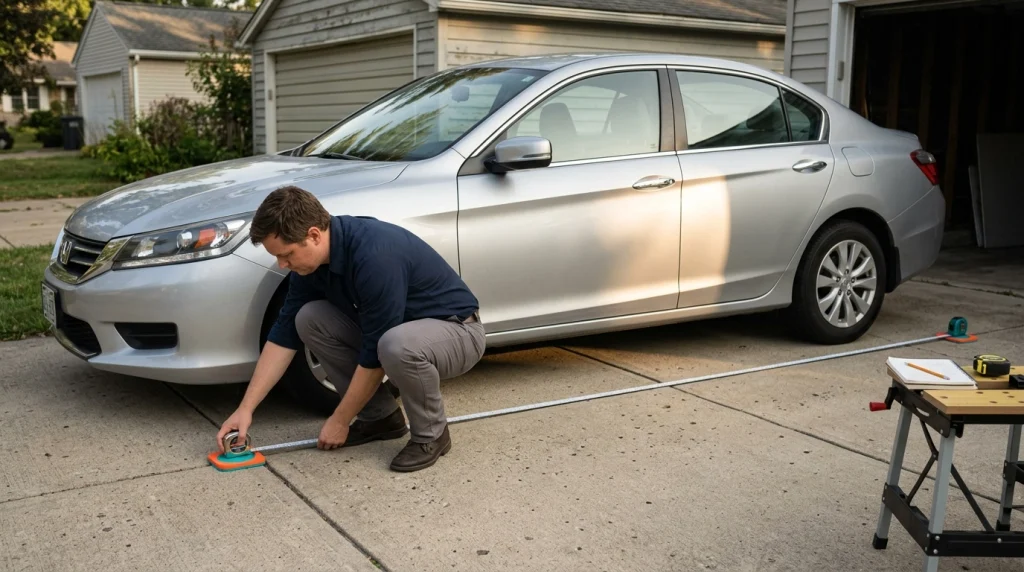
Measure the vehicle’s overall length, body width, and height while it sits on level ground. Take straight measurements instead of following curved body panels.
A flexible measuring tape makes the job easier. A helper is useful for larger vehicles.
What Tools Do You Need?
- A flexible tape measure long enough for your vehicle
- A notebook or phone for recording measurements
- Painter’s tape or removable ground markers
- A helper for long or tall vehicles
- The cover manufacturer’s sizing chart
Close the doors, hood, and trunk before measuring. Decide whether temporary accessories will remain installed while the vehicle is covered.
Step 1: Measure Overall Vehicle Length
Measure the straight horizontal distance from the vehicle’s frontmost point to its rearmost point. Include permanent equipment that extends beyond the bumpers.
Don’t run the measuring tape across the hood, windshield, roof, and trunk.
- Park the vehicle on a flat surface.
- Identify the furthest forward point of the vehicle.
- Mark its position on the ground.
- Repeat at the furthest rearward point.
- Measure the straight distance between those marks.
- Record the measurement in inches or centimeters.
For example, suppose your car measures 181.5 inches long. Record that measurement accurately, then follow the cover maker’s rounding instructions.
Don’t automatically add several inches without checking the product’s specifications.
Step 2: Measure Vehicle Width
Find the widest section of the vehicle’s body and measure across it. Record the distance between the outer edges without including mirrors.
Next, measure the width with the side mirrors extended.
- Body width: The widest point across the vehicle, excluding mirrors.
- Mirror width: The distance between the outermost mirror edges.
- Modified width: Additional width from fender flares or other permanent accessories.
Why record two widths? Some manufacturers base their covers on body width and provide separate mirror allowances.
Other sizing instructions may specifically require mirror-to-mirror width. Always follow the chart you’re using.
Step 3: Measure Vehicle Height
Measure vertically from the ground to the highest point of the vehicle’s standard roof. Keep the tape straight rather than angling it along the windshield.
If permanent accessories increase the height, measure them separately.
- Standard roof height
- Height including fixed roof racks or rails
- Height including a roof cargo box, if it will remain attached
- Additional clearance required for other roof-mounted equipment
Height can be especially important for SUVs, vans, and tall hatchbacks.
Keep in mind that a cover doesn’t necessarily extend all the way to the ground. Manufacturers design their patterns with different hem positions.
Step 4: Check Mirrors, Spoilers, and Other Accessories
Vehicle dimensions tell only part of the story. A spoiler or roof rack can change the shape a cover must accommodate.
Before ordering, inspect these areas:
- Side mirrors: Check for dedicated mirror pockets or instructions for folding mirrors.
- Rear spoiler: Determine whether the cover pattern accommodates its height and projection.
- Roof rack: Confirm whether the cover can fit over the installed equipment.
- External antenna: Follow the manufacturer’s instructions for removal or antenna openings.
- Rear spare tire: Include the additional rear projection when required.
- Aftermarket body kit: Account for wider or longer exterior components.
A standard vehicle-specific cover may not fit a heavily modified version of the same model.
Step 5: Record Your Measurements
Keep your measurements together before comparing products. This avoids repeatedly measuring the same vehicle.
| Measurement | What to Record |
|---|---|
| Overall length | Frontmost to rearmost point |
| Body width | Widest point without mirrors |
| Mirror width | Outer mirror edge to outer mirror edge |
| Roof height | Ground to highest standard roof point |
| Accessories | Extra dimensions and locations |
You can also check the manufacturer’s listed vehicle dimensions through Edmunds. Published specifications provide a helpful cross-check for an unmodified vehicle.
Section Takeaway: Record length, body width, mirror width, roof height, and accessory dimensions. Compare measurements using the definitions supplied by the cover manufacturer.
How Do You Read a Car Cover Size Chart?
A car cover size chart explains which vehicle dimensions a particular cover is designed to accommodate. Use the chart from the exact product you’re considering.
One brand’s medium cover may have different measurements from another brand’s medium.
Example Car Cover Size Comparison
Consider the following hypothetical sizing chart. These numbers demonstrate the selection process and are not universal car cover standards.
| Example Size | Maximum Length | Maximum Body Width | Maximum Height |
|---|---|---|---|
| A | 175 in | 70 in | 57 in |
| B | 185 in | 74 in | 60 in |
| C | 195 in | 78 in | 63 in |
Imagine a sedan measuring 181 inches long, 72 inches wide, and 58 inches tall. In this example, Size B accommodates all three measurements.
Size A fails the length, width, and height requirements. Size C offers extra capacity but may create unnecessary looseness.
This simplified example assumes the chart specifies maximum supported vehicle dimensions. Actual charts can use size ranges, fabric dimensions, or vehicle-specific fitment rules.
Should You Size Up or Size Down?
Never intentionally choose a cover smaller than the manufacturer’s required vehicle measurements. Oversizing isn’t automatically the best solution either.
When your vehicle falls between sizes, compare the full fitment requirements instead of looking at length alone.
- Check every dimension: A suitable length doesn’t guarantee enough width or height.
- Read the sizing notes: The manufacturer may recommend a different size for specific body shapes.
- Review mirror compatibility: Pockets must align with the vehicle’s mirrors.
- Check hem placement: Extra fabric shouldn’t drag across the ground.
- Consider adjustable features: Elastic hems and approved tie-downs can help control modest looseness.
If two sizes appear equally suitable, ask the manufacturer which pattern fits your exact vehicle better.
Can You Choose a Cover Using Your Car’s Model?
Yes. Many custom-fit cover sellers use vehicle details rather than requiring manual measurements.
Enter the correct year, make, model, and body style. Some fitment systems also request trim details.
For example, a Toyota Corolla sedan and a Corolla hatchback shouldn’t automatically be treated as identical shapes.
The same principle applies to Honda Civic body styles, Ford Mustang variations, and different Chevrolet Silverado cab and bed configurations.
For an additional vehicle specification reference, you can use Kelley Blue Book.
Section Takeaway: Match all required measurements to the product’s actual size chart. Vehicle-specific fitment is often simpler for an unmodified car.
Universal vs. Custom-Fit Car Covers: Which Size Is Better?
Universal covers accommodate several vehicles within specified size ranges. Custom-fit covers use a pattern developed around a particular vehicle configuration.
Neither option should be selected without checking compatibility.
Universal Car Covers
Universal covers are useful when you need a product that fits a general vehicle category. They usually come in several length or dimension ranges.
Their fit depends on how closely the vehicle matches the cover’s intended shape.
- Best for: Common body styles that match the stated measurements.
- Main advantage: Flexible compatibility across different vehicles.
- Main limitation: More loose material or less precise mirror alignment.
- Important check: Confirm the full measurement range before buying.
Custom-Fit Car Covers
A custom-fit cover is patterned for a particular vehicle or vehicle configuration. Its contours may accommodate bumpers, rooflines, and mirror positions more accurately.
This can reduce excessive fabric movement and make installation more predictable.
- Best for: Owners who want closer vehicle-specific coverage.
- Main advantage: A pattern matched to the intended vehicle.
- Main limitation: Compatibility can change with aftermarket modifications.
- Important check: Confirm year, model, body style, and relevant trim details.
Universal vs. Custom-Fit Comparison Table
| Feature | Universal Cover | Custom-Fit Cover |
|---|---|---|
| Sizing method | Vehicle measurements and size ranges | Vehicle-specific fitment pattern |
| Body contour | Generalized | More closely matched |
| Mirror accommodation | Varies by product | Often patterned for specific mirror positions |
| Measuring needed | Usually recommended | Often unnecessary for stock vehicles |
| Modified vehicles | Requires dimension checks | May require a revised or specialty pattern |
Does Indoor or Outdoor Use Change the Required Size?
The basic vehicle dimensions remain the same whether you park indoors or outdoors. However, the intended environment can influence how important secure fitment becomes.
Outdoor covers must resist weather exposure and remain properly secured when conditions change.
- Indoor storage: Prioritize clean, soft materials and convenient handling.
- Outdoor parking: Prioritize appropriate weather protection and secure attachment.
- Wind exposure: Avoid substantial looseness and use the manufacturer’s approved securing system.
- Frequent use: Choose a design that’s practical to install and remove without dragging.
Material selection is a separate decision from sizing. A well-sized cover still needs suitable fabric for its intended environment.
Never install a cover over hot exhaust components, and follow the manufacturer’s cooling instructions.
What Size Car Cover Do SUVs, Trucks, and Modified Cars Need?
SUVs, pickup trucks, vans, and modified vehicles need covers that match their actual dimensions and body shapes. A cover labeled for a particular vehicle category may still be unsuitable.
Length alone doesn’t describe the entire vehicle.
How Do You Choose an SUV Cover Size?
Measure an SUV’s length, width, and height just as you would a sedan. Pay particular attention to roof height and the rear hatch profile.
Compact crossovers and full-size SUVs can differ substantially in overall dimensions.
- Confirm the exact model year and body configuration.
- Measure fixed roof rails or racks separately.
- Check for rear-mounted spare tires.
- Compare the vehicle’s height against the cover’s approved range.
- Check mirror and antenna compatibility.
A low-profile passenger-car cover should not be selected simply because its length matches the SUV.
How Do You Choose a Pickup Truck Cover?
Pickup covers need to account for cab configuration, bed length, and installed accessories. Two trucks with the same model name may have very different exterior lengths.
Measure your specific truck rather than relying on a general model listing.
- Cab configuration: Regular, extended, and crew cabs can change the vehicle’s proportions.
- Bed length: Confirm the correct short, standard, or long-bed configuration.
- Tonneau cover: Check whether its shape or hardware affects the car cover.
- Camper shell: A taller enclosure may require a different pattern.
- Aftermarket bumpers: Include additional front or rear projection.
A truck with a camper shell may require a specialty cover rather than an ordinary pickup pattern.
Do Spoilers, Roof Racks, and Body Kits Affect Sizing?
Yes. Accessories can change the exterior dimensions or prevent a standard cover from following the original body contours.
Even an accessory that adds little overall length can interfere with a closely fitted pattern.
- Large spoilers: May need extra clearance or a special rear pattern.
- Roof racks: Increase height and can create protruding contact points.
- Wide-body kits: Increase width beyond factory specifications.
- Front splitters: Can increase the vehicle’s effective front projection.
- Rear tire carriers: Extend the required coverage behind the vehicle.
- Roof cargo boxes: Can change both height and roof contour substantially.
Remove temporary accessories when practical and permitted by the manufacturer. For permanent modifications, ask the cover supplier about compatible patterns.
Why Do Vehicle Model Years and Trims Matter?
Manufacturers can redesign a vehicle’s bumpers, roofline, and body proportions between generations. Some trims also receive different exterior accessories.
A cover that fits one model year isn’t automatically compatible with another.
Check the full vehicle description when shopping:
- Model year
- Manufacturer and model
- Body style
- Trim or exterior package, when relevant
- Factory and aftermarket accessories
For example, different Ford F-150 bed configurations require separate fitment consideration. The same issue applies to pickups from Chevrolet, Ram, Toyota, and other manufacturers.
Section Takeaway: Special body shapes and accessories matter as much as basic measurements. Confirm the actual vehicle configuration before ordering.
How Can You Tell Whether a Car Cover Fits Correctly?
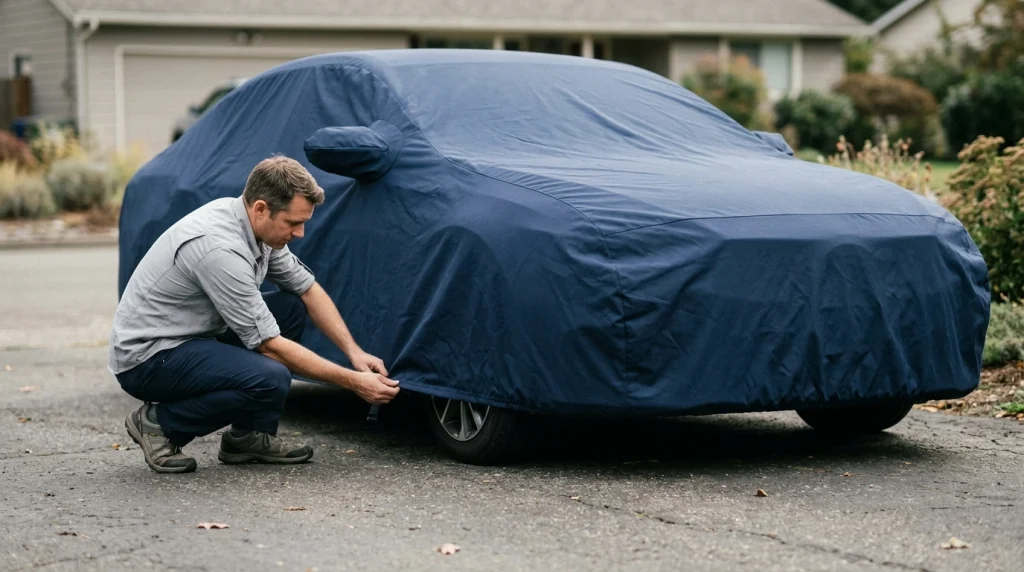
A properly sized cover should reach its intended positions without excessive stretching, uneven alignment, or large loose sections. Check the fit during the first installation.
Do this in calm conditions with the vehicle clean and cool.
What Does a Properly Fitted Cover Look Like?
Start by identifying the cover’s front and rear sections. Then position the fabric according to the manufacturer’s installation instructions.
Check the following areas:
- Front bumper: The designated front hem reaches and stays in position.
- Rear bumper: The rear section covers the intended area without extreme tension.
- Roof: The material lies reasonably evenly without large unsupported folds.
- Mirrors: Pockets align correctly or the fabric accommodates mirrors as designed.
- Side panels: Coverage is reasonably balanced on both sides.
- Fasteners: Straps and elastic sections work without being forced.
Small natural folds don’t necessarily indicate a sizing problem. Significant pulling or shifting deserves attention.
What If Your Car Cover Is Too Tight?
Stop pulling if the cover will not reach its intended mounting points. Forcing it can damage the fabric or place pressure on vehicle accessories.
Check for these problems first:
- Confirm that the cover is facing the correct direction.
- Verify the vehicle’s listed year and body style.
- Check whether mirrors must be folded.
- Inspect spoilers, racks, and other accessories.
- Compare the vehicle’s measurements with the product chart again.
If the dimensions fall outside the approved range, request an exchange or suitable replacement.
What If Your Car Cover Is Too Loose?
First, confirm the cover is centered and installed correctly. Use only the securing methods specified by its manufacturer.
Loose fabric should not be allowed to drag along the ground or repeatedly flap against dirty paint.
- Check that the elastic hems sit in the intended positions.
- Fasten approved retention straps correctly.
- Inspect mirror positioning and overall alignment.
- Remove trapped debris before adjusting the fabric.
- Consider a smaller approved size or more tailored pattern if excessive slack remains.
Don’t improvise with tight ropes or hard fasteners against painted surfaces. These can create additional damage risks.
Final Car Cover Sizing Checklist
Before confirming your purchase, review every item below.
- Vehicle year, make, model, and body style are correct.
- Overall vehicle length has been measured or verified.
- Body width and mirror width are recorded separately.
- Roof height meets the manufacturer’s requirements.
- Spoilers, racks, antennas, and other accessories have been checked.
- The product’s actual sizing chart has been reviewed.
- Cover design matches the intended vehicle shape.
- Indoor or outdoor use matches the fabric’s intended purpose.
- Retention features are suitable for the parking conditions.
- The retailer’s return or exchange policy has been checked.
You can also consult broader vehicle ownership and maintenance information at Consumer Reports Cars when evaluating accessories and protection needs.
One final habit matters: keep the vehicle and the cover’s inner surface clean before installation. Accurate sizing cannot eliminate abrasion risks from trapped dirt.
Section Takeaway: Inspect bumper coverage, mirror alignment, roof fit, and hem security. Exchange an incompatible cover rather than forcing it onto the vehicle.
Frequently Asked Questions About Car Cover Sizes
How do I know what size car cover I need?
Measure your vehicle’s overall length, body width, and height. Compare those measurements with the specific cover manufacturer’s size chart.
For a custom-fit cover, use the exact year, make, model, and body style. Check accessories and aftermarket modifications before ordering.
Is it better to buy a bigger car cover?
Not necessarily. A larger cover may provide enough fabric to reach the bumpers but create excess material around the roof and sides.
Choose the size that meets all manufacturer requirements with the least unnecessary slack. Never compensate for a poor body-shape match simply by oversizing.
Can one car cover fit different vehicles?
Yes. Universal covers can fit several vehicles within the manufacturer’s specified dimensions and body categories.
However, similar length doesn’t guarantee compatible height, width, or mirror placement. Check each vehicle separately before reusing the same cover.
Do car cover measurements include side mirrors?
That depends on the manufacturer. Some sizing charts require body width without mirrors, while others ask for mirror-to-mirror width.
Measure both values and follow the product’s instructions. Dedicated mirror pockets must also align with the vehicle.
What if my car is between two cover sizes?
Compare length, width, height, body shape, and the manufacturer’s sizing notes. Don’t select the larger option automatically.
If neither size clearly matches, ask the seller about a vehicle-specific alternative. A correctly patterned cover is preferable to excessive stretching or loose fabric.
Does car cover size change with the model year?
It can. A redesigned model may have different bumpers, proportions, mirror positions, or overall dimensions.
Always verify compatibility using the vehicle’s exact model year and body style. Don’t assume a cover from an earlier generation will fit correctly.
Can I use a sedan car cover on an SUV?
Usually, a sedan cover isn’t the right choice for an SUV because the vehicles have different height and body proportions.
Even when their lengths match, the sedan cover may lack the necessary side coverage. Choose a pattern approved for the SUV’s dimensions.
Final Takeaway: The best car cover size is the one that matches your vehicle’s complete exterior dimensions and shape, not simply a familiar size label.
Before buying, measure carefully, verify your exact vehicle configuration, and compare the manufacturer’s fitment instructions. A few minutes of checking can help you avoid a cover that’s frustrating to install or unsuitable for your car.
