
Securing a Car Cover in Wind: Complete 2026 Guide

Quick Answer
The safest way to secure a car cover in wind is to start with a snug, vehicle-sized outdoor cover, then fasten every built-in underbody strap or buckle. Add approved wheel anchors or reinforced tie-down points when needed, and remove excess slack before the wind increases. Kelley Blue Book also recommends that a storage cover fit the vehicle snugly and be secured well because loose fabric can flap against the paint.
Fastest way to secure the cover
- Choose the right fit: Use an outdoor cover sized for your vehicle instead of an oversized universal cover.
- Seat both hems: Pull the elastic front and rear edges below the bumpers where the cover design allows.
- Fasten every strap: Connect the factory underbody buckles without twisting the webbing.
- Remove loose fabric: Center the cover so large pockets of material cannot catch the wind.
- Add safe anchors: Use reinforced wheel loops or manufacturer-approved tie-down points if your cover supports them.
- Recheck the forecast: Move the vehicle under shelter or remove the cover when severe winds exceed what the cover is designed to handle.
One rule I always follow
- Never attach a tie-down to exhaust components, brake lines, suspension parts, sharp body edges, or anything that could be damaged by tension.
Securing a car cover in wind is less about tying dozens of knots and more about controlling movement. A cover that fits correctly and stays evenly tensioned is much less likely to balloon, flap, or disappear across the driveway.
I treat loose fabric as the main warning sign. This guide shows how I would secure an everyday car, SUV, or truck without creating new risks for the paint or vehicle.
In This Guide
Why Does a Car Cover Blow Off in Wind?
A car cover usually blows loose because air gets underneath an exposed edge and inflates the fabric. The larger the loose area becomes, the more material the wind can grab.
A wind-secured car cover is a correctly fitted cover whose hems, straps, buckles, or approved anchors limit both lift and side-to-side movement.
- Oversized fit: Extra fabric creates large pockets that catch moving air.
- Unsecured lower edges: Wind can enter beneath the front, rear, or sides.
- Missing straps: An elastic hem alone may not control the center of a large cover.
- Incorrect positioning: A cover shifted toward one end leaves more slack at the other.
- Worn elastic: Aging hems may stop gripping the lower body properly.
- Broken buckles: One failed restraint can let an entire side begin lifting.
Fit matters more than many owners expect. In its 2026 testing, Car and Driver found proper sizing and underbody straps important for outdoor covers, while loose covers were more vulnerable to wind.
Wind creates lift as well as sideways force
Picture air moving around the vehicle. If it slips beneath the cover, the fabric can behave like a small sail.
Once the cover balloons, its attachment points receive repeated pulling loads. That is why stopping airflow underneath is often more effective than simply adding a heavy object on top.
A poor fit also increases paint movement
The cover does not need to fly away to cause trouble. Repeated flutter can move dusty fabric across painted panels thousands of times during a windy night.
That is one reason I would fix the fit before adding stronger restraints. Holding an oversized cover down more tightly does not remove all that loose material.
How Do You Secure a Car Cover in Wind?
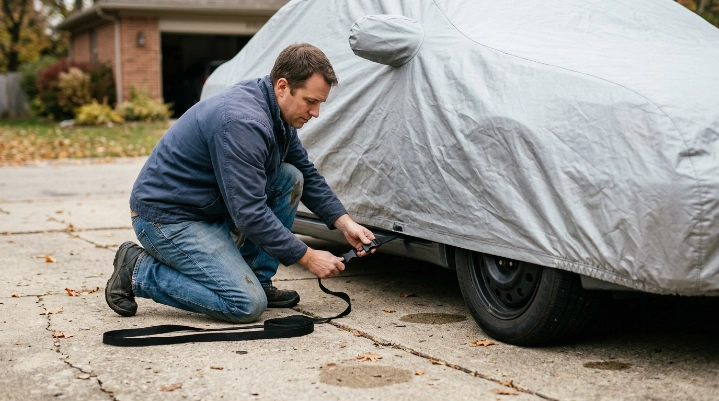
Center the cover, fully seat the front and rear hems, then fasten every built-in restraint from the lowest practical points. Finish by checking that no large section can balloon away from the body.
1. Start with a clean, correctly sized cover
Check the label or manufacturer’s fit chart before installation. A model-specific or accurately sized cover should follow the basic shape of the vehicle without excessive hanging fabric.
Inspect the cover before each windy period.
- Look for torn seams.
- Check buckle stitching.
- Inspect elastic hems.
- Check grommets for tearing.
- Remove grit from the inner surface.
2. Identify the front and rear before unfolding everything
Many covers mark the front with a tag or label. Positioning it correctly keeps mirror pockets, hems, vents, and straps where the designer intended.
I like to anchor one end loosely before pulling the remaining material across the vehicle. That reduces the chance of the cover sliding onto the ground.
3. Pull the elastic hems into position
Seat the front hem first, then work toward the rear. Make sure the material stays centered over the roof and both sides.
Do not stretch a cover far beyond its intended size. Excessive tension can damage seams, elastic, or mirror pockets.
4. Fasten the underbody straps
Most wind-oriented outdoor covers use one or more straps that pass underneath the vehicle. Connect each factory buckle and adjust it until the webbing is secure without crushing the cover against sharp edges.
- Keep straps flat: Twisted webbing can concentrate pressure.
- Keep straps away from heat: Never route them around an exhaust pipe.
- Avoid moving parts: Stay clear of steering, suspension, and drivetrain components.
- Use the intended buckle: Do not replace a failed restraint with wire or improvised metal hooks.
5. Secure approved wheel or lower-edge anchors
If the cover includes wheel loops, tire straps, or reinforced lower tie points, use them according to its instructions. Wheel-area restraints can help control side-to-side movement without putting tension on delicate trim.
Do not tie the cover to mirrors, wipers, door handles, antennas, spoilers, or plastic bumper trim unless the manufacturer specifically designed the system that way.
6. Perform a final balloon test
Walk around the vehicle and gently lift several sections of the cover. You should not find a large loose pocket that can easily fill with air.
Pay special attention to the hood, roof, trunk, and the windward side. Those broad surfaces often show loose material first.
Section Takeaway: A snug fit plus multiple properly positioned restraints works better than relying on one tight rope or one elastic hem.
Which Car Cover Tie-Down Method Works Best?
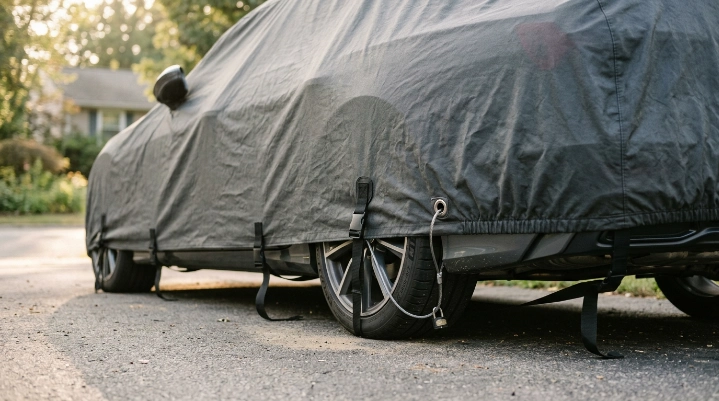
For ordinary outdoor parking, built-in front, center, and rear restraints offer the most balanced approach when the cover is designed for them. Wheel anchors can add stability, while a cable through two grommets is usually better for security than full wind control.
| Securement method | Typical restraint points | Best use | Main limitation |
|---|---|---|---|
| Elastic hems | Front and rear perimeter | Keeping ends tucked beneath the vehicle | Does not strongly control the middle of a loose cover |
| Single underbody strap | One cross-car restraint near the center | Moderate movement control on a snug cover | Front and rear can still lift if the fit is loose |
| Three underbody straps | Front, middle, and rear | Distributing restraint along the vehicle | Requires correct routing and sound buckles |
| Wheel-loop system | Up to four wheel areas, depending on design | Reducing side lift and shifting | Not available on every cover |
| Cable through grommets | Usually two reinforced lower-side grommets | Theft deterrence and basic lower-edge control | Does not stop large roof or hood sections from ballooning |
More properly placed anchor points generally spread the load better than one concentrated attachment. Car and Driver reached a similar conclusion while testing windshield covers, noting that more anchor points improved securement.
Should you add bungee cords?
I would only use an additional elastic restraint when the cover manufacturer permits it and reinforced attachment points exist. An exposed metal hook can strike paint or glass if it slips loose.
Never hook a bungee blindly underneath the car. You could catch a brake line, wiring harness, exhaust component, or vulnerable plastic panel.
What about ropes?
Rope can create concentrated pressure and may saw against the cover during movement. Factory webbing straps with plastic buckles are usually easier to tension evenly.
If a cover depends on improvised rope to stay attached, the better fix may be a more suitable outdoor cover.
How Tight Should a Car Cover Be in Wind?
A wind-ready car cover should be snug enough that large sections cannot billow, but not stretched so tightly that seams, mirrors, or elastic edges remain under heavy tension. Think fitted jacket, not shrink wrap.
Signs the cover is too loose
- Large fabric pockets sit above the hood or roof.
- The lower sides hang well below their intended position.
- The cover shifts several inches during small gusts.
- One side repeatedly rides upward.
- The hems no longer remain below the intended edges.
Signs the cover is too tight
- Seams are visibly stretching.
- Mirror pockets are pulling sideways.
- Buckles are difficult to connect even when fully loosened.
- The fabric presses hard against sharp trim or accessories.
- Elastic hems must be overstretched to reach the bumpers.
A proper fit falls between those extremes. The cover should follow the vehicle’s shape while leaving enough flexibility for installation and normal material movement.
Universal vs. vehicle-specific covers
Universal covers can work when their dimensions closely match the vehicle. The risk rises when a cover is purchased several sizes too large just to make installation easier.
A model-specific cover usually controls excess fabric more effectively. That can matter a lot when the parking area is exposed.
How Do You Stop a Windy Car Cover From Scratching Paint?
Keep both the vehicle and inner cover surface clean, then prevent the fabric from repeatedly flapping across the finish. Dirt trapped between moving fabric and paint is the combination I try hardest to avoid.
Never cover a dirty car for long windy periods
A light layer of dust may look harmless. Under moving fabric, however, contamination can become abrasive.
Wash or safely remove loose dirt before long-term covering when practical. Also inspect the cover’s lining for sand, leaves, dried mud, and other debris.
Do not let the cover drag on the ground
Ground contact can transfer grit directly to the inside surface. Fold or roll the cover deliberately during removal instead of pulling it onto pavement.
- Start from one end.
- Fold dirty outer surfaces inward.
- Keep the clean inner lining away from the ground.
- Store the cover dry whenever possible.
Check antennas, spoilers, and accessories
Aftermarket spoilers, roof racks, antennas, light bars, and sharp accessories can create pressure points. Use a cover designed to accommodate those parts.
Do not pull fabric tightly over an accessory that creates a sharp ridge. Wind movement can increase rubbing at that exact spot.
Inspect after windy weather
Look at the front corners, mirror areas, roof edges, and rear quarters after a windy period. These locations often reveal movement before the damage becomes obvious elsewhere.
Also inspect straps for fraying and buckle stitching for separation. Small failures are easier to address before the next storm.
Section Takeaway: Preventing scratches requires two things at once: clean contact surfaces and minimal cover movement.
When Should You Remove a Car Cover Instead?
Remove the cover or move the vehicle under shelter when severe weather is expected and you cannot secure the cover according to its instructions. No universal wind-speed number applies to every cover, material, vehicle, and parking location.
Check the manufacturer’s limits first
Some manufacturers describe their products as wind-resistant but do not provide a tested wind-speed rating. Do not create your own safety threshold from marketing terms such as “windproof.”
If the product instructions specify restrictions, follow them. Replace damaged straps before relying on the cover again.
Use shelter for major storms when possible
A cover cannot stop branches, signs, roofing material, or other heavy debris. For dangerous storms, changing the parking location provides much more protection than adding another strap.
Kelley Blue Book’s 2026 hurricane vehicle preparation guidance recommends garage storage when available and strategic sheltered parking when a vehicle must remain outdoors.
Remove the cover if it begins failing
Do not wait for the cover to tear completely. A partially detached cover can whip against paint and put far greater loads on its remaining restraints.
- One or more buckles have broken.
- A grommet is tearing through the fabric.
- The front or rear hem repeatedly blows over the vehicle.
- The cover fills with air despite proper adjustment.
- Material is striking nearby vehicles or property.
Do not use heavy loose objects as improvised anchors
Bricks, rocks, tools, or other hard objects should not sit on top of a covered vehicle. Wind can move them and turn a minor cover problem into body or glass damage.
Loose objects around the parking area should also be secured before strong weather arrives.
Section Takeaway: A car cover is weather protection, not storm-proof shelter. When conditions overwhelm its designed restraints, move the vehicle or remove the cover.
Frequently Asked Questions
Can I use bungee cords to secure a car cover?
You can use them only when the cover manufacturer allows additional elastic restraints and provides suitable reinforced points. Avoid exposed metal hooks near paint, glass, brake lines, exhaust components, wiring, or suspension parts.
How do I keep a universal car cover from blowing away?
Start by confirming that the universal size closely matches your vehicle. Seat both elastic hems, connect every factory underbody strap, center the material, and use approved lower or wheel anchors if included.
Should a car cover be tight in windy weather?
It should be snug, not overstretched. Large loose pockets encourage ballooning, while excessive tension can damage seams, elastic, mirror pockets, and fasteners.
Can a car cover scratch paint in the wind?
Yes. A dirty or loose cover can repeatedly rub contamination against the finish. Keeping the vehicle and lining clean while minimizing fabric movement reduces that risk.
Can I tie a car cover to the wheels?
Use the wheels only when the cover includes a wheel-loop or tie-down system intended for that purpose. Do not route improvised ropes around brake components, steering parts, or suspension hardware.
Is an elastic hem enough for windy outdoor parking?
An elastic hem helps keep the front and rear edges tucked down, but exposed outdoor parking often benefits from underbody restraints as well. Follow the specific cover’s installation instructions.
Should I leave my car covered during a severe storm?
Not automatically. If the cover cannot remain securely attached, or dangerous debris is likely, sheltered parking is safer. A garage, carport, or appropriate parking structure provides protection a fabric cover cannot match.
The bottom line: securing a car cover in wind starts with fit, not force. Choose the correct outdoor cover, use every designed restraint, remove loose fabric, keep the contact surfaces clean, and inspect the system whenever the weather changes.
If your current cover needs improvised ropes, heavy objects, or constant readjustment to survive ordinary wind, consider replacing it with a better-fitting design that includes proper underbody or wheel-area restraints.