
How to Clean Mildew From a Car Cover Safely

Quick Answer
To clean mildew from a car cover, first check the cover’s care label, then work outside or in a well-ventilated space. Use a mild cleaner approved for the fabric, scrub gently, rinse completely, and let both sides air-dry before reinstalling or storing it; general EPA mold-cleanup guidance also stresses removing moisture and drying cleaned materials thoroughly.
Quick mildew-cleaning steps
- Check the label: Confirm whether the cover requires hand washing or allows machine washing.
- Protect yourself: Wear gloves and avoid breathing concentrated mold or mildew particles.
- Use mild cleaner: Choose only a cleaner permitted by the cover manufacturer.
- Scrub gently: Work the affected area with a soft sponge or soft-bristle brush.
- Rinse completely: Remove cleaner from the outer and inner surfaces.
- Dry fully: Never fold, bag, or reinstall the cover while it is damp.
A mildewed car cover needs more than a quick rinse because the odor and discoloration usually point to trapped moisture. My rule is simple: protect the fabric first, because an aggressive cleaner can ruin a good cover faster than the mildew did.
In This Guide
What Causes Mildew on a Car Cover?
Mildew develops when moisture remains in or around the cover long enough for fungal growth to establish itself. Damp storage, covering a wet vehicle, condensation, poor airflow, and humid garages are common conditions that create the problem.
Definition: On a car cover, mildew usually refers to surface fungal growth that appears as spotting, discoloration, or a musty odor after the fabric stays damp.
The cover does not need to be soaked. A small amount of trapped moisture can linger between layers, seams, folds, or the vehicle surface.
Why does a stored car cover smell musty?
A cover folded while slightly damp can hold moisture deep inside its folds. A storage bag can make matters worse when it limits airflow.
- Damp folding: Water remains trapped between layers of fabric.
- Wet vehicle: Moisture evaporating from the car becomes trapped under the cover.
- Condensation: Temperature changes can create moisture underneath a covered vehicle.
- Dirty fabric: Organic debris and grime can remain on the cover alongside moisture.
- Humid storage: A closed garage or storage area may dry the cover too slowly.
Mildew also can leave a stain after the living growth has been cleaned away. A remaining shadow does not automatically mean the cleaning failed.
The bigger test is whether the surface is clean, dry, and free of a returning musty smell. Recurring growth usually means the moisture source still exists.
What Should You Check Before Cleaning Mildew?
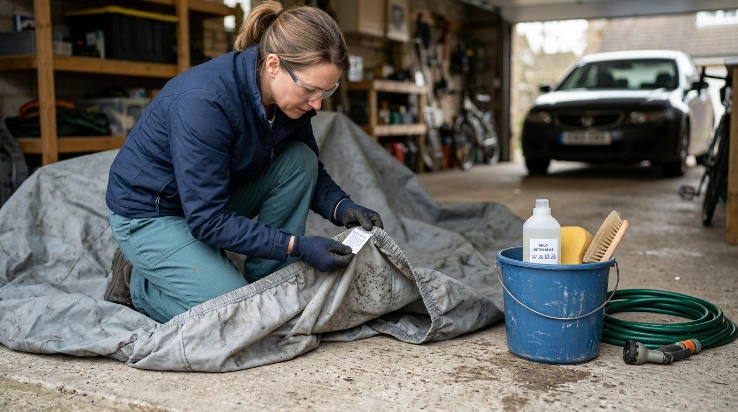
Start with the sewn care label or the manufacturer’s current instructions. Car covers use different fabrics, coatings, membranes, liners, and seams, so one cleaning method does not fit every cover.
Check whether the cover can be washed
Look for instructions covering water temperature, detergent, washing-machine type, and drying. If the label is missing, I favor gentle hand washing rather than gambling with an unknown coated fabric.
- A mild detergent or manufacturer-approved cleaner
- A clean bucket or large basin
- A soft sponge or soft-bristle brush
- A garden hose or clean rinse water
- Protective gloves
- Eye protection if splashing is possible
- A large, clean area for air drying
If there is substantial visible mold growth, take exposure seriously. The CDC’s mold cleanup guidance recommends protective gloves, eye protection, and respiratory protection for mold cleanup, with extra caution for people who are more vulnerable to mold exposure.
Remove the cover from the vehicle first when practical
For mildew treatment, removing the cover lets you inspect the inside surface and prevents dirty runoff from sitting on the paint. It also makes it easier to see whether growth has reached seams or the soft inner lining.
Do not aggressively shake a heavily contaminated cover in an enclosed garage. Move it outdoors first and handle it carefully.
How Do You Clean Mildew From a Car Cover?
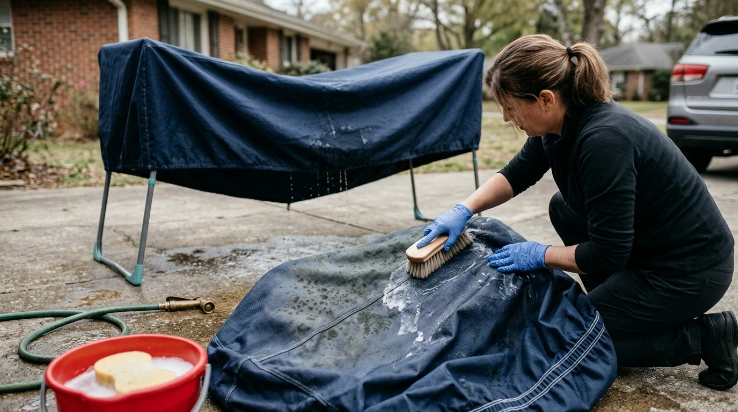
The safest general method is gentle cleaning followed by a complete rinse and thorough air drying. The exact cleaner, water temperature, and washing method should still come from the cover’s own care instructions.
1. Move the cover to a ventilated cleaning area
Work outdoors when possible. Spread the cover over a clean surface, large drying rack, or another location where both sides can be reached without dragging it through dirt.
2. Inspect both sides
Check the outer fabric, inner lining, seams, mirror pockets, elastic edges, and folded areas. Mark any concentrated mildew patches so they receive extra attention.
- Look for black, gray, green, or brown spotting.
- Check for a musty odor on the inner surface.
- Inspect coated areas for peeling or delamination.
- Look for weakened seams or fabric before scrubbing.
3. Test your cleaner on a hidden area
Use the manufacturer-approved cleaner whenever that information is available. Apply a small amount to an inconspicuous edge and check for color change, coating damage, or unusual stiffness.
Do not assume a household mold remover is fabric-safe. Products designed for tile, grout, siding, or bathroom surfaces can be too aggressive for a coated automotive cover.
4. Wet and gently clean the mildew
Dampen the affected area and apply the approved mild cleaning solution. Use a soft sponge or brush with light pressure rather than grinding the stain into the fibers.
- Work one manageable section at a time.
- Apply enough solution to clean the surface without unnecessarily soaking layered material.
- Gently agitate the mildew-affected area.
- Clean beyond the visible edge of each spot.
- Repeat with fresh solution when the water becomes dirty.
Pay attention to the inside face of the cover. That surface sits against your vehicle, so leftover dirt or residue is not something you want rubbing against the paint later.
5. Rinse until no cleaner remains
Rinse the cleaned section thoroughly with fresh water. Keep going until you cannot see or feel soap residue.
Cleaner left behind can attract dirt and may affect the way some fabrics handle water. A second full rinse is a sensible step when the care instructions allow it.
6. Air-dry the cover completely
Open the cover fully so trapped pockets can drain and dry. Flip or reposition it when necessary so seams, elastic hems, and the inner lining receive airflow.
- Do not fold it while any section feels cool and damp.
- Do not put it back into a storage bag while moist.
- Do not reinstall it on a wet vehicle.
- Do not use machine heat unless the care label specifically permits it.
A humid day can make a large cover take longer than expected to dry. Give it the extra time.
Section Takeaway: Clean mildew gently, rinse the entire treated area, and make complete drying part of the repair. Removing the stain without removing the moisture problem invites the mildew back.
Can You Machine-Wash a Mildewed Car Cover?
Sometimes, but only when the manufacturer’s instructions permit it. Current 2026 guidance still varies considerably between cover brands and fabric constructions.
| Guidance example | Washing method | Water / cycle | Drying |
|---|---|---|---|
| CarCovers.com care guidance | Large commercial front-loading washer for its machine-washable covers | Cold water, gentle/delicate cycle, with at least two rinses | Air dry |
| Coverking care guidance | Hand washing recommended instead of machine washing | Lukewarm wash water with mild detergent, followed by a cool rinse | Air dry |
| Coverstore vehicle-cover guidance | Hand wash when machine compatibility is unknown; machine wash only when appropriate | Its hand-wash example uses 1 ounce of mild soap or detergent per gallon of water | Generally air dry unless the manufacturer states otherwise |
The differences in that table are exactly why I don’t recommend copying washing-machine settings from another cover. The label attached to your specific cover wins.
Why can an agitator be a problem?
A center agitator can twist a large cover around itself and place unnecessary force on seams or bonded layers. A cover that barely fits inside a washer also cannot circulate or rinse properly.
If machine washing is permitted, give the cover enough drum space to move freely. Large SUV and truck covers may require a commercial-capacity machine.
What Cleaners Should You Avoid?
Avoid any chemical or cleaning method that the cover manufacturer prohibits. In particular, don’t assume stronger cleaning means better mildew removal.
- Bleach: Many car-cover care instructions specifically prohibit it because it may damage fabric, color, or protective treatments.
- Fabric softener: It can leave a coating or residue and is commonly prohibited by cover manufacturers.
- Harsh solvents: Degreasers and strong solvents may attack waterproofing, coatings, adhesives, or bonded layers.
- Pressure washing: High-pressure water can stress fabric, seams, and layered construction.
- Hot water: Avoid it unless the specific care label allows that temperature.
- High dryer heat: Heat may shrink fabric or damage coatings on covers that require air drying.
If you use any household cleaning product, never combine cleaners. In particular, bleach must never be mixed with ammonia or other cleaning chemicals.
Should you use vinegar or baking soda?
Online cleaning advice often recommends vinegar or baking soda for mildew, but that does not mean either is safe for every automotive cover. A waterproof coating or specialty finish changes the equation.
If the manufacturer does not approve a home remedy, I would skip the experiment. Mild approved detergent and careful rinsing are easier to control.
When is replacement better than cleaning?
Replacement starts making sense when mildew is widespread, repeatedly returns after complete drying, or has penetrated a deteriorating liner. The same applies when the material is cracking, delaminating, tearing, or losing structural strength.
- The fabric remains strongly musty after repeated proper cleaning.
- Mildew returns even after correcting the moisture source.
- The inner lining is deteriorating or shedding material.
- Seams or elastic sections are failing.
- The cover no longer fits or protects the car correctly.
A permanent cosmetic stain alone does not always require replacement. Judge the cover by cleanliness, condition, odor, and continued performance.
How Do You Stop Mildew From Coming Back?
Moisture control is the long-term fix. If the same cover repeatedly becomes damp, cleaning it over and over only treats the symptom.
Never store a damp car cover
Let the cover dry all the way through before folding it. Check thick seams, elastic hems, pockets, and layered areas rather than judging dryness from one exposed panel.
- Air-dry after rain before storage.
- Dry both the inner and outer surfaces.
- Keep storage bags dry and clean.
- Avoid tightly sealing residual moisture inside plastic.
Don’t cover a wet car
A recently washed or rain-soaked vehicle should dry before you install the cover. Water left on the body can evaporate into the small space underneath and raise humidity around the fabric.
Improve airflow around stored vehicles
Garages can remain humid even when the floor looks dry. Ventilation or dehumidification can help when condensation is a recurring problem.
Check the floor, walls, and ceiling for moisture sources too. A leaking garage or persistently damp parking area can keep feeding the problem.
Keep the cover clean
Leaves, pollen, dust, bird residue, and other debris collect moisture and make the cover harder to dry. Remove loose debris regularly instead of waiting until the fabric becomes heavily soiled.
- Inspect the cover after storms.
- Remove leaves from folds and windshield areas.
- Clean bird droppings and other concentrated contamination promptly.
- Wash the cover according to its actual condition and manufacturer instructions.
Also inspect the car itself when you find recurring dampness. Weatherstrip leaks, trunk water, or another vehicle moisture issue can create a musty environment even when the cover is not the original cause.
Section Takeaway: The most reliable mildew prevention strategy is simple—keep the vehicle, cover, and storage environment dry. Never pack the cover away until every layer and seam has finished drying.
Frequently Asked Questions
Can I use bleach to remove mildew from a car cover?
Don’t use bleach unless your specific car-cover manufacturer explicitly allows it. Many cover-care instructions prohibit bleach because it can harm fabric, color, coatings, or water-resistant treatments.
Can I wash a mildewed car cover in a washing machine?
Only if the care label allows machine washing. Follow the required machine type, cycle, water temperature, detergent, rinse procedure, and drying instructions instead of assuming all covers are washable the same way.
Will mildew stains come completely out?
Not always. Fungal growth can leave discoloration even after the material has been cleaned and fully dried, so a faint remaining stain does not necessarily mean active mildew remains.
Why does my car cover still smell musty after washing?
Lingering odor can mean the cover is still damp, cleaner was not fully rinsed away, or contamination remains deeper in the fabric. Dry it completely and inspect the lining and seams before using it again.
Can I put my car cover in the dryer?
Only when the manufacturer’s instructions specifically permit machine drying. Many covers require air drying because excessive heat may shrink fabric or damage laminated and water-resistant layers.
Can I pressure-wash mildew off a car cover?
I would avoid pressure washing unless the cover manufacturer specifically approves it. High-pressure water can stress seams, coatings, and layered materials when a garden hose and gentle washing would be safer.
How do I keep a stored car cover from getting mildew?
Clean it when needed and allow both surfaces to dry completely before folding. Store it in a dry, ventilated location and never put a damp cover directly into a closed storage bag.
If you’ve found mildew on your cover, don’t attack it with the strongest cleaner in the garage. Check the label, clean gently, rinse thoroughly, fix the moisture source, and give the cover enough time to become completely dry before it protects your car again.