
How to Fix a Loose Car Cover: A Practical 2026 Guide

Quick Answer
To fix a loose car cover, center it on the vehicle, pull the elastic hems completely below the front and rear bumpers, and tighten every supplied strap or buckle. If large loose panels still flap or balloon, the cover is probably oversized, worn out, or the wrong shape for your vehicle; current car cover testing from Car and Driver also emphasizes overall fit as an important part of cover performance.
5 quick steps to tighten a loose car cover
- Center the cover: Match the front, rear, mirror pockets, and roof seams to the vehicle before tightening anything.
- Seat both hems: Pull the elastic edges fully below the front and rear bumpers instead of leaving them resting on top.
- Tighten supplied straps: Use the cover’s built-in belly straps, buckles, tie-down loops, or wind-retention system exactly as designed.
- Check loose panels: Look around the doors, roof, mirrors, wheel arches, and bumpers for fabric that can catch wind.
- Replace a bad fit: If significant slack remains after correct installation, switch to the correct size or a vehicle-specific cover.
One important rule
- Don’t keep adding tension to compensate for a badly oversized cover. Excess tension can stress seams, elastic, grommets, and buckles without fixing the underlying fit problem.
A loose car cover can turn a useful layer of protection into an annoying sail. I’ve seen covers that looked acceptable in a driveway become obviously oversized as soon as a light breeze lifted the side panels.
The good news is that most loose-cover problems don’t require special tools. In this guide, I’ll show you how to diagnose the fit, tighten the cover correctly, secure it against ordinary wind, and decide when replacement makes more sense than another temporary fix.
In This Guide
Why Is My Car Cover Loose?
A car cover is usually loose because its dimensions, positioning, or retention system cannot keep the fabric close to the vehicle. The most common causes are an oversized cover, off-center installation, stretched elastic, loose straps, or a poor match between the cover shape and vehicle body.
Definition: A loose car cover is a cover with enough uncontrolled fabric to lift, shift, flap, or balloon after it has been centered and secured according to its instructions.
The cover is too large
Oversizing is the first thing I check. A cover may match your car’s length but still have too much width or height around the roof, doors, mirrors, and bumpers.
That extra material gives air somewhere to collect. Once wind gets beneath the hem, the loose panel can inflate and pull the rest of the cover out of position.
The cover is installed off-center
A correctly sized cover can still feel loose when it has shifted several inches toward one end. One bumper may look tight while the opposite end hangs low.
- Check the front label: Many covers identify which end belongs at the front.
- Align mirror pockets: They should sit naturally over the mirrors without pulling sideways.
- Check roof seams: Seams should follow the roofline instead of twisting diagonally.
- Compare both sides: Similar amounts of fabric should hang along the driver and passenger sides.
The elastic hem has stretched
Elastic loses holding power as it ages, especially after repeated stretching and outdoor exposure. A hem that once tucked firmly beneath the bumper may eventually hang almost straight.
You can confirm this by reinstalling the cover carefully. If the fabric dimensions still look correct but the front or rear edge refuses to grip, worn elastic becomes a likely cause.
The retention straps are loose or missing
Some covers rely on more than elastic. They may have belly straps, buckles, loops, grommets, or separate wind straps that control movement across the middle of the vehicle.
Don’t assume those pieces are optional. If the cover was designed around them, leaving them unused can create enough slack for wind to lift the sides.
| What You See | Likely Cause | Best First Fix |
|---|---|---|
| Loose everywhere | Cover too large | Verify size and vehicle fitment |
| Loose only at front or rear | Off-center fit or weak elastic | Re-center and inspect the hem |
| Sides lift in wind | Retention system not secured | Tighten approved straps or buckles |
| Loose around mirrors or spoiler | Shape or accessory mismatch | Confirm exact body-style compatibility |
| Fit keeps worsening | Worn elastic, seams, or straps | Repair approved parts or replace cover |
How Do I Fix a Loose Car Cover Step by Step?
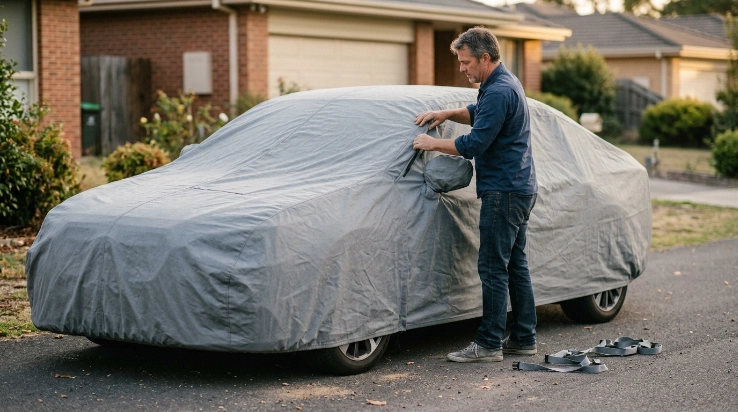
Start over instead of trying to tighten a badly positioned cover. A clean reinstall makes it much easier to separate an installation problem from a sizing problem.
1. Remove and inspect the cover
Take the cover off and spread it on a clean surface. Look for stretched hems, torn stitching, broken buckles, damaged straps, enlarged grommet holes, or sections that have permanently stretched.
Check the label for the intended vehicle or size range. If you have changed vehicles since buying the cover, don’t assume similar overall length means similar fit.
2. Find the front and rear
Locate any front tag, antenna opening, mirror pockets, or shaped bumper sections. Starting backward often creates a fit that looks inexplicably loose.
Orient the cover before placing it on the car. This takes seconds and avoids dragging fabric around while searching for the correct direction.
3. Center the roof section first
Lay the middle of the cover across the roof and work outward. Keep the centerline running from the hood through the roof toward the trunk or rear hatch.
I like to check both mirror areas before pulling down the bumpers. If one mirror pocket is stretched while the other hangs loose, the cover still isn’t centered.
4. Seat the front and rear hems
Pull the front hem below the bumper, then secure the rear hem below the rear bumper. The elastic should wrap around the lower edge instead of resting loosely on a horizontal surface.
Don’t force a cover that feels too short. Excessive stretching can damage the elastic or seams and usually means the cover is installed incorrectly or doesn’t fit.
5. Secure the intended straps
Fasten every supplied buckle or strap according to the manufacturer’s directions. Remove slack until the cover stays controlled, but stop before the fabric becomes drum-tight.
- Keep buckles off paint: Position hardware against covered fabric where the design allows.
- Stay clear of the exhaust: Never route straps against a hot tailpipe.
- Don’t improvise attachment points: Avoid tying cords to mirrors, door handles, suspension parts, or trim.
- Never jack the car for a strap: Feed an approved underbody strap from one side to the other while staying outside the vehicle’s underside.
6. Perform the hand-gap test
Walk around the vehicle and gently lift the cover at the doors, bumpers, roof edges, and rear quarters. Small natural folds are normal, but broad hanging panels indicate unresolved slack.
If the cover remains baggy after correct positioning and strap adjustment, tightening harder isn’t the answer. Recheck its size and shape.
Section Takeaway: Fix positioning before adding tension. A correctly centered cover should need its retention system to control normal movement, not to force an oversized shell into shape.
How Do I Secure a Loose Car Cover in Wind?
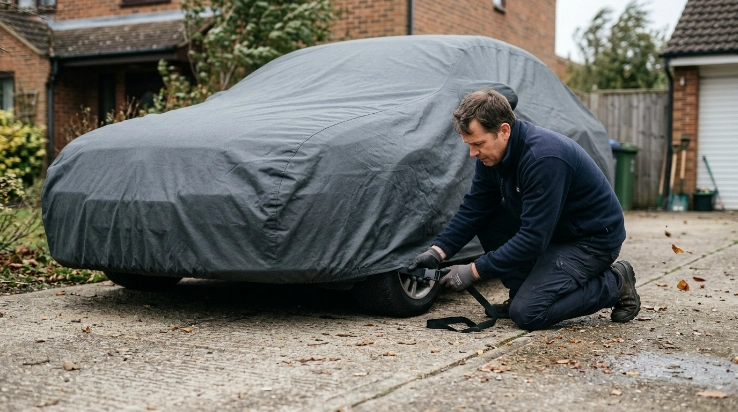
For ordinary breezy conditions, a snug fit plus the manufacturer’s approved straps usually gives you the best starting point. Strong or sustained winds are different because they can repeatedly lift the cover and load its seams.
Covercraft’s current guidance for windy conditions recommends proper fit and added retention while also advising removal during severe or sustained high winds.
Use wind straps only as intended
Wind straps can control the middle of a cover where gusts often create ballooning. They should supplement a properly fitted cover rather than disguise one that is several sizes too large.
A typical system places straps across the covered vehicle and routes them underneath to the opposite side. The CarCover.com wind-strap installation guide instructs users to position the straps over the cover and keep buckles away from bare paint.
Snug is better than excessively tight
Tighten a strap until it removes obvious slack and limits movement. Don’t keep pulling until seams distort or the material is visibly stretched across body edges.
Too much tension moves stress somewhere else. That may be a seam, grommet, elastic hem, buckle attachment, mirror pocket, or sharp body contour.
Don’t use bungee cords as a universal fix
Generic bungee cords can create concentrated force and hard attachment points. Hooks can also become a paint and glass hazard if they slip free.
Use the retention hardware specified for the cover whenever possible. If you add an aftermarket system, choose one made specifically for vehicle covers and follow its instructions.
Know when to remove the cover
A cover that repeatedly balloons, snaps, or pulls away from the bumpers is telling you that conditions are overpowering its retention system. At that point, more straps aren’t automatically safer.
During severe wind or storms, temporarily removing and storing the cover may reduce the chance of torn fabric, damaged hardware, or repeated movement against the vehicle.
Section Takeaway: Wind straps are a retention aid, not a cure for incorrect sizing. If severe wind keeps overpowering a correctly installed cover, removal can be the better option.
Should I Repair the Cover or Replace It?
Repair makes sense when the cover still fits the vehicle and one replaceable retention part has failed. Replacement makes more sense when the basic dimensions or material condition are wrong.
Repair may be worthwhile when:
- The cover still follows the vehicle’s shape closely.
- A removable strap or buckle is damaged.
- The manufacturer offers a replacement elastic, strap, buckle, or approved repair kit.
- A small seam issue can be repaired without changing the cover’s dimensions.
- The fabric remains flexible, clean, and structurally sound.
Replace the cover when:
- It is obviously oversized: Large loose panels remain after proper installation.
- The elastic is failing throughout: Both ends hang loose and no longer recover.
- The fabric has stretched: The cover has permanently lost its original shape.
- Several retention points are damaged: Multiple straps, grommets, or seams are failing together.
- Your vehicle has changed: The cover was made for another body style, wheelbase, roof profile, spoiler, or mirror arrangement.
A universal cover can work when its size range closely matches the vehicle. However, you’ll usually accept more unused fabric than you would with a model-specific pattern.
Custom-fit doesn’t mean you can ignore installation. Even a well-shaped cover will sit poorly if the front and rear are reversed or the mirror pockets aren’t aligned.
How Do I Prevent Loose-Cover Scratches and Fit Problems?
Keeping the cover stable is only half the job. The surfaces touching each other also need to stay clean.
Consumer Reports’ car-washing guidance recommends removing loose dirt before rubbing the finish because trapped particles can contribute to scratching. The same principle matters beneath a moving car cover.
Cover a clean vehicle
Dust, sand, pollen, and road grit can sit between the cover and clearcoat. If loose fabric moves repeatedly, that contamination becomes more concerning than clean fabric touching clean paint.
Wash the vehicle when needed and allow it to dry before installing the cover. Don’t place a clean cover on a visibly gritty car just because rain is coming.
Keep the inside of the cover clean
Don’t throw the cover onto a dirty garage floor and then place the same surface against your paint. Fold it so the vehicle-contact side stays protected.
Follow the manufacturer’s cleaning directions for your specific fabric. Different multilayer, woven, coated, and soft-lined materials can have different washing requirements.
Check the fit after weather changes
A strap can settle after its first windy day, and a hem can shift when the cover gets disturbed. A short walk-around helps you catch movement before it becomes a repeated problem.
- Confirm both bumper hems are still seated.
- Check that mirror pockets remain aligned.
- Look for a strap that has loosened.
- Inspect buckles for contact with painted panels.
- Look for new areas of flapping or ballooning.
Store the cover dry
Let a wet cover dry according to its care instructions before long-term storage. Stuffing damp material into a closed storage bag can create odor and mildew problems.
Good storage also preserves the cover’s shape. Fold it instead of leaving it crushed under heavy objects for long periods.
Frequently Asked Questions
How can I make a car cover fit tighter?
Center the cover, align any mirror pockets, pull both elastic hems below the bumpers, and tighten the supplied retention straps. If broad panels remain loose after correct installation, the cover is probably the wrong size or shape rather than simply needing more tension.
What can I use to hold a car cover down?
Use the straps, buckles, grommet system, cable, or wind-retention accessories approved for the cover. Purpose-made wind straps can help with normal gusts, but avoid improvised hooks or cords that can contact paint, glass, exhaust parts, or vehicle trim.
Why does my car cover keep blowing off?
The cover may be oversized, installed off-center, missing its retention straps, or using worn elastic that no longer grips the bumpers. Wind entering beneath a loose hem can inflate the cover, so correct the basic fit before adding extra restraints.
Can a loose car cover scratch the paint?
A loose cover can move more than a snug one, especially in windy conditions. Keep both the paint and the inner cover surface clean, because dirt or grit trapped between moving surfaces can increase the chance of visible marks or fine scratches.
Can I shrink a car cover that is too big?
Don’t intentionally shrink a vehicle cover unless its manufacturer specifically says the material can be treated that way. Heat or aggressive washing can damage coatings, seams, elastic, or water resistance, while producing an unpredictable fit.
How tight should a car cover be?
A car cover should follow the vehicle closely enough that large panels don’t hang or balloon, while still installing without extreme force. Straps should remove slack without distorting seams, crushing trim, or stretching the fabric tightly across sharp body contours.
Is a custom-fit car cover better for windy parking?
A model-specific cover usually leaves less excess fabric for wind to catch because its shape follows the vehicle more closely. However, even a custom-fit cover needs correct installation and its intended retention system, and severe winds may still justify temporary removal.
Final Takeaway
The best way to fix a loose car cover is to solve the reason it is loose. Re-center the cover, seat the elastic hems, secure the intended straps, and then check whether uncontrolled fabric remains.
If a correctly installed cover still hangs, balloons, or shifts, stop trying to compensate with more tension. The right long-term fix is usually a better-fitting cover or replacement of worn retention components.
Before leaving the vehicle covered outdoors, give the installation one final walk-around. A minute spent checking the fit can save you from chasing the cover across the driveway later.