
Choosing the Wrong Car Cover: Mistakes That Can Damage Your Car

Quick Answer
Choosing the wrong car cover can cause paint rubbing, trapped moisture, poor weather protection, loose fabric, and premature cover failure. Match the cover to your parking environment, vehicle shape, climate, and frequency of use instead of choosing by price or layer count alone; current car cover testing from Car and Driver also shows clear differences in fit, fastening, weather resistance, and construction.
Mistakes to avoid first
- Wrong environment: A lightweight indoor cover may not handle rain, wind, UV exposure, or outdoor debris.
- Poor fit: Excess fabric can flap and rub while an overly tight cover can strain seams and vehicle accessories.
- Dirty installation: Dust or grit trapped between the cover and paint can become abrasive when the fabric moves.
- Poor moisture control: Covering a damp car or using unsuitable material can slow evaporation underneath.
- Weak fastening: Outdoor wind can shift or lift a cover that isn’t properly secured.
- Wrong priorities: More layers don’t automatically mean a cover is better for your specific car.
My simple rule
- Choose for where the car sits, how clean it stays, and how securely the cover fits before comparing marketing claims.
I’ve seen car owners spend good money on a cover only to create a new problem for the paint underneath. The mistake usually isn’t using a car cover; it’s choosing one that doesn’t match the vehicle or storage conditions.
As of 2026, there are more cover styles and materials than most drivers need. This guide breaks the decision down into the factors that matter on an everyday car.
In This Guide
What Happens If You Choose the Wrong Car Cover?
The wrong car cover can provide less protection than expected and may create problems of its own. Poor fit, dirty contact surfaces, trapped moisture, and inadequate fastening are the issues I watch most closely.
A car cover is a removable protective barrier designed to shield a parked vehicle from contaminants or environmental exposure. The right design depends heavily on whether the vehicle stays indoors or outside.
Loose fabric can move across the paint
A cover should stay reasonably stable after it’s installed and secured. Large loose sections give wind more material to catch.
Movement becomes more concerning when dust, pollen, sand, or road grime sits between the fabric and paint. That contamination can make repeated rubbing much harsher than clean fabric touching clean paint.
- Too large: Excess material can balloon, sag, or flap.
- Too small: The material may stretch over mirrors, spoilers, antennas, and bumper edges.
- Wrong shape: Correct overall length doesn’t guarantee a good body-shape match.
- Weak retention: Loose straps or worn elastic can let an otherwise suitable cover move.
Weather protection may not match the environment
An indoor dust cover and an outdoor weather cover solve different problems. I wouldn’t expect lightweight garage fabric to behave like a secured outdoor cover during wind and rain.
The opposite mistake also happens. A bulky outdoor cover can be unnecessary for a clean garage where softness, dust protection, and easy removal matter more.
The cover can wear out faster
Using a cover outside when it wasn’t designed for prolonged outdoor exposure can stress fabric, seams, elastic, and fastening points. Sun and wind are especially hard on lightweight materials.
Section Takeaway: The wrong cover doesn’t simply provide weaker protection. Poor fit, contamination, moisture, and uncontrolled movement can turn the cover itself into another source of wear.
Should You Buy an Indoor or Outdoor Car Cover?
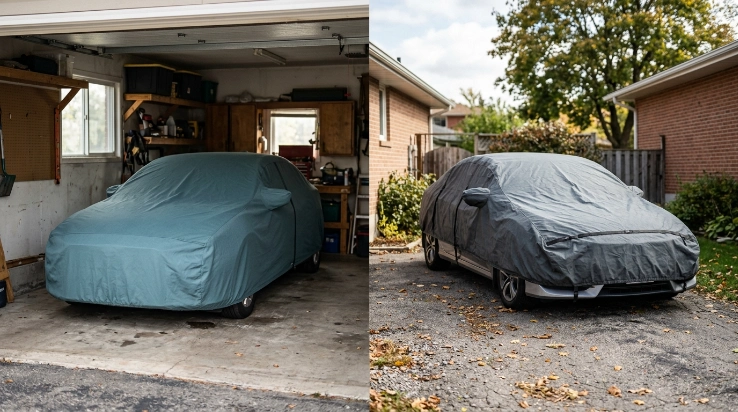
Choose an indoor cover for controlled garage storage and an outdoor cover for exposure to weather, sunlight, wind, and environmental debris. Don’t assume one cover performs both jobs equally well.
I start every car-cover decision by asking one question: Where will the vehicle spend most of its covered time?
| Cover Type | Best For | Main Priority | Common Wrong Choice |
|---|---|---|---|
| Indoor cover | Garage or enclosed storage | Softness and dust protection | Using it outdoors in wind or rain |
| Outdoor cover | Driveway or exposed parking | Weather resistance and secure fit | Ignoring ventilation and fastening |
| Universal cover | Budget or occasional use | Correct size range | Accepting large loose panels |
| Vehicle-specific cover | Frequent or long-term use | Body-shape compatibility | Ordering for the wrong body style |
Indoor storage has its own risks
Garage-kept cars still collect dust. Garages can also become humid, especially after wet vehicles, snow, or rainwater enter the space.
If a vehicle spends weeks or months parked, don’t treat the cover as the entire storage plan. Consumer Reports’ guidance for cars that aren’t driven much covers other maintenance concerns that remain important while a vehicle sits.
Outdoor storage demands stronger retention
For outdoor use, I look closely at hems, straps, buckles, grommets, and how tightly the cover follows the body. Weather resistance means little if wind can repeatedly pull the material across the paint.
- Frequent rain: Prioritize appropriate water resistance and drying ability.
- Strong sunlight: Look for material intended for extended outdoor and UV exposure.
- Windy parking: Prioritize secure attachment and controlled fit.
- Trees nearby: Consider bird droppings, leaves, pollen, sap, and small debris.
- Garage storage: Prioritize a clean, soft inner surface and easy handling.
Section Takeaway: Indoor and outdoor covers have different jobs. Choose for the car’s real parking environment rather than buying the cover with the longest feature list.
How Important Is Car Cover Fit?
Fit is one of the most important parts of choosing a car cover. A good cover follows the vehicle closely enough to control movement without stretching aggressively over protruding parts.
I don’t judge fit by vehicle length alone. Roof height, mirror position, body style, bumpers, spoilers, antennas, and other accessories can change how the cover sits.
Universal vs. vehicle-specific fit
A universal cover fits a range of similarly sized vehicles. That can work well when its dimensions and retention system closely match your car.
A vehicle-specific cover is shaped around a narrower vehicle application. That usually reduces excess fabric, but you still need to confirm the exact year, make, model, and body configuration.
- Sedan vs. hatchback: Similar length can hide major differences at the rear.
- Coupe vs. sedan: Roofline and door-area proportions can differ.
- SUV vs. crossover: Height and rear profile may change fit substantially.
- Factory spoiler: It may require extra space or a compatible pattern.
- Aftermarket parts: Wings, roof racks, antennas, and body kits can alter fit.
Signs the cover is too loose
Install the cover correctly before deciding it’s oversized. Center it, seat the front and rear hems, then secure every fastening point the manufacturer intends you to use.
- Large folds remain after installation.
- Side panels hang well away from the body.
- The fabric balloons easily in a light breeze.
- The cover shifts noticeably despite secured straps.
- Extra material gathers around the bumpers or roof.
Signs the cover is too tight
A tight fit isn’t automatically a good fit. Fabric shouldn’t need excessive stretching to reach the bumpers or fastening points.
- Seams are under obvious tension.
- Mirror pockets pull sideways.
- Sharp body edges push hard against the material.
- The cover continually slips upward from a bumper.
- Installation requires force instead of controlled tension.
Section Takeaway: Aim for secure, controlled fit rather than maximum tightness. A correctly sized cover should stay put without straining itself or the vehicle’s exterior parts.
Which Car Cover Material Should You Choose?
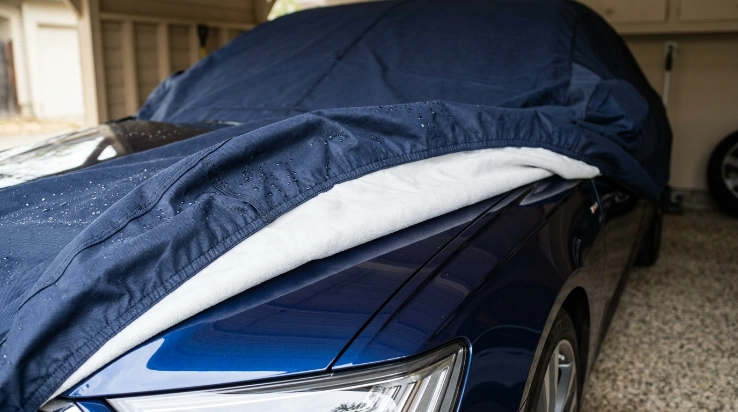
Choose car-cover material according to the protection you need rather than layer count alone. Weather resistance, breathability, inner-surface softness, durability, and handling all matter.
Marketing terms can make this confusing. I separate material performance into a few practical jobs.
Outer protection
The outside of the cover deals with the environment first. An outdoor cover needs construction suited to the conditions where you’ll use it.
- Rain exposure: The material should resist water appropriately for outdoor use.
- Sun exposure: Outdoor fabric should be intended to handle prolonged sunlight.
- Debris exposure: The cover should create a physical barrier against common contamination.
- Wind exposure: Material and seams must work with a secure retention system.
Inner-surface softness
The side touching your vehicle deserves just as much attention. I prefer a smooth, paint-friendly surface without coarse seams resting against sensitive areas.
Softness still doesn’t make a dirty cover safe. A clean liner sliding over dirty paint can carry grit along with it.
Breathability and moisture movement
Breathability describes a material’s ability to allow water vapor to move through it. It doesn’t mean rain should simply pass through the cover.
A breathable design can help moisture escape after humid air or condensation develops underneath. You should still avoid intentionally covering a wet vehicle.
More layers aren’t automatically better
A thick multi-layer cover can be useful outdoors, but thickness alone doesn’t tell you how it fits or behaves in wind. It also doesn’t tell you how soft the inner surface is.
Current 2026 cover testing demonstrates why I compare real construction and use-case performance instead of treating every “all-weather” claim as equivalent. Fit, waterproofing, fastening, softness, and durability can vary considerably between products.
Section Takeaway: Choose material as a complete system. Outer protection, moisture management, inner softness, fit, and fastening need to work together.
Can a Car Cover Scratch Paint or Trap Moisture?
Yes, a car cover can contribute to scratches or moisture problems when it’s dirty, loose, installed over contamination, or used while the vehicle is wet. The risk comes from the conditions around the cover as much as the fabric itself.
This is why I never look at a cover as a magic protective shell. The way you use it matters.
How scratching can happen
Dust and fine grit are the biggest concern for me. Once trapped between two surfaces, contamination can move when you install, remove, or reposition the cover.
Consumer Reports also warns that dirt carried by cleaning materials can damage vehicle finishes, which reflects the same basic principle: keep anything touching the paint clean. Their car detailing guidance explains safe exterior-cleaning practices.
- Clean the vehicle: Don’t cover visibly dusty or gritty paint.
- Clean the liner: Keep the inside of the cover away from dirty floors.
- Control movement: Secure outdoor covers using their intended fastening system.
- Lift carefully: Avoid dragging a dirty cover across large painted panels.
How moisture gets trapped
A waterproof exterior doesn’t guarantee a permanently dry space underneath. Humid air, condensation, wet ground, a damp cover, or a freshly washed vehicle can introduce moisture.
Temperature changes can also create condensation beneath a cover even when rain never penetrates it. That makes drying and ventilation important.
Don’t cover a wet car and forget it
If possible, let the paint, glass, trim, wheels, seams, and cover dry before long-term installation. Remove the cover if you discover persistent dampness and identify the moisture source.
- Was the car wet when covered?
- Was the cover itself stored damp?
- Is the vehicle parked over wet soil or grass?
- Does the garage have a humidity problem?
- Is the cover suitable for that storage environment?
Good exterior care matters beyond the cover itself. Kelley Blue Book’s car maintenance resources are a useful starting point for keeping the rest of the vehicle’s upkeep in perspective.
Section Takeaway: A clean, dry, correctly fitted cover is far safer than a loose cover thrown over dirty or damp paint. Your installation routine matters as much as the material.
How Do You Choose the Right Car Cover?
Choose the right car cover by identifying the parking environment first, then verifying fit, material, inner surface, fastening, and maintenance requirements. Don’t begin with price or the number of advertised layers.
Here’s the sequence I use when evaluating a cover for an everyday vehicle.
- Decide where you’ll use it. Indoor and outdoor storage create different protection requirements.
- Confirm the exact vehicle. Check year, make, model, body style, and relevant accessories.
- Identify your biggest exposure. Consider dust, sun, rain, wind, pollen, birds, tree debris, or long-term storage.
- Check the inner surface. Look for clean, smooth construction where the cover contacts paint.
- Review moisture management. Outdoor protection shouldn’t ignore ventilation and drying.
- Inspect the fastening system. Confirm the cover can remain secure in your expected conditions.
- Plan how you’ll keep it clean. A dirty cover can transfer contamination back to the car.
Don’t shop by price alone
A cheap cover isn’t automatically wrong, and an expensive one isn’t automatically correct. A modest cover that fits your actual use can be a better choice than a premium cover designed for different conditions.
I care more about suitability than prestige. The cover has one job: protect the parked vehicle without creating unnecessary new risks.
Don’t shop by “waterproof” alone
Water resistance matters outdoors, but rain is only one problem. Wind stability, drying, contamination, heat exposure, fit, and storage habits matter too.
Inspect the cover after installation
My final check takes less than a minute. I walk around the vehicle and look for tension points, hanging panels, exposed areas, unsecured straps, and anything that could move repeatedly.
- Front and rear hems are seated correctly.
- Mirror areas aren’t under excessive tension.
- Large fabric panels aren’t hanging loose.
- Straps and buckles are positioned as intended.
- The inside surface was clean before installation.
- The vehicle was dry enough for storage.
Recheck an outdoor cover after strong weather until you understand how it behaves in your parking location. Small fit problems are easier to correct before they become worn seams or repeated paint contact.
Section Takeaway: The best car cover isn’t the one with the most marketing features. It’s the one that fits your vehicle, environment, and real-world storage routine.
Frequently Asked Questions
Can choosing the wrong car cover damage paint?
It can contribute to paint marks when the cover is loose, dirty, or moving over contamination. Keep the vehicle and liner clean, choose the correct fit, and secure outdoor covers so unnecessary movement is minimized.
Is a loose car cover bad for a car?
A noticeably loose cover is more likely to shift, flap, or balloon in wind. Reinstall it correctly and use the intended straps before assuming the size is wrong; persistent excess fabric can indicate poor sizing or shape compatibility.
Should a car cover be completely waterproof?
An outdoor cover should provide the level of water protection appropriate for its intended use, but moisture management still matters. Condensation or existing moisture can form underneath even when rain doesn’t pass directly through the outer material.
Can I put a car cover on a dirty car?
I avoid it whenever possible. Dust, sand, pollen, and road grit can become trapped between the fabric and paint, increasing the chance of abrasion when the cover is installed, removed, or moved by wind.
Is a custom-fit car cover always better?
Not automatically. A properly designed vehicle-specific cover often controls excess fabric well, but you still need the correct application, suitable material, clean inner surface, and appropriate protection for where the vehicle is stored.
Can I use an indoor car cover outside?
Only if the manufacturer specifically says it is suitable for those outdoor conditions. Indoor covers commonly prioritize dust protection and softness rather than prolonged exposure to rain, sunlight, and wind.
How do I know if I bought the wrong car cover?
Warning signs include persistent flapping, excessive folds, strained seams, exposed body areas, moisture that won’t clear, poor fastening, or a cover that doesn’t match your storage environment. If correct installation doesn’t solve the issue, reconsider the size or cover type.
Final Takeaway: Choosing the wrong car cover usually comes down to a mismatch between the cover, the vehicle, and the parking environment. Get those three things aligned first, then compare materials, features, and price.
Before leaving a new cover on your car for days or weeks, install it once and inspect every side. That simple check can reveal most sizing, fastening, and contact problems before they become expensive lessons.