
How to Fix a Stretched Car Cover: A Practical DIY Guide

Quick Answer
To fix a stretched car cover, first re-center it and confirm the cover is still the correct size for your vehicle. If the fabric fits but the edges no longer grip, repair or replace the worn elastic hem; if the entire cover has permanently stretched or distorted, replacement is usually safer than trying to shrink it with heat. You can also review current car accessory guidance from Car and Driver when evaluating cover fit and retention.
Quick steps to fix the fit
- Step 1: Remove the cover and inspect the fabric, elastic hems, straps, seams, and buckles.
- Step 2: Reinstall it from the center so the front, rear, mirrors, and sides align evenly.
- Step 3: Tighten only the manufacturer-provided straps or retention system.
- Step 4: Replace weakened elastic if the fabric itself still fits correctly.
- Step 5: Replace the cover if large panels remain permanently baggy after correct installation.
Avoid this shortcut
- Skip high heat: Don’t use boiling water, a hot dryer, heat gun, or other uncontrolled heat unless the cover manufacturer specifically permits it.
A stretched car cover can start as a small annoyance and become a bigger fit problem outdoors. Loose fabric catches wind, shifts around the vehicle, and makes an otherwise usable cover harder to secure.
I start with the fit before trying to modify anything. A cover that looks stretched may simply be off-center, have worn elastic, or be the wrong size for the vehicle.
In This Guide
- Why Does a Car Cover Become Stretched?
- How Do You Know What Part of the Cover Has Stretched?
- How Do You Fix a Stretched Car Cover Step by Step?
- Can You Fix a Stretched Elastic Hem?
- Can You Shrink a Stretched Car Cover Back to Size?
- How Do You Prevent a Car Cover From Stretching Again?
- Frequently Asked Questions
Why Does a Car Cover Become Stretched?
A car cover usually becomes stretched because its fabric, elastic hem, seams, or retention straps have spent too much time under tension. Incorrect sizing and repeated wind movement can accelerate the problem.
Definition: A stretched car cover is a vehicle cover that has permanently lost enough of its original shape or tension to sag, flap, shift, or fit differently after correct installation.
Wind repeatedly pulls on loose fabric
A loose panel acts like a small sail when air gets underneath it. Repeated lifting can load the seams, hem, straps, and fabric every time the cover moves.
- Side panels balloon: Too much width gives wind room to enter and lift the cover.
- Front or rear lifts: Weak elastic may no longer grip around the bumper.
- Straps pull hard: A loose cover can transfer repeated loads into the strap attachment points.
- Seams distort: Long-term tension can leave shaped sections looking twisted or uneven.
The cover may be too small
A cover that’s undersized can also stretch. Constantly forcing it over mirrors, spoilers, bumper corners, or roof accessories puts tension into the fabric.
You shouldn’t need to yank aggressively to install a correctly matched cover. If one bumper only stays covered when the opposite end is pulled extremely tight, check the fitment before blaming normal aging.
Elastic and straps wear independently of the main fabric
Sometimes the cover itself hasn’t stretched much at all. The elastic hem has simply lost its ability to contract.
This distinction matters because a healthy cover with worn elastic may still be repairable. A cover with widespread fabric distortion is much harder to restore reliably.
- Elastic problem: Fabric dimensions look normal, but an edge no longer gathers.
- Fabric problem: Large panels remain baggy even when laid flat.
- Strap problem: The cover fits correctly until the retention system is tightened.
- Sizing problem: The cover has always had excessive material in several areas.
Section Takeaway: Identify what actually stretched before modifying the cover. Worn elastic, distorted fabric, bad sizing, and poor installation require different fixes.
How Do You Know What Part of the Cover Has Stretched?
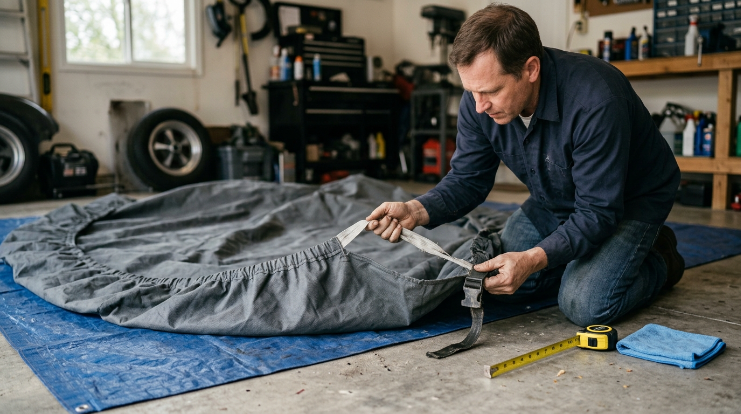
Remove the cover and inspect it before attempting a repair. Your goal is to separate a worn component from an overall fit problem.
I like to lay the cover on a clean floor or large clean sheet. That removes the vehicle’s shape from the equation and makes distortion easier to spot.
| What You Notice | Likely Cause | Best First Fix |
|---|---|---|
| Front or rear edge hangs loose | Weak elastic hem | Inspect or replace elastic |
| One end loose and opposite end tight | Off-center installation | Remove and reinstall |
| Loose across roof and both sides | Oversizing or stretched fabric | Verify size and fabric condition |
| Straps no longer tighten enough | Stretched strap or damaged buckle | Replace approved retention part |
| Seams pull around mirrors or spoiler | Cover too small or wrong shape | Check exact vehicle fitment |
| Fabric looks wavy even off the car | Permanent material distortion | Consider replacement |
Also inspect for thinning, cracking, peeling layers, torn stitching, enlarged grommet holes, and brittle sections. Those problems suggest the cover is deteriorating rather than merely losing tension.
For broader vehicle-care information, resources such as Kelley Blue Book can help you keep storage and exterior protection within your regular maintenance routine.
How Do You Fix a Stretched Car Cover Step by Step?
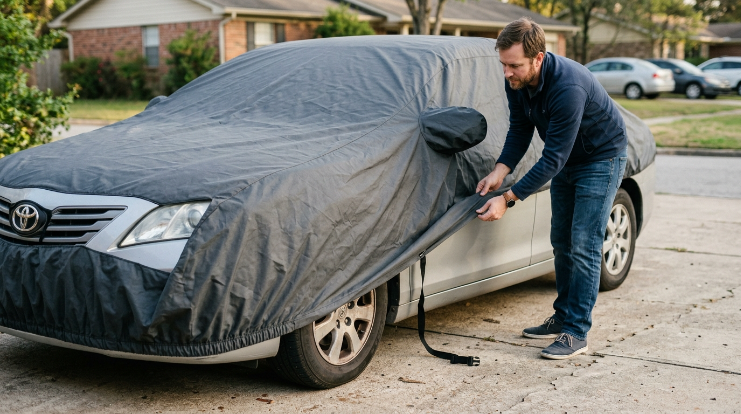
Start with a complete reinstall before sewing, cutting, or replacing anything. Many apparent stretching problems disappear once the cover is centered and secured correctly.
1. Remove the cover completely
Don’t try to diagnose the fit while one end remains hooked around a bumper. Take it off and place it on a clean surface.
- Check the fabric: Look for permanently baggy or distorted panels.
- Check the seams: Watch for pulled stitching or sections that no longer lie flat.
- Check the elastic: Compare how strongly the front and rear hems gather.
- Check the straps: Look for stretching, fraying, damaged buckles, or torn anchors.
2. Confirm the orientation
Find the front label, mirror pockets, antenna opening, zipper, or shaped bumper sections. Installing the cover backward can create both tight and loose areas.
Don’t tighten anything yet. First make sure every shaped feature naturally lines up with the vehicle.
3. Center the roof section
Place the middle of the cover along the vehicle’s centerline. Keep roughly equal material hanging on the driver’s and passenger’s sides.
- Check both mirrors: One pocket shouldn’t pull harder than the other.
- Check the roof seams: They shouldn’t run diagonally because the cover is twisted.
- Check both ends: Front and rear overhang should make sense before you seat the hems.
4. Seat the elastic hems correctly
Fit the front edge around its intended location, then work toward the rear. Avoid stretching one end as far as possible before positioning the rest of the cover.
If the edge no longer contracts around the bumper despite correct alignment, the elastic is probably the problem.
5. Secure the original retention system
Fasten the supplied straps, buckles, or tie-down system according to the cover manufacturer’s instructions. Tighten enough to control slack without pulling the cover drum-tight.
- Use intended attachment points: Don’t improvise by tying cords around mirrors or trim.
- Keep hardware controlled: Loose buckles shouldn’t swing against painted surfaces.
- Avoid excessive tension: More force can transfer the problem into seams and strap anchors.
6. Recheck the loose areas
Walk around the vehicle after installation. Large unsupported sections that remain loose tell you the problem wasn’t simple positioning.
At this stage, decide whether you’re dealing with elastic, straps, or permanently stretched material. Don’t keep tightening hardware to disguise an oversized or distorted cover.
Section Takeaway: Reinstall first and repair second. Correct alignment often fixes uneven slack without permanently altering the cover.
Can You Fix a Stretched Elastic Hem?
Yes, a stretched elastic hem can sometimes be repaired when the surrounding fabric and stitching remain healthy. Replacing the elastic is usually more practical than trying to make worn elastic contract again.
Check the manufacturer’s warranty and care instructions before opening a sewn hem. Altering it may affect warranty coverage or damage a multilayer cover.
Option 1: Replace the elastic
If the elastic runs through an accessible sewn channel, a new section may restore the gathering action. Match the replacement elastic’s width and construction as closely as possible to the original.
- Remove the cover and mark the section that has lost tension.
- Inspect the hem for torn fabric before opening any stitching.
- Access the old elastic only if the cover’s construction allows it.
- Measure the existing elastic and channel width.
- Install compatible replacement elastic without over-tightening it.
- Close the seam securely and test the fit gently.
If you’re uncomfortable sewing technical fabric, an upholstery or alteration shop may be a better option. A neat repair is preferable to cutting a large opening into an otherwise usable cover.
Option 2: Replace a removable strap
A stretched webbing strap can make the whole cover feel loose even when its dimensions remain correct. Replace removable straps or buckles with manufacturer-approved parts whenever possible.
General maintenance resources from Edmunds are also useful when building a broader vehicle storage and care routine.
Can You Shrink a Stretched Car Cover Back to Size?
You generally shouldn’t attempt to shrink a car cover with uncontrolled heat. Car covers use different fabrics, coatings, liners, laminates, elastic components, and seam constructions.
A method that changes one material may damage another. High heat can also distort a cover unevenly instead of restoring its original dimensions.
Avoid high-heat DIY tricks
- Hot dryer: Don’t use it unless the care label specifically permits that drying method and temperature.
- Boiling water: It gives you little control over coatings, elastic, adhesives, or laminated layers.
- Heat gun: Concentrated heat can create local damage and uneven distortion.
- Open flame: Never expose cover fabric to flame in an attempt to tighten it.
Follow the care label instead
If the fit changed after washing or drying, go back to the manufacturer’s instructions. Different cover materials can have completely different cleaning and drying requirements.
Don’t assume ordinary laundry advice applies. Treat the sewn care label or manufacturer’s instructions as the controlling source for your specific cover.
When replacement makes more sense
If the entire roof, hood, sides, and bumper sections remain loose after correct installation, the fabric may have permanently distorted. Trying to force it back into shape can create new stress points.
| Condition | Repair? | Why |
|---|---|---|
| Only elastic has weakened | Often reasonable | Main fabric can still be usable |
| One removable strap stretched | Usually reasonable | Component may be replaceable |
| Small localized seam distortion | Possibly | Depends on surrounding fabric strength |
| Large panels permanently baggy | Usually replace | Overall dimensions have changed |
| Fabric is brittle, peeling, or repeatedly tearing | Replace | Material deterioration extends beyond fit |
Section Takeaway: Don’t treat heat as a universal shrinking method. Repair replaceable components when practical, but replace a cover with widespread permanent distortion.
How Do You Prevent a Car Cover From Stretching Again?
The best prevention is a cover that fits the vehicle correctly and isn’t forced to handle loads its retention system can’t control. Proper installation matters every time you use it.
Choose the correct size and shape
Match more than overall vehicle length. Body width, roof height, mirror location, spoilers, racks, bumpers, and body style all affect how a cover sits.
- Check year and model: Application-specific covers should match the exact vehicle configuration.
- Consider accessories: Roof racks and spoilers can change the needed shape.
- Don’t force mirror pockets: They should line up without heavy sideways tension.
- Watch universal sizing: A length match alone doesn’t guarantee a good overall fit.
Control wind movement
Secure every retention component intended by the manufacturer. A cover that repeatedly balloons or snaps in wind experiences far more movement than one that stays controlled.
If severe conditions overwhelm the cover’s intended retention system, removing and storing the cover may be better than improvising extreme tension.
Keep the cover clean and dry
Dirt and moisture don’t directly cause stretching, but good storage habits help preserve the entire cover. Follow its cleaning instructions and store it clean and completely dry.
For broader exterior-care guidance, Consumer Reports publishes vehicle maintenance and car-care information for owners.
Inspect the hems occasionally
Check elastic, straps, seams, and buckles before they fail completely. Early wear is usually easier to address than a cover that has spent months flapping loosely.
- Monthly outdoor check: Look for slack, pulled stitching, and worn straps during regular use.
- After strong wind: Inspect attachment points before reinstalling the cover.
- After washing: Confirm the fit once the cover is fully dry.
- Before long storage: Fix questionable retention parts before leaving the vehicle covered.
Section Takeaway: Correct sizing, moderate tension, proper storage, and early inspection reduce the chances of a car cover becoming permanently stretched.
Frequently Asked Questions
Can a stretched car cover return to its original size?
Sometimes a cover only appears stretched because it’s installed off-center or its elastic has weakened. Permanently distorted fabric is less likely to return reliably to its original shape, so widespread bagginess after correct installation usually points toward replacement.
Can I put a stretched car cover in the dryer to shrink it?
Don’t use dryer heat as a shrinking treatment unless the manufacturer specifically allows that temperature and drying method. Cover materials vary, and excessive heat can damage coatings, elastic, laminated layers, adhesives, or the fabric itself.
How tight should a car cover be?
A car cover should be snug enough to stay controlled without being stretched hard across mirrors, bumpers, spoilers, or seams. You should not need extreme force during installation, and large loose panels should not repeatedly flap or balloon.
Can I tighten a loose cover with extra bungee cords?
It’s better to use the retention system designed for the cover. Improvised bungee hooks can create concentrated loads, and loose hardware may become a hazard around paint or glass if it slips free.
Is replacing the elastic cheaper than replacing the whole cover?
It can be worthwhile when only the elastic has failed and the surrounding cover remains flexible, strong, and correctly sized. If the fabric is also distorted, brittle, peeling, or repeatedly tearing, replacing only the elastic won’t solve the underlying problem.
Why did my car cover suddenly become loose?
Check whether it shifted, whether an elastic hem or strap failed, and whether the fit changed after cleaning. A cover can also loosen gradually from repeated wind loading or long-term wear, even when the change seems sudden.
Should I replace a stretched cover that still stays on the car?
Not automatically. Reinstall it correctly and inspect its condition first, but replacement makes sense when large sections remain uncontrolled, the retention system can’t stabilize it, or the material shows widespread deterioration.
Fixing a stretched car cover starts with diagnosis, not more tension. Re-center it, inspect the elastic and straps, and repair individual worn components only when the main fabric remains healthy.
If the entire cover has permanently changed shape, replacement is usually the cleaner solution. A correctly fitting cover is easier to secure, easier to use, and less likely to spend its life flapping in the wind.
My final rule is simple: repair a good cover with one bad component, but don’t keep modifying a cover that no longer matches the vehicle.