
EV Car Cover Issues: Common Problems, Risks, and How to Avoid Them

Quick Answer
The most common EV car cover issues are blocked charge-port access, restricted cooling while charging, trapped moisture, wind rubbing, dirty fabric scratching paint, and poor fit around cameras, mirrors, spoilers, and charging hardware. The safest approach is to use a clean, breathable, properly fitted EV-compatible cover and follow your vehicle manufacturer’s instructions whenever the car is plugged in. For general EV charging safety, NHTSA’s electric-vehicle guidance recommends following the vehicle owner’s manual and manufacturer charging instructions.
EV cover problems to check first
- Charging access: A standard cover may block the charging door or bunch around a connected cable.
- Cooling airflow: Some manufacturers place specific restrictions on covers used while an EV is plugged in.
- Trapped moisture: Rain, condensation, or a damp cover can keep exterior surfaces wet longer.
- Paint rubbing: Dirt between the cover and paint can become abrasive when the fabric moves.
- Poor fit: Loose fabric can flap while tight fabric can pull against mirrors, spoilers, trim, and the charging area.
- Wrong cover type: A generic universal cover may lack charging access or manufacturer-required ventilation.
Best first step
- Check your EV owner’s manual before covering the vehicle while charging, then inspect the cover’s fit, charge-port opening, ventilation, cleanliness, and fastening system.
Covering an electric vehicle seems simple until you need to plug it in. That’s when an ordinary car cover can create problems you wouldn’t think about with a gasoline daily driver.
I’ve found that EV owners need to think about charging access and manufacturer restrictions alongside the usual moisture, dirt, wind, and fit problems. This 2026 guide walks through each issue and shows you what I’d check before leaving an EV covered.
In This Guide
- What Problems Can an EV Car Cover Cause?
- Can You Put a Car Cover on an EV While Charging?
- Why Does Moisture Build Up Under an EV Car Cover?
- Can an EV Car Cover Scratch the Paint?
- EV-Specific vs. Standard Car Covers: What’s Different?
- How Do You Prevent EV Car Cover Problems?
- Frequently Asked Questions
What Problems Can an EV Car Cover Cause?
An EV car cover can cause trouble when it interferes with charging, traps moisture, moves across dirty paint, or fits poorly around the vehicle. Many of the problems are ordinary car-cover problems, but charging adds another consideration.
An EV car cover is a removable protective fabric shell used over a battery-electric vehicle. EV-specific versions may include features such as charge-port openings or a shape tailored around that particular vehicle.
Blocked charge-port access
The charging port can sit in very different places depending on the EV. It may be in a front fender, rear quarter panel, grille area, or another exterior location.
A generic cover might completely cover that opening. Pulling or folding material away from the port can then leave the cover poorly positioned.
- Fabric can bunch: Loose material may collect around the charging connector.
- The cable can pull the cover: Routing the cord through an improvised opening can distort the cover’s fit.
- The charging door can become awkward to reach: Some EVs use powered or delicate charge-port doors.
- Weather protection can decrease: Folding back a large section exposes more of the vehicle.
Ford, for example, offers a Mustang Mach-E cover specifically designed with charge-port access. That tells me charging access should be treated as a design requirement, not an afterthought.
Cooling or airflow interference
EVs can manage battery temperature during charging. Exactly how they do that depends on the manufacturer and vehicle.
This is where I avoid making universal rules. You need to follow the instructions for your exact EV.
Tesla’s Model 3 guidance gives a useful real-world example. Tesla cautions owners to use a Tesla-approved cover while the vehicle is plugged in because another cover may prevent adequate battery cooling.
That warning doesn’t automatically apply to every EV. It proves why checking the owner’s manual matters before charging beneath any full-body cover.
Cameras and exterior hardware
Modern EVs often have exterior cameras and sensors, though gasoline vehicles can have the same equipment. A parked vehicle generally doesn’t need every driving-assistance camera exposed, but a tight cover can still press against vulnerable exterior parts.
- Mirror housings
- Cameras mounted near fenders or pillars
- Door handles
- Roof antennas
- Spoilers
- Charging doors
- License-plate brackets
I don’t stretch a cover hard over one of these areas just to make the hem reach the bumper. Excessive tension usually tells me the size or shape is wrong.
Normal car-cover problems still apply
Being electric doesn’t protect the paint from a dirty or loose cover. Grit, moisture, wind, poor storage, and worn fabric can still cause headaches.
| What You Notice | Likely Cover Issue | First Check |
|---|---|---|
| Can’t reach charge port | Cover lacks EV charging access | Check for a model-specific charging opening |
| Cover bunches around cable | Poor charging-port design or fit | Stop stretching the cover and reposition it |
| Water droplets underneath | Condensation or trapped moisture | Dry both vehicle and cover |
| Fine marks on paint | Dirt plus fabric movement | Inspect the inside lining and paint |
| Cover balloons in wind | Loose fit or poor fastening | Check sizing, hem, and straps |
| Fabric pulls around charging door | Cover is too tight or badly aligned | Remove tension before charging |
Section Takeaway: EV covers face the same dirt, wind, moisture, and fit problems as conventional covers, but charging access and manufacturer cooling requirements add another layer.
Can You Put a Car Cover on an EV While Charging?
You can cover some EVs while charging when the manufacturer permits it and the cover is designed appropriately. Don’t assume every full-body cover is safe to use on every plugged-in EV.
The owner’s manual should settle this question for your specific make, model, model year, and cover.
Why manufacturer instructions come first
EV charging isn’t simply electricity entering a stationary battery. The vehicle monitors the charging process and may actively manage battery temperature.
NHTSA advises EV owners to follow the owner’s manual and manufacturer instructions for charging safety and maintenance. I apply the same rule to anything wrapped around the car during charging.
Tesla provides a clear example
Tesla states in Model 3 documentation that owners should use a genuine Tesla cover when the vehicle is not being used. More importantly, it warns against using a non-Tesla cover while the Model 3 is plugged in because battery cooling could be affected.
That’s model/manufacturer guidance, not a blanket statement about every EV. Check your own manual rather than extending Tesla’s warning to a Ford, Hyundai, Kia, Rivian, Chevrolet, or another EV.
Charging-port access matters too
A suitable cover should let you connect the charging cable without fighting the fabric. The connector should seat normally and the cable shouldn’t be forced into an unnatural angle by the cover.
Tesla’s charging instructions, for example, tell owners to align the connector and insert it fully. A cover shouldn’t make that basic connection harder.
- Keep the connector accessible: Don’t bury it beneath layers of fabric.
- Avoid cable tension: The cover shouldn’t push or pull noticeably on the plug.
- Confirm charging: Use your vehicle’s normal charging indicator before walking away.
- Follow cover instructions: Some manufacturer-approved covers have a dedicated opening or flap.
Rain isn’t automatically the problem
Owners sometimes assume any moisture near an EV means charging has to stop. NHTSA says plug-in EV chargers are weather-resistant, while the U.S. Department of Energy says properly rated outdoor charging equipment can be used outdoors, including in rain.
That doesn’t mean damaged equipment is safe. It also doesn’t mean a random cover modification around the connector is a good idea.
Mechanic Alert: Never modify high-voltage charging components, damaged connectors, or EV electrical hardware yourself. Stop charging and contact a qualified EV technician or the equipment manufacturer if you find damage, overheating, exposed conductors, or persistent charging faults.
Section Takeaway: A covered EV can sometimes charge normally, but the answer depends on the vehicle and cover. Manufacturer instructions outrank generic car-cover advice.
Why Does Moisture Build Up Under an EV Car Cover?
Moisture develops when water or humid air gets beneath the cover faster than it can dry. A wet vehicle, damp fabric, condensation, humid parking area, and limited airflow can all contribute.
The EV battery isn’t what creates most ordinary cover condensation. I troubleshoot the parking environment and cover first.
Covering the EV while it’s wet
This is one of the easiest mistakes to prevent. A freshly washed or rain-soaked vehicle can hold water in many hidden areas.
- Mirror housings
- Door handles
- Window seals
- Charging-door edges
- Badges and trim
- Wheel openings
If I know the car will remain covered for days, I let those areas dry before installing the cover. I also make sure the inside of the cover is dry.
Condensation can happen without a leak
A cover doesn’t have to leak for droplets to appear underneath it. Temperature changes can cause humid air near the vehicle to condense on cooler surfaces.
That distinction matters. Buying a more waterproof cover won’t necessarily solve a condensation problem.
Breathability helps moisture escape
A breathable cover can let water vapor escape instead of sealing it against the body. Breathability still isn’t permission to install a soaking-wet cover.
Ford’s Mach-E cover description specifically highlights breathable fabric intended to let moisture, condensation, and heat escape. That’s the kind of EV-specific design detail I look for.
Check the parking surface
A damp garage or wet parking surface keeps more moisture near the vehicle. Grass and persistently wet ground can also keep the immediate environment humid.
- Check for garage roof leaks.
- Look for water entering beneath doors.
- Allow wet concrete to dry where practical.
- Improve garage ventilation if humidity stays high.
- Never fold and store the cover while it’s damp.
Section Takeaway: Most moisture beneath an EV cover is an environmental and ventilation problem. Dry the car and cover first, then investigate condensation, water entry, and airflow.
Can an EV Car Cover Scratch the Paint?
Yes. An EV car cover can contribute to paint marks when dirt is trapped between the fabric and finish and the cover moves across it.
The same rule applies whether you’re covering a Tesla Model 3, Mustang Mach-E, Hyundai Ioniq 5, Kia EV6, Rivian R1S, or a gasoline vehicle.
Dirt is the bigger problem
A soft cover touching clean paint isn’t the same as a dusty cover moving across dirty paint. Fine grit changes the situation.
I think of loose dirt as the abrasive layer. Wind or repeated installation then supplies the movement.
- Road grit: Fine contamination can remain on lower doors and rocker areas.
- Dust: Indoor storage isn’t automatically dust-free.
- Sand: Small particles can become trapped in the cover lining.
- Dirty storage: Dragging a removed cover across a garage floor can contaminate its inside surface.
Loose covers move more
A cover that’s too large can balloon and flap. Repeated movement is most concerning when dirt is already present underneath.
Tight doesn’t automatically mean better. An undersized cover can put unnecessary tension on mirrors, trim, spoilers, and the charge-port area.
Be careful when removing the cover
I avoid dragging a full cover lengthwise across the paint. Instead, I lift and fold sections progressively so the dirty outside surface stays away from the clean inside surface.
- Disconnect the charging cable first when necessary for safe removal.
- Release all straps and fasteners.
- Lift the sides instead of dragging them across the ground.
- Fold toward the roof in controlled sections.
- Store the dry cover in a clean bag or container.
If you see scratches, first determine whether they’re superficial marks or actual finish damage. Don’t aggressively polish an unfamiliar EV finish just because you noticed a line after removing a cover.
Section Takeaway: Cleanliness and movement matter more than the EV badge. A clean, well-fitted cover on clean paint is much safer than a loose cover rubbing trapped grit.
EV-Specific vs. Standard Car Covers: What’s Different?
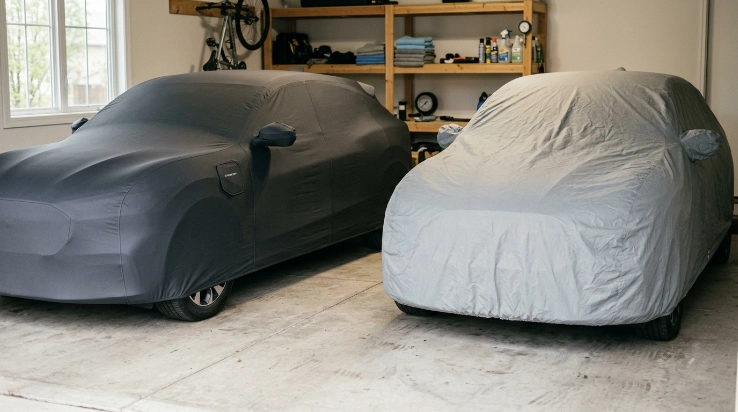
An EV-specific cover can provide charging access and vehicle-specific fit that a universal cover may lack. A standard cover can still work for some parked EVs when the manufacturer allows it and charging access isn’t needed.
| Feature | EV-Specific Cover | Generic/Standard Cover |
|---|---|---|
| Charge-port access | May include dedicated opening | Often absent |
| Body fit | Usually tailored to model shape | May fit several vehicle sizes |
| Charging compatibility | May be designed for covered charging | Must be verified separately |
| Mirror/spoiler shape | More likely to match specific body | May leave excess or tight fabric |
| Breathability | Depends on product | Depends on product |
| Best use | Regular protection with model-specific needs | Basic protection where fit and instructions permit |
An EV label alone isn’t enough
I wouldn’t buy a cover just because the product page puts “EV” in the title. The useful features need to match your actual vehicle.
- Correct model and model-year fit
- Charge-port location
- Manufacturer charging restrictions
- Indoor or outdoor use
- Breathable construction
- Secure fastening
- Soft, clean inner surface
For an EV that stays plugged in frequently, charge-port access can be a major convenience. For an unplugged vehicle stored indoors, that feature may matter much less.
Cold climates add another consideration
Ice can make charging hardware harder to use. Tesla documentation notes that charge-port latches can freeze in extremely cold conditions on affected vehicles.
Ford also offers dedicated winter charging-port covers for several electrified models. A full vehicle cover and a charging-port winter protector solve different problems, so don’t assume one substitutes for the other.
Section Takeaway: The strongest reason to choose an EV-specific cover is functional compatibility, especially charge-port access and correct vehicle fit. The word “EV” on the packaging isn’t enough.
How Do You Prevent EV Car Cover Problems?
Preventing EV cover issues comes down to four things: follow the owner’s manual, start clean and dry, use the right fit, and inspect the setup after installation. Don’t wait for scratches or charging trouble before checking it.
1. Read the charging instructions first
Check your manufacturer’s manual for cover restrictions while plugged in. Search the manual for terms such as “car cover,” “vehicle cover,” “charging,” and “charge port.”
This step matters because manufacturer requirements can differ. For broader charging basics, the U.S. Department of Energy home-charging guide explains home equipment and outdoor charging considerations.
2. Start with a clean vehicle
Don’t place a cover over obvious road grit, sand, mud, or abrasive contamination. Pay particular attention to lower doors, bumpers, and rocker panels.
A full detail isn’t required every evening. I just don’t want visible grit trapped beneath moving fabric.
3. Make sure everything is dry
Dry the paint and the inside of the cover before longer storage. Give hidden seams and trim time to drain after washing.
- Check mirror housings.
- Check around the charging door.
- Check window and trunk seals.
- Check the lower edge of the cover.
- Never pack a damp cover away.
4. Check the charge-port opening
If you’re charging while covered, install the cover according to its instructions before connecting everything. Make sure any charging flap or opening sits where intended.
The charging connector should insert normally. Don’t use the cover as a strap to hold the charging plug in place.
5. Look for tension and loose fabric
Walk around the EV after installation. You should spot trouble quickly if you know where to look.
- Large loose folds that can catch wind
- Stretched seams around mirrors
- Fabric pressing against the charging connector
- Tension around spoilers or sharp trim
- Hem sitting far above the bumper
- Straps rubbing painted panels
6. Recheck after bad weather
Outdoor covers experience wind, heavy rain, dust, snow, and temperature changes. I wouldn’t install one and ignore it for months.
After severe weather, check whether it shifted and whether moisture got underneath. Correcting a small fit problem early is easier than dealing with repeated rubbing.
7. Replace a failing cover
A cover doesn’t need to split in half before it’s worn out. Its ability to protect the vehicle can decline gradually.
- Torn or stretched seams
- Brittle fabric
- Damaged inner lining
- Persistent contamination that won’t clean out
- Failed straps or elastic
- Excessive looseness
- Water behavior that has changed significantly
I judge a cover by condition rather than age alone. If it no longer stays clean, secure, correctly fitted, and suitable for the way I park or charge the EV, it’s time to reconsider it.
Section Takeaway: The best prevention routine is simple: check manufacturer instructions, keep both surfaces clean and dry, maintain proper fit, preserve charging access, and inspect the cover regularly.
Frequently Asked Questions
Can I charge my electric car with a car cover on?
Sometimes, but only when your vehicle manufacturer permits it and the cover is compatible with charging. Some covers have dedicated charge-port openings. Check your owner’s manual first because certain manufacturers place specific restrictions on covers used while the EV is plugged in.
Can a car cover overheat an EV battery?
Don’t assume every cover is safe during charging. Tesla, for example, warns that a non-approved cover on a plugged-in Model 3 can interfere with adequate battery cooling. Requirements vary, so follow the instructions for your exact vehicle.
Do I need a special car cover for an EV?
Not always. A correctly fitted conventional cover may be suitable when the EV is parked and unplugged. An EV-specific cover becomes more useful when you need charge-port access, model-specific fit, or manufacturer-approved compatibility while charging.
Why is my EV wet underneath the car cover?
The usual causes are condensation, covering the car while damp, putting on a wet cover, water intrusion, or poor drying conditions. Remove the cover and let both surfaces dry fully before investigating where the moisture originated.
Can a car cover damage Tesla paint?
Any vehicle’s finish can develop marks when dirt is trapped beneath a moving cover. Keep the car and inner cover surface clean, minimize wind movement, and use a correctly fitted product. Tesla also recommends following its own cover guidance for the applicable model.
Is it safe to charge an EV outside in the rain?
NHTSA states that plug-in electric-vehicle chargers are weather-resistant, and U.S. Department of Energy guidance says appropriately rated outdoor charging equipment can be used outdoors. Always follow the vehicle and charging-equipment instructions, and never use damaged electrical hardware.
Should an EV car cover be waterproof or breathable?
For outdoor use, look for weather protection suited to your conditions while also considering moisture escape. A completely dry vehicle, breathable construction, correct fit, and appropriate water resistance generally matter more than choosing a cover based only on a “waterproof” marketing label.
Final Takeaway: Is Covering an EV a Good Idea?
A car cover can be useful for an EV, but choosing one involves more than matching the vehicle’s length. Charging access, manufacturer instructions, fit, cleanliness, ventilation, and moisture management all matter.
My rule is simple: if the EV will be plugged in beneath the cover, I verify charging compatibility first. If it will be stored unplugged, I focus on clean paint, dry surfaces, breathable material, secure fit, and minimal movement.
A cover should make vehicle ownership easier. If you’re constantly stretching it around the charging cable, finding condensation underneath, or watching it flap across the paint, the cover isn’t doing its job.
