
Convertible Cover Issues: Common Problems, Causes, and Fixes

Quick Answer
Convertible cover issues usually come from poor fit, trapped moisture, wind movement, dirty fabric, worn seams, or interference with the folding roof. If you’re using a protective car cover rather than the vehicle’s built-in top cover, check the fit and fastening points first. For general vehicle safety information, you can also review NHTSA vehicle guidance.
Common convertible cover problems
- Poor fit: Loose material can flap, bunch up, or expose parts of the vehicle.
- Paint rubbing: Dirt between the cover and paint can increase surface abrasion when wind moves the fabric.
- Trapped moisture: Covering a damp convertible can slow drying and encourage odors or staining.
- Top interference: A cover or tonneau-style panel can interfere with roof movement if positioned incorrectly.
- Worn fasteners: Broken straps, elastic, clips, or mounting points can let the cover shift.
- Material deterioration: UV exposure, heat, repeated folding, and weather can weaken fabric over time.
What to check first
- Remove the cover, clean the contact surfaces, let everything dry, then reinstall it according to its intended orientation and fastening method.
Convertible cover issues can mean several different things, from an outdoor protective cover that rubs the paint to a built-in roof storage cover that will not close correctly.
I approach these problems by identifying the exact cover first. That simple step prevents a lot of unnecessary parts swapping and guesswork.
In This Guide
What Are Convertible Cover Issues?
Convertible cover issues are problems involving either a removable vehicle cover, a soft-top protection cover, or a factory mechanism that covers the folded convertible roof.
The right fix depends heavily on which type you have.
Protective car covers
A removable convertible car cover protects the vehicle while parked. It may cover the entire car or only the roof and cabin area.
Problems usually involve fit, wind movement, moisture, dirt, fading, torn fabric, or weak fastening points.
Convertible top covers
Some convertibles use a boot, tonneau panel, deck cover, or powered panel that hides the folded roof.
These systems can develop alignment, hinge, cable, sensor, hydraulic, lubrication, or latch problems.
Convertible soft tops themselves
The soft roof isn’t technically a car cover, but owners often use the terms interchangeably when searching for help.
Soft-top problems can include leaking seams, cloudy windows, shrinking material, damaged seals, fading, or failure to raise and lower.
| Problem | Likely Area | First Check |
|---|---|---|
| Cover flaps in wind | Removable cover | Fit, straps, elastic hems |
| Water underneath | Removable cover or soft top | Dryness, drainage, seams |
| Paint looks hazy or scratched | Cover-to-paint contact | Dirt and wind movement |
| Roof cover won’t close | Factory roof mechanism | Obstructions, alignment, warning messages |
| Cover tears near corners | Removable cover | Tension and sharp contact points |
Section Takeaway: Identify whether the problem involves an external cover, the soft top itself, or the factory roof-storage mechanism before attempting a repair.
Why Can a Convertible Cover Cause Damage?
A cover can cause damage when movement, contamination, moisture, or excessive tension creates repeated contact with the vehicle.
A correctly fitted clean cover should reduce exposure, not become another source of wear.
Wind makes loose covers move
Wind is one of the first things I check when someone shows me scuffing after using an outdoor cover.
A loose cover can move thousands of small times during one windy night.
- Loose sides: Excess fabric can slap against doors and quarter panels.
- Baggy roof area: Material may shift across the convertible top.
- Weak straps: The cover can rotate or lift when gusts get underneath.
- Wrong size: A generic cover may never tension correctly around a low convertible body.
Dirt becomes an abrasive layer
Clean fabric touching clean paint is different from fabric moving across grit.
Dust, pollen, sand, and road debris can sit between the cover and clear coat.
Movement then drags those particles over the surface. Fine scratches or dull-looking areas may follow.
Sharp edges create stress points
Convertible vehicles often have mirrors, antennas, spoilers, trim edges, or roof hardware that create concentrated pressure.
A cover stretched tightly across these areas can wear from the inside outward.
- Inspect mirror pockets.
- Check antenna openings.
- Look around windshield corners.
- Inspect seams near the trunk edge.
- Check elastic hems for excessive tension.
If I see the same wear mark on both the cover and vehicle, I treat that contact point as the starting clue.
Section Takeaway: Most cover-related surface damage comes from movement plus contamination, not simply from the cover touching the vehicle.
Why Is My Convertible Cover Not Fitting Properly?
A convertible cover usually fits poorly because it is the wrong size, installed backward, stretched over an accessory, or no longer holding its original shape.
Start by comparing its seams and pockets with the vehicle’s actual body contours.
Universal covers can be too loose
A universal cover must accommodate many vehicles, so the shape rarely follows one convertible perfectly.
That extra fabric may collect around mirrors, bumpers, or the rear deck.
A loose fit becomes more troublesome outdoors because wind can get underneath.
Custom-fit covers can still be installed incorrectly
Even a model-specific cover may look wrong if front and rear orientation gets reversed.
I usually find the label first, then locate the mirror pockets before pulling anything tight.
- Place the folded cover on the vehicle.
- Confirm which end faces forward.
- Fit mirror pockets without stretching them.
- Work the cover toward both bumpers.
- Secure its intended straps or fastening system.
- Check that no material is under abnormal tension.
Accessories can change the fit
An aftermarket spoiler, antenna, luggage rack, wind deflector, or body kit can change the dimensions the cover must accommodate.
Forcing the original cover over the modification can tear seams or concentrate pressure.
Old fabric can shrink or stretch
Repeated heat, moisture, UV exposure, washing, and folding eventually change some materials.
The cover may become tighter in one area while sagging elsewhere.
Practical check: If a cover once fit correctly but suddenly doesn’t, inspect the elastic, seams, straps, and vehicle accessories before assuming you bought the wrong size.
Section Takeaway: A secure fit should be snug without forcing fabric across mirrors, trim, roof components, or sharp edges.
Can a Convertible Cover Trap Moisture?
Yes. A breathable cover can help moisture escape, but it cannot guarantee a completely dry space underneath in every environment.
Humidity, temperature changes, wet installation, poor ventilation, and long storage periods all matter.
Never cover a wet convertible for long-term storage
This is one habit I avoid whenever possible.
If the roof or body is wet, I let it dry before installing the cover.
Putting a cover over trapped water can slow evaporation. Dampness may remain around seams, trim, weatherstripping, or the soft top.
Condensation is different from a leaking cover
Condensation forms when moisture in the air collects as temperatures change.
That means finding dampness underneath doesn’t always prove rain passed directly through the material.
| Moisture Pattern | Possible Cause |
|---|---|
| Small droplets across a wide area | Condensation |
| Wetness concentrated below a seam | Water intrusion or seam leakage |
| Musty smell after storage | Cover or top stored damp |
| Water near a low body area | Drainage or pooling issue |
Waterproof and breathable are not the same thing
A highly water-resistant cover focuses on limiting outside water penetration.
Breathability describes how easily moisture vapor can escape through the material.
Those characteristics can overlap, but neither term should be treated as an absolute guarantee.
Consumer automotive resources at Consumer Reports Cars can also help with broader vehicle ownership and maintenance decisions.
Section Takeaway: Install a cover only after the car and soft top are dry, and don’t assume breathable material eliminates condensation.
Why Won’t the Convertible Top Cover Close?
A factory convertible roof cover may fail to close because something blocks its travel, the roof hasn’t completed its sequence, or part of the mechanism needs adjustment or repair.
Don’t force the panel if the system stops unexpectedly.
Check for simple obstructions first
Many powered convertible systems require clear space around the roof storage area.
Loose luggage, trim pieces, cargo, or displaced fabric can interfere with movement.
- Remove loose objects from the roof-storage area.
- Check that the trunk divider is positioned correctly, if equipped.
- Inspect visible fabric for bunching.
- Look for obvious bent or displaced trim.
- Read any roof-related warning shown on the instrument display.
Lubrication and linkage problems can affect movement
Hinges and mechanical joints can become stiff as they age.
One owner report collected by Edmunds describes a Mercedes-Benz C-Class convertible roof cover that initially improved after associated parts were lubricated, although later repairs involved additional roof components. That example shows why a temporary improvement doesn’t always identify the root cause. :contentReference[oaicite:1]{index=1}
Sensors and switches matter
Modern convertible systems often monitor several positions before allowing the next part of the opening or closing sequence.
A switch or sensor problem can therefore stop movement even when nothing looks mechanically broken.
Cables, latches, hydraulic parts, and motors can fail
A powered roof mechanism contains moving parts under load.
If the panel moves unevenly, makes abnormal noises, repeatedly stops, or needs manual assistance, professional diagnosis is the safer choice.
Mechanic Alert: Convertible roof systems can contain powered linkages and stored mechanical force. Avoid placing your hands near moving hinges, panels, or latches while the system operates. Have a qualified technician diagnose electrical, hydraulic, cable, or structural faults.
If you suspect a safety defect or recall-related issue, search your vehicle information through NHTSA’s recall resources.
Section Takeaway: When a powered top cover won’t close, rule out obstructions first. Repeated faults, uneven movement, or warning messages justify professional diagnosis.
How Do You Prevent Convertible Cover Problems?
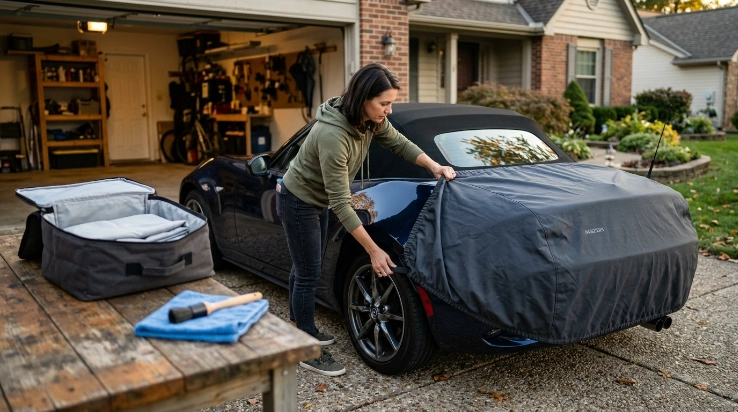
You can prevent many convertible cover issues by keeping the car clean, using the correct fit, controlling wind movement, and never storing the cover wet.
Small maintenance habits matter more than complicated treatments.
Clean the vehicle before covering it
I avoid putting an outdoor cover over visible dust or road grime whenever possible.
The cleaner the contact surfaces are, the less abrasive material sits between the fabric and finish.
Keep the inside of the cover clean
The inner surface deserves the same attention as the outside.
A clean vehicle won’t stay protected if the cover’s lining already contains sand or dried debris.
Secure it against wind
- Use intended straps: Secure only the fastening points designed by the manufacturer.
- Check elastic hems: Replace a cover if the edges no longer stay positioned.
- Avoid improvised ropes: Tight cords can rub paint or concentrate pressure.
- Inspect after storms: Reposition any material that has shifted.
Dry the cover before storing it
Folding damp fabric into a trunk or storage bag can create odors and staining.
Let both sides dry completely first.
Inspect the convertible top at the same time
A cover can hide developing problems if you rarely remove it.
Every few uses, I check the roof fabric, seals, rear window, stitching, and drainage areas.
As of 2026, convertible vehicles still range from simple manual soft tops to complex multi-panel powered systems. Your owner’s manual remains the best first reference for model-specific operating and care instructions.
For general ownership information and vehicle comparisons, resources such as Edmunds and Kelley Blue Book can provide additional context.
Section Takeaway: Keep the vehicle and cover clean, dry both before storage, secure the cover correctly, and inspect the convertible roof regularly.
Convertible Cover Issues FAQ
Can a car cover damage a convertible top?
It can if the cover is dirty, excessively tight, poorly fitted, or moving constantly in wind. Use a cover compatible with your convertible, keep its inner surface clean, and avoid forcing fabric across roof trim or sharp hardware.
Why does my convertible cover keep blowing off?
The cover may be too large, incorrectly installed, or secured with worn straps or elastic. Confirm its orientation and size first. If wind repeatedly gets underneath despite correct installation, the cover may not be appropriate for exposed outdoor storage.
Should I cover my convertible when it’s wet?
Avoid covering a wet convertible for extended storage. Trapped water and humid air can slow drying around the roof, seals, body seams, and trim. Let the vehicle and the inside of the cover dry before reinstalling it whenever possible.
Why is there condensation under my convertible cover?
Temperature changes and humidity can create condensation even under breathable material. Moisture underneath doesn’t automatically mean the cover leaks. Dry installation, airflow, weather conditions, and storage duration all influence how much condensation forms.
Why won’t my convertible top storage cover close?
Check for cargo, displaced fabric, an incorrectly positioned trunk divider, or a roof sequence that hasn’t completed. If the mechanism moves unevenly, makes unusual noises, displays warnings, or repeatedly stops, have a qualified technician inspect it.
Can a loose cover scratch car paint?
A loose cover can contribute to scratching when wind moves contaminated fabric across the finish. Dust or grit between the paint and cover increases the risk. Cleaning both surfaces and reducing movement are the most important preventive steps.
How often should I inspect a convertible cover?
Give it a quick check whenever you install or remove it. Look for worn straps, torn seams, dirty lining, thinning fabric, stretched elastic, and damaged contact areas. Outdoor covers exposed to strong sun or wind deserve more frequent inspection.
Final Takeaway
Most convertible cover issues become easier to diagnose once you separate external car-cover problems from faults involving the vehicle’s actual folding roof mechanism.
Loose fit, dirt, wind, and moisture usually explain removable-cover problems. Obstructions, alignment, sensors, cables, latches, motors, or hydraulic components are more relevant when a factory roof cover refuses to operate.
Start with the simple checks. Keep everything clean and dry, never force a powered roof mechanism, and get professional help when the system moves unevenly or repeatedly stops.
