
Car Cover Not Breathable? Risks, Signs, and What to Do

Quick Answer
If your car cover is not breathable, heat, humidity, and condensation can stay trapped between the fabric and your vehicle. That can keep the paint and metal surfaces damp longer, increasing the risk of mildew, staining, corrosion, and finish problems. This is one reason manufacturers such as Covercraft favor breathable water-resistant materials instead of completely airtight waterproof fabrics.
Signs your cover may not breathe well
- Condensation underneath: Water droplets keep appearing even when rain has not passed through the fabric.
- Slow drying: The vehicle stays damp long after surrounding surfaces have dried.
- Musty odor: The underside of the cover develops a damp or mildew-like smell.
- Persistent damp spots: Moisture remains around the roof, glass, trunk, mirrors, or body seams.
- Heat buildup: The area beneath the cover feels noticeably hot and humid after sun exposure.
Best first move
- Remove the cover and let both the vehicle and cover dry completely before deciding whether to use it again.
I’ve seen drivers focus so heavily on keeping rain off a car that they overlook what happens underneath the cover. A cover can look protective from the outside while creating a warm, damp space against the vehicle.
That matters for daily drivers, stored cars, and anything parked outdoors in humid weather. Here’s how I diagnose a car cover that does not breathe properly and decide whether it needs better drying, different use, or replacement.
In This Guide
- What Does It Mean When a Car Cover Is Not Breathable?
- What Problems Can a Non-Breathable Car Cover Cause?
- How Can You Tell if Your Car Cover Is Not Breathable?
- Breathable vs. Waterproof Car Covers: Which Is Better?
- What Should You Do if Your Car Cover Traps Moisture?
- How Do You Choose a Breathable Car Cover in 2026?
- Frequently Asked Questions
What Does It Mean When a Car Cover Is Not Breathable?
A non-breathable car cover does not let trapped water vapor and heat escape efficiently. Moist air can therefore remain between the cover and the vehicle instead of drying naturally.
A breathable car cover is a cover whose material allows water vapor, heat, and humid air to move through or escape while still providing useful protection from outside contaminants.
Breathability does not mean the fabric has obvious holes. Modern materials can resist rain while still allowing moisture vapor to leave.
That distinction is important. Water resistance and breathability are separate characteristics.
- Water resistance helps reduce rain penetration from outside.
- Breathability helps moisture already underneath escape.
- Drying speed affects how long the fabric remains wet after rain or washing.
- Fit affects airflow and how much the material moves against the paint.
A cover can therefore shed rain well and still manage moisture underneath. Several current outdoor-cover manufacturers specifically design fabrics around that balance.
I treat a car cover as environmental protection, not as a sealed plastic bag. The vehicle needs protection from outside moisture without having normal evaporation completely blocked.
What Problems Can a Non-Breathable Car Cover Cause?
The biggest concern is prolonged moisture retention. A car that repeatedly stays damp under its cover has a different problem from a car that briefly gets wet and then dries.
Condensation can stay against the vehicle
Condensation forms when moisture in the air turns into liquid water on a cooler surface. You may find droplets on the roof, windows, hood, trunk, or inside surface of the cover.
A breathable material helps that moisture leave as conditions change. An airflow-resistant cover can slow the process.
Mold and mildew become more likely
Damp fabric stored or used without enough drying can develop musty odors and mildew. Manufacturers also warn about mold and mildew when moisture remains trapped beneath a cover.
The first clue may be smell rather than visible growth. I would not put a musty cover straight back onto clean paint.
Metal surfaces can remain wet longer
Moisture around exposed metal, damaged paint, fasteners, seams, and other vulnerable areas is something I want to minimize. Persistent dampness is especially concerning where road salt or other contamination is already present.
Consumer Reports also notes that road grit and residue should be removed because contamination can contribute to paint damage and corrosion. Its car-maintenance guidance explains why regular cleaning matters.
Dirt can become part of the problem
Breathability is not the only concern. A dirty vehicle underneath any cover creates another risk.
- Dust can remain against the clear coat.
- Sand can become trapped in the cover lining.
- Wind can move contaminated fabric across raised body panels.
- Wet grime can stay in contact with the finish longer.
Consumer Reports recommends rinsing away loose dirt before touching automotive paint because particles can cause scratching. The same logic applies before covering a vehicle.
How Can You Tell if Your Car Cover Is Not Breathable?
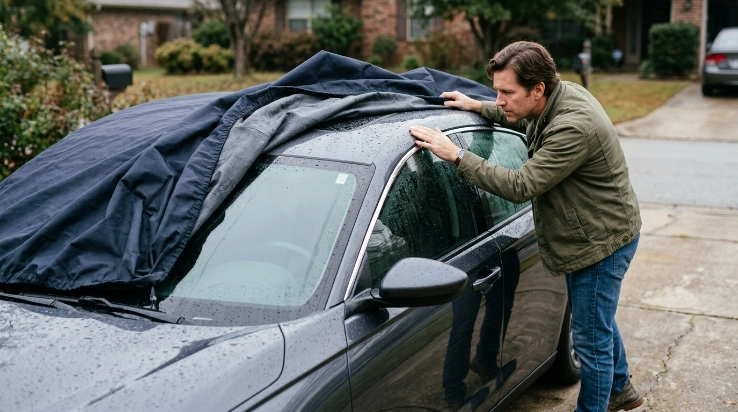
Repeated condensation is the clearest warning sign. One damp morning does not prove the material is bad, but persistent moisture deserves investigation.
I use the pattern below rather than judging a cover by marketing words alone.
| What You Notice | Possible Explanation | What to Check First |
|---|---|---|
| Droplets beneath cover | Condensation or trapped humidity | Whether car and cover were dry when installed |
| Car stays damp for hours | Slow evaporation or limited ventilation | Fabric breathability and local humidity |
| Water after rain | Rain penetration or condensation | Whether water is coming through or forming underneath |
| Musty smell | Cover remained damp during use or storage | Seams, lining, hems, and folded areas |
| Marks at body edges | Movement, contamination, or moisture | Fit, wind exposure, and inner-surface cleanliness |
Do a simple dry-cover check
Start when the car and cover are completely dry. Install the cover normally and inspect underneath after the conditions that usually trigger your problem.
- Check the roof and glass first.
- Inspect the hood and trunk surfaces.
- Feel the inner fabric for dampness.
- Check mirrors, badges, seams, and trim gaps.
- Compare exposed humidity with what you find underneath.
If moisture repeatedly stays trapped while surrounding surfaces dry, the cover or storage environment needs attention. Do not keep reinstalling it without finding the cause.
Breathable vs. Waterproof Car Covers: Which Is Better?
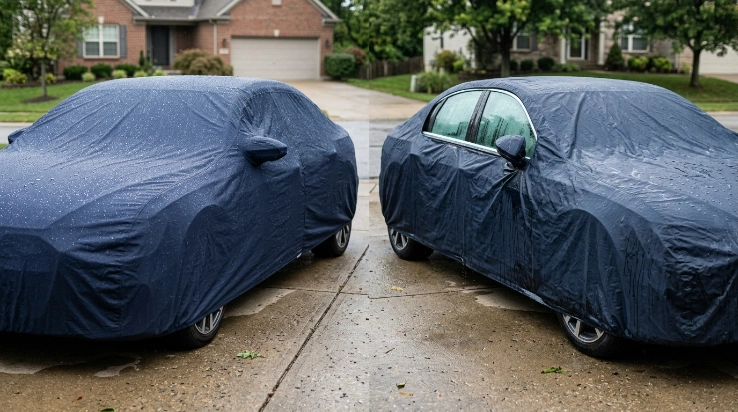
For most vehicle storage situations, I prefer a breathable cover with the right level of water resistance over an airtight waterproof barrier. The goal is to manage both incoming rain and trapped moisture.
A completely waterproof material may sound ideal for outdoor storage. The problem is that preventing water from entering is only half the moisture equation.
| Feature | Breathable Water-Resistant Cover | Non-Breathable Waterproof Barrier |
|---|---|---|
| Rain protection | Designed to shed or resist water | Can block liquid water strongly |
| Moisture escape | Allows vapor and heat to escape | Can restrict evaporation |
| Condensation management | Generally better suited to drying | Can keep condensation trapped |
| Best use | Vehicle-specific indoor or outdoor protection | Situations where an airtight barrier is specifically appropriate |
Covercraft explicitly says its automotive cover fabrics are breathable so moisture, condensation, and heat can escape. Its current product guidance also distinguishes water resistance from true waterproofing.
That does not mean every breathable cover is automatically good. Fit, softness, UV resistance, weather resistance, seams, and fastening still matter.
What Should You Do if Your Car Cover Traps Moisture?
Remove the cover and dry everything first. Do not try to solve a moisture problem while leaving wet fabric pressed against the vehicle.
- Remove the cover: Take it off carefully without dragging dirty fabric across the paint.
- Dry the vehicle: Check paint, glass, trim gaps, mirrors, badges, and lower panels.
- Dry the cover: Open it fully so air can reach both sides.
- Inspect the lining: Look for dirt, staining, mildew, residue, or damaged material.
- Check the fit: Excess fabric can move in wind and create unnecessary contact.
- Review the environment: Persistent garage humidity or frequent outdoor condensation can worsen the problem.
- Replace the cover if needed: Move to a breathable design intended for your parking conditions.
Never cover the car while it is still wet
I make this a hard rule after washing a vehicle. Water hides around mirror housings, trim, door handles, weather stripping, badges, and panel gaps.
Give those areas enough time to dry. Installing a cover too soon simply puts the moisture into a confined space.
Clean the vehicle before long-term storage
A cover should not seal bird droppings, grime, road salt, or tar against the paint. Start with a clean vehicle when the car will sit for an extended period.
Edmunds recommends cleaning a vehicle before long-term storage and using a suitable weatherproof cover when garage storage is unavailable.
Kelley Blue Book likewise treats a car cover as only one part of proper vehicle storage. Its long-term car storage guidance covers preparation beyond simply putting fabric over the vehicle.
How Do You Choose a Breathable Car Cover in 2026?
Choose the cover for where the car actually sits. An indoor garage and an exposed driveway create different priorities.
For indoor storage
I prioritize softness, dust protection, breathability, and a controlled fit. Extreme rain protection usually matters less inside a dry garage.
- Soft paint-facing surface
- Breathable construction
- Good dust protection
- Vehicle-appropriate fit
- Easy cleaning and dry storage
For outdoor storage
Outdoor covers need a broader balance. They must handle weather while still allowing trapped moisture and heat to escape.
- Water resistance: Helps manage rain without relying on an airtight barrier.
- Breathability: Helps humidity and condensation escape.
- UV resistance: Matters for vehicles parked in strong sunlight.
- Secure fit: Reduces excess movement during windy conditions.
- Paint-safe interior: Helps reduce direct fabric abrasion.
- Fast drying: Makes repeated wet-weather use easier to manage.
WeatherTech, for example, describes its Sunbrella outdoor covers as breathable so heat and humidity can vent rather than accumulating underneath.
Fit matters almost as much as fabric
A breathable cover can still cause trouble if it is oversized and constantly moving. Wind-driven fabric can repeatedly touch the same mirrors, fenders, roof edges, and body lines.
I want a secure fit without forcing fabric tightly over sharp accessories. Mirror pockets, spoilers, antennas, and other body features should be accommodated correctly.
Do not choose by the word “waterproof” alone. In 2026, I would look for clear manufacturer information about breathability, water resistance, intended environment, fit, care, and drying.
Frequently Asked Questions
Can a non-breathable car cover damage paint?
It can contribute to paint problems if moisture, dirt, or heat remains trapped underneath for extended periods. The cover may also create abrasion when contaminated fabric moves across the finish. Keep the vehicle and cover clean, dry, and correctly fitted.
Why is my car wet underneath the cover when it did not rain?
Condensation is a common explanation. Humid air trapped beneath the cover can cool against the vehicle and form water droplets. Remove the cover, dry both surfaces, and check whether the material allows adequate moisture vapor to escape.
Should a car cover be completely waterproof?
Not necessarily. A breathable water-resistant automotive cover can be preferable because it manages outside precipitation while still allowing trapped heat and moisture to escape. A completely impermeable material may interfere with drying if moisture gets underneath.
How do I know whether my car cover is breathable?
Check the manufacturer’s material specifications rather than relying on appearance. Look for explicit references to breathable fabric, moisture-vapor escape, ventilation, or condensation management. Repeated dampness underneath a dry, correctly installed cover is also a warning sign worth investigating.
Can I put a breathable cover on a wet car?
I would not. Breathability can help moisture escape, but it is not a substitute for drying the vehicle first. Let the paint, trim, mirrors, seams, and cover dry completely before installation whenever possible.
Can mildew grow under a car cover?
Persistent dampness can create conditions where mildew develops on contaminated surfaces or the cover itself. A musty smell is an early warning. Remove the cover, clean it according to its care instructions, and let everything dry fully before reuse.
Is a breathable car cover better for long-term storage?
Breathability is an important feature because stored vehicles still experience humidity and temperature changes. However, long-term storage also requires a clean vehicle, correct cover type, proper fit, and attention to the battery, tires, fluids, fuel system, and storage environment.
Final Takeaway
If your car cover is not breathable, do not ignore recurring condensation or dampness underneath it. Remove the cover, dry the vehicle, inspect the fabric, and determine whether the problem is the cover, the environment, or both.
For most daily-driver situations, I look for the right balance of breathability, water resistance, secure fit, cleanliness, and paint-safe material. Keeping water out matters, but letting trapped moisture escape matters too.