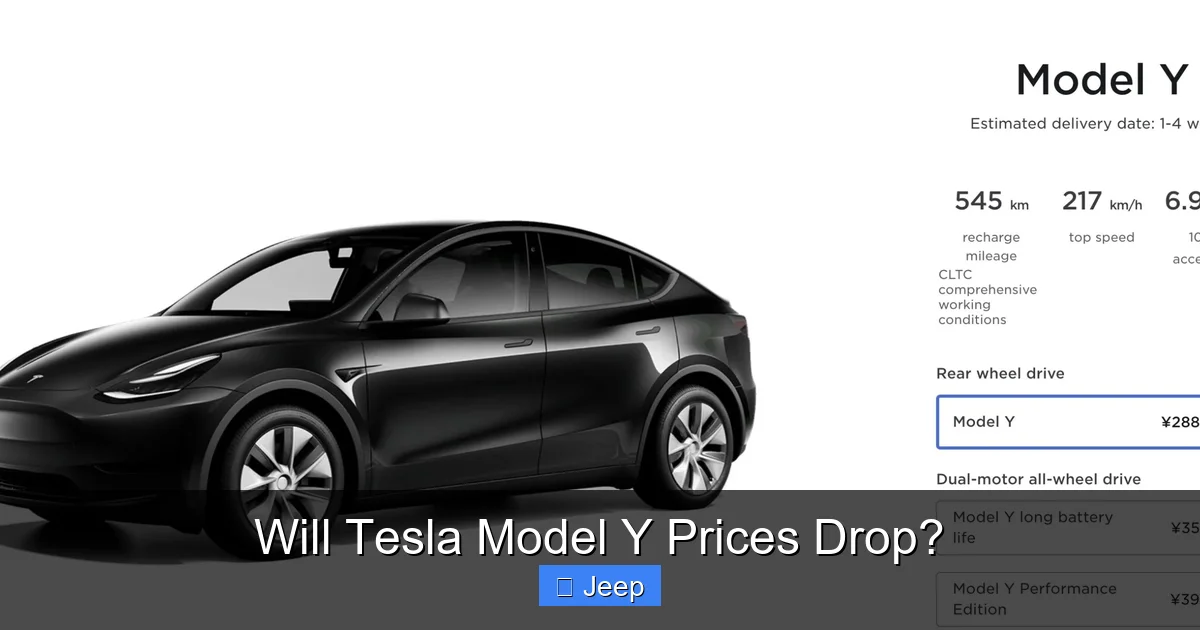
Will Tesla Model Y Prices Drop?

Contents
- 1 Key Takeaways
- 2 📑 Table of Contents
- 3 The Tesla Price Rollercoaster: A Recent History Lesson
- 4 The Big Push: What Could Force Prices DOWN
- 5 The Anchor: What Could Stall or Reverse Price Drops
- 6 The Wild Card: The Ever-Changing EV Tax Credit Landscape
- 7 Should You Wait? A Practical Decision Framework
- 8 The Total Cost of Ownership (TCO) Lens
- 9 Frequently Asked Questions

Car Shampoo Concentrate

Power Steering Fluid

Car Seat Cover (Universal Fit)

Parking Sensor Kit
Will Tesla Model Y prices drop? The short answer is: probably, but not necessarily in a straight line. While Tesla’s history of price cuts suggests future reductions are possible, factors like production costs, demand, and new model releases create uncertainty. This deep dive explores the key drivers behind Tesla’s pricing strategy to help you decide whether to buy now or wait.
Key factors include Tesla’s direct sales model, evolving federal tax credits, and intensifying competition from both legacy automakers and new EV entrants. Understanding these dynamics is crucial for any potential buyer.
So, you’re thinking about buying a Tesla Model Y. It’s easy to see why—it’s the world’s best-selling electric vehicle for a reason. It offers great range, a minimalist tech-forward interior, and that instant electric torque. But there’s one big question buzzing in your head, isn’t there? Will the price drop if I just wait a few months? It’s the million-dollar question for any potential buyer, and with Tesla, it’s especially tricky. Let’s pull back the curtain on Tesla’s pricing playbook and look at all the factors that could push that price down—or up—in the coming months and years.
Key Takeaways
- Tesla has a history of adjusting prices frequently. Unlike traditional dealerships, Tesla sets prices centrally, allowing for quick cuts or increases based on demand and inventory.
- Inflation and battery material costs are major upward pressures. While economies of scale help, raw material price spikes can stall or reverse price decline trends.
- Federal and state EV incentives directly impact effective price. Changes to the $7,500 tax credit rules can make a “wait-and-see” approach risky if you qualify now.
- New competing EVs will put pressure on the Model Y’s segment. As more affordable electric crossovers launch, Tesla may use price to maintain its market share lead.
- The “Highland” refreshed Model Y could cause temporary price stability or even increases. New model rollouts often lead to initial price premiums before eventual cost reductions.
- Your personal timeline matters more than market timing. If you need a car now, waiting for an uncertain price drop may cost more in the long run through higher financing or missed incentives.
- Consider the total cost of ownership, not just the sticker price. Savings on fuel and maintenance are significant for EVs, altering the true value equation.
📑 Table of Contents
The Tesla Price Rollercoaster: A Recent History Lesson
To predict the future, we must first understand the past. If you’ve been watching Tesla prices for the last few years, you’ve seen a wild ride. In early 2023, Tesla initiated a series of aggressive, nationwide price cuts across its lineup, including the Model Y. The goal? To stimulate demand in a rising-interest-rate environment and leverage their newly solidified production capacity at Gigafactories like Berlin and Texas. These cuts sometimes reached thousands of dollars overnight, making headlines and frustrating recent buyers.
But the story doesn’t end there. As 2023 progressed and demand for the Model Y remained incredibly strong—it was the best-selling car in the world, period, not just EVs—Tesla began to hold the line on prices. In fact, they even increased prices slightly at various points as inventory dwindled and waitlists grew. This volatility is the core of the “to buy or not to buy” anxiety. It proves that Tesla prices are not set in stone; they are a dynamic tool in a complex business strategy. They are reacting to real-time data on orders, inventory, and competition.
The Direct Sales Advantage (and Disadvantage)
Why can Tesla do this when Ford or Toyota can’t? The answer is their direct-to-consumer sales model. There are no independent dealerships with their own pricing, inventory, and profit margins to consider. Tesla controls every aspect of the sale, from the website price to the delivery center. This allows for lightning-fast adjustments. A traditional automaker might want to cut prices, but they have to negotiate with thousands of franchise dealers, a slow and messy process. For Tesla, a price change is a simple software update on their website. This agility is a double-edged sword for consumers: it means prices can fall quickly, but it also means they can rise just as fast if the market shifts.
The Big Push: What Could Force Prices DOWN
Let’s get to the heart of your question. What are the tangible forces that could actually lead to a lower price tag on a new Model Y? There are several powerful contenders.

Visual guide about Will Tesla Model Y Prices Drop?
Image source: cdn.teslanorth.com
1. The Relentless March of Battery Cost Reduction
This is the single biggest long-term factor. The battery is the most expensive component in an EV, often 30-40% of the total cost. Tesla’s entire mission is built on scaling battery production and improving cell chemistry to drive down cost per kilowatt-hour ($/kWh). Their 4680 battery cell design, being ramped up at Gigafactory Texas, promises significant cost savings and energy density improvements. While there have been delays in full-scale production, the trend is clear: battery costs have been falling for over a decade. As this technology matures and production scales globally, those savings should eventually be passed on to consumers in the form of lower vehicle prices or better features at the same price.
2. Increased Production Scale and “The Machine That Builds the Machine”
Elon Musk often talks about building “the machine that builds the machine.” This refers to Tesla’s relentless focus on manufacturing innovation—simplifying vehicle design, using giant castings (like the rear underbody of the Model Y), and optimizing factory workflows. The more units they build, the lower the fixed cost (R&D, factory leases) allocated to each car. The Shanghai and Berlin factories have been pivotal in achieving massive scale. Gigafactory Texas is now producing hundreds of thousands of Model Ys. This scale is a powerful lever for reducing per-unit costs. If Tesla’s order backlog softens significantly, they will likely use this cost advantage to lower prices and boost sales volume.
3. The Specter of Competition
The EV market is no longer a solo act. The compact crossover SUV segment, where the Model Y lives, is about to get incredibly crowded. We’re seeing serious contenders like the Hyundai Ioniq 5 and Kia EV6, the Ford Mustang Mach-E, the Chevrolet Equinox EV, and upcoming models from Volkswagen, Honda, and Toyota. Many of these will target the same $40,000-$50,000 price band as the base Model Y. While Tesla has a strong brand and Supercharger network, it cannot ignore a market share battle. Price is one of the most direct weapons in that fight. If competitors offer similar range and features for less, Tesla will be forced to respond. This external pressure is a major argument for future price reductions.
The Anchor: What Could Stall or Reverse Price Drops
Before you start budgeting for that hypothetical lower price, you must consider the powerful countervailing forces. The market isn’t a one-way street.

Visual guide about Will Tesla Model Y Prices Drop?
Image source: teslarati.com
1. Inflation and Raw Material Volatility
Remember when we talked about battery costs? While the long-term trend is down, short-term volatility is brutal. Prices for key battery materials like lithium, nickel, and cobalt have seen史诗般的 (epic) swings. Geopolitical issues, mining supply chain disruptions, and general inflationary pressure on wages and components can all squeeze margins. Tesla has thin profit margins compared to legacy automakers. If input costs spike, they have two choices: absorb the hit (hurting profitability) or raise prices. They’ve done both in the past. So, a broad economic downturn or a commodity price surge could easily put a pause on any price-cut plans.
3. The “Highland” Refreshed Model Y Effect
Automakers typically introduce major refreshes with a price premium. Tesla is no exception. Reports are strong that a heavily revised “Highland” Model Y is on the way for late 2024 or 2025. It’s expected to feature a completely new interior (finally ditching the yoke wheel as standard), updated exterior styling, improved battery efficiency, and possibly even a structural battery pack. When a new model variant launches, Tesla will want to maximize profit on the initial, high-demand run. This often means holding prices steady or even increasing them slightly for the new version. The current, older-spec Model Y might see some clearance discounts to make room, but the “average” price of a new Model Y could actually go up during the transition period. Waiting for the refresh might mean paying more for the new features, not less for the old ones.
4. Sustained, Overwhelming Demand
Here’s the simplest economic principle: if people are lining up to buy your car at the current price, why would you lower it? For much of 2023 and into early 2024, the Model Y has enjoyed phenomenal demand with short delivery timelines. Tesla’s pricing strategy is famously reactive to order flow. A sustained, red-hot order book is the single biggest reason to believe prices will not drop—and could even increase. They will only cut prices if they perceive a meaningful and sustained drop in order volume that threatens their production targets and profitability.
The Wild Card: The Ever-Changing EV Tax Credit Landscape
You cannot discuss the effective price of a Tesla Model Y without talking about the $7,500 federal tax credit. This isn’t a Tesla policy; it’s a U.S. government policy, and it’s a huge deal. The Model Y currently qualifies for the full $7,500 credit because its final assembly is in the U.S. and it meets the new battery component sourcing rules. But this could change.
The rules are complex and subject to annual review. If Tesla’s supply chain shifts or if the government tightens the rules, the credit could be reduced or eliminated for certain configurations. This would effectively increase the out-the-door price by $7,500 overnight. Conversely, if more qualifying components are used, the credit could become more secure. The uncertainty here is massive. You might be waiting for a $2,000 price cut from Tesla, only to lose a $7,500 credit. From a financial planning perspective, the tax credit is often more valuable than any potential sticker-price reduction. Its future is a critical, unpredictable variable.
Should You Wait? A Practical Decision Framework
So, with all these forces in play, what should a smart buyer do? There’s no universal answer, but you can build a personal framework.

Visual guide about Will Tesla Model Y Prices Drop?
Image source: cdn.motor1.com
- If you need a car now (lease ending, old car died): Waiting is not an option. The risk of a price drop is irrelevant. Focus on securing the best current deal, ensuring you qualify for all available incentives, and maybe consider leasing to hedge against a potential future price drop.
- If you have a reliable car and can wait 6-12 months: This is the gray zone. You are betting on one of two scenarios: a) Demand softens due to higher interest rates or new competition, forcing Tesla to cut prices, or b) The “Highland” refresh causes a clearance sale on outgoing models. The risk is that demand stays strong, the refresh launches with a higher price, and/or the tax credit changes unfavorably. You must decide if the potential savings are worth the uncertainty and the cost of driving your current car for another year (depreciation, maintenance, fuel).
- If you can wait 18+ months: The long-term trend of falling battery costs is on your side. The market will be much more competitive. The refreshed Model Y will be established and likely have a more stable price point. This is the lowest-risk timeline for potentially seeing a lower nominal price, but you are also postponing years of ownership and savings.
A crucial tip: When you see news of a price cut, it’s often for a specific reason—usually a build-up of inventory at a particular factory or a slow sales month. These cuts can be reversed just as quickly. Don’t assume a trend has started from one data point.
The Total Cost of Ownership (TCO) Lens
Finally, obsessing over the window sticker is a classic car-buying trap. For an EV, the TCO is where the real story lies. Even if the Model Y’s price doesn’t drop, your effective cost per mile might be lower than a cheaper gasoline car.
- Fuel/Energy Savings: Charging at home, especially with a time-of-use rate, is dramatically cheaper than gasoline. Over 5 years, this can easily save you $5,000-$10,000+.
- Maintenance Savings: No oil changes, no spark plugs, no transmission fluid, far fewer moving parts to break. Tesla’s maintenance schedule is much simpler and cheaper.
- Insurance Costs: This is a known pain point. Tesla insurance is often higher than for comparable gas cars due to repair costs and performance. Get quotes before you buy.
- Home Charging Setup: Factor in the cost to install a Level 2 charger. This is a one-time cost that dramatically improves convenience. You can learn more about the specific electrical requirements and costs for your home in our detailed guide on how much it costs to install a 220V outlet for a Tesla.
- Post-Purchase Customization: If you do buy, consider protecting your investment. Many owners explore paint protection film (PPF) or vinyl wraps. The cost to wrap a Tesla Model Y varies widely based on coverage and material, but it’s a popular way to preserve the factory paint and personalize the look. Check out our analysis of how much does it cost to wrap a Tesla Model Y for a full breakdown. Similarly, window tinting is a common first upgrade for privacy and heat rejection; see our guide on how much to tint a Tesla Model Y for cost expectations.
When you add up these savings, a $3,000 price difference becomes much less significant over a 5-year ownership period.
Frequently Asked Questions
Will Tesla Model Y prices drop in 2024?
It’s possible but not guaranteed. Much depends on Tesla’s order backlog in the second half of the year and the timing of the “Highland” refresh. If demand softens, small cuts could return. If the new model launches, focus may shift to it, potentially stabilizing prices on the current model.
Is it better to buy a Tesla Model Y now or wait for the refreshed model?
It depends on your priorities. The refreshed “Highland” Model Y will likely have improvements but may launch at a similar or slightly higher price. If you want the latest tech and design, wait. If you want the best possible deal on a current model, waiting for the refresh might mean a clearance discount on outgoing inventory, but this isn’t certain.
How often does Tesla change its prices?
Very frequently compared to traditional automakers. Tesla can and does change prices with little notice—sometimes multiple times in a single quarter—based on real-time demand, inventory levels, and competitive actions. There is no fixed schedule.
Does the federal tax credit affect the Model Y’s price?
Not directly. Tesla sets the MSRP independently. However, the $7,500 tax credit dramatically affects the effective price for buyers who qualify. Changes to the credit rules could make the car $7,500 more or less expensive overnight, which is a more impactful change than most typical Tesla price adjustments.
What is the biggest reason Tesla would lower prices?
The primary reason is a sustained drop in demand relative to production capacity. If Tesla’s order backlog shrinks and inventory starts to pile up at delivery centers, they will almost certainly use price reductions as the first tool to stimulate sales and maintain factory output.
Should I expect a big price drop like in early 2023?
Probably not. The 2023 cuts were a specific strategic move in a high-interest-rate environment after a period of very high prices. Current demand is strong, and Tesla’s margins, while healthy, are not as expansive as they were then. Any future cuts are more likely to be smaller and more targeted.