
Why Is My 2017 Hyundai Elantra Shaking?

A shaking 2017 Hyundai Elantra is almost always a sign of an underlying mechanical or maintenance issue that needs attention. Common culprits range from simple problems like unbalanced tires or worn spark plugs to more serious concerns like failing engine mounts or internal engine damage. Driving with a persistent vibration can cause further, more expensive damage, so getting a proper diagnosis from a qualified mechanic is the critical first step to identifying and solving the problem safely and cost-effectively.
Key Takeaways
- Engine & Drivetrain Issues: Problems like misfiring cylinders (bad spark plugs/coils), failing engine/transmission mounts, or damaged CV joints are top causes of shaking, especially during acceleration or at specific RPMs.
- Tire & Wheel Problems: The most frequent cause is tire-related: uneven wear, improper balancing, bent wheels, or incorrect tire pressure will cause vibrations, typically felt in the steering wheel at higher speeds.
- Brake System Faults: Warped brake rotors cause a pulsating brake pedal or shaking when braking. severely worn brake pads can also contribute to vibration.
- Suspension & Steering Wear: Worn components like tie rod ends, ball joints, or wheel bearings can cause a shimmy or shake, often accompanied by clunking noises or loose steering feel.
- Electrical & Fuel Delivery: A weak battery or failing fuel pump/purge valve can cause rough running and engine shake, particularly at idle or low speeds.
- Diagnosis is Key: The nature of the shake (when it happens, where you feel it) provides vital clues. A professional mechanic will use this info along with scans and inspections to pinpoint the exact cause.
- Safety First: Do not ignore persistent shaking. It compromises vehicle control, accelerates wear on other parts, and can lead to catastrophic failure, leaving you stranded or causing an accident.
📑 Table of Contents
Introduction: That Unsettling Feeling in Your Elantra
You’re cruising down the road in your trusty 2017 Hyundai Elantra, a car known for its reliability and value, when suddenly—a vibration. Maybe it’s a subtle shiver through the steering wheel at 65 mph. Maybe it’s a violent shudder that feels like the car is falling apart at a stoplight. No matter how it manifests, that shaking is your Elantra’s urgent way of saying, “Hey, something’s wrong here!” Ignoring it is a gamble you don’t want to take. What starts as a minor annoyance can quickly morph into a major, costly repair, or worse, a safety hazard.
The 2017 Elantra is a fantastic sedan, but like any complex machine with over 30,000 parts, things wear out, break, or get out of spec. The challenge—and the key to a smart, affordable fix—is figuring out what is causing the shake. Is it a simple tire issue you could have solved for $50, or is it a sign of a deep engine problem costing thousands? This guide will walk you through every possible cause, from the most common and inexpensive to the rare and severe. We’ll break it down by system, help you describe the symptoms like a pro, and give you the knowledge you need to talk confidently with your mechanic and get your smooth-riding Elantra back.
The Usual Suspects: Engine and Drivetrain Vibrations
When your Elantra’s engine feels like it’s dancing a jig, the problem is almost certainly within the powerplant or the components that transfer its power to the wheels. These vibrations are often felt in the seat, the floor, or throughout the entire cabin, and they frequently change with engine speed (RPM) rather than vehicle speed.

Visual guide about Why Is My 2017 Hyundai Elantra Shaking?
Image source: bluesky.cdn.imgeng.in
Misfiring Cylinders: The Rough Idle and Hesitation
Your Elantra’s 2.0L or 1.6L engine needs a precise spark, fuel, and air mixture in each cylinder to run smoothly. If one cylinder stops firing correctly—a misfire—the engine’s balance is thrown off, causing a distinct shake. You’ll often notice it most at idle or when accelerating from a stop. The check engine light will almost certainly be on, storing a code like P0301 (misfire on cylinder 1). The most common fixes are:
- Spark Plugs: Worn or fouled plugs are a classic culprit, especially if your Elantra is past its recommended service interval.
- Ignition Coils: These provide the high-voltage spark. A failing coil on a specific cylinder will cause that cylinder to misfire. They are a common failure point.
- Fuel Injectors: A clogged or leaking injector can starve a cylinder of fuel.
- Vacuum Leaks: A cracked hose can introduce unmetered air, leaning out the mixture.
Diagnosing a misfire involves reading the engine codes and often performing a “cylinder swap” test to isolate if the problem is the plug, coil, or injector itself.
Failing Engine and Transmission Mounts
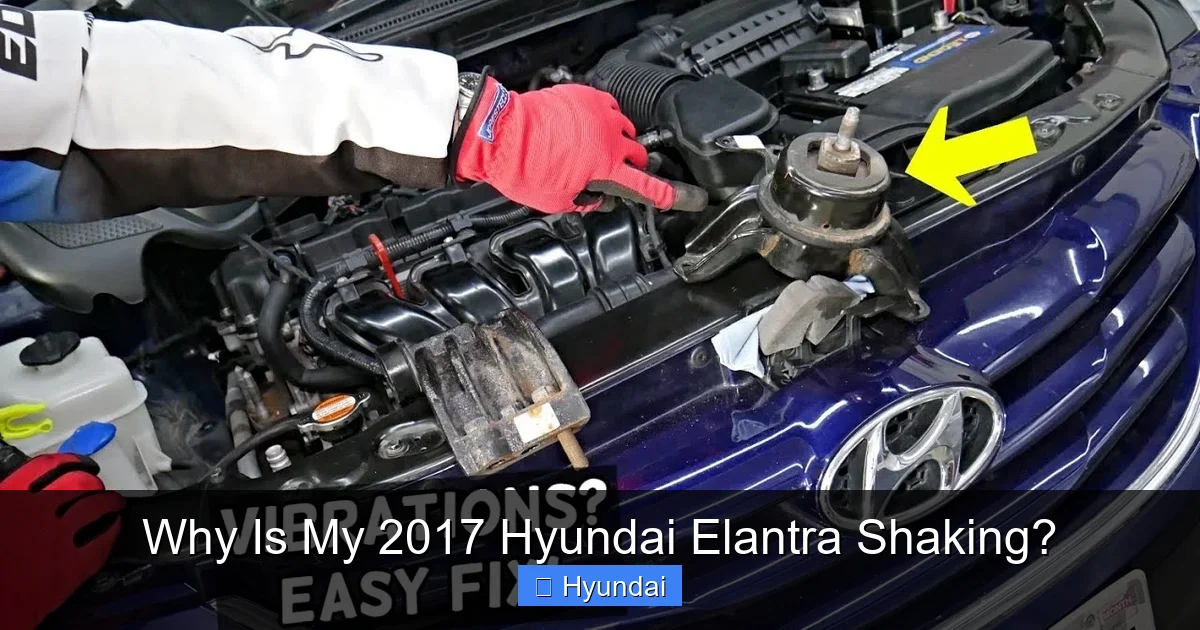
Engine and transmission mounts are rubber (or hydraulic) blocks that secure the powerplant to the car’s frame. They absorb engine vibrations and shocks. When these mounts deteriorate—cracking, crumbling, or collapsing—the engine is free to move excessively. This causes a violent shudder, especially when you apply throttle (starting from a stop) or when the engine is under load (going uphill). You might also hear a loud clunk when shifting into Drive or Reverse. Diagnosing bad mounts often involves a visual inspection for tears or leaks and sometimes a “power brake” test where an assistant revs the engine while you observe engine movement. A severely broken mount is a serious safety issue as it can allow the engine to shift and damage other components.
CV Joint and Driveshaft Problems
Constant Velocity (CV) joints are the flexible couplings on the ends of your front axles (in a front-wheel-drive Elantra). A damaged or worn outer CV joint will produce a distinctive clicking or popping noise when turning, but as it fails severely, it can cause a vibration felt in the steering wheel or floor during acceleration. An inner CV joint or a damaged driveshaft (on AWD models, though rare for this Elantra) can cause a more general shudder. Inspecting the CV boot for tears and grease splatter is the first step; a torn boot lets contaminants in, destroying the joint.
Wheel and Tire Issues: The Most Common Cause
If the vibration is directly linked to your vehicle’s speed—smooth at 30 mph, terrible at 70 mph, gone at 80 mph—and is focused in the steering wheel, seat, or floorboard, your tires and wheels are the prime suspects. These are also some of the simplest and least expensive fixes.
Visual guide about Why Is My 2017 Hyundai Elantra Shaking?
Image source: hyundaimaintenance.com
Wheel Imbalance
This is the #1 cause of speed-related vibration. Over time, wheels lose small weights, or the tire’s weight distribution changes slightly. An imbalanced wheel creates a centrifugal force that shakes the car. The fix is simple: a mechanic will spin the wheel on a balancer and add small weights to correct it. This is a routine service often done with tire rotations.
Tire Damage and Uneven Wear
A tire with a sidewall bubble (from an impact) or a cupped, scalloped tread pattern will cause a rough ride and vibration. Cupping is often a symptom of another problem, like worn suspension components or incorrect tire pressure. A visual and tactile inspection of the tire tread and sidewalls is essential. If your Elantra’s tires are worn unevenly (more on one edge, in the center, or in a wavy pattern), it points to alignment issues or worn parts. Proper tire inflation is also critical; low tire pressure can cause vibrations and poor handling.
Bent Wheels
Hitting a deep pothole or curb can bend a wheel’s rim. A bent wheel will cause a steady shake at highway speeds that doesn’t change with brake application. A wheel can often be straightened if the bend isn’t too severe, but replacement may be necessary.
Brake System Vibrations
If your Elantra shakes specifically when you apply the brakes, the problem is almost certainly in the braking system. This is a critical safety issue that needs immediate attention.
Visual guide about Why Is My 2017 Hyundai Elantra Shaking?
Image source: thecarhow.com
Warped Brake Rotors
Brake rotors are the large metal discs the brake pads squeeze to slow the car. Excessive heat from aggressive braking, or simply age and rust, can cause the rotor surface to become uneven, or “warped.” When you brake, the pads contact this uneven surface, and the steering wheel or brake pedal will pulsate rapidly. The fix is to either machine (resurface) the rotors if they’re thick enough, or replace them. It’s standard practice to replace brake pads at the same time.
Worn Brake Pads or Sticking Calipers
Severely worn brake pads with a thin layer of material left can cause vibration. More commonly, a brake caliper that is stuck or not sliding properly will cause the pad to drag unevenly, leading to rotor warping and vibration. You might also notice a pulling sensation to one side when braking.
Suspension and Steering Component Wear
Your Elantra’s suspension and steering system is a complex network of linkages, joints, and bearings designed to keep the wheels planted and the steering precise. Wear in these parts often causes a vibration that may change with steering input or road conditions, and is frequently accompanied by clunks, squeaks, or a general “looseness” in the steering.
Wheel Bearings
A failing wheel bearing will typically produce a hum, growl, or rumbling noise that changes with vehicle speed and may get louder when turning (loading one side). As it fails completely, it can introduce a vibration. A bad bearing can also cause wheel play when checked manually.
Tie Rod Ends, Ball Joints, and Control Arm Bushings
These joints allow your wheels to turn and move up and down. Excess wear creates play in the system, which can translate to a shimmy or shake, especially at certain speeds or when hitting bumps. A mechanic will check for play by “rocking” the wheel and listening for clunks. Worn bushings (rubber cushions) can also cause vibrations and clunking noises.
Electrical and Fuel System Culprits
Sometimes the shake isn’t mechanical but comes from the systems that make the engine run.
Weak or Failing Battery
A severely weak car battery can struggle to turn the starter motor fast enough, causing a slow, labored cranking that feels like a shake. It can also cause the alternator to work overtime, creating electrical voltage fluctuations that affect engine sensors and idle quality. If your Elantra is slow to start or the dash lights dim when cranking, checking and testing the battery should be an early step. A weak battery can also contribute to other problems, much like how an overheating issue can have multiple root causes.
Fuel Delivery Issues
A clogged fuel filter, a failing fuel pump, or a faulty fuel pressure regulator can cause the engine to run lean (not enough fuel), resulting in a rough idle and shake. A diagnostic scan might not always show these, requiring fuel pressure tests.
Faulty Engine Sensors
Sensors like the Mass Air Flow (MAF) sensor or oxygen (O2) sensors provide critical data to the engine computer. A bad sensor can send incorrect information, leading to poor fuel mixture and ignition timing, causing a rough run and vibration.
Conclusion: The Path to a Smooth Ride Again
Your 2017 Hyundai Elantra shaking is a symptom, not the disease. The key to solving it—and avoiding a wallet-draining, time-consuming guess—is a methodical diagnosis. Start by paying close attention to the details: When does it happen (idle, acceleration, braking, constant speed)? Where is it felt (steering wheel, seat, pedals)? Are there any noises (clunks, clicks, hums)? Is the check engine light on?
Armed with this information, take your Elantra to a trusted, independent mechanic or a Hyundai specialist. A good technician will start with a road test to replicate the issue, then perform a series of checks: scanning for engine codes, inspecting tires and wheels, checking for play in suspension/steering components, and examining engine/transmission mounts. They may also perform a cylinder balance test to isolate a misfiring cylinder.
While some fixes, like a tire balance or spark plug replacement, are relatively straightforward, others like internal engine work or mount replacement are major jobs. Getting an accurate diagnosis first is non-negotiable. Remember, a shaking car is a car that is actively harming itself. The longer you wait, the more components that are stressed by the vibration will fail, turning a $200 repair into a $2,000 one. Address the shake promptly, get a proper diagnosis, and you’ll have your smooth, reliable Elantra back on the road where it belongs.
Frequently Asked Questions
Is it safe to drive my 2017 Hyundai Elantra if it’s shaking?
It depends on the severity and cause. A mild vibration from slightly unbalanced tires may be safe for a short drive to a shop. However, a severe shake, especially from failing engine mounts, CV joints, or brakes, is unsafe and could lead to loss of control or a breakdown. When in doubt, have it towed.
Why does my Elantra shake only when I accelerate?
Acceleration-specific shaking points strongly to drivetrain components. The most likely causes are severely worn or damaged CV joints (often with a clicking noise when turning), or failing engine/transmission mounts that allow the engine to move excessively under load. A severe engine misfire will also be most noticeable when you press the gas pedal.
Could a simple tire rotation fix the shaking?
It might, if the vibration is caused by uneven tire wear. A rotation promotes even wear. However, if the vibration is due to imbalance, a rotation will move the imbalance to a different position, and the shake will likely follow. A proper tire balancing is the correct fix for imbalance, not just a rotation.
How much will it cost to fix a shaking 2017 Hyundai Elantra?
The cost varies wildly by cause. A tire balance is $20-$50. Spark plugs and coils might be $200-$400. Brake rotor replacement can be $300-$600 per axle. Replacing engine mounts can range from $500 to over $1,500 depending on labor. A proper diagnosis, which typically costs $100-$150, is essential to get an accurate quote.
My check engine light is on and the car is shaking. What does that mean?
This is a classic sign of an engine misfire. The shaking is the physical result of a cylinder not firing properly. The check engine light will have stored a misfire code (like P0300, P0301, etc.). The repair is usually focused on the ignition system (spark plugs, coils) or fuel delivery for that specific cylinder.
Could low transmission fluid cause shaking?
Yes, but it’s less common in a 2017 Elantra with an automatic transmission. Low or degraded transmission fluid can cause harsh shifting, slipping, and shuddering, particularly when shifting gears or under load. Checking the transmission fluid level and condition is a good part of a thorough diagnosis if other common causes are ruled out.
