
Why Does My Dodge Ram Crank but Not Start?

Contents
- 1 Key Takeaways
- 2 📑 Table of Contents
- 3 Why Does My Dodge Ram Crank but Not Start?
- 4 Understanding the Crank-No-Start Condition
- 5 Top Causes of a Dodge Ram Cranking but Not Starting
- 6 How to Diagnose a Crank-No-Start Dodge Ram
- 7 Preventative Maintenance Tips
- 8 When to Call a Mechanic
- 9 Conclusion
- 10 Frequently Asked Questions


If your Dodge Ram cranks but won’t start, it’s often due to fuel, ignition, or electrical issues. Common culprits include a bad fuel pump, faulty crankshaft sensor, or clogged fuel filter.
Key Takeaways
- Fuel delivery problems are a top cause—check the fuel pump, fuel filter, and fuel pressure.
- Ignition system failures like bad spark plugs or a failed coil pack can prevent combustion.
- A faulty crankshaft position sensor stops the engine from starting by disrupting timing signals.
- Electrical issues such as a weak battery, corroded terminals, or bad ground connections can mimic a no-start condition.
- Engine immobilizer or security system may prevent startup if the key isn’t recognized.
- Timing belt or chain failure can cause internal engine damage and prevent starting.
- Diagnostic trouble codes (DTCs) should be scanned early to pinpoint the issue efficiently.
📑 Table of Contents
Why Does My Dodge Ram Crank but Not Start?
You’re ready to hit the road, keys in hand, heart set on a smooth drive. You turn the key—your Dodge Ram roars to life with a strong crank—but then… nothing. The engine turns over, but it refuses to fire up. No combustion. No startup. Just silence after the cranking stops. Sound familiar?
This frustrating scenario is more common than you might think, especially with Dodge Rams from the 2000s through the 2010s. While it’s alarming, the good news is that most “crank but no start” issues are diagnosable and often fixable without a full engine rebuild. The key is understanding what’s happening under the hood when your truck turns over but won’t ignite.
In this guide, we’ll walk you through the most common reasons your Dodge Ram cranks but doesn’t start, how to troubleshoot them step by step, and when it’s time to call in a professional. Whether you’re dealing with a 5.7L HEMI, a 3.6L Pentastar, or an older 5.9L Magnum, the principles remain similar. Let’s get your Ram back on the road.
Understanding the Crank-No-Start Condition
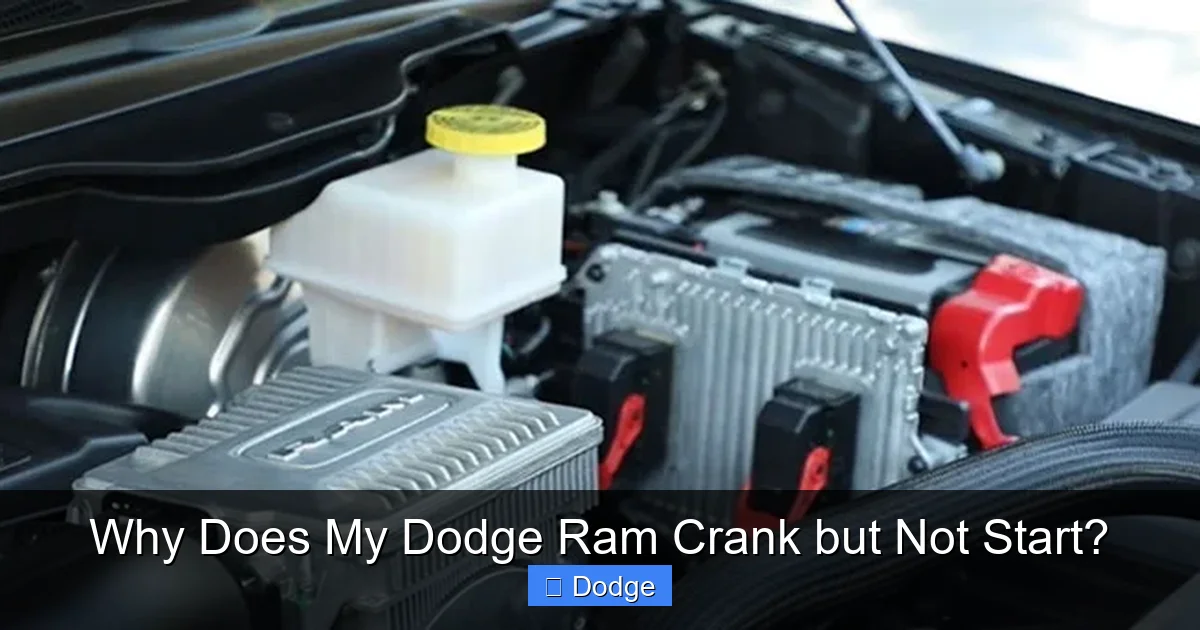
Visual guide about Why Does My Dodge Ram Crank but Not Start?
Image source: bryansgarage.com
Before diving into fixes, it’s important to understand what “cranking but not starting” actually means. When you turn the key to the “start” position, the starter motor engages and spins the engine’s crankshaft. This is the “cranking” sound you hear—a rapid, mechanical whirring. If the engine doesn’t fire up after a few seconds, it means one (or more) of the essential systems required for combustion isn’t working.
For an engine to start, three things must happen:
1. **Fuel must be delivered** to the combustion chamber.
2. **Spark must be generated** at the right time to ignite the fuel.
3. **Compression must be present** in the cylinders.
If any of these fail, your engine will crank but not start. In a Dodge Ram, the most common failures involve fuel delivery, ignition, or sensor communication. Let’s break down each system and how it can go wrong.
What Happens During Engine Startup?
When you turn the key, the engine control unit (ECU) activates several systems:
– The fuel pump primes the fuel system.
– The ignition system prepares to fire spark plugs.
– Sensors (like the crankshaft and camshaft position sensors) send timing data to the ECU.
– The ECU calculates the correct fuel injection and spark timing.
If the ECU doesn’t receive proper signals—say, from a faulty crankshaft sensor—it may prevent fuel injectors from pulsing or spark plugs from firing. This is a safety feature to avoid engine damage, but it also means your truck won’t start.
Common Symptoms of a Crank-No-Start
Here’s what you might notice:
– The engine cranks normally (not slow or weak).
– No “popping” or “sputtering” sounds that suggest partial combustion.
– Dashboard lights come on, but the engine doesn’t fire.
– No smell of gasoline (which could indicate no fuel delivery).
– Check Engine Light may or may not be on.
These symptoms help narrow down the cause. For example, if the engine cranks slowly, it’s likely a battery or starter issue—but that’s not our case here. We’re focusing on strong cranking with no ignition.
Top Causes of a Dodge Ram Cranking but Not Starting
Visual guide about Why Does My Dodge Ram Crank but Not Start?
Image source: bryansgarage.com
Now that we understand the basics, let’s explore the most common reasons your Dodge Ram won’t start despite cranking.
1. Fuel Delivery Issues
Fuel delivery is one of the top culprits. If fuel isn’t reaching the engine, combustion can’t happen—no matter how strong the spark or how good the compression.
Faulty Fuel Pump
The fuel pump is responsible for sending gasoline from the tank to the engine at the correct pressure. Over time, fuel pumps wear out, especially in trucks that sit for long periods or are driven with low fuel levels.
Symptoms of a bad fuel pump:
– Engine cranks but won’t start.
– Loss of power while driving.
– Whining noise from the fuel tank.
– Hard starting, especially when the engine is hot.
In many Dodge Rams, the fuel pump is located inside the fuel tank. Replacing it requires dropping the tank, which is labor-intensive. But if the pump has failed, it’s often the only fix.
How to test: Turn the key to “ON” (don’t start). Listen for a humming sound from the rear of the truck for 2–3 seconds. This is the fuel pump priming. If you don’t hear it, the pump may be dead.
Clogged Fuel Filter
The fuel filter traps dirt and debris before fuel reaches the engine. Over time, it can become clogged, restricting fuel flow.
Location: On most Dodge Rams, the fuel filter is integrated into the fuel pump module or located along the fuel line under the truck.
Solution: Replace the fuel filter every 30,000–60,000 miles. A clogged filter can cause hard starting or no-start conditions, especially under load.
Low Fuel Pressure
Even if the pump is running, it might not be delivering enough pressure. Modern engines require precise fuel pressure (usually 45–65 psi for gasoline engines).
How to check: Use a fuel pressure gauge connected to the Schrader valve on the fuel rail. Compare readings to factory specs. Low pressure could mean a weak pump, clogged filter, or faulty fuel pressure regulator.
2. Ignition System Failures
If fuel is present but there’s no spark, the engine won’t start. The ignition system includes spark plugs, ignition coils, and related wiring.
Bad Spark Plugs
Spark plugs wear out over time. In a Dodge Ram with a 5.7L HEMI, spark plugs should be replaced every 30,000–100,000 miles, depending on the type (copper, platinum, or iridium).
Symptoms:
– Misfires.
– Rough idle.
– Poor fuel economy.
– No start in severe cases.
Tip: If your Ram has over 100,000 miles and you’ve never changed the plugs, this could be the issue.
Failed Ignition Coils
Each cylinder has an ignition coil that sends high voltage to the spark plug. Coils can fail due to heat, vibration, or age.
How to test: Swap a suspected bad coil with one from another cylinder. If the misfire moves, the coil is bad. In a no-start condition, a completely failed coil pack (especially on one bank) can prevent combustion.
Note: On coil-on-plug systems (common in 2009+ Rams), each coil is mounted directly on the spark plug. They’re easier to access but can still fail.
3. Crankshaft Position Sensor Failure
The crankshaft position sensor (CKP) tells the ECU the exact position and speed of the crankshaft. This data is critical for timing fuel injection and spark.
If the CKP sensor fails, the ECU doesn’t know when to fire the spark plugs or inject fuel—so the engine won’t start, even if it cranks normally.
Common symptoms:
– Cranks but no start.
– Intermittent stalling.
– Check Engine Light with code P0335 (Crankshaft Position Sensor “A” Circuit).
Location: Usually near the crankshaft pulley or transmission bell housing.
Testing tip: Use an OBD2 scanner to check for CKP-related codes. If the sensor is bad, replace it. It’s a relatively inexpensive part (around $50–$100), but labor can vary.
4. Electrical and Battery Issues
Even with a strong crank, electrical problems can prevent startup.
Weak or Dying Battery
A battery that’s too weak may still crank the engine but not provide enough power for the fuel pump, injectors, or ignition system.
How to check: Use a multimeter to test battery voltage. It should be 12.6V when off and above 10V while cranking. If it drops below 9V, the battery may be failing.
Tip: Clean battery terminals and cable connections. Corrosion can cause poor conductivity.
Bad Ground Connections
The engine needs a solid ground to complete electrical circuits. A corroded or loose ground strap between the engine and chassis can disrupt fuel injectors or sensors.
Solution: Inspect and clean all ground connections, especially the main engine ground strap.
5. Engine Immobilizer or Security System
Modern Dodge Rams use an immobilizer system that prevents the engine from starting unless the correct key is used.
How it works: The key contains a transponder chip. When inserted, the vehicle’s computer reads the chip. If it doesn’t recognize the key, it disables the fuel injectors or ignition.
Symptoms:
– Engine cranks but won’t start.
– Security light flashes on the dashboard.
– “No Chip” or “Key Not Detected” message (on newer models).
Possible fixes:
– Try a spare key.
– Reprogram the key (requires a scan tool or dealership).
– Check for damaged key fob or ignition cylinder.
6. Timing Belt or Chain Failure
In interference engines (like the 5.7L HEMI), if the timing chain or belt breaks, the camshaft stops turning while the crankshaft continues to rotate. This can cause valves to collide with pistons, leading to internal damage.
Symptoms:
– Engine cranks but won’t start.
– Unusual noises during cranking (clicking or grinding).
– Check Engine Light with timing-related codes.
Note: The 5.7L HEMI uses a timing chain, which is more durable than a belt—but it can still stretch or fail over 150,000+ miles.
Solution: Inspect the timing chain and tensioner. Replacement is complex and may require engine disassembly.
How to Diagnose a Crank-No-Start Dodge Ram
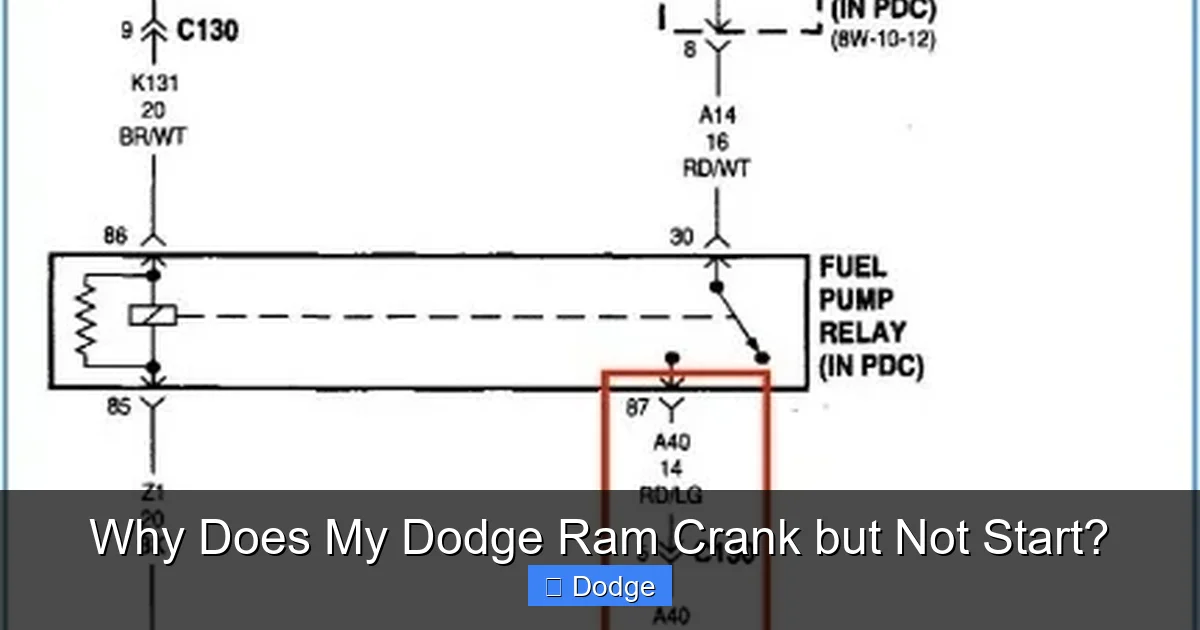
Visual guide about Why Does My Dodge Ram Crank but Not Start?
Image source: alldata.com
Diagnosing a no-start condition requires a systematic approach. Here’s a step-by-step method to identify the root cause.
Step 1: Scan for Diagnostic Trouble Codes (DTCs)
Use an OBD2 scanner to check for stored codes. Even if the Check Engine Light isn’t on, pending codes may exist.
Common codes for no-start:
– P0335: Crankshaft Position Sensor
– P0230: Fuel Pump Primary Circuit
– P0300: Random/Multiple Cylinder Misfire
– P0617: Starter Relay Circuit
Codes can point you directly to the faulty component.
Step 2: Check Fuel Delivery
– Listen for the fuel pump priming when you turn the key to “ON.”
– Test fuel pressure with a gauge.
– Inspect fuel lines for leaks or kinks.
Step 3: Test for Spark
Remove a spark plug, reattach it to the coil, and ground it against the engine block. Have someone crank the engine while you watch for a spark. No spark? Check coils, wiring, and CKP sensor.
Step 4: Verify Compression
Use a compression tester to check cylinder pressure. Low compression in one or more cylinders could indicate internal engine damage.
Step 5: Inspect Electrical Connections
Check battery voltage, clean terminals, and inspect ground straps. A loose connection can mimic a major failure.
Preventative Maintenance Tips
An ounce of prevention is worth a pound of cure. Here’s how to avoid future no-start issues.
Regular Fuel System Maintenance
– Replace the fuel filter every 30,000–60,000 miles.
– Use quality fuel and consider a fuel system cleaner every 10,000 miles.
– Avoid running the tank below ¼ full to prevent fuel pump overheating.
Ignition System Care
– Replace spark plugs at manufacturer-recommended intervals.
– Inspect ignition coils for cracks or carbon tracking.
– Use dielectric grease on coil boots to prevent moisture intrusion.
Battery and Electrical Checks
– Test the battery annually, especially in cold climates.
– Clean terminals and cables every 6 months.
– Check alternator output (should be 13.5–14.5V while running).
Sensor and Software Updates
– Have the ECU scanned periodically for software updates.
– Replace sensors (like CKP or camshaft position) at high mileage.
When to Call a Mechanic
While many no-start issues can be diagnosed at home, some require professional tools and expertise.
Call a mechanic if:
– You’ve checked fuel, spark, and compression—and still can’t find the issue.
– The problem is intermittent or hard to replicate.
– Internal engine damage is suspected (e.g., timing chain failure).
– You need key reprogramming or immobilizer reset.
A certified Dodge technician has access to factory scan tools and service bulletins that can speed up diagnosis.
Conclusion
A Dodge Ram that cranks but won’t start is frustrating, but it’s rarely a death sentence for your truck. Most causes—like a bad fuel pump, faulty crankshaft sensor, or ignition failure—are repairable with the right tools and knowledge.
Start by scanning for codes, then systematically check fuel, spark, and electrical systems. Don’t overlook simple fixes like a weak battery or dirty connections. And remember: regular maintenance is your best defense against unexpected no-starts.
With patience and a methodical approach, you’ll likely have your Ram roaring back to life in no time. And if all else fails, a trusted mechanic can help you get back on the road safely.
Frequently Asked Questions
Why does my Dodge Ram crank but not start even with a new battery?
A new battery ensures strong cranking, but it doesn’t fix fuel, ignition, or sensor issues. The problem could be a failed fuel pump, bad crankshaft sensor, or faulty ignition coils—all of which prevent combustion despite a good battery.
Can a bad alternator cause a no-start condition?
A failing alternator usually causes a dead battery over time, but it won’t typically prevent starting if the battery is fully charged. However, if the alternator isn’t charging while driving, it could lead to a no-start on the next attempt.
How do I know if my fuel pump is bad in my Dodge Ram?
Listen for a humming sound from the fuel tank when you turn the key to “ON.” If you don’t hear it, the pump may be dead. Also, test fuel pressure with a gauge—low or no pressure indicates a faulty pump or clogged filter.
Will a Dodge Ram start without a crankshaft position sensor?
No. The ECU needs the crankshaft position sensor to determine engine timing. Without it, the fuel injectors and spark plugs won’t fire, resulting in a crank-no-start condition.
Can bad gas cause my Ram to crank but not start?
Yes. Contaminated or old gasoline can prevent proper combustion. Water in the fuel or extremely low octane can cause hard starting or no-start, especially in high-compression engines like the HEMI.
How much does it cost to fix a crank-no-start issue in a Dodge Ram?
Costs vary widely. A new fuel pump may cost $300–$600 (parts and labor), while a crankshaft sensor is around $100–$200. Ignition coils range from $50–$150 each. Diagnostics may add $100–$150 if done by a shop.


