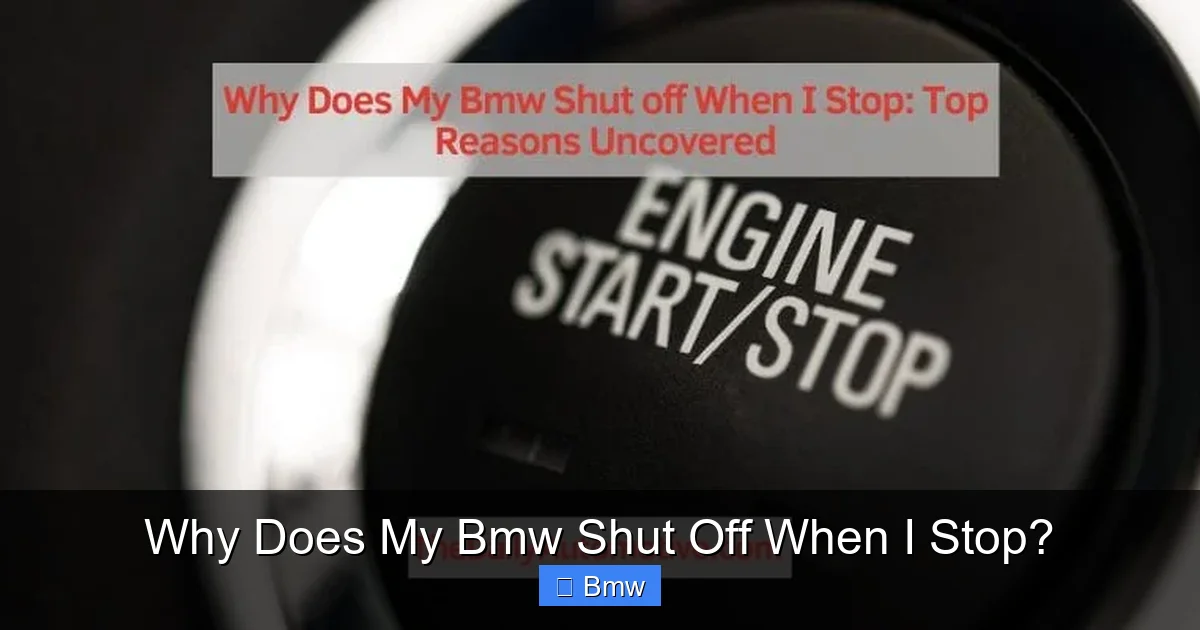
Why Does My Bmw Shut Off When I Stop?

Contents
- 1 Key Takeaways
- 2 📑 Table of Contents
- 3 That Heart-Stopping Moment: Your BMW Dies at a Red Light
- 4 The Usual Suspect: BMW’s Start-Stop System
- 5 The Mechanical Heart: Idle Air Control Valve (IACV) Failure
- 6 Fuel Starvation at a Standstill: Delivery Problems
- 7 Spark and Air: The Ignition and Intake System
- 8 Sensor Confusion: When the Computer Gets Bad Data
- 9 The Diagnostic Path: From Your Garage to the Shop
- 10 Conclusion: Don’t Ignore the Stall
- 11 Frequently Asked Questions

Anti Rust Spray

Car Jump Starter

Digital Tire Pressure Gauge

Car Vacuum Cleaner (Portable)
If your BMW shuts off when you come to a stop, it’s most often related to the car’s automatic start-stop system or a faulty idle control system. While sometimes a simple software setting, it can also signal problems with fuel delivery, ignition components, vacuum leaks, or engine sensors. This issue ranges from a minor nuisance to a serious safety risk, so proper diagnosis by a qualified technician is crucial to identify and fix the root cause.
Key Takeaways
- Start-Stop System is the Prime Suspect: BMW’s fuel-saving feature is designed to shut off the engine at stops, but a malfunction can cause it to activate inappropriately or fail to restart.
- Idle Air Control Valve (IACV) Failure is Common: This valve regulates air during idle; if it gets dirty or fails, the engine can’t maintain RPM and stalls.
- Fuel and Ignition Issues Are Critical: Weak fuel pumps, clogged injectors, or failing spark plugs/coils can starve the engine of power exactly when idle demand is highest.
- Vacuum Leaks Disrupt Air-Fuel Mixture: Cracks in hoses let in unmetered air, leaning out the mixture and causing a rough idle that can lead to a stall.
- Sensor and Electrical Faults Confuse the Computer: Bad MAF, crankshaft position, or throttle body sensors send wrong data, making the engine computer miscalculate fuel and air.
- Never Ignore the Problem: A stalling engine at intersections is dangerous and can lead to accidents or leave you stranded.
- Professional Diagnosis is Essential: The cause requires scanning for fault codes and methodical testing; guessing leads to wasted money and time.
📑 Table of Contents
- That Heart-Stopping Moment: Your BMW Dies at a Red Light
- The Usual Suspect: BMW’s Start-Stop System
- The Mechanical Heart: Idle Air Control Valve (IACV) Failure
- Fuel Starvation at a Standstill: Delivery Problems
- Spark and Air: The Ignition and Intake System
- Sensor Confusion: When the Computer Gets Bad Data
- The Diagnostic Path: From Your Garage to the Shop
- Conclusion: Don’t Ignore the Stall
That Heart-Stopping Moment: Your BMW Dies at a Red Light
You’re piloting your BMW down a city street. The rhythm of traffic has you coming to a smooth stop at a red light. You take your foot off the brake, ready to go… and nothing. The engine has quietly died. The dashboard lights flicker on, maybe a warning chime sounds, and you’re suddenly the center of impatient attention as you frantically try to restart your car. If this scenario feels familiar, you’re not alone. The complaint “my BMW shuts off when I stop” is a frequent one in repair shops and online forums. It’s an issue that bridges the gap between a simple computer glitch and a potentially serious mechanical failure. This guide will walk you through everything you need to know, from the most likely, benign causes to the more urgent problems that need immediate attention. We’ll talk in plain language, no mechanic jargon required, so you can understand what’s happening under the hood and have a informed conversation with your technician.
First, take a breath. While unnerving, this symptom has a defined set of common culprits. The good news? Many are relatively inexpensive to fix. The bad news? Some indicate wear on major components. The key is systematic diagnosis. We’ll break it down by system, starting with the feature BMW probably put there on purpose.
The Usual Suspect: BMW’s Start-Stop System
Let’s address the elephant in the driver’s seat. Since the early 2010s, nearly every BMW has come equipped with an automatic start-stop system. Its sole purpose is to save fuel and reduce emissions by automatically turning off the engine when you come to a complete stop (at a light, in heavy traffic) and restarting it when you lift your foot off the brake or press the accelerator. In theory, it’s seamless. In practice, it can be the source of your frustration.
Visual guide about Why Does My Bmw Shut Off When I Stop?
Image source: cdn.thedailyautomotive.com
How It’s *Supposed* to Work
The system uses a network of sensors—battery charge, engine temperature, cabin temperature, driver seatbelt status—to decide if it’s safe and efficient to shut down. When conditions are met, it kills the engine. A more robust starter motor (or an integrated starter-generator in newer models) and a stronger battery handle the constant restarts. You should barely notice it, except for the slight vibration and the “Auto Start Stop” indicator on the dash.
When the System Goes Rogue
Your BMW might be shutting off because the start-stop system is acting up, not because the engine is mechanically failing. Common reasons include:
- A Weak or Failing Battery: This is the #1 cause. The system constantly checks battery health. If the battery can’t hold a sufficient charge (common after 3-4 years), the system will deactivate itself to prevent a no-start situation. You might see a battery or start-stop warning light. But sometimes, it tries to work and fails, causing the engine to die and not restart properly.
- Faulty Start-Stop Buttons or Sensors: The button that deactivates the system can fail. More commonly, a sensor like the brake pedal switch or the gear selector position sensor sends a bad signal, tricking the car into thinking it’s okay to shut down when it’s not, or preventing a restart.
- Software Glitches: Like all complex computers, the engine control unit (ECU) can have bugs. A software update from the dealer can sometimes resolve erratic start-stop behavior.
Practical Tip: Try driving with the start-stop system manually turned OFF (using the button with the “A” and circular arrow icon). If the problem completely disappears, you’ve isolated the issue to that system or its supporting components (battery, sensors). This is the easiest and first diagnostic step you can do yourself.
The Mechanical Heart: Idle Air Control Valve (IACV) Failure
If disabling the start-stop system doesn’t help, we move from the designed feature to the engine’s fundamental ability to idle. The Idle Air Control Valve (IACV) is a small but critical component. Its job is to let a precise amount of air bypass the closed throttle plate when the engine is idling, maintaining a stable RPM (usually around 600-800).
Symptoms of a Failing IACV
When the IACV gets gunked up with oil and carbon (a common issue on higher-mileage BMWs with the N47, N55, or B47 engines) or simply wears out, it can’t control airflow properly. You’ll notice:
- A rough, fluctuating idle that dips dangerously low before the engine computer (DME) tries to compensate.
- The engine may stall when coming to a stop, when the AC compressor engages (adding load), or when turning the steering wheel (power steering load).
- Sometimes, a diagnostic scan will show a specific IACV-related fault code.
Diagnosis and Fix
A mechanic can often diagnose this by checking for codes and by physically removing and inspecting the valve. It’s usually located on the throttle body housing. Cleaning it with specialized throttle body cleaner can sometimes restore function, but often replacement is the most reliable fix. This is a very common repair on BMWs and typically isn’t wildly expensive for the part, though labor can vary.
Fuel Starvation at a Standstill: Delivery Problems
An engine needs a consistent, pressurized supply of fuel, especially at idle when combustion events are less frequent and the air-fuel mixture is more sensitive. Any weakness in the fuel delivery chain can cause a stall right when you stop.
Visual guide about Why Does My Bmw Shut Off When I Stop?
Image source: cdn.thedailyautomotive.com
The Fuel Pump’s Fading Groan
The in-tank electric fuel pump provides constant pressure. As it ages, it may still provide enough pressure at higher RPMs when fuel demand is high, but it can weaken and fail to maintain pressure at low, steady idle speeds. This is a classic failure pattern. You might also experience hesitation or sputtering during acceleration before the idle stall begins.
Clogged Fuel Injectors
Over time, injectors can get gunked up, disrupting their precise spray pattern. At idle, a partially clogged injector may not deliver enough fuel for a smooth burn, causing a mis fire and eventual stall. Using quality fuel and occasional fuel system cleaning additives can help prevent this.
Dirty Fuel Filter
A severely clogged fuel filter restricts flow. Like a weak pump, it might allow enough fuel for driving but starve the engine during the delicate idle phase. This is a simpler and cheaper fix if it’s the cause.
Example: A client with a 2012 BMW 328i reported stalling only at stoplights. A fuel pressure test revealed the pump was barely meeting minimum spec at idle but was fine at higher pressures. Replacing the pump solved the issue completely.
Spark and Air: The Ignition and Intake System
For combustion to happen, you need spark, fuel, and air in the right ratio. We’ve covered fuel. Let’s look at spark and air.

Visual guide about Why Does My Bmw Shut Off When I Stop?
Image source: thedailyautomotive.com
Worn Spark Plugs and Failing Coils
Worn spark plugs have a larger gap, requiring more voltage to fire. At idle, the ignition system’s voltage output is lower. This mismatch can cause weak or inconsistent sparks, leading to mis fires. A single mis fire in a 4-cylinder engine at idle can be enough to upset the balance and stall. Failing ignition coils exhibit similar symptoms. Often, you’ll feel a shake or shudder before the stall. A quick scan for mis fire codes (P0300-P0304) points directly to a specific cylinder.
Vacuum Leaks: The Sneaky Air Intruder
Engines are designed to take in a specific amount of air measured by sensors. A vacuum leak—a cracked or disconnected hose, a faulty PCV valve, or even a leaking intake manifold gasket—allows extra, “unmetered” air to sneak into the engine. This leans out the air-fuel mixture (too much air, not enough fuel). The engine computer tries to compensate, but at idle, it often fails, causing a rough idle and stall. You might hear a hissing sound from the engine bay. A smoke machine test is the best way to find these elusive leaks.
Sensor Confusion: When the Computer Gets Bad Data
Your BMW’s DME relies on a symphony of sensor inputs. If one key sensor sends a wrong signal, the entire orchestra plays poorly.
Mass Air Flow (MAF) Sensor
The MAF measures exactly how much air is entering the engine. If it’s dirty (from oil vapor, often from a faulty PCV system) or failing, it can under-report airflow. The DME then injects too little fuel, leaning out the mix and causing a stall, especially at idle where the margin for error is smallest. A clean, functioning MAF is vital.
Throttle Body Issues
Modern BMWs use an electronic throttle body (no physical cable). The motor that controls the throttle plate or the potentiometer that tells the computer its position can fail. This can cause the throttle plate to not open enough for idle, or to close too much, strangling the engine. You might see a “Drivetrain Malfunction” warning.
Crankshaft/Camshaft Position Sensors
These sensors tell the computer the exact position of the engine’s rotating assembly. If one fails intermittently, the computer loses its timing reference, can’t fire the injectors or coils correctly, and the engine will die. These often cause a no-start condition more than a stall, but a dying sensor can cause stalling when stopping.
The Diagnostic Path: From Your Garage to the Shop
So, what do you do? Panic is not the answer. A methodical approach saves time and money.
Step 1: The Simple Checks (You Can Do This)
First, ensure the start-stop system isn’t the sole culprit by driving with it OFF. Next, check the basics. Is the air filter clogged? Is the fuel level critically low (which can cause fuel pump aeration)? Are all engine bay connectors tight? Listen for vacuum leaks. Note any other symptoms: warning lights, rough running only when hot or cold, strange smells (like burning oil, which could point to other issues).
Step 2: Scan for Codes
This is non-negotiable. Take your BMW to a shop (or use a capable OBD-II scanner yourself) to read the DME’s stored fault codes. These alphanumeric codes (e.g., P0507 – Idle Air Control System RPM Higher Than Expected) are the single biggest clue. They point directly to the circuit or component the computer has identified as faulty. Do not guess or replace parts without a code.
Step 3: Professional Live Data and Testing
A good BMW technician will use advanced scan tools to view live data streams: fuel trims, MAF readings, IACV position, oxygen sensor values, etc. They’ll perform specific tests: a fuel pressure test, a smoke test for vacuum leaks, and tests on suspect sensors and actuators. This is where experience with BMW-specific systems pays off.
Important Note: While this article focuses on BMWs, the underlying mechanical principles are universal. You’ll find similar issues—like idle control problems or fuel pump failures—in other vehicles. For instance, owners of certain trucks have reported comparable stalling when stopped, often traced to similar idle air control or fuel delivery issues, as detailed in articles about Why Does My Dodge Ram Stall When I Stop. Similarly, an overheating engine can also shut down, a problem explored in guides on Why Does My Car Overheat When I Stop. And neglected maintenance, like skipping oil changes, can lead to carbon buildup that affects idle quality, a topic covered in discussions about Will My Car Tell Me When I Need An Oil Change. Seeing patterns across different makes can help you understand that your BMW’s problem, while specific in its details, is part of common automotive engineering.
Conclusion: Don’t Ignore the Stall
Your BMW shutting off when you stop is a clear message from your car that something is wrong. It’s trying to tell you that its idle control, fuel delivery, ignition, or sensor network isn’t functioning correctly. While it’s tempting to just disable the start-stop button and live with it, that’s only masking the problem. The underlying issue, if it’s not the start-stop system itself, will likely worsen. A minor vacuum leak can lead to a clogged catalytic converter from running lean. A weak fuel pump will eventually leave you stranded. A failing IACV will make driving in traffic unbearable and potentially unsafe.
The path forward is clear: get a proper diagnosis. Start with the free and easy step of turning off the start-stop system. If that doesn’t solve it, seek out a reputable independent BMW specialist or a dealership with strong diagnostic skills. Provide them with a detailed description of when it happens (hot/cold engine, with/without AC), any warning lights, and any recent work done. A systematic, code-led diagnosis will find the root cause. Fixing it will restore your confidence, your safety, and the smooth, refined driving experience you expect from the Ultimate Driving Machine. Don’t let a stalling engine turn your BMW from a pleasure into a source of stress.
Frequently Asked Questions
Is it dangerous to drive my BMW if it shuts off when I stop?
Yes, it is dangerous. Stalling at an intersection can cause a rear-end collision or put you in the path of cross traffic. It also means you could lose power steering and brake assist, making the car harder to control. Have it diagnosed and repaired before driving it regularly.
How much does it typically cost to fix a BMW that stalls at idle?
The cost varies wildly by cause. Replacing a dirty IACV or a bad coil might cost $300-$700. A fuel pump replacement can be $800-$1,500. A vacuum leak repair might be $100-$300. A major sensor or software issue could be less. Always get a specific diagnosis and quote.
Can I permanently disable the start-stop system myself?
You can disable it per drive with the button. Some aftermarket modules claim to permanently disable it, but this may void warranty, trigger fault codes, and is generally not recommended as it defeats a designed emissions and fuel economy feature. Fix the underlying cause instead.
My BMW only stalls when the air conditioning is on. What does that mean?
>This is a classic symptom of an idle control issue. The AC compressor puts a significant load on the engine at idle. If the idle air control valve or throttle body can’t increase airflow to compensate for that load, the RPMs will drop too far and the engine will stall. This strongly points to the IACV or throttle body.
Could low oil cause my BMW to shut off at a stop?
Extremely low oil can cause severe engine damage that might lead to stalling, but it’s not a common direct cause of idle stalling. However, neglected oil changes lead to sludge and carbon buildup, which can indirectly affect sensors and idle performance. Always maintain proper oil levels and change intervals.
Why does my BMW shut off only when it’s hot (after driving for a while)?
Heat-related stalling often points to a failing component that breaks down when hot. This could be a crankshaft position sensor, an ignition coil, or a fuel pump that loses pressure as it gets warm. It can also be a vapor lock issue in the fuel system (rare in modern cars) or an overheating engine that’s going into protection mode. A scan when the engine is hot and stalling is crucial.