
Why Does My Dodge Ram Stall When I Stop?

If your Dodge Ram stalls when you stop, it’s often due to a malfunctioning idle air control valve, a dirty throttle body, or vacuum leaks. These issues disrupt proper airflow and engine management, especially at low speeds. Diagnosing and fixing the root cause can restore smooth idling and prevent frustrating stalls.
Key Takeaways
- Faulty idle air control (IAC) valve: This component regulates idle speed; if it fails, the engine may stall when coming to a stop.
- Dirty or clogged throttle body: Carbon buildup restricts airflow, causing erratic idling and stalling.
- Vacuum leaks: Unmetered air entering the engine confuses the ECU, leading to stalling at idle.
- Weak or failing fuel pump: Inadequate fuel pressure can cause the engine to die when demand drops at idle.
- Faulty mass airflow (MAF) sensor: Incorrect air measurement disrupts the air-fuel mixture, resulting in stalling.
- Electrical issues or bad grounds: Poor connections can interrupt signals to critical engine components.
- Transmission or torque converter problems: In automatic models, a malfunctioning torque converter can cause stalling when stopping.
📑 Table of Contents
Why Does My Dodge Ram Stall When I Stop?
You’re cruising down the highway in your Dodge Ram, enjoying the power and comfort that made you fall in love with this truck. Then, as you slow down to stop at a red light, the engine sputters—and suddenly, it dies. The dashboard lights up, and you’re left sitting at the intersection, frustrated and worried. You restart the engine, and it runs fine… until the next stop. Sound familiar?
This is a common but concerning issue for many Dodge Ram owners. Stalling when coming to a stop isn’t just annoying—it can be a safety hazard, especially in heavy traffic or at busy intersections. The good news? In most cases, this problem has a fixable cause. Understanding why your Dodge Ram stalls when you stop is the first step toward getting it resolved quickly and safely.
Modern Dodge Rams are engineered for performance, durability, and efficiency. However, like any complex machine, they rely on a delicate balance of mechanical and electronic systems. When one component fails or becomes dirty, it can throw off the entire operation—especially during low-speed maneuvers like idling or stopping. The engine needs just the right amount of air, fuel, and spark to keep running smoothly when you’re not pressing the gas. If any part of that equation is off, stalling can occur.
In this guide, we’ll walk you through the most common reasons your Dodge Ram might stall when you stop. We’ll cover everything from simple maintenance fixes to more complex mechanical issues. Whether you’re a DIY enthusiast or planning to visit a mechanic, this information will help you ask the right questions and understand what’s happening under the hood.
Common Causes of Stalling When Stopping
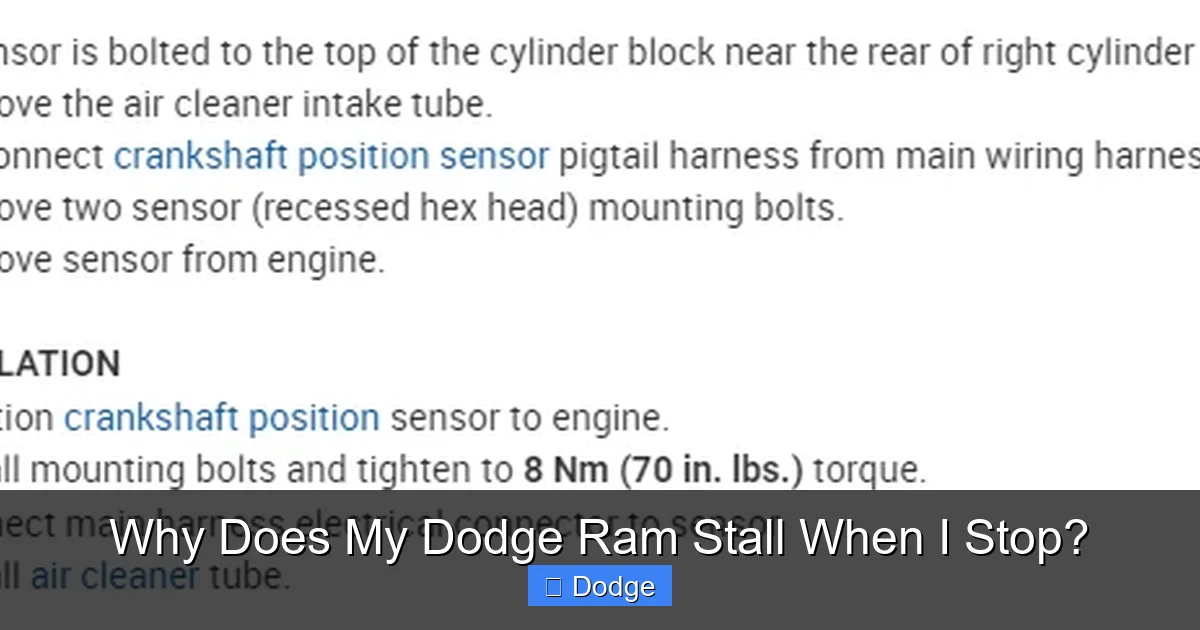
Visual guide about Why Does My Dodge Ram Stall When I Stop?
Image source: 2carpros.com
Stalling at idle is rarely caused by a single, isolated issue. More often, it’s the result of one or more components failing to work in harmony. Let’s break down the most frequent culprits behind this frustrating problem.
1. Faulty Idle Air Control (IAC) Valve
The idle air control valve—often called the IAC valve—is a small but critical component located on or near the throttle body. Its job is to regulate how much air bypasses the throttle plate when the engine is idling. When you take your foot off the gas, the throttle plate closes, but the engine still needs a small amount of air to keep running. The IAC valve opens and closes to allow just the right amount of air through, maintaining a smooth idle.
Over time, the IAC valve can become clogged with carbon deposits or fail electrically. When this happens, it may not open properly, starving the engine of air at idle. The result? The engine sputters and stalls when you come to a stop.
For example, if you notice your Ram idling roughly or stalling only when the engine is warm, the IAC valve is a prime suspect. In some cases, the engine may restart immediately, but the problem will keep recurring until the valve is cleaned or replaced.
2. Dirty or Clogged Throttle Body
The throttle body is the gateway through which air enters the engine. It contains the throttle plate, which opens and closes as you press the accelerator. Over time, oil vapors and fuel residues can leave behind a sticky carbon buildup on the inside of the throttle body and around the throttle plate.
This buildup restricts airflow, especially at low speeds. When the throttle plate can’t move freely or when airflow is uneven, the engine struggles to maintain a stable idle. You might notice the engine revving up and down (surging) or stalling completely when you stop.
Cleaning the throttle body is a relatively simple task that many truck owners can do at home with a throttle body cleaner and a soft brush. However, be careful not to damage the delicate components inside. If the buildup is severe, it may take a few cleanings to fully restore proper function.
3. Vacuum Leaks
Your engine relies on a precise balance of air and fuel. The intake manifold creates a vacuum that helps draw air into the combustion chambers. If there’s a leak in the vacuum system—such as a cracked hose, loose connection, or damaged gasket—unmetered air sneaks into the engine.
This extra air isn’t measured by the mass airflow (MAF) sensor, so the engine control unit (ECU) doesn’t know it’s there. As a result, the air-fuel mixture becomes too lean (too much air, not enough fuel), causing rough idling, hesitation, and stalling.
Vacuum leaks are tricky because they can be hard to spot. Common signs include a high or fluctuating idle, a hissing sound under the hood, or a check engine light with codes related to lean conditions. A smoke test is the most reliable way to detect vacuum leaks, but you can also inspect hoses for cracks, brittleness, or loose clamps.
4. Weak or Failing Fuel Pump
The fuel pump delivers gasoline from the tank to the engine at the correct pressure. When you’re driving, the engine demands more fuel, and the pump works harder. But at idle, the demand drops—and if the pump is weak or failing, it may not maintain adequate pressure.
A weak fuel pump can cause the engine to stall when you stop because it can’t supply enough fuel to keep the engine running at low RPMs. You might also notice poor acceleration, hesitation under load, or difficulty starting the engine.
Fuel pressure can be tested with a gauge connected to the fuel rail. If the pressure drops below specifications at idle, the fuel pump or fuel pressure regulator may need replacement.
5. Faulty Mass Airflow (MAF) Sensor
The MAF sensor measures how much air is entering the engine and sends that information to the ECU. The ECU then calculates how much fuel to inject for optimal combustion. If the MAF sensor is dirty, damaged, or malfunctioning, it can send incorrect data, leading to a rich or lean fuel mixture.
A dirty MAF sensor is a common cause of stalling. Over time, dirt, oil, and debris can coat the sensor’s delicate wires or film, interfering with its readings. Cleaning the MAF sensor with a specialized cleaner can often resolve the issue. However, if the sensor is electrically faulty, it will need to be replaced.
6. Electrical Issues or Bad Grounds
Modern engines rely heavily on electrical signals to operate. If there’s a poor connection, corroded wire, or bad ground, critical components like the IAC valve, fuel injectors, or ignition system may not function properly.
For example, a bad ground connection can cause intermittent stalling, especially when the engine is warm. The problem may come and go, making it difficult to diagnose. Inspecting the battery terminals, ground straps, and wiring harnesses can help identify and fix these issues.
Diagnosing the Problem: Step-by-Step
Visual guide about Why Does My Dodge Ram Stall When I Stop?
Image source: hondatheotherside.com
Now that you know the common causes, let’s talk about how to figure out which one is affecting your Dodge Ram. Diagnosing a stalling issue requires a methodical approach. Here’s how to get started.
Step 1: Check for Check Engine Lights
The first thing to do is scan for diagnostic trouble codes (DTCs). Even if the check engine light isn’t on, there may be pending codes stored in the ECU. Use an OBD2 scanner to read the codes. Common codes related to stalling include:
– P0505: Idle Air Control System Malfunction
– P0171 or P0174: System Too Lean (Bank 1 or Bank 2)
– P0101: MAF Sensor Performance
– P0230: Fuel Pump Primary Circuit Malfunction
These codes can point you directly to the faulty component.
Step 2: Inspect the Throttle Body and IAC Valve
Open the hood and locate the throttle body. Remove the air intake hose and visually inspect the inside. If you see black, greasy buildup around the throttle plate, it’s time for a cleaning.
You can clean the throttle body and IAC valve using a throttle body cleaner spray. Avoid using carburetor cleaner, as it can damage sensors. Spray the cleaner onto a soft brush or cloth and gently scrub the throttle plate and bore. Be careful not to force the throttle plate open too wide.
After cleaning, reassemble everything and start the engine. Let it idle for a few minutes to see if the stalling issue improves.
Step 3: Listen for Vacuum Leaks
With the engine running, listen carefully under the hood for a hissing sound. This could indicate a vacuum leak. You can also spray small amounts of carburetor cleaner around suspected areas (like hose connections or the intake manifold). If the engine RPM changes when you spray, you’ve found a leak.
Alternatively, use a smoke machine to pressurize the intake system and visually identify leaks.
Step 4: Test Fuel Pressure
If you suspect a fuel delivery issue, test the fuel pressure. You’ll need a fuel pressure gauge that connects to the Schrader valve on the fuel rail. Compare the reading to your Ram’s specifications (usually around 45–55 psi for most models).
If the pressure is low, especially at idle, the fuel pump, fuel filter, or pressure regulator may be faulty.
Step 5: Clean or Replace the MAF Sensor
Locate the MAF sensor, usually between the air filter box and the throttle body. Disconnect the electrical connector and remove the sensor. Spray it with MAF cleaner—do not touch the wires inside. Let it dry completely before reinstalling.
If cleaning doesn’t help, consider replacing the sensor.
Step 6: Check Electrical Connections
Inspect the battery terminals, ground straps, and wiring harnesses for corrosion, looseness, or damage. Clean the terminals with a wire brush and ensure all connections are tight.
Also, check the ground strap from the engine to the chassis. A poor ground can cause all sorts of electrical gremlins.
Preventative Maintenance Tips

Visual guide about Why Does My Dodge Ram Stall When I Stop?
Image source: fourwheely.com
Once you’ve fixed the stalling issue, you’ll want to keep it from happening again. Regular maintenance is key to preventing future problems.
Regular Throttle Body Cleaning
Make it a habit to clean the throttle body every 30,000 to 50,000 miles, especially if you drive in stop-and-go traffic or use lower-quality fuel. This simple step can prevent carbon buildup and keep your idle smooth.
Replace the Air Filter
A dirty air filter restricts airflow and can cause the MAF sensor to work harder. Replace the air filter every 15,000 to 30,000 miles, or more often if you drive in dusty conditions.
Use Quality Fuel and Additives
Top-tier gasoline contains more detergents that help keep fuel injectors and intake valves clean. Consider using a fuel system cleaner every 3,000 to 5,000 miles to remove deposits.
Inspect Vacuum Hoses Annually
Check all vacuum hoses for cracks, brittleness, or leaks. Replace any that look worn. Use a vacuum hose diagram (found in your owner’s manual or online) to identify all connections.
Monitor Fuel System Health
Replace the fuel filter according to your maintenance schedule (usually every 30,000 miles). If you suspect fuel pump issues, have the system tested before it fails completely.
When to See a Mechanic
While many stalling issues can be resolved at home, some problems require professional diagnosis and repair. Here’s when it’s time to visit a trusted mechanic:
– The check engine light is on with multiple or complex codes.
– You’ve tried cleaning and inspecting components, but the problem persists.
– You suspect internal engine or transmission issues.
– The stalling is accompanied by unusual noises, smoke, or loss of power.
A professional mechanic has access to advanced diagnostic tools, such as oscilloscopes and smoke machines, that can pinpoint elusive problems. They can also perform tests like compression checks or cylinder balance tests if needed.
Conclusion
Stalling when you stop in your Dodge Ram is more than just an inconvenience—it’s a sign that something in your engine’s delicate balance is off. Whether it’s a dirty throttle body, a faulty IAC valve, or a vacuum leak, the root cause is usually identifiable and fixable.
By understanding the common causes and following a systematic diagnostic approach, you can often resolve the issue yourself. Regular maintenance—like cleaning the throttle body, replacing the air filter, and inspecting hoses—can prevent many of these problems from occurring in the first place.
If you’re unsure or the problem persists, don’t hesitate to consult a professional. Your safety and the longevity of your Ram depend on a well-running engine. With the right care and attention, your truck will continue to deliver the power and reliability you expect, stop after stop.
Frequently Asked Questions
Why does my Dodge Ram stall only when I come to a complete stop?
This is often due to a faulty idle air control (IAC) valve or a dirty throttle body. These components regulate airflow at idle, and if they’re not working properly, the engine may not get enough air to stay running when you stop.
Can a bad battery cause my Ram to stall when stopping?
A weak battery usually causes starting problems, not stalling. However, a bad ground connection or corroded terminals can disrupt electrical signals to engine components, potentially leading to stalling. Check your battery and grounds if you suspect an electrical issue.
How often should I clean the throttle body on my Dodge Ram?
It’s recommended to clean the throttle body every 30,000 to 50,000 miles, or sooner if you notice rough idling or stalling. Regular cleaning prevents carbon buildup that can restrict airflow.
Will a clogged fuel filter cause stalling at idle?
Yes, a clogged fuel filter can restrict fuel flow, especially at low engine speeds. This can lead to insufficient fuel pressure and cause the engine to stall when idling or stopping.
Can the transmission cause my Ram to stall when I stop?
In automatic transmissions, a malfunctioning torque converter or transmission solenoid can cause stalling when coming to a stop. This is less common but possible, especially if the stalling is accompanied by shifting issues.
Is it safe to drive my Ram if it stalls when I stop?
No, it’s not safe. Stalling in traffic can lead to accidents or leave you stranded. Have the issue diagnosed and repaired as soon as possible to ensure your safety and prevent further damage.
