
How Far Can You Drive on Minimum Oil in Audi?

Driving your Audi with minimum oil is extremely risky and can cause catastrophic engine damage in minutes, not miles. There is no safe distance—the moment the oil warning light illuminates, you must stop and address the issue immediately. Audi’s advanced engines are particularly sensitive to low oil, making prompt action non-negotiable to avoid a costly engine rebuild or replacement.
That sickening moment when the oil warning light flickers on in your Audi. Your heart skips a beat. You’re on the highway, miles from home, and the dashboard is screaming a silent alarm. The immediate thought? “How far can I drive on minimum oil in my Audi before something terrible happens?” It’s a question born from a mix of panic and pragmatism. We’ve all been there—hoping the light is a false alarm, praying we can just make it to the next exit or the garage down the street. But when it comes to your Audi’s engine, hope is not a strategy. The relationship between minimum oil and engine survival is not a game of miles, but a countdown to failure. This guide cuts through the uncertainty. We’ll explore what “minimum oil” really means for your specific Audi, demystify the warning systems, and explain, in brutal clarity, why the answer to “how far?” is almost always “not at all.” Your engine’s life depends on what you do in the next few minutes.
Key Takeaways
- Zero Miles is the Only Safe Distance: The oil warning light means imminent danger. Continuing to drive, even a short distance, risks severe engine wear or total failure.
- Audi Engines Are High-Performance and Sensitive: Modern turbocharged Audi engines (TSI/TFSI) operate at high temperatures and pressures, demanding perfect oil lubrication at all times.
- The Warning System Is Your Last Chance: By the time the dashboard light comes on, oil pressure may already be critically low. Do not ignore it or “check later.”
- Low Oil ≠ Just “Add a Quart”: While adding oil might temporarily resolve a low *level*, it doesn’t fix the underlying cause (leak, burn-off, or faulty sensor).
- Prevention Is Everything: Regular oil checks, using the correct Audi-specification oil (e.g., VW 502 00/504 00), and addressing excessive oil consumption early are your best defenses.
- Tow Truck Is Cheaper Than an Engine: The cost of a tow and repair is always less than replacing a seized engine. Never gamble with low oil.
- Know Your Audi’s Specifics: Some models have oil level sensors (MMI display) while others only have a pressure warning. Understand your specific instrument cluster alerts.
📑 Table of Contents
- What Does “Minimum Oil” Actually Mean in Your Audi?
- How Audi’s Oil Warning System Works (And Why It’s Not a Suggestion)
- The Real Risks: What Happens Inside Your Engine When Oil Is Minimum
- So, How Far CAN You Drive? The Brutal Answer
- Immediate Action Plan: What to Do When the Oil Light Comes On
- Prevention: The Only Winning Strategy
- Conclusion: Your Audi’s Oil Light Is a Stop Sign, Not a Speed Bump
What Does “Minimum Oil” Actually Mean in Your Audi?
Before we talk distance, we must define the enemy. “Minimum oil” isn’t a precise technical term, but a driver’s description of a critically low state. In your Audi, this can manifest in two crucial, and very different, ways: low oil level and low oil pressure. Understanding the difference is the first step in recognizing the severity of the situation.
Low Oil Level vs. Low Oil Pressure: The Critical Difference
Low Oil Level refers to the actual quantity of oil sitting in your sump (oil pan). Your engine needs a certain volume of oil to function properly. If the level drops below the “MIN” or “ADD” mark on the dipstick (or the corresponding electronic message on your MMI screen), there’s simply not enough fluid to be sucked up by the oil pump, circulated through the tight clearances of the turbocharger, bearings, and camshafts, and splashed onto the cylinder walls. This leads to immediate metal-on-metal contact in critical areas.
Low Oil Pressure, on the other hand, is a different beast. It means the oil pump is struggling to push the oil through the engine’s galleries with sufficient force. This can happen even if the oil level is technically “okay.” Causes include a failing oil pump, a clogged oil filter, using the wrong viscosity oil (too thick for cold weather or too thin for hot), or extreme engine wear that increases clearances. The pressure warning light (usually a red can icon) is arguably more urgent than a low level warning because it indicates a systemic failure in the lubrication system itself.
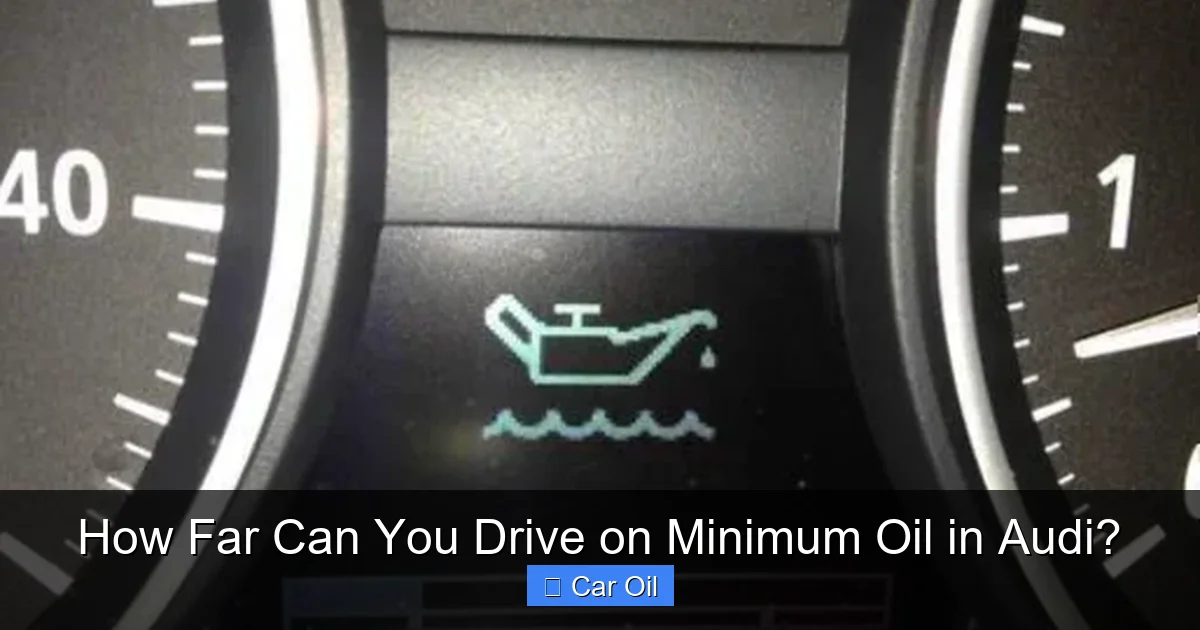
Many modern Audis, especially from the 2000s onward, have an electronic oil level sensor that communicates with the MMI (Multi Media Interface) system. You might see a message like “Oil level: Minimum” or a graphic of an oil can with an exclamation point. This is a low oil level warning. A separate, usually red, oil pressure light is a low oil pressure warning. Both are red alerts. Both require immediate engine shutdown.
Why Audis Are Particularly Sensitive to Low Oil
You might think, “My old Honda ran on low oil for weeks!” Don’t assume that experience translates. Modern Audi engines, particularly the turbocharged gasoline direct injection (TFSI/TSI) and diesel (TDI) units, are engineering marvels of high performance and efficiency. They also run hotter, under higher compression, and with tighter tolerances than ever before.
- Turbochargers spin at over 250,000 RPM and rely on a constant, pressurized film of oil to prevent the turbine shaft from welding itself to the bearings. Starve it of oil for seconds, and you destroy a $2,000+ turbo.
- Direct Injection systems place the fuel injectors directly into the combustion chamber, increasing cylinder pressures and temperatures. This puts extra stress on piston rings and cylinder walls, which rely on an oil film for protection.
- Timing Chains (common in many Audi models) are oiled internally. Low oil pressure can lead to chain stretch, tensioner failure, and catastrophic interference engine damage where pistons collide with valves.
In short, your Audi’s engine is a high-strung athlete. It doesn’t just need oil; it needs the right amount of the right oil at the right pressure at all times. Falling below the minimum in any category is like asking that athlete to run a marathon with a severed tendon.
How Audi’s Oil Warning System Works (And Why It’s Not a Suggestion)
Your Audi isn’t trying to be annoying; it’s trying to save you from financial ruin. The warning system is a last line of defense, but it’s vital to understand what triggers it and what it’s actually telling you.

Visual guide about How Far Can You Drive on Minimum Oil in Audi?
Image source: i.pinimg.com
The Two Main Warning Types: Level and Pressure
As mentioned, the two warnings are distinct. A low level warning (often a yellow/amber icon or MMI message) tells you the quantity is low. A low pressure warning (a red oil can icon) tells you the lubrication system is failing right now. If you see a red oil pressure light, shut the engine off IMMEDIATELY, even if you’re in the fast lane. Do not coast. Do not try to get to the shoulder. The damage is happening as you read this. Pull over safely and shut it down.
The low level warning gives you a tiny, tiny window—maybe 30-60 seconds of idle time—to safely pull over and shut the engine off before the level drops further and pressure collapses. It is NOT an invitation to “go a few more miles.”
The Role of the MMI and Electronic Sensors
In Audis equipped with the MMI system, the oil level is often displayed electronically. You might need to navigate to “Car” -> “Service & Checks” -> “Oil Level” to see it. This sensor, usually located in the oil pan, measures the level when the car is on level ground and the engine has been off for a few minutes (or sometimes with a specific procedure). It’s more accurate than a dipstick but not infallible. A faulty sensor can give a false “minimum” reading, but you should never assume it’s false. The cost of investigating a false alarm is far less than the cost of an engine.
Some older or base-model Audis may only have a traditional dipstick. The procedure is the same: park level, engine off for 5-10 minutes, pull dipstick, wipe, reinsert, pull again, read. The “MIN” and “MAX” (or “ADD” and “FULL”) marks are your bible.
Why the Warning Comes On So Late
This is a common frustration. The warning doesn’t come on when the oil is a quart low. It comes on when it’s dangerously low—often several quarts below the full mark. This is by design to avoid nuisance warnings, but it leaves you with almost no margin for error. By the time your Audi tells you it’s at minimum, the oil pump pickup tube may be partially or fully exposed, sucking air instead of oil. The countdown to damage has already begun.
The Real Risks: What Happens Inside Your Engine When Oil Is Minimum
To understand why you can’t drive on minimum oil, you need to visualize the carnage. Engine oil does three things: lubricate, cool, and clean. Remove any one of those functions, and destruction follows a predictable, rapid path.
Visual guide about How Far Can You Drive on Minimum Oil in Audi?
Image source: autocornerd.com
Stage 1: Boundary Lubrication Fails (Seconds to Minutes)
In a healthy engine, a pressurized film of oil separates all moving metal parts (crankshaft journals, camshaft lobes, piston pins). This is called hydrodynamic lubrication. When oil pressure drops due to low level, this film collapses. Metal surfaces begin to make contact. This is called boundary lubrication, and it’s incredibly destructive. You get scuffing, scoring, and abrasive wear on bearings and cylinder walls. The engine will begin to make a deep, metallic knocking or ticking noise—the sound of metal being ground away.
Stage 2: Overheating and Thermal Breakdown (Minutes)
Oil is a major coolant. It carries heat away from the combustion chamber (via the piston underside), the turbocharger, and bearings. With insufficient oil, these components overheat rapidly. The oil itself thermally breaks down, losing viscosity and its ability to lubricate. It turns from a protective liquid into a tar-like sludge that clogs passages. The turbocharger, which can reach over 1,000°F, fails first. You might see bluish smoke from the exhaust as it burns its own oil seals.
Stage 3: Catastrophic Failure (Minutes to Hours)
This is the point of no return. A main bearing welds to the crankshaft. A piston seizes in its cylinder. A timing chain snaps. The result is a thrown rod (punching a hole in the engine block), a valve train collapse, or a complete lock-up. The engine is now a paperweight. The repair cost equals or exceeds the car’s value. This isn’t a hypothetical; it’s what happens every day to drivers who thought they could “just make it to the shop.”
For a deeper dive into the specific symptoms and consequences of low oil, reading about what happens if you have low oil in your car can provide crucial context on the silent, progressive damage that occurs.
So, How Far CAN You Drive? The Brutal Answer
Now, the question you’ve been waiting for. How many miles? How many minutes? The answer is分段, but the conclusion is monolithic: You should not drive any measurable distance with the oil warning on.
Visual guide about How Far Can You Drive on Minimum Oil in Audi?
Image source: vehiclefreak.com
The “Emergency Mileage” Myth
You’ll find forums and anecdotes claiming, “I drove my A4 5 miles on the oil light and it was fine.” This is survivorship bias. For every one of those stories, there are dozens of engines that died after 1 mile. The “emergency mileage” is a gamble with terrible odds. Some factors might buy you a few minutes of partial function:
- Cold, slow-speed driving on a level road (less stress, lower temps).
- A minor leak that just dropped you to “MIN” (vs. a catastrophic seal failure).
- An older, looser engine with more clearance (though this is rare in modern Audis).
But these are exceptions that prove the rule. You are betting your $5,000-$15,000 engine on a hope. The only “emergency” procedure is to pull over, shut off, and call for help.
Why This Is Different From Running Out of Gas
This is a critical distinction. When your gas light comes on in a Toyota Camry, you have a predictable reserve (often 30-50 miles). The fuel system is designed with a buffer. The oil system is not. There is no reserve tank. The oil pan is your reservoir, and the warning comes on when you’ve exhausted the safety margin. Driving on low oil is more like driving with a broken water pump—damage is instantaneous and severe. The analogy of how many miles you can drive when the gas light comes on does not apply here. One is a planned reserve; the other is a failure state.
The One (Very Limited) Exception
The only scenario where you might move the car a very short distance (think <50 feet, not miles) is if the oil warning comes on while you are in an immediately dangerous position, like the middle of a busy highway or railroad crossing. In that case, you may cautiously accelerate just enough to reach the shoulder. Once there, shut it off. Do not continue to an off-ramp or destination. Every second of engine run time is causing damage.
Immediate Action Plan: What to Do When the Oil Light Comes On
Panic is the enemy. A clear, calm sequence of actions is your best tool. Follow these steps precisely the moment you see an oil warning.
Step 1: Acknowledge and Assess (0-10 Seconds)
Do not ignore it. Do not turn up the radio. Mentally note: “Oil warning active.” Your primary goal is to get the engine to a complete stop with minimal further operation.
Step 2: Signal and Safely Exit Traffic (10-30 Seconds)
If you are on a highway, turn on your hazard lights immediately. Gradually, calmly, and without sudden braking, steer the car to the right-hand shoulder or an exit ramp. Do not stop in a travel lane. Your safety from other vehicles is the first priority.
Step 3: Shut Down the Engine (Within 60 Seconds of Warning)
Once you are safely off the road and at a complete stop, turn the engine off. Do not let it idle to “cool down.” The damage is pressure-related, not just heat-related. Idling continues the destruction. Turn the key to the “off” position.
Step 4: Diagnose (Only If It’s Safe)
If you are in a safe location (wide shoulder, parking lot), you can check the oil level after waiting 5-10 minutes for oil to drain back to the sump. Do not open the hood if you are on a narrow shoulder with fast traffic. Your safety is paramount. If you can check safely:
- Locate the dipstick (usually with a yellow/orange handle).
- Pull, wipe clean, reinsert fully, pull again.
- Read the level. Is it below MIN/ADD? Is there no oil on the stick at all?
- Also check for major leaks under the car.
If you are not comfortable or safe doing this, skip to step 5. The fact the warning is on is proof enough of a critical problem.
Step 5: Call for Professional Help
This is not a “add oil and go” situation in most cases. You need a professional. Call your Audi dealer, a trusted independent Audi specialist, or a roadside assistance service. Explain: “My Audi’s oil warning light is on, and I have pulled over and shut off the engine.” Describe what you saw on the dipstick if you checked it. The only correct resolution is a diagnosis and repair by a qualified mechanic. This may involve a tow.
If you do add oil to get it to the MIN mark, it is only to allow a qualified mechanic to safely move the car from the shoulder to a shop. You are still not driving it normally. You are creating a temporary, fragile state for a very short tow distance. The underlying cause (leak, burn, sensor) must be found and fixed. Understanding the proper procedure for how to put oil in a car is useful, but it’s only a band-aid on a hemorrhaging wound in this context.
Prevention: The Only Winning Strategy
Since the cure for driving on minimum oil is expensive and brutal, prevention is the only rational strategy. This means changing your relationship with your Audi’s oil system from passive to proactive.
1. Check Oil Regularly, With the Car Level and Cold
Make it a monthly ritual, or every 1,000 miles. The best time is before starting the car in the morning, after it’s been sitting overnight on level ground. Don’t check when hot; you’ll get a false reading. Use the correct procedure for your model (dipstick or MMI). Know what “full” and “min” look like. Don’t wait for a warning.
2. Use ONLY Audi-Specified Oil
This is non-negotiable. Your owner’s manual specifies the exact viscosity and specification. For most modern Audis, this is a VW 502 00 (for gasoline) or VW 507 00 (for diesel) specification oil. These are not just suggestions; they are engineered for the specific materials and stresses in your engine. Using a generic oil or the wrong weight can increase wear and consumption, leading to low levels. If you’re unsure, researching if you can put different oil in your car is a must before you ever pop the hood.
3. Address Excessive Oil Consumption Immediately
Some Audis are notorious for burning oil. It’s not “normal.” If you find yourself adding a quart or more between regular service intervals (every 5,000-10,000 miles), you have a problem. Common causes include piston ring failure (a known issue on certain TSI engines), valve seal leaks, or turbocharger seal leaks. Get this diagnosed. Ignoring it is a direct path to running on minimum oil.
4. Adhere to Strict Service Intervals
Change your oil and filter on time, using a high-quality filter (OEM or OEM-spec). Old, degraded oil loses its protective additives and becomes abrasive. It also contributes to sludge that can clog passages and strain the system. Consider using high-quality full synthetic oils designed for long-life service if your driving pattern matches.
5. Listen and Feel
Be attuned to your car. Unusual ticking from the top end (valve train) on cold starts can indicate low oil or worn components. A loss of power, a strange turbo whine, or a general feeling of roughness can all be symptoms of lubrication issues. Don’t dismiss them.
Conclusion: Your Audi’s Oil Light Is a Stop Sign, Not a Speed Bump
Let’s be perfectly clear. The question “How far can you drive on minimum oil in an Audi?” has a single, unwavering answer: zero miles if you value your engine. The moment that light comes on, your engine’s clock is ticking down. The high-revving, turbocharged heart of your Audi is not designed for limping. It’s designed for performance, and performance demands perfect lubrication. The risks—catastrophic, wallet-emptying, car-ending engine failure—are simply too great to ever justify pushing your luck. The $200 tow truck bill is a bargain compared to the $8,000 engine replacement. The smartest, cheapest, and only correct response to an oil warning is to stop, shut down, and get professional help. Treat your Audi’s oil system with the respect it deserves, check it religiously, use the right oil, and never, ever ignore the warning. Your future self, holding a working key fob instead of a tow truck receipt, will thank you.
Frequently Asked Questions
Can I drive my Audi with the oil light on for a mile or two?
No. Even one mile of driving with the oil warning illuminated can cause significant internal wear. The warning indicates oil pressure has already dropped to a dangerous level. Shut the engine off immediately and seek professional assistance.
What’s the difference between the oil level and oil pressure warnings?
The oil level warning (often an MMI message) means the quantity of oil is critically low. The oil pressure warning (a red oil can icon) means the lubrication system is failing right now. Both require immediate engine shutdown. The pressure warning is the most urgent.
My Audi’s oil level is at MIN. Can I just add a quart and keep driving?
You can add oil to bring the level back to the normal range, but you must first understand why it got low. A major leak or excessive burn-off means the problem persists. Adding oil is a temporary measure to get to a repair shop, not a solution. Do not resume normal driving until the root cause is fixed.
Why does my Audi burn so much oil? Is it normal?
No, excessive oil consumption is not normal, though it’s a known issue on some Audi models (particularly certain 2.0 TFSI engines). Common causes include worn piston rings, valve stem seals, or turbocharger seals. If you’re adding more than a quart between 3,000-5,000 mile oil changes, get it diagnosed immediately to prevent running on minimum oil.
I added oil and the light went out. Is it safe to drive now?
It may be safe to drive a very short distance (to a nearby repair shop) if the light was solely due to a low level that you’ve corrected. However, you must have the vehicle inspected to find the cause of the low oil. If the light was a pressure warning, the engine should not be restarted until a mechanic diagnoses it.
Can a faulty sensor cause the oil light to come on when oil is fine?
Yes, a failed oil level sensor or pressure switch can trigger a false warning. However, you should never assume it’s false. The risk of ignoring a real warning is catastrophic engine damage. A mechanic must test the sensor and the actual oil pressure/level before declaring it safe. The cost of a diagnosis is minimal compared to an engine replacement.
