
Which Hyundai Sonata Years to Avoid

Not all Hyundai Sonata model years are created equal. Our research reveals two major problematic eras: the 2006-2010 models with transmission failures and the 2011-2014 generations plagued by the notorious Theta II engine defect. Later models (2015-2019) are generally reliable, while the tech-heavy 2020+ versions have emerging software gremlins. Always get a pre-purchase inspection and a full vehicle history report before buying any used Sonata.
Let’s be real for a second. The Hyundai Sonata has come a long, long way. I remember when a used Sonata from the early 2000s was basically a joke in some car circles—a cheap, unreliable placeholder until you could afford something “better.” But Hyundai didn’t just improve; they transformed. The modern Sonata is a stylish, feature-packed, and genuinely competitive midsize sedan that gives the Toyota Camry and Honda Accord a serious run for their money. It’s a testament to how far the brand has come.
But here’s the crucial catch: that transformation wasn’t an overnight flip of a switch. It was a journey with some serious bumps in the road. For every reliable 2018 Sonata humming happily down the highway, there’s a 2012 model in a tow yard with a seized engine. Understanding which Hyundai Sonata years to avoid isn’t about trashing the model; it’s about smart shopping. It’s the difference between buying a fantastic value and buying a money pit on wheels. We’re going to break down exactly which years carry the biggest red flags, why they have them, and how you can protect yourself. Think of this as your ultimate decoder ring for the used Sonata market.
Key Takeaways
- The 2006-2010 Sonatas are transmission time bombs. These models suffer from premature automatic transmission failure, often before 100,000 miles, leading to costly repairs or replacements.
- The 2011-2014 Sonatas have a fatal engine flaw. The Theta II 2.4L and 2.0T engines are prone to catastrophic failure due to manufacturing debris causing rod bearing wear and seizure, with Hyundai’s recall and warranty extensions not covering all cases.
- 2015-2019 models are the “sweet spot” for reliability. Hyundai addressed the major engine issues and used more proven transmissions, making these the most recommended years for a used Sonata purchase.
- 2020+ models introduce new tech problems. While mechanically sound, these newer Sonatas report issues with infotainment systems, sensor failures, and intermittent electrical problems that can be frustrating and expensive to diagnose.
- Always verify recall and warranty work. For any potentially problematic year, confirm with a Hyundai dealer that all applicable recalls and extended warranty repairs (like the Theta II engine warranty) were completed using the Best Battery For Hyundai Sonata guides for your specific model year.
- A pre-purchase inspection is non-negotiable. No matter the year, have a trusted, independent mechanic perform a thorough inspection, including a computer diagnostic scan for any stored or pending trouble codes.
- Check the vehicle history report diligently. Look for red flags like title problems, inconsistent odometer readings, and most importantly, any records of major engine or transmission repairs.
📑 Table of Contents
The Problematic Eras: A Timeline of Trouble
To make this simple, we can group the Sonata’s history into three clear reliability buckets: the “Avoid” years, the “Proceed with Extreme Caution” years, and the “Generally Safe Bet” years. The dividing lines are stark and are defined by two major engineering failures that haunted the lineup for over a decade.
The Dark Ages: 2006-2010 (The Transmission Debacle)
If you see a used Sonata from this generation priced suspiciously low, run. These are the years you absolutely must avoid unless you have a spare transmission in your garage and enjoy major surgery on your car. The core issue is the 5-speed automatic transmission, specifically the 5F25 and 5F35 units paired with the 3.3L V6 and even some 2.4L four-cylinder engines.
These transmissions are notorious for premature failure. We’re talking about shuddering, harsh shifts, slipping gears, and complete failure often well before 100,000 miles. The failure mode is typically worn clutch packs and a failed solenoid pack. The repair cost? A complete rebuild or replacement can easily hit $3,000-$4,000. For a car that might only be worth $5,000, this turns a “bargain” into a catastrophic loss. Consumer complaints flooded the NHTSA database for these years, and Hyundai did issue some extended warranties and Technical Service Bulletins (TSBs), but they were often bandaids on a bullet wound. This generation cemented the “unreliable Hyundai” stereotype for a whole cohort of buyers.
The Engine Catastrophe: 2011-2014 (The Theta II Engine Nightmare)
Hyundai thought they had solved their problems with the all-new, sleek sixth-generation Sonata for 2011. New platform, new design, new engines. Unfortunately, the new Theta II 2.4L GDI (Gasoline Direct Injection) and 2.0L Turbo engines carried a devastating and potentially deadly flaw from the factory.
The problem? Metallic debris, left over from the manufacturing process of the crankshaft, would not be completely cleaned out of the engine block. This debris would circulate in the oil, acting like fine sandpaper, and wear down the rod bearings. The result? Low oil pressure, terrifying knocking sounds (often called “rod knock”), and ultimately, a complete engine seizure. This wasn’t slow wear and tear; it was a ticking time bomb. Some engines failed with under 40,000 miles. The danger wasn’t just financial; a sudden loss of power on a highway is a major safety hazard.
Hyundai was forced into a massive class-action lawsuit and a landmark settlement. They extended the warranty on these engines to 10 years/100,000 miles (later amended) and issued recalls for software updates and, in some cases, engine replacements. BUT, the coverage is a tangled web. It often requires proof of regular oil changes with the correct oil (5W-20 or 5W-30, depending on year) and can be denied if any other factor is blamed. Many owners fell through the cracks. This era single-handedly created the “Which Hyundai Sonata years to avoid” conversation. If you are looking at a 2011-2014 Sonata, you must verify in writing with a Hyundai dealer that the specific VIN is fully covered under the Theta II warranty settlement and that any related service was performed. Assume the worst unless proven otherwise.
The Turning Point: 2015-2019 (The Reliable Sweet Spot)
For the 2015 model year, Hyundai extensively re-engineered the Theta II engine. They changed the crankshaft machining process, oil passage designs, and added improved debris filters. The goal was to eliminate the manufacturing debris issue at its source. And by all accounts, they succeeded. The 2015-2019 Sonata models, powered by the revised 2.4L GDI or the 1.6L/2.0L turbo engines, have shown none of the catastrophic failure patterns of their predecessors.
These are the years you can shop for with genuine confidence. The 6-speed automatic transmissions (and later 8-speed in the turbo) are robust and reliable. The interiors are still holding up well, and the feature set is excellent. You’re getting a modern, efficient, and well-built car that has largely shed the major reliability baggage of the previous decade. Minor issues exist—like any infotainment glitch or wear item—but nothing on the scale of a $6,000 engine replacement. This seven-year span represents the best value in the used Sonata market.
The New Frontier of Frustration: 2020-Present (Software & Electronics)
The completely redesigned 2020 Sonata is a fantastic car on paper and in most driving situations. However, it ushered in a new category of problems: complex software and electronics gremlins. Because the major powertrain components are now proven, the issues aren’t usually “make the car undrivable” but rather “make the car incredibly annoying to own.”
Common complaints involve the large touchscreen infotainment system freezing, rebooting, or losing connectivity. Backup camera failures, faulty blind-spot monitoring sensors, and intermittent issues with the digital gauge cluster are frequently reported. These problems are notoriously difficult to diagnose and fix, often requiring multiple trips to the dealer and module reprogramming. While not as financially ruinous as a blown engine, they destroy the ownership experience. When considering a 2020+ Sonata, a thorough test of every electronic function—every screen, every sensor, every voice command—is absolutely critical.
How to Spot a Troubled Sonata Before You Buy
Knowing the bad years is only half the battle. You need to know how to investigate a specific car. A clean Carfax doesn’t mean a clean bill of health.
Visual guide about Which Hyundai Sonata Years to Avoid
Image source: hyundaimaintenance.com
The Pre-Purchase Inspection (PPI) Is Your Bible
Do not skip this. Pay a reputable, independent mechanic (not the dealership selling the car) for a comprehensive pre-purchase inspection. For a Sonata from a problematic year, this inspection must include:
- A full computer diagnostic scan. This is the most important step. It will reveal any stored or pending trouble codes, even if the check engine light is off. Codes related to misfires (P0300-P0304), fuel system, or transmission solenoid circuits are major red flags.
- An oil analysis. For 2011-2014 models, an oil sample sent to a lab can detect excessive metal particulates (like aluminum from bearings) long before a catastrophic failure. It’s a cheap insurance policy.
- A rigorous test drive. Drive the car when it’s cold and when it’s hot. Listen for any knocking, ticking, or grinding from the engine. Feel for any shuddering, slipping, or harsh clunks from the transmission during acceleration and gear changes. Test every single electronic feature.
Reading Between the Lines of a Vehicle History Report
Don’t just glance at the title and accident section. Dig deeper.
- Service History: Are there records? Consistent oil changes are good. Long gaps are bad. Look specifically for any engine or transmission-related repairs.
- Odometer Consistency: Any gaps or rollbacks are a huge red flag for potential neglect or fraud.
- Number of Owners: One careful owner is ideal. Multiple owners in short periods can indicate unresolved problems the previous owners got tired of.
The Smart Buyer’s Checklist for Any Used Sonata
Armed with year-specific knowledge, use this universal checklist for every Sonata you consider.
Visual guide about Which Hyundai Sonata Years to Avoid
Image source: hyundaimaintenance.com
- Verify All Recalls & Warranty Work: Go to the NHTSA website (nhtsa.gov/recalls) and enter the VIN. Note any open recalls. Then, call a Hyundai dealer with the VIN and ask them to print the full warranty and service history. For 2011-2014 cars, grill them on the Theta II engine: was the long-block replacement ever done? Is the VIN still eligible for coverage under the settlement?
- Test Every Single Function: In the parking lot, turn on the headlights (high and low), wipers, AC (set to max, listen for compressor engagement), heater, all power windows/locks, the sunroof (if equipped), the radio/screen, Bluetooth pairing, navigation (if equipped), backup camera, blind-spot monitoring, and adaptive cruise control if it has it. A single non-functioning module can hint at larger electrical issues.
- Cold Start & Hot Start Test: Start the car when it’s been sitting overnight. Listen for any prolonged cranking, smoke from the exhaust (blue = burning oil, white = coolant), or abnormal noises. Then, after a 20-minute drive, turn it off and restart it. Some issues only appear when the engine is hot.
- Check for Fluids & Leaks: Look under the car for fresh oil, coolant, or transmission fluid leaks. Check the oil level and condition—it should be clean, not sludgy or milky. The transmission fluid (if serviceable) should be red and not smell burnt.
- Inspect the Tires & Brakes: Uneven tire wear can indicate suspension problems. If the brakes feel spongy, pull to one side, or the pedal is very low, expect a $500+ repair. For specific model years, consult guides like Best Tires For 2015 Hyundai Sonata to understand potential wear patterns and costs.
Conclusion: Your Best Bet and Final Advice
The Hyundai Sonata’s story is one of remarkable redemption. The cars being built today are world-class. But that history of failure in the 2006-2014 period is real, documented, and financially devastating. When someone asks “Which Hyundai Sonata years to avoid?”, the answer is clear and data-driven: avoid the 2006-2010 models for transmission issues and be exceptionally wary, doing deep VIN-specific verification, of the 2011-2014 models due to the Theta II engine.
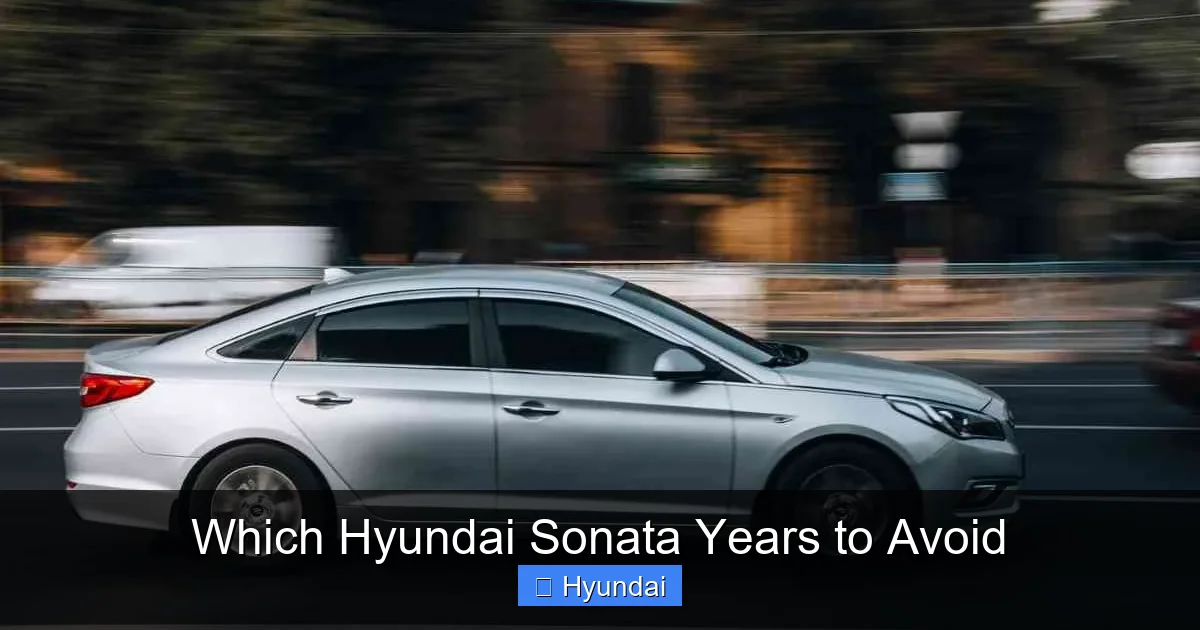
Visual guide about Which Hyundai Sonata Years to Avoid
Image source: autocareaids.com
Your best path to a fantastic, reliable, and affordable used Sonata is to target the 2015-2019 model years. You get a car that’s past its most troubled period, with modern features and proven powertrains, for a fraction of the price of a new one. For the 2020+ models, be a meticulous electronics inspector. No matter what, never buy based on price or appearance alone. The $150 you spend on a pre-purchase inspection is the best investment you’ll make in your used car journey. It’s the shield that protects you from the very specific, very expensive ghosts of Hyundai’s past.
Frequently Asked Questions
What is the absolute worst year for a Hyundai Sonata to avoid?
The single riskiest years are 2011-2014 due to the Theta II engine defect, which can lead to total engine failure. The 2006-2010 models are also terrible due to transmission issues. If forced to choose, the 2011-2014 era carries a higher average repair cost and safety risk.
Are all 2012 Hyundai Sonatas bad?
Statistically, yes, the 2012 Sonata has a much higher incidence of catastrophic engine failure due to the Theta II defect. However, if the specific VIN you are looking at has had the long-block engine replacement performed under the Hyundai warranty extension and has perfect documentation, it could be mechanically sound. But it’s a gamble, and the car’s value will always be depressed by its problematic history.
How much does it cost to replace a Theta II engine?
A full engine replacement at a dealership or reputable shop typically costs between $6,000 and $9,000, including parts and labor. This is often more than the car’s market value, which is why these failures are so financially ruinous and why the warranty extension was so critical for covered vehicles.
Is a 2021 Hyundai Sonata reliable?
Mechanically, yes. The powertrain in the 2021 Sonata is very reliable. However, you must be prepared for potential electronic and software glitches. A 2021 Sonata is a good purchase if you meticulously test every infotainment and driver-assist feature and get a full diagnostic scan to ensure no modules are failing.
Should I buy a used Hyundai Sonata with over 100,000 miles?
It depends entirely on the year and service history. A 2018 Sonata with 100,000 miles and a perfect service record is a much better bet than a 2013 Sonata with the same mileage and no records. For high-mileage cars from the “avoid” years (pre-2015), the risk of major failure increases dramatically and is generally not worth the savings.
How can I check if a Sonata’s Theta II engine is covered by warranty?
You must call a Hyundai dealership’s service department with the vehicle’s 17-digit VIN. They can look up the specific warranty status in Hyundai’s system. Do not trust a private seller’s word. Get the coverage status in writing. Also, review the details of the class-action settlement online to understand the exact terms and exclusions.
