
Which Bmw Models Have Ambient Air?

BMW does not offer a feature called “ambient air.” The term you’re looking for is Ambient Lighting, a sophisticated interior illumination system. This feature is widely available across most BMW models, primarily from the 2016 model year onward, and is often bundled in premium packages like the Ambient Lighting Package or as part of the Executive Package. Availability varies by model year, trim level, and region, so always verify the specific vehicle’s specifications.
Key Takeaways
- Terminology First: “Ambient air” is a common misnomer. BMW’s correct feature is Ambient Lighting, which uses subtle LEDs to illuminate interior surfaces, not to control cabin air quality or filtration.
- Widespread Availability: Ambient Lighting is a staple in modern BMWs, standard or optional on nearly all models from the F30 3 Series (2016+) and G01 X3 (2018+) onward, including the 1, 2, 4, 5, 6, 7, 8 Series, and X1 through X7 SUVs.
- Package-Dependent: It’s rarely a standalone option. You’ll typically find it within the Ambient Lighting Package, Executive Package, Premium Package, or as part of a higher trim like M Sport or Luxury.
- Customization is Key: Modern BMW Ambient Lighting systems offer multiple color choices (often 11+ colors) and brightness settings, controllable via the iDrive infotainment system for a personalized cabin mood.
- Not for Air Filtration: If you’re concerned about cabin air quality, look for the Cabin Air Filter (standard on all models) or the Air Quality Package with activated carbon filters, which is a separate system entirely.
- Retrofitting is Complex: Adding Ambient Lighting to a pre-2016 model without it is a major, expensive electrical modification involving new wiring harnesses and modules, and is generally not recommended.
- Always Verify: The single best way to confirm is by checking the original window sticker (Monroney label) for the specific VIN, or by consulting a BMW dealership’s build sheet for that exact vehicle.
[FEATURED_IMAGE_PLACEHOLDER]
📑 Table of Contents
- Demystifying “Ambient Air”: It’s All About the Light
- A Beacon of Modern BMW: The Evolution of Ambient Lighting
- The Model-by-Model Guide: Where You’ll Find the Glow
- How It Works and How You Control It
- How to Find Out If a Specific Used BMW Has It
- Ambient Lighting vs. The Competition: A Quick Comparison
- Beyond the Glow: The Real “Air” Systems in Your BMW
Demystifying “Ambient Air”: It’s All About the Light
Have you ever heard a friend talk about their car’s “ambient air” feature and wondered what magical, scented, or climate-controlling wonder that could be? You’re not alone. In the world of BMW, the phrase “ambient air” is a persistent piece of automotive folklore—a slight mishearing or mashup of terms that points to one of the brand’s most delightful modern features: Ambient Lighting.
Let’s clear the air right now: BMW does not have an “ambient air” system that perfumes or significantly alters cabin air composition through vents. What they do have, and what people are almost certainly referring to, is a network of hidden LED strips that cast a soft, colorful glow onto the dashboard, door panels, center console, and sometimes even the footwells. It’s about creating atmosphere, not aerating. This subtle illumination transforms the interior from a functional space into a tailored lounge, especially at night. So, as we dive into which BMW models have this feature, we’re unequivocally discussing Ambient Lighting.
A Beacon of Modern BMW: The Evolution of Ambient Lighting
From Niche to Necessary: How It Spread Across the Lineup
BMW didn’t invent ambient interior lighting, but they certainly perfected its integration into a premium driving experience. The earliest iterations appeared as a standalone option on high-end models like the E65 7 Series and E90 3 Series in the mid-to-late 2000s. These were often simple, single-color (usually white or blue) systems with limited zones. The real revolution came with the F30/F31 3 Series and F20 1 Series generation around 2012-2015, where it became a more prominent, multi-zone feature bundled in the Ambient Lighting Package.
Visual guide about Which Bmw Models Have Ambient Air?
Image source: i.ytimg.com
The tipping point for ubiquity arrived with the new cluster of platforms (the so-called “CLAR” platform) launched from 2016 onward. Models like the G30 5 Series, G01 X3, and G11 7 Series made ambient lighting a core component of their premium packages. Today, it’s hard to find a new BMW without at least some form of interior ambient illumination, especially in markets like North America and Europe where consumers expect such tech. The system has evolved from static colors to dynamic, multi-color setups with up to 11 selectable hues and even “themed” lighting that changes with driving mode or climate control settings.
The Model-by-Model Guide: Where You’ll Find the Glow
Now, for the meat of the matter. Which BMWs have this? The short answer is: almost all of them from the last 8-9 years. But specifics matter. Availability hinges on three things: the model generation, the equipment package ordered, and sometimes the specific market. Below is a breakdown by core model lines. Remember, model years can vary by region.
Visual guide about Which Bmw Models Have Ambient Air?
Image source: media.evkx.net
1 Series, 2 Series, and M2
The compact BMWs got in on the action early. The F20/F21 1 Series (2012-2019) offered Ambient Lighting primarily in the M Sport Package or the dedicated Ambient Lighting Package in later years. Its successor, the F40 1 Series (2019-present), includes it as part of the Executive Package or higher trims. The F22/F23 2 Series and the current G42 2 Series similarly feature it bundled with M Sport or Premium packages. Even the high-performance BMW M2 (F87 and G87) comes standard with a sportier version of ambient lighting, often with M-specific colors like red or blue accents.
3 Series, 4 Series, and M3/M4
The quintessential BMW sedan and its coupe/convertible siblings have long been ambassadors for this tech. The iconic F30 3 Series (2012-2019) made ambient lighting a popular option. The current G20/G21 3 Series and G22/G23 4 Series feature a sophisticated, multi-color system as part of the Ambient Lighting Package or often standard on models equipped with the Executive Package. For the performance icons, the BMW M3 (G80) and BMW M4 (G82) include it standard, with dynamic lighting that can pulse in sync with the engine’s RPMs in sport modes—a feature that really shows what the system can do.
5 Series, 6 Series, and M5/M6
In the executive sedan and grand tourer realm, ambient lighting is a hallmark of luxury. The F10/F11 5 Series (2010-2017) had it available in higher trims. The current G30/G31 5 Series and its grand tourer sibling, the BMW 6 Series Gran Turismo (G32), feature it almost universally, as it’s deeply integrated into the Executive Package and the luxurious Luxury Package. The high-performance BMW M5 (F90 and current G60) and the now-discontinued M6 (F06/F12/F13) always included it as a standard feature, blending performance with a bespoke cockpit atmosphere.
7 Series and 8 Series: The Flagship Lounge
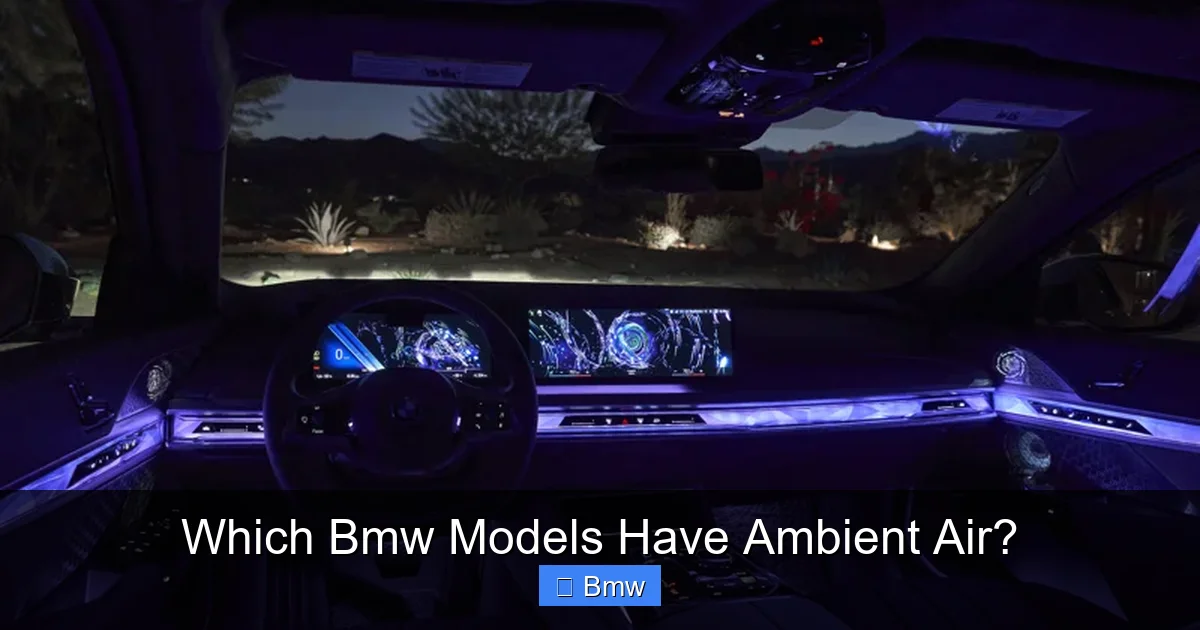
Here, ambient lighting isn’t just an option; it’s an expected element of a full luxury statement. The F01 7 Series (2008-2015) was one of the first to pioneer the concept in a BMW. The current G11/G12 7 Series and the grand tourer BMW 8 Series (G14/G15/G16) take it to the next level. These models often feature the most extensive LED arrays, illuminating surfaces like the contour lighting on the door panels, the instrument panel, and even the rear reading lamps with integrated mood lighting. It’s seamlessly tied into the Ambient Lighting Package and is almost always present on vehicles with the top-tier Executive Package.
X Series SUVs: From Compact to Full-Size
BMW’s SUV lineup has wholeheartedly embraced ambient lighting, making it a key selling point for family and luxury crossovers.
- X1 (U11/F48): Available with the Xline or M Sport Package, or the Premium Package.
- X2 (F39): Typically bundled with the M Sport Package.
- X3 (G01/F97): A very common feature, part of the Premium Package or M Sport Package.
- X4 (G02/F98): Similar to the X3, found in M Sport and higher trims.
- X5 (G05/F15): Widely available via the Premium Package, Executive Package, or standard on higher trims like the xDrive50i.
- X6 (G06/F16): Follows the X5’s availability pattern.
- X7 (G07): As the flagship SUV, it features extensive ambient lighting as part of its standard luxury appointments on most models, especially with the Executive Package.
How It Works and How You Control It
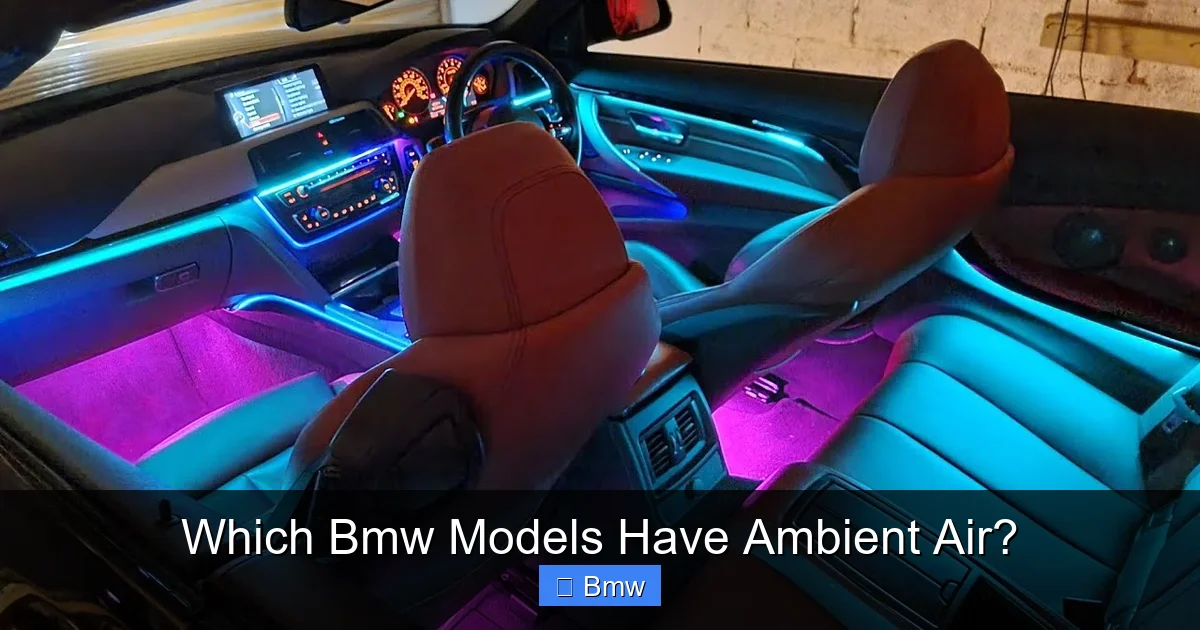
The system is elegantly simple in concept. A series of thin, flexible LED strips are meticulously tucked away in crevices—along the edges of the dashboard, beneath the door handles, around the center console, and in the footwells. When activated, they emit a soft, indirect light that washes over the hard surfaces, eliminating harsh shadows and creating a sense of spaciousness and calm.
Visual guide about Which Bmw Models Have Ambient Air?
Image source: i.ytimg.com
Control is almost always through the central iDrive controller or touchscreen. You’ll navigate to the “Climate/Comfort” or “Lighting” menu. Here, you can typically:
- Select a Color: Choose from a palette of 6 to 11 colors (white, blue, orange, red, green, purple, etc.).
- Adjust Brightness: Set the intensity from a subtle glow to a more pronounced illumination.
- Choose Themes: Some models link the color to the driving mode (e.g., Sport mode turns LEDs red, Comfort mode uses blue/white).
- Zone Control: In newer models (G20 3 Series and later), you can sometimes dim or brighten specific zones like the door panels vs. the footwells independently.
Pro Tip: The lighting often activates when you unlock the car, when opening a door, and when turning on the headlights. It’s a small but powerful welcome feature.
How to Find Out If a Specific Used BMW Has It
This is the crucial part for a buyer. A seller might say “it has ambient lighting,” but you need proof. Here’s your actionable checklist:
- Check the Window Sticker (Monroney Label): If the original sticker is in the car’s records, look for “Ambient Lighting” or “Ambient Lighting Package” under the “Interior” or “Convenience” section.
- Ask for the BMW Build Sheet: A dealer can pull the exact factory build sheet for a VIN. It will list every option code (like SA6U for Ambient Lighting in many models). This is the gold standard.
- Physical Inspection: At night, with the car on but headlights off, look at the base of the windshield (dashboard edge), the lower part of the A-pillar trims, and the center console area. You should see faint, even strips of light when the interior lights are on. Turn the dash dimmer switch; the ambient lights should brighten/dim with it.
- Use the iDrive Menu: As described above, dig through the lighting settings. If you find a color picker for interior accents, you have it.
- Online VIN Decoders: While not 100% complete for all markets, sites like bimmer.work or bmwvin.com can often decode standard and optional equipment from the VIN, including lighting packages.
Ambient Lighting vs. The Competition: A Quick Comparison
BMW’s system is excellent, but it operates in a crowded field. How does it stack up?
- Audi: Audi’s Ambient Lighting is arguably the most celebrated in the industry, with more extensive coverage (often lighting the entire door panel with dynamic contours) and seamless integration with their Virtual Cockpit and MMI. It’s available on nearly all their models from the A4 upward. You can see which Audi models have it here.
- Mercedes-Benz: Mercedes uses “Ambient Lighting” as well, often with up to 64 colors and dramatic “theater-style” fading. It’s a key part of their optional Ambient Lighting Plus package. Their system is highly customizable and sometimes more flamboyant than BMW’s typically understated approach.
- Kia: Surprising many, Kia offers a very competent ambient lighting system in models like the Kia K5 and Telluride, often as part of their premium packages. Read about the Kia K5’s ambient lighting features here. It’s a great example of this trickle-down luxury tech.
BMW’s strength lies in its perfect balance—it’s sophisticated, integrated without being gaudy, and always feels like a natural extension of the driver-focused cockpit philosophy. It doesn’t shout; it whispers elegance.
Beyond the Glow: The Real “Air” Systems in Your BMW
Since we’re clearing the air, let’s briefly touch on what *does* handle air in your BMW. If cabin air quality is your true concern, focus on these:
- Cabin Air Filter (Microfilter): Standard on every BMW. It filters pollen, dust, and pollutants from incoming air. It’s a maintenance item that needs replacing every 15,000-30,000 miles.
- Air Quality Package (SA 3AG): This is an optional feature on many models. It adds an activated carbon filter that additionally reduces gaseous pollutants and odors. It’s the closest thing to an “air purifying” system BMW offers.
- Rear Seat Climate Control: Some models (like the 7 Series and X7) have dedicated vents and controls for rear passengers, but this is about airflow, not filtration.
So, if you want your BMW’s interior air clean, change your cabin air filter regularly and consider the Air Quality Package. If you want it to look stunning at night, you want Ambient Lighting.
Frequently Asked Questions
Is “ambient air” the same as the cabin air filter in my BMW?
No. They are completely different systems. “Ambient air” is a misnomer for Ambient Lighting, the LED interior mood lighting. The Cabin Air Filter is a physical filter that cleans incoming air from outside. Both exist in your car but serve entirely separate purposes.
Can I retrofit Ambient Lighting into an older BMW that didn’t come with it?
While technically possible, it is a complex, expensive, and invasive modification. It requires running new wiring throughout the cabin, installing LED strips in hidden locations, and often adding new control modules. It’s not recommended for most owners due to cost, potential for electrical issues, and lack of seamless integration with the original iDrive system.
Does Ambient Lighting affect my BMW’s battery life?
Negligibly. The LED strips consume very little power (typically less than 5 watts total). The system is designed to turn off automatically when the car is locked or the battery is low, so you won’t come back to a dead battery from leaving the interior lights on.
What’s the difference between BMW’s Ambient Lighting and the “Theater Lighting” or “Lighting Package”?
Terminology varies by model year and region. “Ambient Lighting” is the core feature. “Theater Lighting” often refers to a more advanced version that includes dynamic fading effects or additional zones (like in the rear of a 7 Series). “Lighting Package” is sometimes a broader bundle that includes ambient lighting plus other features like illuminated sill plates or door handle lighting. Always check the specific package contents.
Can I change the color of the Ambient Lighting to match my mood?
Yes, in most modern BMWs (G20 3 Series and later, G30 5 Series, G11 7 Series, and corresponding SUVs). You can select from a palette of colors (usually 6-11 options) via the iDrive infotainment system. Some models even allow the color to change automatically based on the selected driving mode (e.g., red for Sport, blue for Comfort).
If I buy a used BMW, how can I be 100% sure it has Ambient Lighting?
The only definitive way is to obtain the official BMW build sheet for the vehicle’s VIN from a dealership. This factory document lists every option code. Look for codes like SA6U (Ambient Lighting) or SA6N (Ambient Lighting with Extended Applications). A physical check at night for the LED strips and the color menu in iDrive are excellent secondary confirmations.