Where Is the Tpms Reset Button on Toyota Camry?

Contents
- 1 Key Takeaways
- 2 Where Is the TPMS Reset Button on Toyota Camry?
- 3 Understanding the Toyota Camry TPMS System
- 4 Locating the TPMS Reset Button (2007–2017 Toyota Camry Models)
- 5 Step-by-Step TPMS Reset Procedure (2007–2017 Camry)
- 6 Resetting TPMS on 2018–2024 Toyota Camry Models (No Physical Button)
- 7 Troubleshooting Common TPMS Issues
- 8 When to Visit a Toyota Dealer or Mechanic
- 9 Maintaining Your TPMS for Long-Term Reliability
- 10 Final Thoughts
- 11 Frequently Asked Questions

Tire Repair Kit

Battery Terminal Cleaner

Reflective Stickers

Interior Cleaner Spray
Knowing where the TPMS reset button is on your Toyota Camry can save you time, money, and stress. This guide walks you through the exact location, step-by-step reset procedures, and helpful tips for different model years—so you can keep your tire pressure monitoring system working perfectly.
This is a comprehensive guide about Where Is the TPMS Reset Button on Toyota Camry?.
Key Takeaways
- TPMS reset button location varies by model year: Older Camrys (2007–2017) often have a physical button near the steering column, while newer models (2018+) use the infotainment system or instrument cluster menu.
- Always check tire pressure before resetting: Ensure all tires are inflated to the recommended PSI (found on the driver’s door jamb sticker) to avoid false warnings.
- Use the correct reset procedure: Follow the specific steps for your model year—pressing the button too early or too late can prevent a successful reset.
- Battery disconnection may be needed: In some cases, disconnecting the car battery for 10–15 minutes can help reset the TPMS if the standard method fails.
- Visit a dealer if issues persist: If the TPMS light stays on after multiple resets, there may be a sensor fault or low battery in a tire sensor requiring professional diagnosis.
- Regular maintenance prevents TPMS problems: Check tire pressure monthly and inspect sensors during tire rotations or replacements.
- Aftermarket wheels may affect TPMS: If you’ve installed new rims, ensure they’re compatible with Toyota’s TPMS system to avoid malfunctions.
[FEATURED_IMAGE_PLACEHOLDER]
Where Is the TPMS Reset Button on Toyota Camry?
If you’ve ever seen that little tire-shaped warning light flicker on your Toyota Camry’s dashboard, you’ve encountered the Tire Pressure Monitoring System (TPMS). It’s designed to alert you when one or more of your tires is significantly underinflated—a safety feature that helps prevent blowouts, improves fuel efficiency, and extends tire life. But what happens when you’ve properly inflated your tires and the light won’t go off? That’s when you need to reset the TPMS.
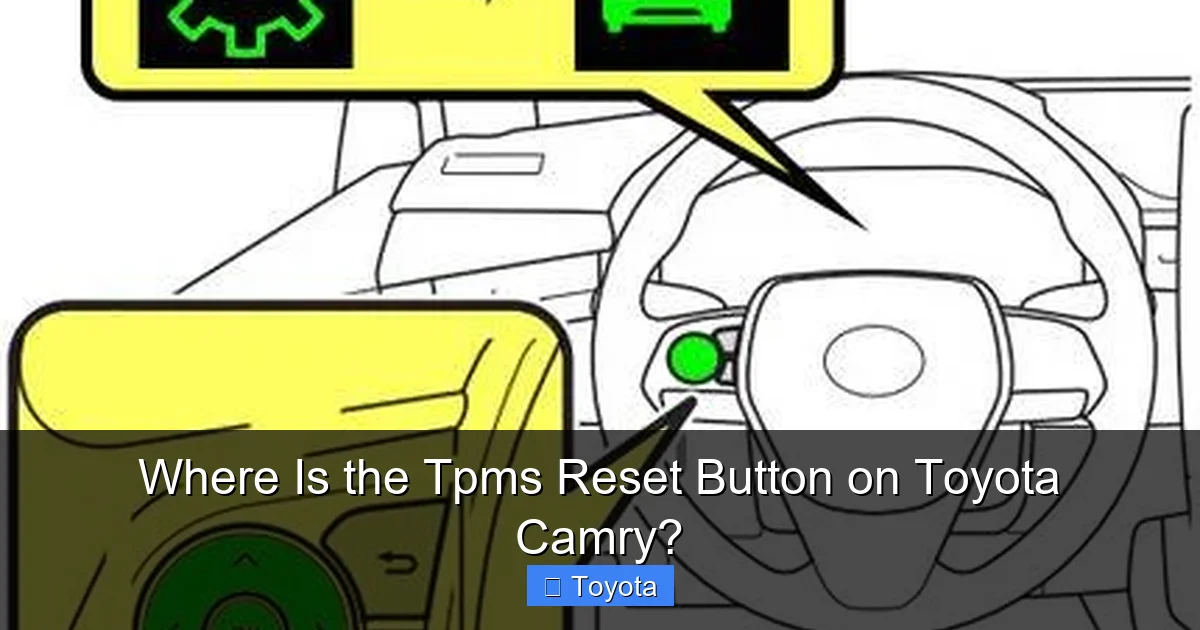
Many Toyota Camry owners assume there’s a single, universal “TPMS reset button” hidden somewhere under the dashboard or behind the glove box. The truth? It’s not that simple. The location and method for resetting the TPMS depend heavily on your Camry’s model year. From 2007 to 2017, most models feature a physical reset button, usually tucked near the steering column. But starting in 2018, Toyota shifted to a digital reset process using the vehicle’s instrument cluster or touchscreen infotainment system.
This guide will walk you through everything you need to know—where to find the TPMS reset button (or menu), how to use it correctly, and what to do if the light still won’t turn off. Whether you drive a 2009 Camry LE or a 2023 Camry Hybrid XSE, we’ve got you covered. Plus, we’ll share practical tips to avoid common mistakes and keep your TPMS functioning smoothly for years to come.
Understanding the Toyota Camry TPMS System
Before diving into reset procedures, it helps to understand how the TPMS actually works in your Toyota Camry. The system uses sensors mounted inside each tire (usually attached to the valve stem) to monitor air pressure in real time. These sensors transmit data wirelessly to the vehicle’s onboard computer. If pressure drops below a certain threshold—typically 25% below the recommended level—the dashboard warning light illuminates.
There are two main types of TPMS: direct and indirect. Toyota Camrys use a direct TPMS, meaning each tire has its own physical sensor that measures actual pressure. This is more accurate than indirect systems, which estimate pressure based on wheel speed differences detected by the ABS system.
The TPMS isn’t just about safety—it’s also about efficiency. Underinflated tires increase rolling resistance, which reduces gas mileage. According to the U.S. Department of Energy, keeping tires properly inflated can improve fuel economy by up to 3%. Over time, that adds up to real savings at the pump.
It’s also worth noting that TPMS sensors have batteries inside them. These typically last 5–10 years, but once they die, the sensor must be replaced—not just recharged. That’s why older Camrys (especially those from 2007–2012) may start showing persistent TPMS warnings even after a reset: the sensor batteries are simply worn out.
Another key point: the TPMS light may come on temporarily in cold weather. Tire pressure drops about 1 PSI for every 10°F decrease in temperature. So if you inflate your tires on a warm fall day and then face a sudden winter chill, the light might trigger—even though nothing is wrong. In these cases, a simple reset after re-inflating usually does the trick.
Locating the TPMS Reset Button (2007–2017 Toyota Camry Models)
For Toyota Camry owners with models from 2007 to 2017, the good news is that there’s usually a physical TPMS reset button—no menu diving required. However, its exact location can vary slightly depending on the year and trim level.
In most cases, you’ll find the TPMS reset button under the dashboard, near the steering column, often on the lower left side (driver’s side). It’s typically a small, unmarked black or gray button, sometimes recessed into the panel. You might need to crouch down and look up from beneath the steering wheel to spot it. Some owners describe it as being “hidden in plain sight”—easy to miss if you don’t know what you’re looking for.
On certain trims like the SE or XLE, the button may be located slightly to the right or integrated into a cluster of other switches. If you can’t find it, consult your owner’s manual—Toyota usually includes a diagram showing its position. Alternatively, search online for “TPMS reset button location [your model year] Toyota Camry” and you’ll likely find photos from other owners.
One helpful tip: the button is often near the hood release lever or the fuse box cover. If you see a small, round button with no label, there’s a good chance that’s it. Don’t confuse it with the brake fluid reservoir cap or other under-dash components—those won’t help with TPMS.
Once you’ve located the button, the next step is knowing when and how to press it. Timing matters! You can’t just mash the button randomly and expect the system to reset. There’s a specific sequence that tells the car’s computer to recalibrate the sensors.
Step-by-Step TPMS Reset Procedure (2007–2017 Camry)
Resetting the TPMS on a 2007–2017 Toyota Camry is straightforward—if you follow the steps in the right order. Here’s a reliable method that works for most models in this range:
Step 1: Inflate all tires to the correct pressure.
Check the sticker on the driver’s door jamb for the recommended PSI (usually around 32–35 PSI for most Camrys). Use a quality tire gauge—don’t rely solely on the gas station air pump display, as these can be inaccurate. Make sure all four tires (plus the spare, if equipped) are properly inflated.
Step 2: Turn the ignition to “ON” (but don’t start the engine).
Insert the key and turn it to the “ON” position. You should see dashboard lights illuminate, including the TPMS warning light. Do not press the brake pedal or start the engine yet.
Step 3: Locate and press the TPMS reset button.
Find the small button under the dashboard near the steering column. Press and hold it for about 3–5 seconds. You should see the TPMS light blink several times—this indicates the system is entering reset mode.
Step 4: Start the engine.
After releasing the button, start the car. Let it idle for a few minutes. The TPMS light should turn off within 1–3 minutes as the system recalibrates.
Step 5: Drive the vehicle.
Take your Camry for a short drive (about 10–15 minutes at speeds above 20 mph). This allows the sensors to transmit updated pressure data and confirms the reset was successful.
If the light remains off after driving, you’re all set! If it comes back on, double-check tire pressures and repeat the process. Sometimes the system needs a second attempt to fully sync.
A common mistake? Pressing the button too early or too late in the sequence. For example, if you press it while the engine is running, the system won’t recognize the command. Always follow the ignition “ON” → press button → start engine order.
Another tip: avoid resetting the TPMS immediately after inflating tires in cold weather. Let the car sit for 10–15 minutes so tire pressures stabilize. Rapid temperature changes can cause temporary fluctuations that confuse the system.
Resetting TPMS on 2018–2024 Toyota Camry Models (No Physical Button)
Starting with the 2018 model year, Toyota redesigned the Camry with a sleeker interior and advanced tech—including a fully digital TPMS reset process. There is no physical reset button on 2018 and newer Camrys. Instead, you’ll use the instrument cluster display or the central touchscreen (depending on trim level) to initiate the reset.
This change aligns with Toyota’s broader shift toward integrated vehicle systems. While it may seem more complicated at first, the digital method is actually more precise and reduces the risk of accidental resets.
Here’s how to do it:
For models with a 7-inch or 9-inch touchscreen (most trims):
1. Turn the ignition to “ON.”
2. Tap the “Menu” button on the steering wheel or touchscreen.
3. Navigate to “Vehicle Settings” > “TPMS Reset” or “Tire Pressure.”
4. Select “Reset” and confirm.
5. The system will prompt you to drive the vehicle for 10–15 minutes to complete calibration.
For models with a smaller instrument cluster (base L or LE trims):
1. Turn the ignition to “ON.”
2. Use the steering wheel controls to scroll to the “Settings” menu on the dashboard display.
3. Find “TPMS” or “Tire Pressure Monitor.”
4. Select “Reset” and follow on-screen instructions.
5. Drive the car as directed.
In both cases, the TPMS light will blink during the reset process and turn off once calibration is complete. If the light stays on, ensure all tires are properly inflated and try the reset again.
One advantage of the digital system? It often provides more feedback. You might see messages like “TPMS Reset Complete” or “Calibrating… Please Drive Vehicle.” This helps confirm the process is working.
However, if your infotainment system freezes or the menu doesn’t appear, try restarting the car. Sometimes a simple reboot resolves software glitches. Also, make sure your Camry isn’t in “Maintenance Mode” or “Valet Mode,” as these can restrict access to certain settings.
Troubleshooting Common TPMS Issues
Even with the correct reset procedure, TPMS problems can persist. Here are some common issues and how to address them:
Issue 1: TPMS light won’t turn off after reset.
This often means one or more sensors aren’t transmitting data. Possible causes include a dead sensor battery, damaged sensor, or interference from aftermarket wheels. Try driving the car for 20–30 minutes at varying speeds. If the light remains, visit a Toyota dealer or tire shop for a diagnostic scan.
Issue 2: Light comes on in cold weather.
As mentioned earlier, temperature drops reduce tire pressure. Inflate tires to the recommended PSI when cold (before driving), then reset the TPMS. The light should stay off unless pressure drops further.
Issue 3: Only one tire shows low pressure.
Check that tire for leaks, punctures, or a faulty valve stem. Even a slow leak can trigger the TPMS. Use soapy water to detect bubbles around the valve or rim.
Issue 4: After installing new tires or wheels.
If you’ve recently replaced tires or switched to aftermarket rims, the TPMS sensors may not be compatible. Some wheels don’t accommodate Toyota’s sensor design. Always verify compatibility before purchasing. If needed, have new sensors installed and programmed by a professional.
Issue 5: Intermittent TPMS warnings.
This could indicate a weak sensor battery or electrical interference. Older Camrys (pre-2015) are especially prone to this. A technician can test each sensor’s signal strength and recommend replacements.
Pro Tip: Keep a portable tire inflator in your trunk. It lets you quickly top off tires and reset the TPMS without visiting a gas station—especially useful during road trips or winter months.
When to Visit a Toyota Dealer or Mechanic
While most TPMS resets can be done at home, there are times when professional help is needed. If you’ve followed all steps correctly and the light still won’t turn off, it’s likely a hardware issue—not a software glitch.
Visit a Toyota dealership or certified mechanic if:
– The TPMS light flashes continuously (indicating a system malfunction).
– You hear a beeping sound along with the warning (suggests a critical fault).
– Multiple resets fail over several days.
– You suspect a sensor is damaged or dead.
Dealers have specialized tools to read TPMS error codes and test individual sensors. They can also reprogram sensors after tire rotation or replacement—something most home mechanics can’t do.
Additionally, if your Camry is still under warranty, TPMS sensor replacement may be covered. Even out of warranty, dealerships often offer competitive pricing on OEM sensors compared to third-party alternatives.
Don’t ignore a persistent TPMS warning. Driving with underinflated tires increases the risk of blowouts, especially at highway speeds. It also wears out tires unevenly, costing you more in the long run.
Maintaining Your TPMS for Long-Term Reliability
Prevention is always better than repair. To keep your Toyota Camry’s TPMS working smoothly:
– Check tire pressure monthly using a digital gauge.
– Rotate tires every 5,000–7,000 miles to ensure even wear.
– Inspect valve stems for cracks or leaks during oil changes.
– Avoid driving over potholes or curbs, which can damage sensors.
– Replace TPMS sensors every 7–10 years, even if they seem functional.
Many auto shops include TPMS checks during routine maintenance. Ask your technician to verify sensor health during your next visit.
Also, consider upgrading to a TPMS diagnostic tool if you’re a DIY enthusiast. These handheld devices (available for $30–$100) let you read sensor IDs, check battery life, and troubleshoot issues without visiting a shop.
Final Thoughts
Knowing where the TPMS reset button is on your Toyota Camry—and how to use it—is a valuable skill that enhances both safety and convenience. Whether you drive an older model with a hidden physical button or a newer one with a digital menu, the process is manageable with the right guidance.
Remember: always inflate tires to the correct pressure first, follow the reset sequence carefully, and don’t hesitate to seek professional help if problems persist. With regular maintenance and attention, your TPMS will keep you informed and your ride smooth for years to come.
Frequently Asked Questions
Where is the TPMS reset button on a 2015 Toyota Camry?
The TPMS reset button on a 2015 Toyota Camry is typically located under the dashboard, near the steering column on the driver’s side. Look for a small, unmarked black or gray button beneath the instrument panel. You may need to crouch down to see it clearly.
How do I reset the TPMS on a 2020 Toyota Camry?
On a 2020 Camry, there is no physical reset button. Instead, turn the ignition to “ON,” go to the touchscreen menu, select “Vehicle Settings,” then “TPMS Reset.” Confirm the reset and drive the car for 10–15 minutes to complete calibration.
Why won’t my TPMS light turn off after resetting?
If the TPMS light remains on, possible causes include a dead sensor battery, incorrect tire pressure, or a damaged sensor. Ensure all tires are properly inflated and try the reset again. If the issue persists, visit a mechanic for diagnostics.
Can I drive with the TPMS light on?
It’s not recommended. The TPMS light indicates low tire pressure, which can lead to reduced fuel efficiency, uneven tire wear, or even a blowout. Inflate your tires and reset the system as soon as possible.
Do I need to reset TPMS after rotating tires?
Not always, but it’s a good practice. Tire rotation can temporarily disrupt sensor signals. After rotating, check tire pressures and perform a TPMS reset if the light comes on.
How often should I check my tire pressure?
Check tire pressure at least once a month and before long trips. Tires naturally lose air over time, and temperature changes can affect pressure. Regular checks help maintain optimal performance and safety.