
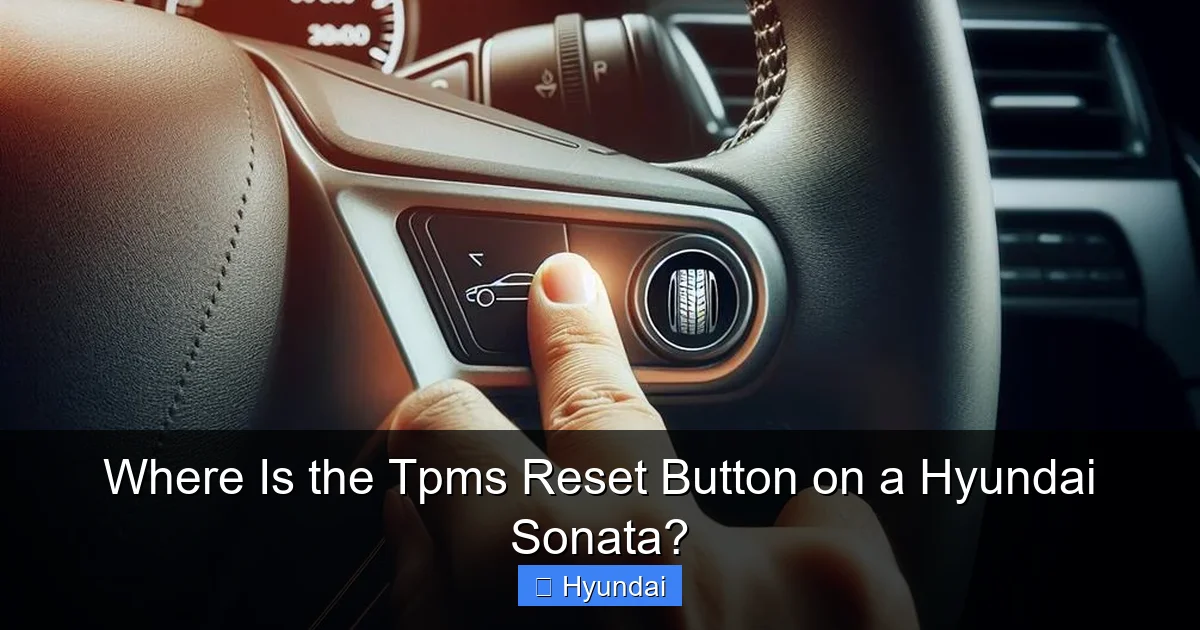
Where Is the Tpms Reset Button on a Hyundai Sonata?

Contents
- 1 Key Takeaways
- 2 📑 Table of Contents
- 3 Understanding Your Sonata’s TPMS: Direct vs. Indirect
- 4 The Hunt: Where to Look for a Physical Reset Button (Pre-2014 Models)
- 5 The Modern Reality: No Button, New Procedure (2014+ Models)
- 6 Step-by-Step Reset Guide: Putting It All Together
- 7 Common Issues and Troubleshooting
- 8 Professional vs. DIY: When to Call for Help
- 9 Frequently Asked Questions

Car Tire Inflator

Car Jump Starter

Car Shampoo Concentrate

Diesel Fuel Additive
Finding a dedicated TPMS reset button on a Hyundai Sonata depends heavily on the model year. Most Sonatas built from 2014 onward do not have a standard, accessible button for a manual reset; instead, the system often requires a scan tool or a specific electronic sequence via the vehicle’s settings menu. For earlier models (typically pre-2014), a small, black reset button is usually found inside the fuse panel or under the dashboard. Always ensure your tires are properly inflated to the recommended PSI before attempting any reset procedure.
Ah, the little yellow light on your dashboard that looks like an exclamation point inside a tire. It’s the Tire Pressure Monitoring System (TPMS) warning, and its sudden appearance can be a minor nuisance or a major headache, depending on how you look at it. You’ve likely come here because you’ve either just had your tires serviced, rotated, or replaced, and that light just won’t go away. Or maybe you’ve adjusted the pressure yourself and are scratching your head, wondering, “Where in the world is the TPMS reset button on a Hyundai Sonata?” You’re not alone. This is one of the most common questions for Sonata owners, and the answer, frustratingly, is: it depends entirely on your model year.
The Hyundai Sonata, a staple in the midsize sedan family, has evolved dramatically over its generations. With that evolution came changes in how its safety and monitoring systems operate. What was once a simple, physical button you could press has, in many cases, become a more complex electronic procedure. Don’t worry, though. We’re going to break it all down for every generation you’re likely to encounter on the road today. We’ll explore where the button *might* be, why it might not exist, and what your actual reset options are. By the end, you’ll know exactly what to do to silence that persistent warning light and get back to confident, safe driving.
Key Takeaways
- No Universal Button: Modern Hyundai Sonatas (2014+) typically lack a simple, user-accessible “TPMS reset button” like older vehicles. The reset is often electronic and may require a scan tool.
- Location Varies by Year: For models that do have a physical button (usually pre-2014), it is most commonly located inside the driver’s side fuse panel or behind a small panel on the lower dash near the steering column.
- Inflation is Key First: The TPMS light will not reset if tire pressures are not exactly to the manufacturer’s specifications, as listed on the driver’s door jamb sticker.
- Electronic Reset via Menu: Many newer Sonatas use a “TPMS Learning” or “Tire Pressure” option within the vehicle’s instrument cluster settings menu, activated with the ignition and button presses.
- OBD-II Scan Tool Often Required: For the majority of post-2014 Sonatas, a professional-grade OBD-II scan tool with TPMS programming capability is the standard method to clear the light after tire service.
- Rotating Tires Requires Relearning: If you rotate your tires (especially on models with indirect TPMS), you will almost certainly need to perform a reset procedure for the system to recognize the new sensor positions.
- Consult the Manual: Your owner’s manual is the definitive source for the exact procedure and location for your specific VIN and model year.
📑 Table of Contents
- Understanding Your Sonata’s TPMS: Direct vs. Indirect
- The Hunt: Where to Look for a Physical Reset Button (Pre-2014 Models)
- The Modern Reality: No Button, New Procedure (2014+ Models)
- Step-by-Step Reset Guide: Putting It All Together
- Common Issues and Troubleshooting
- Professional vs. DIY: When to Call for Help
Understanding Your Sonata’s TPMS: Direct vs. Indirect
Before we start hunting for a button, we need to understand what type of TPMS your Sonata uses. This is the single biggest factor determining your reset procedure. There are two main types:
Direct TPMS (Most Common in Modern Sonatas)
This system uses physical sensors mounted inside each wheel (on the valve stem). These sensors broadcast a unique radio frequency ID to the car’s computer. The computer knows which corner of the car each sensor is on. If a sensor’s pressure drops below the threshold, or if the system doesn’t receive a signal from a specific sensor (like after a tire rotation), it triggers the warning light. Resetting a direct system usually requires the car to “relearn” which sensor is in which location. This often requires a special scan tool that can communicate with the TPMS module. On many models, there is no manual button for this.
Indirect TPMS (Less Common, Found on Some Older Models)
This system doesn’t use wheel sensors. Instead, it uses the existing wheel speed sensors from the Anti-lock Braking System (ABS). The car’s computer monitors the rotational speed of each wheel. If one tire is significantly underinflated, its circumference changes, causing it to rotate at a slightly different speed than the others. The system detects this discrepancy and triggers the light. Resetting an indirect system is often simpler—it usually just involves inflating the tires correctly and then driving the car for a few minutes at a steady speed (often above 30 mph) for the system to recalibrate. Some indirect systems may have a reset button.
So, which does your Sonata have? A very strong rule of thumb: Hyundai Sonatas from model year 2014 to the present almost universally use a Direct TPMS system. This is a critical piece of information. If your Sonata is a 2014 model or newer, you should immediately prepare for the likelihood that there is no simple, labeled “TPMS reset button” under the hood or in the cabin. Your reset will be electronic or tool-based. If your Sonata is a 2013 model or older, you have a much higher chance of finding a physical reset button, and your procedure is more likely to be manual.
The Hunt: Where to Look for a Physical Reset Button (Pre-2014 Models)
If you own an older Sonata (typically 2010-2013), your search begins in a few key locations. These models often have a simple, recessed button used for initializing the TPMS after tire service. Grab a flashlight and a small flat-head screwdriver; you’ll need both.
Visual guide about Where Is the Tpms Reset Button on a Hyundai Sonata?
Image source: thecarhow.com
Location 1: The Driver’s Side Fuse Panel
This is the most common location. Look at the end of the dashboard on the driver’s side. You’ll see a rectangular plastic cover. This is the fuse panel. Gently pry this cover off with your screwdriver. Once removed, look inside the panel. You’re not looking for a fuse. Look for a small, black, button-like component, often labeled “TPMS” or simply a blank button. It’s usually about the size of a pencil eraser and sits low in the panel. This is your reset button. On some models, it might be a different color, like red or yellow.
Location 2: Under the Dashboard, Near the Steering Column
If you don’t find it in the fuse panel, get down on the floor on the driver’s side and look up underneath the plastic dashboard trim, to the left of the steering column. There is often a small removable panel or a hole with a rubber cover. The TPMS reset button can be hidden here. It’s a less common spot but worth checking if the fuse panel was a bust.
Location 3: The Glove Box or Center Console
Some manufacturers occasionally hide service buttons in less intuitive places. While rare for Hyundai, it doesn’t hurt to quickly peek inside the glove box (check the sides and back) or under the center console lid/ash tray if your car has one.
Important: If you locate a button that says “TPMS” or looks like it’s meant for a system reset, you’ve found it! The procedure for these older models is usually: turn the ignition to the “ON” position (engine off, dashboard lights on), press and hold the button for about 3 seconds until the TPMS warning light blinks three times, then release. The light should turn off after a few seconds, indicating the reset is complete. You must then drive the car for about 20 minutes at various speeds to allow the system to relearn the sensor positions. But always, always confirm this procedure in your owner’s manual first.
The Modern Reality: No Button, New Procedure (2014+ Models)
Now, let’s address the majority of Sonatas on the road today. If you drive a 2014, 2015, 2016, 2017, 2018, 2019, 2020, 2021, 2022, or 2023 Sonata, you are almost certainly driving a car with a Direct TPMS system that does not have a user-accessible reset button. Hyundai’s design philosophy changed, integrating the reset function into the vehicle’s onboard computer and requiring either a menu-driven sequence or a professional scan tool. This is a security and calibration feature to ensure proper system function.

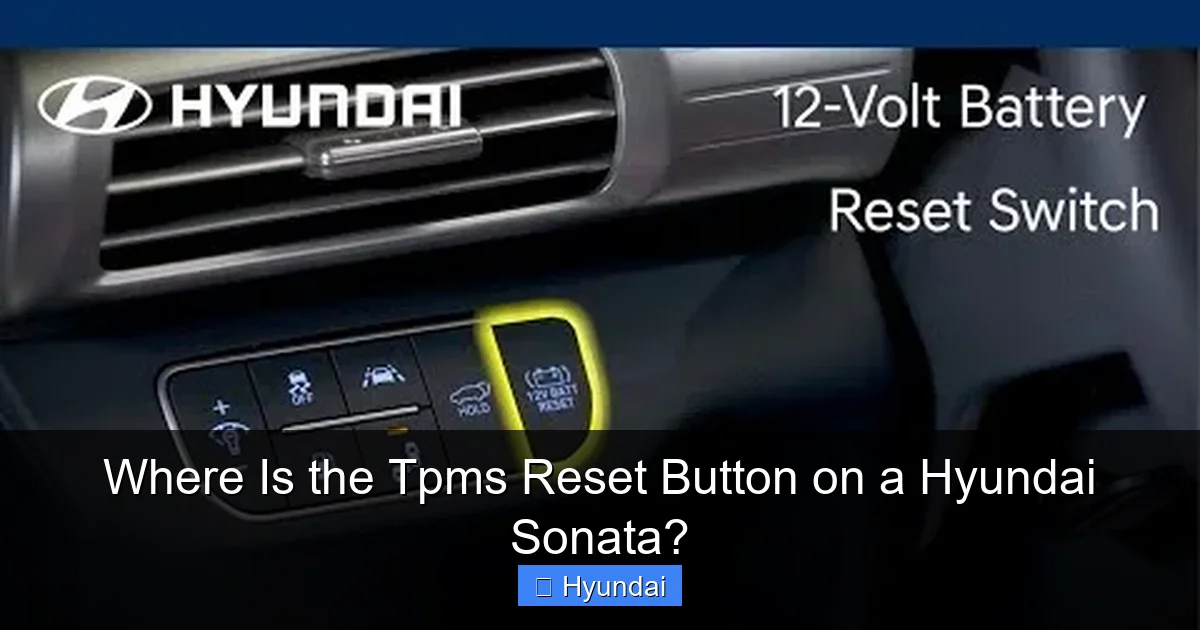
Visual guide about Where Is the Tpms Reset Button on a Hyundai Sonata?
Image source: i.redd.it
Method 1: The Settings Menu (If Equipped)
Some newer Sonata models (particularly certain trims or markets) may have a TPMS reset option buried in the instrument cluster’s settings menu. Here’s how to check:
- With the ignition in the “ON” position (engine off), use the steering wheel-mounted controls or the dashboard buttons to navigate to the “Vehicle Settings” or “User Settings” menu on the digital gauge cluster or infotainment screen.
- Look for an option called “TPMS,” “Tire Pressure,” “TPMS Reset,” or “Tire Learn.” The wording varies.
- Select this option. The system may prompt you to confirm or will tell you to cycle the ignition. Follow the on-screen prompts exactly.
- After confirming, the TPMS light may blink, indicating the reset/learn mode is active.
- You will then need to drive the car. The system will automatically detect and assign the sensors as you drive (usually at speeds above 30 mph for 15-30 minutes). The light should extinguish once learning is complete.
Note: This menu option is not guaranteed on all trims. If you cannot find it, your Sonata likely requires Method 2.
Method 2: The OBD-II Scan Tool (The Standard Professional Method)
This is the most reliable and common method for post-2014 Sonatas. The TPMS reset function is accessed through the vehicle’s On-Board Diagnostics (OBD-II) port, which is located under the dashboard on the driver’s side (it’s the 16-pin connector you use for emissions tests). A generic OBD-II code reader will not be able to reset the TPMS light. You need a dedicated TPMS tool or a high-end professional scan tool (like those from Autel, Launch, or Snap-on) that has the specific Hyundai TPMS reset/relearn software.
The process with a proper tool is straightforward for a technician:
- Connect the scan tool to the OBD-II port.
- Turn the ignition on.
- Navigate the tool’s menu to the “TPMS” or “Tire Pressure” section for Hyundai.
- The tool will communicate with the car’s TPMS control module. It will typically have a “Reset,” “Relearn,” or “Turn Off Warning Light” function.
- The technician will follow the prompts, which may involve selecting which wheel sensors are being replaced/rotated and activating each sensor’s signal.
- Once the tool confirms the procedure is complete, the TPMS light should turn off.
For the average DIYer, this means a trip to a tire shop (like Discount Tire, Tire Kingdom, etc.) or a mechanic. Most places will perform this reset for a small fee ($20-$50) when you get your tires serviced, as it’s part of their standard procedure. This is often the easiest and most cost-effective path.
Step-by-Step Reset Guide: Putting It All Together
Let’s create a universal checklist you can follow, regardless of your Sonata’s year. This methodical approach will save you time and frustration.

Visual guide about Where Is the Tpms Reset Button on a Hyundai Sonata?
Image source: oilreset.com
Step 1: Identify Your Model Year and Trim
This is non-negotiable. Look at your registration or the driver’s door jamb sticker. Knowing the exact year is 80% of the battle. If it’s 2014 or newer, prepare for the electronic/tool method.
Step 2: Check and Adjust All Tire Pressures
Before you even think about a reset, you must get the pressures perfect. Use a reliable, handheld tire pressure gauge. Do not rely on the gauge at a gas station air pump. Find the recommended PSI on the sticker on the driver’s door jamb (it will say something like “32 PSI” for all four tires, or sometimes a different pressure for front vs. rear). Inflate or deflate each tire to match this number exactly. Don’t forget the spare if it has a sensor (some do). If the pressures are off, the reset will fail, and the light will come right back on.
Step 3: Attempt the Physical Button Search (For Pre-2014)
If your car is 2013 or older, perform the search in the fuse panel and under the dash as described above. If you find a button, follow the manual’s hold-and-blink procedure. If you don’t find a button after a thorough search, your specific trim may not have one, or it may be located elsewhere only in the service manual.
Step 4: Search the Vehicle Settings Menu (For 2014+)
With the ignition on, meticulously go through every menu on your gauge cluster and infotainment screen. Look for any mention of TPMS, Tire, or Vehicle Settings. If you find a reset option, follow the on-screen instructions precisely. It will likely require you to confirm and then drive the car.
Step 5: The Inevitable – Visit a Professional
If steps 1-4 fail (which is highly likely for a 2014+ Sonata without a menu option), the answer is clear: you need a scan tool. Call your local tire shop, dealership service department, or a trusted independent mechanic. Explain you need a “TPMS relearn/reset” on your Sonata. It’s a quick, standard procedure for them. This is not a “rip-off” service; it’s compensating for the specialized equipment and software required to interface with your car’s computer. It’s often free if you just had tire work done there.
Common Issues and Troubleshooting
You’ve done everything right, but the light is still on. Here are the most common culprits.
“The Light Came Back On After a Reset”
This usually means one of two things: 1) A tire pressure is still not perfect (re-check them when the tires are cold), or 2) A faulty TPMS sensor. Sensors have batteries that last 7-10 years. If your Sonata is older than that, a dead sensor is very likely. A scan tool will identify which sensor is not communicating. Replacing a sensor involves removing the tire from the wheel, so it’s a tire shop job.
“I Rotated My Tires and the Light Won’t Reset”
On a Direct TPMS system, the car knows the *identity* of each sensor and its programmed location (FL, FR, RL, RR). When you physically move the tires/wheels, the sensors are now in new locations, but the car’s computer still thinks the “Front Left” sensor is on the Front Left wheel. It gets confused and throws a light because the signal from what it thinks is the Front Left sensor is now coming from the Rear Right wheel. A relearn procedure (via scan tool or sometimes a specific drive cycle) is mandatory to teach the car the new positions. This is a perfect example of why the button is gone—the system needs to map specific sensor IDs to specific wheel positions, which a simple button press can’t do.
“The Light Flashes Then Stays Solid”
A flashing TPMS light upon startup (for 30-60 seconds) is normal. It’s the system’s self-check. If it then stays solid, it means a fault has been detected—either low pressure in one or more tires, or a sensor communication failure. Start with the pressure check.
Extreme Temperature Changes
Cold weather can cause tire pressure to drop, triggering the light. If it comes on in the morning during a cold snap but goes away after driving (which warms the tires and increases pressure), it’s likely just a pressure issue due to temperature. Top off the tires to the recommended PSI and the light should go away on its own after a short drive. If it persists, you have a slow leak or a sensor issue.
Professional vs. DIY: When to Call for Help
We’ve danced around it, but let’s be direct: for the vast majority of Hyundai Sonata owners with a 2014 or newer model, the DIY reset via a physical button is almost certainly not an option. Attempting to “find” a button that doesn’t exist will only lead to frustration and possibly pulling apart interior panels for no reason.
DIY is realistically limited to:
- Pre-2014 models with a confirmed physical button location (per manual).
- Pre-2014 models that use an indirect TPMS system (which may just require correct inflation and a drive cycle).
- Checking and adjusting tire pressures correctly.
Calling a professional is the right call for:
- Any 2014+ Hyundai Sonata.
- Any Sonata where you cannot find a physical button and the manual doesn’t describe a simple button procedure.
- Any instance where the light persists after correct inflation and a drive cycle.
- After tire rotation on any Direct TPMS vehicle.
- If a sensor is suspected to be faulty or dead.
The cost of a professional TPMS reset/relearn is minimal compared to the time, stress, and potential for misdiagnosis. Think of it as a necessary service fee, like an oil change. Furthermore, if a sensor needs replacement, a professional will ensure it’s properly mounted, balanced, and programmed to your vehicle’s system, which is not a typical DIY job.
Conclusion
So, where is the TPMS reset button on a Hyundai Sonata? For the modern Sonata driver, the most honest answer is: it’s inside the computer, accessible by a professional scan tool. The era of the simple, user-accessible button for TPMS has largely passed for Hyundai’s mainstream sedans, replaced by more sophisticated direct sensor systems that require electronic communication to function correctly. Your primary tasks as an owner are simple but vital: regularly check and maintain your tire pressures to the exact spec on the door jamb sticker, and understand that after any tire service (rotation, replacement, repair), a formal relearn procedure will be necessary. If your TPMS light is on, start with the pressure check. If that doesn’t solve it, your trusted tire shop or mechanic, armed with the right scan tool, is your next—and final—stop. They’ll get that light off the dash and get you back on the road with peace of mind, knowing your tire pressure monitoring system is once again accurately watching over your safety.
Frequently Asked Questions
Why doesn’t my 2018 Hyundai Sonata have a visible TPMS reset button?
Your 2018 Sonata uses a Direct TPMS system with wheel-mounted sensors. Hyundai integrated the reset function into the vehicle’s computer, requiring a professional scan tool to communicate with the TPMS module and perform a “relearn” after tire service. There is no simple, user-accessible button for this process.
Can I reset the TPMS light on my Sonata without a scan tool?
For most 2014+ Sonatas, no. A scan tool with TPMS programming capability is required. However, you should first ensure all tires are inflated to the exact pressure listed on your door jamb sticker and then drive the car steadily for 20-30 minutes above 30 mph. If the light was triggered by a temporary pressure drop (like from cold weather), this may clear it. If not, a tool is necessary.
What should I do if the TPMS light is on but all my tires are properly inflated?
If the light remains on after verifying correct pressures, it indicates a system fault. The most common cause is a dead or failing TPMS sensor (the battery inside lasts 7-10 years). A scan tool is needed to diagnose which sensor has failed. You will then need to replace that sensor, which requires a tire to be dismounted.
How long do I need to drive after resetting the TPMS?
After a successful reset (whether via a scan tool or an electronic menu), you typically need to drive for 15-30 minutes at speeds above 30 mph. This allows the system to continuously receive signals from all four sensors and confirm their new positions or status. The light should turn off during or shortly after this drive cycle.
Do I need to reset the TPMS after rotating my tires?
Yes, absolutely. On a Direct TPMS system like in your Sonata, the car’s computer is programmed to know which sensor is in which wheel location. Rotating the tires physically moves the sensors, confusing the system. A formal relearn procedure (using a scan tool) is mandatory to tell the car the new positions. Simply inflating the tires is not enough.
Will extreme cold cause my TPMS light to come on?
Yes. For every 10°F drop in temperature, tire pressure decreases by about 1-2 PSI. A significant cold snap can cause pressures to fall below the threshold, illuminating the light. If the light comes on in very cold weather but goes away after driving (which warms the tires and air inside), it was likely just a temperature-related pressure drop. You should add a little air to compensate, but if the light persists in milder weather, you have a genuine issue to diagnose.


