
Where Can I Find the Vin Number on a Car?

The Vehicle Identification Number (VIN) is your car’s unique fingerprint, a 17-digit code essential for ownership, insurance, and legal matters. You can typically find it in several easy-to-spot locations: stamped on a metal plate on the driver’s side dashboard (visible through the windshield), on a sticker or plate inside the driver’s side door jamb, and often on the engine block or frame. Always double-check these spots when buying, selling, or insuring a vehicle to ensure accuracy and avoid fraud.
Ever felt that moment of panic when you need your car’s VIN number for paperwork, an insurance form, or a sale, and you can’t remember where on earth it’s located? You’re not alone. That little 17-digit code is the most important identifier your vehicle has, yet it’s often tucked away in spots we forget. Think of it as your car’s social security number—unique, permanent, and absolutely critical for proving ownership and history. Whether you’re a first-time car buyer, someone preparing to sell, or just a curious owner, knowing exactly where to find your VIN is a fundamental piece of automotive literacy. This guide will walk you through every possible location, from the obvious to the obscure, ensuring you never have to scramble again.
Key Takeaways
- The VIN is a unique 17-digit code: It acts as your car’s fingerprint, containing specific info about its manufacturer, model, year, and serial number.
- It’s legally required for major transactions: You need the VIN for titling, registering, insuring, selling, or buying a vehicle.
- Top locations are the dashboard and door jamb: The most common and accessible spots are the driver’s side dashboard (visible through the windshield) and the door jamb sticker.
- Check multiple spots for verification: Cross-reference the VIN on the dashboard, door, engine, and documents to ensure they all match and detect tampering.
- It helps with recalls, theft, and history: The VIN is used to check for safety recalls, verify a car isn’t stolen, and pull a vehicle history report.
- If it’s missing or illegible, act fast: A missing VIN can complicate sales or legal processes; contact a DMV or professional for guidance.
- Keep your VIN safe and handy: Store it in your phone or records for quick access during insurance claims, service appointments, or roadside assistance.
📑 Table of Contents
- What Exactly Is a VIN, and Why Does It Matter So Much?
- The Most Common Exterior VIN Locations: Your First Stops
- Inside the Car: Interior VIN Spots You Might Miss
- Less Obvious and Vehicle-Specific VIN Locations
- Why Your VIN is Non-Negotiable: More Than Just a Number
- Practical Tips for Verifying and Protecting Your VIN
- Conclusion: Your Car’s Fingerprint is Everywhere
What Exactly Is a VIN, and Why Does It Matter So Much?
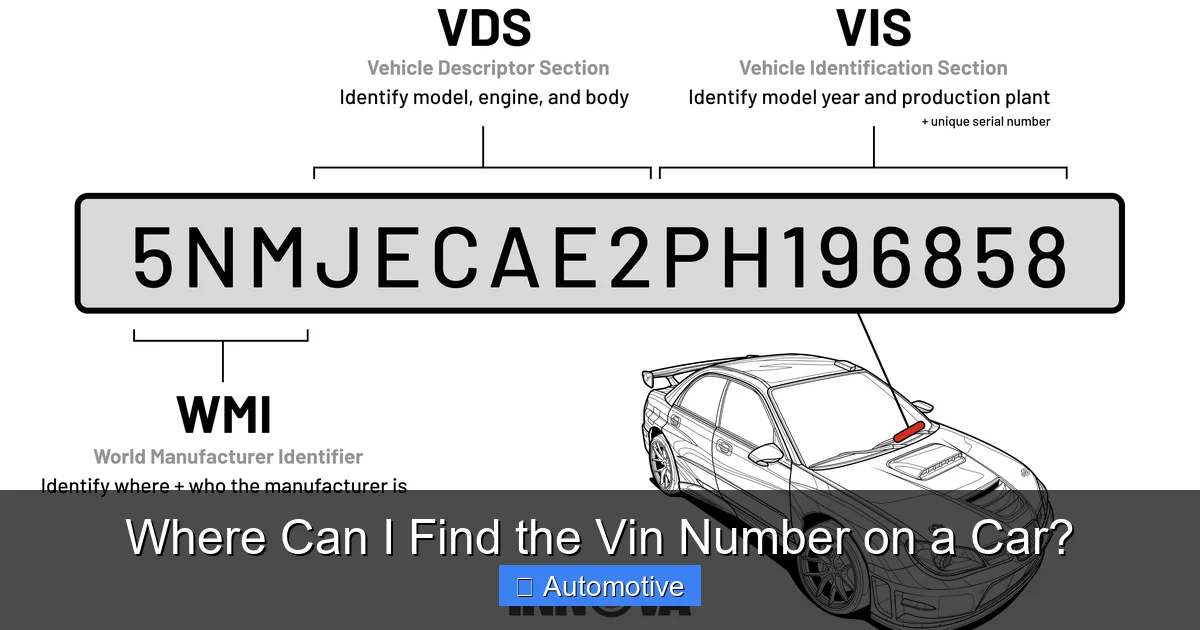
Before we go hunting, let’s understand what we’re looking for. A VIN, or Vehicle Identification Number, is a standardized 17-character code (digits and capital letters) assigned to every street-legal vehicle manufactured since 1981. It’s not a random string; it’s a coded biography of your car. The first three characters represent the country and manufacturer (the World Manufacturer Identifier). Characters 4-8 describe the vehicle’s brand, engine size, body style, and other attributes. The 9th digit is a security check digit. The 10th digit is the model year, the 11th is the plant code, and the final six digits are the sequential serial number. This system, governed by international standards (ISO 3779), means no two cars (with very rare exceptions) share the same VIN.
Why is this number so powerful?
It is the key to your car’s identity. Government agencies use it for titling and registration. Insurance companies rely on it to policy your specific vehicle. Law enforcement uses it to track stolen cars and recover parts. Potential buyers use it to run a vehicle history report (like Carfax or AutoCheck) to uncover past accidents, title problems, or odometer fraud. Mechanics use it to order the correct parts. If your car is subject to a safety recall, the manufacturer uses the VIN to identify affected vehicles. In short, the VIN is the thread that connects your car to its entire documented life. Without it, proving ownership, completing a sale, or even getting a proper repair becomes a tangled mess.
The Most Common Exterior VIN Locations: Your First Stops
When you need to find your VIN quickly, these are the prime locations. They are designed to be visible and accessible for law enforcement, inspectors, and buyers. Start your search here.
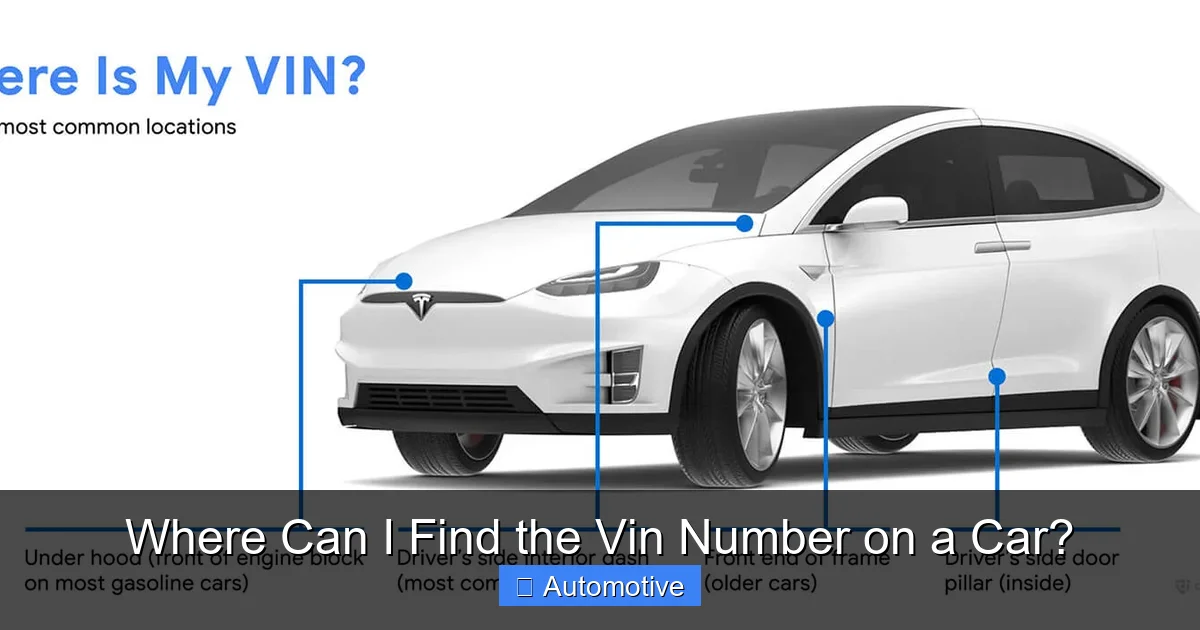
Visual guide about Where Can I Find the Vin Number on a Car?
Image source: driving-tests.org
1. The Driver’s Side Dashboard (The Classic Spot)
This is the most famous and easily accessible location. Look at the base of your windshield on the driver’s side. You should see a small, etched or stamped metal plate or a series of characters printed directly on a label. It’s meant to be read from outside the car, looking in through the windshield. Pro tip: Sometimes dirt or glare makes it hard to see. Try the early morning or late afternoon sun angle, or use a flashlight and a damp cloth to clean the area gently. On older cars, it might be on a plate screwed to the dashboard itself.
2. The Driver’s Side Door Jamb (The Door Sticker)
Open your driver’s side door fully and look at the area where the door latches to the car’s frame (the door jamb). You’ll typically find a sticker or a metal plate riveted there. This sticker is a goldmine of information—it usually lists the VIN, along with tire pressure recommendations, manufacturing date, and sometimes even the color code. This location is extremely convenient because you don’t have to peer through a windshield; it’s right in front of you. Note: If the sticker is peeling, faded, or missing, this can be a red flag for potential title or insurance issues, especially on a used car.
3. The Front windshield (Lower Corner)
In some regions or on certain models (especially some European brands), the VIN might be etched directly into the glass of the driver’s side windshield, usually in the lower corner. It’s often very small and can be hard to spot without close inspection. Run your finger along the bottom edge of the glass on the driver’s side. If you feel a slight etching or see a faint code, that’s likely it. This is a manufacturer anti-theft measure, as it’s difficult to completely remove.
4. The Engine Bay (Radiator Support)
Pop the hood and look at the front of the engine compartment, specifically the metal piece that the radiator bolts to (the radiator support). Many manufacturers stamp or etch the VIN directly onto this metal. It might be on a plate or directly on the bare metal. This location is more common on trucks and older vehicles. It’s less convenient to access than the dashboard but is a verified factory location. Be careful not to confuse it with an engine number, which is different and usually smaller.
Inside the Car: Interior VIN Spots You Might Miss
If the exterior spots are faded, damaged, or you’re dealing with a classic or reconstructed vehicle, the VIN might be located inside the passenger compartment.
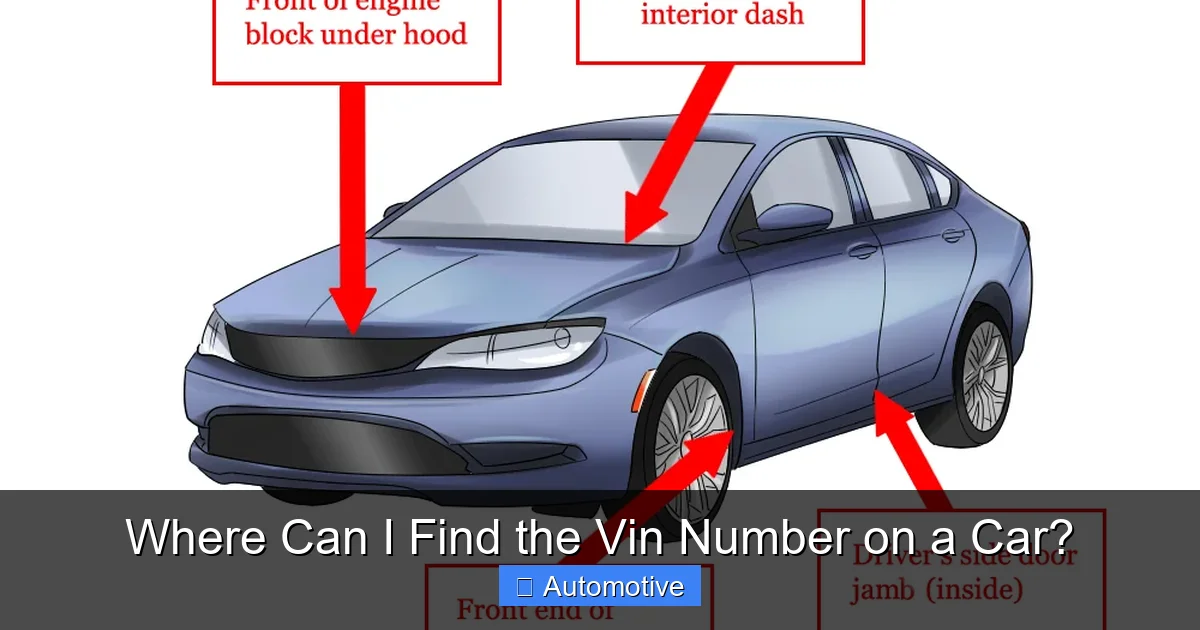
Visual guide about Where Can I Find the Vin Number on a Car?
Image source: d3vl3jxeh4ou3u.cloudfront.net
1. Under the Front Seats
Some manufacturers, particularly in the past, stamped the VIN onto a metal plate or directly onto the frame underneath the front seats. You’ll need to slide the seats all the way forward or backward and look at the floor near the seat tracks. It might be on the driver’s side, passenger’s side, or centered. A flashlight will be your best friend here. This is a very secure location, as it’s not easily accessible or visible.
2. Inside the Glove Compartment or Trunk
Check the inside of your glove box door or the lid of the trunk. A sticker or metal plate with the VIN might be affixed there. Sometimes it’s on a service sticker that also lists oil change intervals or tire sizes. In some sedans and SUVs, you might find it on the underside of the trunk lid, near the latch mechanism. It’s worth a quick peek in these storage areas.
3. On the Firewall (Between Engine and Cabin)
The firewall is the metal wall separating the engine compartment from the passenger cabin. If you look in from the engine bay, you might see the VIN stamped onto the top edge of the firewall or on a plate attached to it. From the passenger side, it’s usually not visible. This is another common spot for older American vehicles.
Less Obvious and Vehicle-Specific VIN Locations
For motorcycles, RVs, commercial trucks, or classic cars, the VIN can be in more unique places. Always consult your owner’s manual first—it will have the exact location for your specific make and model.
Visual guide about Where Can I Find the Vin Number on a Car?
Image source: cdn.shopify.com
Motorcycles and ATVs
On motorcycles, the VIN is typically stamped into the steering head (the front part of the frame where the forks attach). Look just below the handlebars, on the frame itself. It might also be on a plate on the frame down by the engine or on the swingarm. For ATVs and dirt bikes, check the frame near the front or rear suspension mounts.
Commercial Trucks and Trailers
Large commercial vehicles often have the VIN on the driver’s side door jamb, similar to cars. However, it’s also commonly found on the frame rail, usually on the driver’s side, near the front axle. On semi-truck tractors, check the driver’s side of the cab, near the floorboard or on the door pillar. For trailers, look on the tongue (the front part that connects to the hitch) or on a plate on the frame.
Classic Cars (Pre-1981)
Before the standardized 17-digit VIN system, manufacturers used their own formats, often shorter. These could be located in a variety of creative places: on a plate on the firewall, stamped on the engine block, on the door jamb, or even on a chassis plate under the hood. The location varied wildly by brand. For these vehicles, a factory documentation or a marque-specific expert is often needed to decode and verify the number.
Why Your VIN is Non-Negotiable: More Than Just a Number
Knowing where your VIN is located is only half the battle. Understanding why you’ll need it repeatedly is what makes this knowledge truly valuable.
For Buying and Selling
This is the #1 reason people search for their VIN. When you sell your car, you must provide the VIN to the buyer for the title transfer. The buyer will use it to run a history report to verify the car’s past. If you’re buying, you must check the VIN on the car itself against the VIN on the title and registration. Any mismatch is a major red flag for theft, cloning, or major structural repair. Always physically inspect the VIN on the vehicle during a test drive. If you’re planning to sell, it’s wise to have your VIN ready. You can learn about the best places to sell your car by reading our guide on where to sell your car for the most money.
For Insurance and Registration
Your insurance company needs the exact VIN to issue a policy. It ensures they are covering the correct vehicle with the right safety features and repair costs. Similarly, the DMV requires the VIN to issue a new title and registration in your name. If the VIN on your insurance card or registration doesn’t match the car, you could face fines or have a claim denied.
For Repairs, Recalls, and Parts
When you call a dealership or parts store for an engine component, transmission part, or even a specific air filter, they will ask for your VIN to guarantee compatibility. This is especially important for vehicles with multiple engine options or mid-year changes. Furthermore, the National Highway Traffic Safety Administration (NHTSA) uses VINs to identify cars subject to safety recalls. You can check your VIN on their website to see if your car has any open recalls that need fixing.
For Theft Recovery and Legal Proof
If your car is stolen, providing the VIN to police is the single most important step for recovery. It’s entered into national databases. It also serves as the ultimate proof of ownership in court or if you need to prove a car is yours to a towing company or storage facility.
Practical Tips for Verifying and Protecting Your VIN
Finding the number is one thing; making sure it’s correct and safe is another.
Always Cross-Check All Locations
When you buy a used car, or even when you just want to confirm your own car’s info, write down the VIN from at least two different locations on the vehicle (e.g., dashboard and door jamb). Then, compare those to the VIN on the title, registration, and insurance card. They must be identical. A discrepancy is a serious warning sign. Also, inspect the areas where the VIN plates or stickers are attached. Are there signs of tampering? Are the numbers uneven, re-stamped, or do the screws look like they’ve been removed? These could indicate VIN cloning or fraud.
What to Do If the VIN is Missing, Damaged, or Altered
If the VIN plate on the dashboard is missing or the door jamb sticker is gone, don’t panic, but do be cautious. First, check the other locations listed in this article (engine, frame, under seats). If you still cannot locate a full, valid VIN, or if you suspect tampering, you should not purchase the vehicle. For your own car, if a plate is damaged, contact your local Department of Motor Vehicles (DMV) or equivalent. They have procedures for verifying a vehicle’s identity and may issue a new VIN or corrective documentation, often involving a physical inspection by a law enforcement officer or DMV agent. This process can be tedious but is necessary to maintain a clear title.
Keep a Record of Your VIN
Once you’ve found and verified your VIN, store it somewhere safe and separate from the car. Save it in your phone contacts (label it “Car VIN”), in a secure password manager, or in a home safe. You’ll need it for roadside assistance calls, when filing police reports, or when you’re away from the car and need to provide the info. It’s also a good idea to take a clear photo of the VIN plate on your dashboard and keep it in your phone’s photo album.
A Note on VIN Decoding and Privacy
You can use free online VIN decoders to learn basic info about your car—its country of origin, manufacturer, model year, and engine type. However, be cautious about entering your VIN on random websites. While the VIN itself is public information (it’s on your car, after all), some sites may use it to aggregate data or try to sell you unnecessary services. Stick to reputable sources like the official NHTSA recall lookup or well-known automotive history report companies when you need a full report. Remember, your VIN doesn’t contain your personal information (like your name or address), but it is the key that unlocks your car’s public history.
Conclusion: Your Car’s Fingerprint is Everywhere
Finding your car’s VIN isn’t a scavenger hunt with one prize spot; it’s about knowing the multiple, redundant locations the manufacturer has placed it for verification and security. Start with the two easiest spots: the driver’s side dashboard (look through the windshield) and the door jamb sticker. If those are unclear, move to the engine bay, under the seats, or the trunk. For unique vehicles, consult the manual. The golden rule is to always cross-reference the VIN you see on the car with the number on your title and registration. Mismatches are deal-breakers. By making this 17-digit code your familiar friend, you empower yourself as a car owner. You’ll navigate sales, insurance, repairs, and recalls with confidence, armed with the one piece of information that truly defines your vehicle’s identity. So take five minutes today, go locate your VIN, write it down, and store it safely. Future you will be incredibly grateful.
Frequently Asked Questions
Can I find my VIN number if my car is very old, like from the 1960s or 1970s?
Yes, but the system was different before 1981. The VIN (or chassis number) was not standardized and varied by manufacturer. Common locations include the firewall, engine block, a plate on the door jamb, or the frame. You’ll need to research your specific make and year or consult a classic car expert or your local DMV for guidance on decoding and locating it.
What should I do if the VIN on my car’s dashboard is faded or the door sticker is peeling off?
First, check other locations like the engine bay, under the seats, or the trunk to find a legible copy. If you can find a clear VIN elsewhere, use that for official purposes. If all physical VINs are damaged, you must contact your state’s DMV. They will likely require an in-person vehicle inspection by an official to verify the car’s identity and may issue a new VIN or corrective paperwork. Do not attempt to recreate or alter the number yourself.
Is the VIN the same as the engine number or chassis number?
No, they are different. The VIN is a unique 17-digit code for the entire vehicle. An engine number is specific to the engine block and may be different if the engine has been replaced. A “chassis number” is often an older term for the VIN on the frame, but in modern usage, it’s essentially the same as the VIN. Always use the 17-digit VIN for legal and ownership matters, not the engine number.
Can I look up my car’s VIN online if I don’t have the physical car with me?
Only if you have it saved from a previous document (like an insurance card, registration, or old bill of sale). There is no public database where you can enter your name or license plate to retrieve your VIN. For privacy and security reasons, the VIN is not tied to your name in a publicly searchable way. You must have the physical number or a saved copy.
Why are there sometimes two different VINs on my car (e.g., one on the dash and one on the door)?
There should never be two *different* VINs on a legally produced car. All VINs on a single vehicle must be identical. If you see two numbers that don’t match exactly, one is likely a misread, a different label (like a tire pressure or certification sticker), or the car has been in a severe accident where parts were swapped incorrectly. This is a major red flag for a rebuilt or salvage title vehicle. Always verify that every VIN you find is exactly the same.
Where is the VIN located on a motorcycle or ATV?
On motorcycles and ATVs, the VIN is typically stamped directly into the frame, not on a plate. The most common location is on the steering head—the front part of the frame where the front fork attaches. Look just below the handlebars on the frame itself. It may also be on a plate on the frame near the engine or on the swingarm (the rear suspension arm). Consult your owner’s manual for the exact spot for your specific model.