
Where Can I Sell My Car for the Most Money?

Selling your car privately usually brings in the highest price, but it takes time and effort. Online marketplaces, trade-ins, and instant cash offers each have pros and cons—choose based on speed, convenience, and profit goals.
Key Takeaways
- Sell privately for maximum profit: Private buyers typically pay 10–20% more than dealers or online buyers, especially for well-maintained, popular models.
- Use online platforms like Facebook Marketplace and Craigslist: These free or low-cost options give you wide reach and control over pricing and negotiation.
- Get multiple offers from instant buyers: Companies like CarMax, Carvana, and Vroom provide quick quotes—compare them to avoid lowballing.
- Prepare your car before selling: Clean it, fix minor issues, gather service records, and take high-quality photos to boost value and attract serious buyers.
- Time your sale strategically: Spring and early summer see higher demand, especially for convertibles, SUVs, and family cars.
- Understand your car’s true market value: Use tools like Kelley Blue Book (KBB), Edmunds, and NADA Guides to price competitively and fairly.
- Negotiate confidently: Know your bottom line, stay calm during talks, and don’t rush—patience often leads to better offers.
📑 Table of Contents
- Where Can I Sell My Car for the Most Money?
- 1. Sell Your Car Privately: The Gold Standard for Profit
- 2. Trade It In at a Dealership: Convenience Over Cash
- 3. Use Online Car Buyers for Speed and Simplicity
- 4. Sell to a Local Dealer or Independent Buyer
- 5. Consider Auction Sites (For the Right Car)
- 6. Prepare Your Car to Maximize Value
- 7. Time Your Sale for Maximum Demand
- 8. Avoid Common Selling Mistakes
- Conclusion: Choose the Right Path for Your Goals
Where Can I Sell My Car for the Most Money?
So, you’re ready to sell your car—but you want to get the best possible price. Maybe you’ve been driving it for years, and it’s time for an upgrade. Or perhaps you just need the cash and don’t want to leave money on the table. Whatever your reason, one thing is clear: you don’t want to settle for a lowball offer from a dealer or a sketchy online buyer.
The good news? You have more options than ever. From private sales to instant cash apps, there’s a method that fits your timeline, skill level, and profit goals. But not all routes are created equal. Some will get you top dollar but require effort. Others are fast and easy—but might cost you hundreds or even thousands in potential profit.
In this guide, we’ll walk you through every major way to sell your car, compare the pros and cons, and help you decide where to sell your car for the most money—without the stress.
1. Sell Your Car Privately: The Gold Standard for Profit

Visual guide about Where Can I Sell My Car for the Most Money?
Image source: s28126.pcdn.co
If your top priority is getting the most money for your car, selling it privately is almost always the best route. Private buyers are individuals—not businesses—so they’re not trying to flip your car for a profit. That means they’re often willing to pay closer to (or even above) market value, especially if your car is in great condition.
Why Private Sales Pay More
When you sell to a dealership or an online buyer like Carvana, they need to make a profit. That’s why they offer you less—they’ll resell your car for more. But a private buyer is usually looking for a reliable ride at a fair price. If your car checks the boxes (low mileage, clean title, good maintenance), you can often get 10% to 20% more than you would from a dealer.
For example, let’s say your 2018 Honda CR-V is worth about $18,000 in “good” condition according to Kelley Blue Book. A dealer might offer you $15,500 as a trade-in or direct purchase. But a private buyer could easily pay $17,500 or more—especially if you highlight recent repairs, new tires, or a full service history.
Where to List Your Car Privately
You’ve got several solid platforms to choose from:
– Facebook Marketplace: Free to list, huge audience, and easy to use. You can target local buyers and respond quickly to messages. Just be cautious of scams—always meet in public and avoid wire transfers.
– Craigslist: Still popular in many areas, especially for older or budget cars. It’s free in most cities, but you’ll need to sift through spam and lowballers.
– OfferUp: A mobile-friendly app with built-in messaging and user ratings. Great for local sales and includes safety tips.
– Autotrader: More professional, but charges a listing fee (usually $30–$50). Best for newer or higher-value cars where the extra exposure is worth it.
Tips for a Successful Private Sale
– Price it right: Use KBB, Edmunds, or NADA to find the “private party” value—not the trade-in value.
– Take great photos: Clean your car inside and out. Take pictures in daylight, from multiple angles, and include close-ups of the interior, engine, and tires.
– Write a detailed description: Mention mileage, condition, recent maintenance, features, and why you’re selling. Honesty builds trust.
– Be ready to negotiate: Most buyers will try to haggle. Know your lowest acceptable price and stick to it.
– Meet safely: Choose a public place, like a police station parking lot, and bring a friend. Never share personal info too soon.
Selling privately takes more time and effort than other methods, but if profit is your goal, it’s worth it.
2. Trade It In at a Dealership: Convenience Over Cash
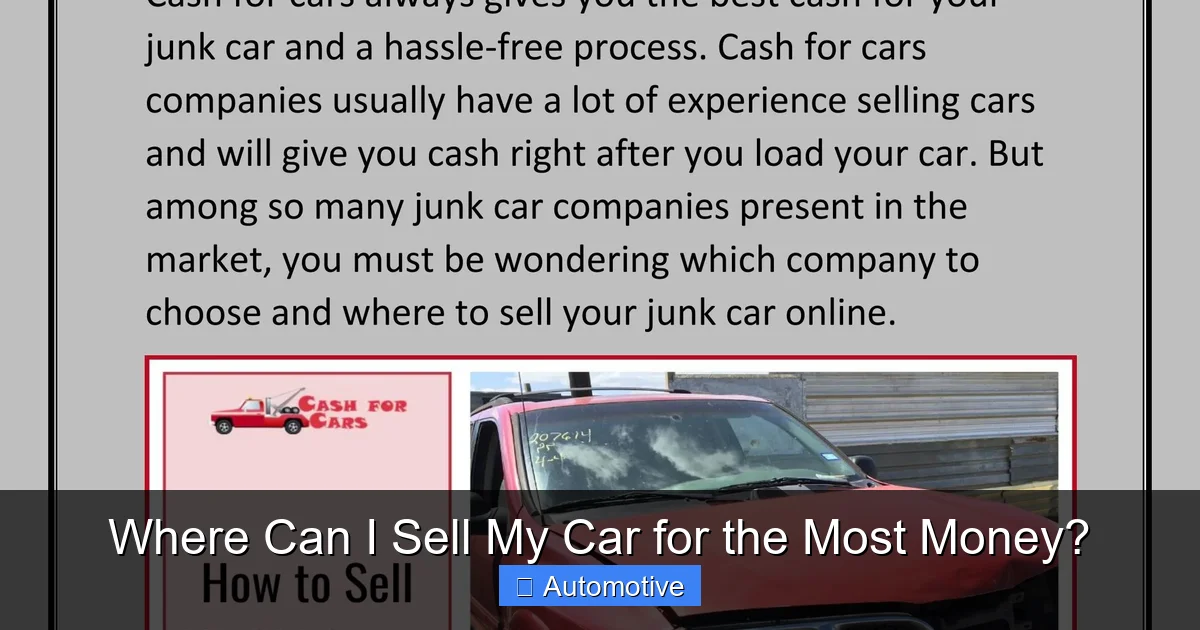
Visual guide about Where Can I Sell My Car for the Most Money?
Image source: image.isu.pub
Trading in your car at a dealership is the easiest option—but it’s rarely the most profitable. Dealers want to make money, so they’ll offer you less than market value. However, there are situations where a trade-in makes sense.
When a Trade-In Makes Sense
– You’re buying a new car and want a one-stop solution.
– Your car has mechanical issues or high mileage—dealers may still take it, while private buyers might walk away.
– You live in a state where trade-ins reduce sales tax on your new purchase (like in California or Texas).
For example, if you’re buying a $30,000 car and trade in your old one for $15,000, you only pay tax on $15,000—not the full $30,000. That can save you $1,000 or more in taxes, depending on your state.
How to Get the Best Trade-In Offer
– Get multiple appraisals: Visit at least three dealerships or use online tools like CarMax’s instant offer.
– Clean your car: A clean, well-maintained car looks more valuable.
– Know your car’s value: Use KBB’s trade-in range to understand what you should expect.
– Negotiate the total deal: Don’t let the dealer lowball your trade-in and overcharge for the new car. Negotiate the out-the-door price of the new vehicle first, then discuss the trade.
While you’ll likely get less cash than a private sale, the convenience and tax savings can make a trade-in worthwhile—especially if you’re upgrading.
3. Use Online Car Buyers for Speed and Simplicity

Visual guide about Where Can I Sell My Car for the Most Money?
Image source: stationedingermany.com
In the last decade, companies like Carvana, Vroom, CarMax, and Shift have revolutionized car selling. These platforms let you get an instant online offer, schedule a pickup or drop-off, and get paid in hours—no meetings, no negotiations, no hassle.
How Online Buyers Work
1. Enter your car’s details (make, model, year, mileage, condition) on their website.
2. Upload photos or complete a virtual inspection.
3. Receive an offer—usually within minutes.
4. Accept the offer, and they’ll come pick up your car (or you drop it off).
5. Get paid via check or direct deposit.
It’s fast, safe, and requires almost no effort. But there’s a catch: these companies need to resell your car, so their offers are typically lower than private sale prices.
Pros and Cons of Online Buyers
Pros:
– Extremely convenient—sell from home.
– No need to meet strangers or handle paperwork.
– Offers are usually firm (no haggling).
– Fast payment—often within 24–48 hours.
Cons:
– Lower offers than private sales (typically 10–15% less).
– May deduct fees for minor issues (scratches, dents, worn tires).
– Limited negotiation—once you accept, the deal is done.
Which Online Buyer Pays the Most?
It varies by car and location, but here’s a general ranking based on user reports:
1. CarMax: Known for fair offers and no-haggle pricing. They’ll appraise your car for free, even if you don’t buy from them.
2. Carvana: Convenient and user-friendly, but offers can be lower than CarMax.
3. Vroom: Similar to Carvana, but some users report slower payouts.
4. Shift: Offers a more personal experience with car concierges, but availability is limited to certain cities.
Pro Tip: Always get quotes from at least two online buyers. Sometimes the difference is hundreds of dollars.
4. Sell to a Local Dealer or Independent Buyer
Sometimes, the best offer comes from a local used car dealer or a small independent buyer—not a big chain. These buyers often specialize in certain types of cars (like trucks, imports, or classics) and may pay more if your vehicle fits their inventory needs.
How to Find the Right Local Buyer
– Search for “cash for cars” or “we buy used cars” in your area.
– Look for dealers who specialize in your car’s make or model.
– Check reviews on Google or Yelp to avoid scams.
For example, if you have a well-maintained Toyota Tacoma, a local truck dealer might offer more than CarMax because they know they can sell it quickly to another buyer.
Negotiating with Local Buyers
Local dealers have more flexibility than big chains. They may be willing to negotiate, especially if your car is in high demand. Bring your research (KBB value, recent repairs) and be ready to walk away if the offer is too low.
5. Consider Auction Sites (For the Right Car)
If you have a rare, classic, or high-demand vehicle, selling at auction could bring in top dollar. Platforms like eBay Motors and Bring a Trailer specialize in unique cars and attract serious collectors.
When Auctions Work Best
– Your car is a classic, muscle car, or limited edition.
– It’s in excellent or restored condition.
– You’re willing to wait for the right buyer.
For example, a 1967 Ford Mustang in great shape could sell for $40,000+ on Bring a Trailer—far more than a private sale in a small town.
Downsides of Auctions
– Listing fees and commissions (usually 5–10% of the sale price).
– No guarantee of a sale—your car might not meet the reserve.
– Shipping and logistics can be complex.
Auctions aren’t for everyone, but for the right car, they can be a goldmine.
6. Prepare Your Car to Maximize Value
No matter where you sell, a well-prepared car will always get more money. Buyers pay for condition, reliability, and peace of mind.
Clean It Inside and Out
– Wash and wax the exterior.
– Vacuum the interior, clean windows, and wipe down surfaces.
– Remove personal items and clutter.
– Consider a professional detail ($100–$200) for a showroom shine.
Fix Minor Issues
You don’t need to rebuild the engine, but small fixes can boost value:
– Replace burnt-out bulbs.
– Fix cracked windshields or mirrors.
– Patch small dents or scratches.
– Replace worn wiper blades or tires if they’re unsafe.
Gather Documentation
Buyers love transparency. Have these ready:
– Vehicle title (signed and ready to transfer).
– Recent service records.
– Owner’s manual and spare keys.
– Carfax or AutoCheck report (shows accident history).
Take High-Quality Photos
Use natural light and a clean background. Shoot from multiple angles:
– Front, back, and both sides.
– Interior (dashboard, seats, trunk).
– Engine bay and undercarriage (if clean).
– Close-ups of any flaws (to build trust).
7. Time Your Sale for Maximum Demand
Believe it or not, when you sell matters almost as much as how you sell.
Best Times to Sell
– Spring and early summer: Demand rises for convertibles, SUVs, and family cars. Families prepare for vacations, and buyers want to avoid winter driving.
– End of the month: Dealers may be more willing to negotiate to meet sales quotas.
– After tax refund season (March–April): Many buyers have extra cash.
Worst Times to Sell
– Winter (especially January–February): Fewer buyers, especially for convertibles or sports cars.
– Right after a new model year launches: Demand for older models drops.
Pro Tip: If you’re not in a rush, wait for the right season. A few weeks of patience could mean hundreds more in your pocket.
8. Avoid Common Selling Mistakes
Even with the best plan, it’s easy to make errors that cost you money.
Overpricing Your Car
Listing your car for $25,000 when it’s worth $20,000 will scare off buyers. Use pricing tools and check similar listings to stay competitive.
Ignoring Scams
Watch out for:
– Buyers who want to pay with a cashier’s check and ask for a refund.
– Requests to ship the car before payment clears.
– Pressure to act quickly.
Not Getting Everything in Writing
Always use a bill of sale and sign the title correctly. In most states, you’ll also need to file a release of liability with the DMV.
Forgetting to Cancel Insurance
Once the car is sold, cancel your insurance to avoid unnecessary charges—but don’t do it until the buyer has insured the vehicle.
Conclusion: Choose the Right Path for Your Goals
So, where can you sell your car for the most money? The answer depends on your priorities.
If you want maximum profit and don’t mind the effort, sell privately through Facebook Marketplace or Craigslist. You’ll get the highest price, especially if your car is clean, well-maintained, and priced right.
If you value speed and convenience, use an online buyer like CarMax or Carvana. You’ll get a fair offer fast—no meetings, no stress.
If you’re buying a new car, a trade-in might make sense—especially with tax savings.
And if you have a unique or classic car, consider an auction.
No matter which route you choose, remember: preparation pays off. Clean your car, fix small issues, gather documents, and price it fairly. Do your research, get multiple offers, and don’t rush the process.
Selling your car doesn’t have to be stressful. With the right strategy, you can walk away with a great price—and maybe even a little extra cash in your pocket.
Frequently Asked Questions
Should I sell my car privately or to a dealer?
Selling privately usually gets you more money—often 10–20% higher than a dealer offer. But it takes more time and effort. If you want speed and convenience, a dealer or online buyer may be better.
How do I know what my car is worth?
Use trusted tools like Kelley Blue Book (KBB), Edmunds, or NADA Guides. Enter your car’s details, including mileage, condition, and features, to get a private party and trade-in value.
Can I sell my car if it has mechanical problems?
Yes, but you’ll get less money. Private buyers may avoid it, but dealers or “cash for cars” companies might still buy it. Be honest about the issues to avoid legal trouble.
Is it safe to sell my car online?
Yes, if you take precautions. Meet in public, bring a friend, avoid wire transfers, and never share personal info too soon. Use platforms with user ratings, like Facebook Marketplace or OfferUp.
How long does it take to sell a car privately?
It varies. Well-priced, clean cars in high-demand areas can sell in a few days. Others may take weeks. Be patient and responsive to messages to speed up the process.
Do I need a Carfax report to sell my car?
No, but it helps. A clean Carfax report builds buyer confidence and can increase your car’s value. You can buy one for about $40 from Carfax.com or get a free alternative from AutoCheck.
