
Where Is the Tpms Reset Button on a 2015 Toyota 4runner?

Finding the TPMS reset button on a 2015 Toyota 4Runner is straightforward once you know where to look—it’s inside the glovebox. However, it’s crucial to confirm your specific trim level, as some base models may not have a dedicated button and require a different reset procedure using the multi-information display. Always ensure your tires are properly inflated to the manufacturer’s specs before attempting any reset.
Key Takeaways
- Location: The TPMS reset button for a 2015 Toyota 4Runner is located on the lower left side of the glovebox interior, behind a small removable cover.
- Not All Trims Have It: Some base-model 4Runners may not come equipped with a physical reset button, relying instead on a menu-driven reset via the vehicle’s multi-information display.
- Prerequisite is Inflation: You must correctly inflate all four tires to the pressure listed on the driver’s door jamb sticker before initiating any reset procedure.
- Procedure is Simple: The reset involves turning the ignition on, pressing and holding the button until the TPMS indicator blinks three times, then starting the engine.
- Driving is Required: After a successful reset, you must drive the vehicle at speeds above 50 km/h (30 mph) for up to 30 minutes for the system to learn the new sensor IDs.
- Sensor Issues Persist: A persistent TPMS light after a proper reset often indicates a faulty tire pressure sensor, a dead sensor battery, or recent tire rotation without a relearn.
- Tool May Be Needed: If your vehicle lacks a button, you will need to use the steering wheel controls to navigate the “TPMS” menu in the multi-information display to perform the reset.
📑 Table of Contents
Introduction: That Annoying TPMS Light
You’re driving your trusty 2015 Toyota 4Runner, maybe cruising down a backroad or navigating city traffic, and suddenly, a bright yellow light illuminates your instrument cluster. It’s the iconic exclamation mark inside a tire cross-section: the Tire Pressure Monitoring System (TPMS) warning. For many, it’s a minor annoyance. For others, it’s a critical safety alert. Your first instinct? Find the reset button. But where is the TPMS reset button on a 2015 Toyota 4Runner? Is it even there? This comprehensive guide will walk you through everything you need to know, from exact location and step-by-step procedures to troubleshooting when things don’t go as planned. We’ll clear up the confusion so you can get back to enjoying your adventure-ready SUV with peace of mind.
The TPMS is a federally mandated safety feature designed to warn you when tire pressure falls 25% or more below the recommended level. While it’s a fantastic system, it doesn’t automatically reset itself after you’ve corrected the pressure. Sometimes, after a tire rotation, sensor replacement, or even a significant temperature drop, the system needs a manual “nudge” to recognize the new or corrected data. That nudge is the reset procedure. Understanding how your 4Runner’s specific system works is the key.
Understanding Your 4Runner’s TPMS
Before we hunt for a button, it helps to understand what we’re dealing with. The 2015 Toyota 4Runner uses a direct TPMS. This means each wheel has its own small, battery-powered sensor mounted inside the valve stem. These sensors constantly radio their pressure and temperature data to the vehicle’s computer. When a sensor’s reading is out of spec, or if the system doesn’t receive a signal from a sensor (like after a tire change), the warning light activates.
Visual guide about Where Is the Tpms Reset Button on a 2015 Toyota 4runner?
Image source: psychoautos.com
Why Is There a Reset Button?
The reset button’s job is to tell the vehicle’s computer, “Hey, pay attention! I’ve just finished work on the tires. Start learning the new sensor IDs now.” It initiates a “relearn” process. During this process, the vehicle listens for the unique ID codes from each of the four wheel sensors and stores them in its memory. Once all four are confirmed and the pressures are within range, the TPMS light should turn off after a short drive. The button is essentially a trigger for this learning cycle.
Direct vs. Indirect TPMS
It’s worth noting that some older or different vehicle brands use an indirect system, which uses the ABS wheel speed sensors to detect differences in rotation speed that indicate low pressure. The 4Runner does not use this. Its system is direct and sensor-based, which is more accurate but requires this manual reset after sensor-related work. This is a common point of confusion, so knowing your system type is the first step.
The Golden Location: Finding the Reset Button
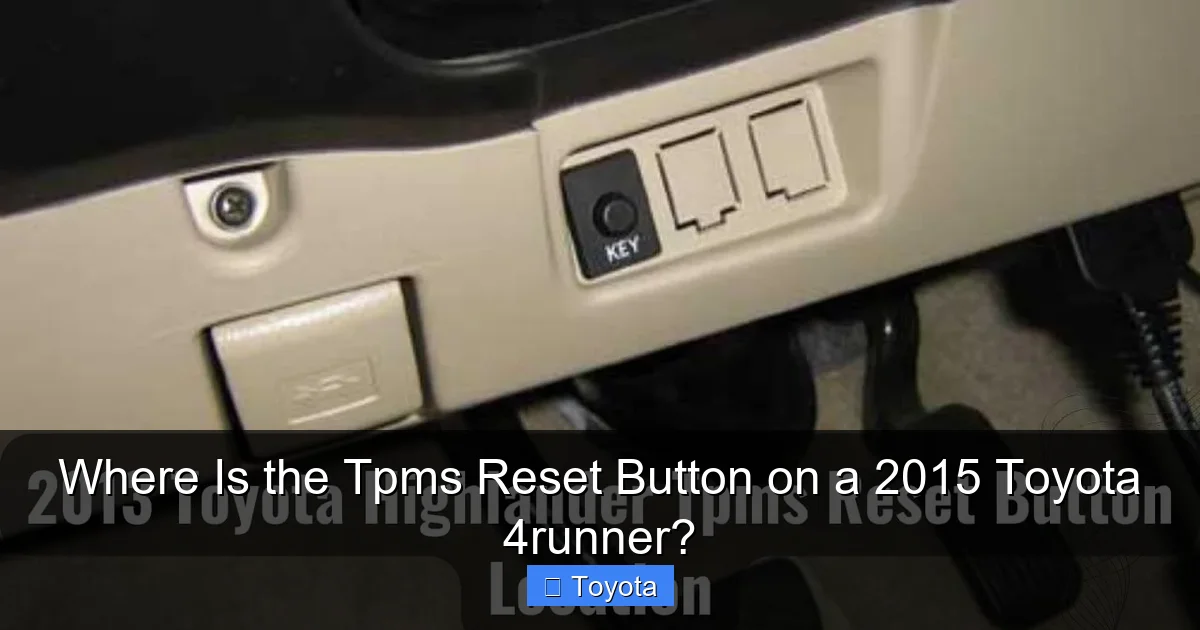
Now, for the moment you’ve been waiting for. For the vast majority of 2015 Toyota 4Runner trims (SR5, Trail, Limited, and TRD Pro), the TPMS reset button is conveniently located inside the glovebox. But don’t just fling the glovebox open and start jabbing around. Here’s the precise, no-miss location:

Visual guide about Where Is the Tpms Reset Button on a 2015 Toyota 4runner?
Image source: knowmyauto.b-cdn.net
- Open your 4Runner’s glovebox fully.
- Look at the lower left-hand corner of the interior glovebox panel.
- You will see a small, rectangular, black plastic cover (about the size of a postage stamp) or sometimes just a recessed circular button outline.
- Gently pry this cover off with a flat-head screwdriver or your fingernail. It’s usually just clipped in place.
- Behind it, you will find the TPMS reset button. It’s a small, red or black push-button.

This location is consistent with many other Toyota SUVs and trucks from this era. It’s placed in the glovebox to keep it out of casual reach (preventing accidental resets) while still being accessible for maintenance. If you’re working on your truck with the hood open, reaching over to the passenger side dash to access the glovebox is standard procedure.
The Important Caveat: “What If There’s No Button?”
Here’s the critical part that trips up many owners. Some base-model 2015 4Runners, particularly certain fleet or very basic configurations, may not have a physical reset button installed at all. Instead, these vehicles use a menu-driven reset via the multi-information display (the small screen in the gauge cluster). How can you tell? If you’ve located the glovebox and there is no cover panel or button hole in that lower left corner, your vehicle almost certainly uses the display method. Don’t panic—the procedure is different but still simple. We’ll cover both methods in the next section.
Step-by-Step Reset Procedures
With your tires properly inflated (check the sticker on the driver’s door jamb for the correct PSI, not the tire sidewall!), it’s time to reset. Follow the guide for your specific setup.

Visual guide about Where Is the Tpms Reset Button on a 2015 Toyota 4runner?
Image source: knowmyauto.b-cdn.net
Procedure A: For Models WITH a Physical Button
- Prepare the Vehicle: Ensure the ignition is OFF. All doors should be closed.
- Turn Ignition to “ON”: Press the engine start/stop button once (without touching the brake pedal) to put the vehicle in “IGNITION ON” or “ACC” mode. The dashboard lights should come on.
- Press and Hold: Firmly press and hold the TPMS reset button you found in the glovebox.
- Watch the Light: Keep holding it. After about 3-5 seconds, you should see the TPMS warning light on the dash blink three times, then turn off. Once it turns off, you can release the button.
- Start the Engine: Press the start button again (with brake pedal) to start the engine.
- Drive to Relearn: Drive the vehicle normally. The TPMS light may come back on briefly during this phase, which is normal. You must drive at speeds above 50 km/h (30 mph) for up to 30 minutes. The system is learning the new sensor positions and pressures. The light should go out permanently once the process is complete.
Procedure B: For Models WITHOUT a Physical Button (Display Reset)
This method uses the buttons on your steering wheel to navigate the cluster menu.
- Prepare & Ignition On: Same as above. Tires inflated, ignition in “ON” mode.
- Enter Menu: Use the ▲ (up) or ▼ (down) arrow buttons on the left side of the steering wheel to scroll through the multi-information display options.
- Find “TPMS”: Scroll until you find the menu option labeled “TPMS” or “Tire Pressure.” Press the ENTER button (the button in the center of the arrow pad) to select it.
- Initiate Reset: Within the TPMS menu, you should see an option like “Register ID” or “Initialize.” Select this option. The display may ask you to confirm or show a message like “Press and hold.”
- Hold & Confirm: You will typically need to press and hold the ENTER button for several seconds until you see a confirmation message like “Registration Complete” or the TPMS light on the dash blinks three times.
- Drive: Start the engine and drive as described in Procedure A to complete the relearn.
Pro Tip: If you’re ever unsure, your owner’s manual is the ultimate authority. The “Tire and Loading Information” or “TPMS” section will have the exact procedure for your specific VIN. You can also often find a quick-reference guide on the inside of your glovebox door.
When and Why You Actually Need to Reset
It’s not just about turning off a light. Knowing why the reset is necessary helps you diagnose problems and avoid unnecessary procedures.
Common Scenarios Requiring a Reset:
- Tire Rotation: This is the #1 reason. The system memorizes which sensor is at which wheel location. Rotating tires swaps their positions, so the computer needs to learn the new arrangement.
- Replacing a Sensor or Tire: Installing a new sensor (which has a unique ID) or mounting a new tire with a sensor requires the system to register that new ID code.
- Adjusting Pressure After a Seasonal Change: If you significantly over-inflated or deflated tires for a specific reason (like off-road air-down) and then returned them to standard pressure, a reset ensures the system’s baseline is accurate.
- After a Flat Repair: Some tire shops will reset the system after a plug/patch, but many do not. It’s good practice to verify.
- False Alerts from Temperature: A rapid, significant temperature drop can lower pressure enough to trigger the light. If you correct the pressure and the light stays on, a reset may be needed.
When NOT to Reset Immediately
If the TPMS light is flashing (instead of solid) when you first start the truck, this indicates a system malfunction, not just low pressure. Do not attempt a reset. A flashing light means a sensor is faulty, the battery in a sensor is dead, or there’s an internal communication error. You need to have the system diagnosed with a professional scan tool at a tire shop or dealership.
Troubleshooting: The Reset Didn’t Work
You followed the steps perfectly. The light blinked, you drove for 30 minutes, but that stubborn TPMS icon is still glowing. Now what? Here’s a logical checklist.
Step 1: Re-Verify the Basics
Double-check your work. Use a reliable, high-quality tire pressure gauge (not the one at the gas station). Inflate each tire to the exact PSI on the door jamb sticker, including the spare if it’s a full-size spare with a sensor (some 4Runners have this). An imbalance of even 1-2 PSI can prevent the system from registering a “good” reading. Also, ensure the reset procedure was done with the ignition in the correct “ON” position, not just “ACC.”
Step 2: The “Relearn Drive”
The drive cycle is critical. You need to drive above 50 km/h (30 mph) for a sustained period. Stop-and-go city traffic may not be sufficient. Find a safe highway or open road and maintain that speed for 15-20 minutes. Sometimes the system needs a bit longer to communicate with all four sensors.
Step 3: Interference or a “Sleeping” Sensor
Other vehicles’ TPMS signals can sometimes interfere. If you’re in a crowded parking lot, try the procedure in a more isolated area. Also, a sensor might not “wake up” properly if the vehicle was off for a long time. Try the reset procedure again from the very beginning.
Step 4: The Culprit is Likely a Faulty Sensor
This is the most common persistent issue. TPMS sensors have batteries that last 7-10 years. Your 2015 4Runner’s sensors are now 9 years old. A dead or dying battery will cause the light to return. Additionally, sensors can be damaged during tire mounting, corrosion can set in on the valve stem, or the sensor itself may have failed. At this point, you need a professional. A tire shop will use a handheld TPMS diagnostic tool to check the signal strength and battery life of each individual sensor. They can identify the bad apple and replace it. Remember, when replacing a single sensor, you must perform a reset to teach the car the new sensor’s ID code.
Frequently Asked Questions (FAQs)
My 2015 4Runner has no button in the glovebox. Is that normal?
Yes, it can be normal. As mentioned, some base trims omit the physical button and use the multi-information display menu instead. Use your steering wheel arrows to navigate to the TPMS menu and look for an “Initialize” or “Register” option. If that menu doesn’t exist either, your vehicle may have been built without the feature, which is rare but possible.
Can I reset the TPMS without starting the engine?
Yes. The entire reset procedure—button press or menu navigation—must be done with the ignition in the “ON” or “ACC” position (dashboard lights on, but engine off). You only start the engine after the reset is initiated (the light has blinked three times) for the subsequent drive cycle.
Do I need a special tool to reset the TPMS?
For the standard procedure after a tire rotation or inflation adjustment, no. The vehicle’s built-in button or menu is all you need. However, if you are replacing a sensor, a professional needs a TPMS programming tool to write the new sensor’s ID to the vehicle’s computer. For just a reset, you are good to go.
How long can I drive with the TPMS light on?
You should address it immediately. While the light itself won’t stop you from driving, it indicates your tire pressure is significantly low. Driving on under-inflated tires is dangerous—it causes poor handling, increased braking distances, excessive tire wear, and can lead to a blowout. Check your pressures as soon as possible.
Will disconnecting the battery reset the TPMS?
No. Disconnecting the battery will reset the radio and clock, but it will not clear a TPMS warning. The TPMS memory is stored in a non-volatile module that retains data even when power is removed. You must use the dedicated reset procedure.
My TPMS light came on after I had new tires put on. Why?
This is very common. The tire shop may have damaged a sensor during mounting, or they simply forgot to perform the mandatory TPMS relearn after rotating or installing the tires. First, have them check that all sensors are working and that the tires are inflated to spec. Then, perform the reset procedure yourself or ask them to do it. If the light returns, a sensor may be broken and need replacement.
Frequently Asked Questions
What is Where Is the TPMS Reset Button on a 2015 Toyota 4Runner??
Where Is the TPMS Reset Button on a 2015 Toyota 4Runner? is an important topic with many practical applications.
