
Where Is the Subwoofer in a Tesla Model 3?

Contents
- 1 Key Takeaways
- 2 📑 Table of Contents
- 3 The Hidden Symphony: Understanding Tesla’s Audio Architecture
- 4 Pinpoint Precision: Exactly Where the Subwoofer Lives
- 5 Engineering Elegance: Why Tesla Buried the Bass
- 6 Sound Showdown: Standard vs. Premium Audio Systems
- 7 Beyond Stock: Upgrading Your Model 3’s Bass
- 8 Keeping the Beat: Maintenance and Troubleshooting
- 9 Conclusion: The Bass That’s Out of Sight, Not Out of Mind
- 10 Frequently Asked Questions


The subwoofer in a Tesla Model 3 is not in the trunk as you might expect. Instead, Tesla cleverly integrates it into the rear wheel well on the driver’s side (left side in left-hand drive markets). This design saves precious cargo space and is a key component of the Premium Audio system. Understanding its location is essential for troubleshooting, potential upgrades, and appreciating Tesla’s efficient packaging.
You’re driving your Tesla Model 3, the music is playing, and you feel that deep, satisfying bass thump. You might wonder, as with many traditional cars, “Where is that powerful sound coming from?” In most sedans, you’d pop the trunk and find a big, boxy subwoofer taking up valuable space. But your Model 3 is different. It’s a masterclass in minimalist design and efficiency, and that philosophy extends all the way down to its audio components. The answer to where the subwoofer is located is one of the vehicle’s cleverest packaging secrets, and understanding it gives you a new appreciation for Tesla’s engineering. It’s not hiding in plain sight; it’s tucked away in a spot that maximizes every cubic inch of your car’s interior. This guide will take you on a detailed tour from the driver’s seat to the rear wheel well, explaining not just the “where” but the brilliant “why” behind Tesla’s decision.
Key Takeaways
- The subwoofer is located in the rear driver’s side wheel well. You access it by removing the plastic liner from inside the wheel well, not from the trunk or cabin.
- This is a space-saving design choice. By moving the subwoofer out of the trunk, Tesla maximizes usable cargo volume, a critical advantage for an electric vehicle.
- Only the Premium Audio System includes a dedicated subwoofer. The base audio system uses a different configuration without a traditional standalone subwoofer.
- The location contributes to sound staging and bass response. Placing it low and to the side can create a more immersive audio experience within the cabin’s acoustics.
- Aftermarket upgrades are possible but complex. Replacing or adding a subwoofer requires working in the tight wheel well space and may involve integrating with Tesla’s digital audio system.
- Access requires careful removal of the rear wheel liner. It’s a straightforward process for DIYers but requires care to avoid damaging retaining clips and weather seals.
📑 Table of Contents
- The Hidden Symphony: Understanding Tesla’s Audio Architecture
- Pinpoint Precision: Exactly Where the Subwoofer Lives
- Engineering Elegance: Why Tesla Buried the Bass
- Sound Showdown: Standard vs. Premium Audio Systems
- Beyond Stock: Upgrading Your Model 3’s Bass
- Keeping the Beat: Maintenance and Troubleshooting
- Conclusion: The Bass That’s Out of Sight, Not Out of Mind
The Hidden Symphony: Understanding Tesla’s Audio Architecture
Before we hunt for the subwoofer, we need to understand the orchestra it’s part of. Tesla’s approach to in-car audio is a departure from many traditional automakers. Instead of simply sourcing a premium-branded speaker system, Tesla designed its audio systems from the ground up, specifically for the unique acoustics of the Model 3’s cabin. This is a car with no engine noise, a panoramic glass roof, and a remarkably rigid structure—all factors that dramatically change how sound behaves inside.
Two Tiers of Sound: Standard vs. Premium
Tesla offers two distinct audio experiences in the Model 3. The Standard Audio System is, well, standard. It provides good clarity and volume for most listeners but lacks the deep, authoritative bass that audiophiles and bass enthusiasts crave. Critically, the standard system does not have a traditional, standalone subwoofer. Instead, it relies on larger door-mounted speakers and software tuning to extend the low-frequency response as much as possible. It’s a clever workaround, but physics is physics; you can’t truly reproduce very low frequencies without a dedicated driver.
The Premium Audio System, available as an upgrade on most trims and standard on others, is where the magic happens. This is the system that includes the dedicated subwoofer we’re discussing. It’s not just about adding a single speaker; it’s a complete overhaul with more total speakers (often 14 or 15 vs. 8), higher power amplifiers, and sophisticated digital signal processing. The system is designed to create a “concert hall” effect, with sound seemingly emanating from all directions. The subwoofer is the foundation of this experience, handling the lowest frequencies (typically below 80 Hz) that the other speakers simply cannot manage efficiently. This frees up the mid-range and tweeter speakers to handle their frequencies with less distortion, resulting in cleaner, more detailed sound across the board.
The Role of the Subwoofer in Modern Car Audio
A subwoofer’s job is to reproduce the lowest frequencies in the audio spectrum—the deep bass notes in music, the rumbling explosions in movies, and the visceral impact in video games. In a car, these low frequencies are non-directional, meaning your ears can’t easily pinpoint where they’re coming from. This allows engineers to place the subwoofer in locations that are acoustically favorable and spatially efficient, rather than where it looks best. Tesla exploited this characteristic to its absolute advantage. Instead of a bulky box in the trunk, they integrated a compact, high-performance subwoofer driver into a cavity that already existed in the vehicle’s structure: the rear wheel well. This is a solution born from pure necessity and brilliant packaging, a hallmark of electric vehicle design where every square millimeter of space is sacred.
Pinpoint Precision: Exactly Where the Subwoofer Lives
Now, for the treasure map. The subwoofer enclosure in a Tesla Model 3 with the Premium Audio System is located in the rear driver’s side wheel well. For those in left-hand drive markets (like the United States), this is the left side of the car. For right-hand drive markets (like the UK, Australia, Japan), it is the right side. It is mounted vertically, with the speaker cone facing inward, toward the center of the car and the cabin. The enclosure itself is a molded plastic housing that is part of the vehicle’s rear structure, sealed to create an optimal acoustic chamber.

Visual guide about Where Is the Subwoofer in a Tesla Model 3?
Image source: thesubboxshop.com
Accessing the Subwoofer: A Step-by-Step Visual Guide
You cannot access it from the trunk. The metal body panel of the wheel well is solid. To get to it, you must access it from inside the rear wheel well. Here is the process:
- Step 1: Safety First. Park on a level surface, engage the parking brake, and chock the front wheels. You’ll be working near the rear tire, so safety is paramount.
- Step 2: Remove the Rear Wheel Liner. The plastic splash guard (or liner) inside the rear wheel well is held in place by a series of plastic retainers (often push-pins or clips). Starting at the top or bottom, carefully pry these clips off using a plastic trim removal tool or a flathead screwdriver wrapped in tape to avoid scratching. Work your way around the liner until it is free. It may have some wiring for a wheel well light or sensor attached; disconnect these carefully.
- Step 3: Reveal the Enclosure. Once the liner is removed, you will see the interior of the wheel well. The subwoofer enclosure is a large, usually black or dark gray, plastic housing mounted on the inner side of the wheel well. You’ll see the speaker cone and its wiring harness connected to it.
- Step 4: Disconnect and Remove (if needed). To remove the subwoofer itself, disconnect the wiring harness plug (press the tab and pull). Then, you’ll typically find several bolts (usually 10mm or 12mm) securing the enclosure to the body. Remove these bolts to take the entire assembly out. This is the point where you would replace the subwoofer or upgrade the enclosure.
Pro Tip: Take photos as you go, especially of the clip locations and wiring connectors. This makes re-assembly much easier. Also, inspect the plastic liner for cracks and the weather seals for damage during reinstallation to prevent water leaks.
What You’ll See (and What You Won’t)
When you look at the enclosure, you are not seeing a large, powerful 12-inch subwoofer like you might in a custom car install. Tesla uses a relatively small-diameter, high-excursion driver (likely 6.5 to 8 inches) designed to move a lot of air efficiently in a compact space. The magic is in the engineering of the enclosure and its integration with the car’s body. The sound port (the opening where the bass comes out) is not directly facing you; it’s designed to couple with the air volume of the wheel well and the cabin’s rear footwell area, using the car’s structure as part of the acoustic system. You also won’t see a large, separate amplifier for it; the amplification is integrated into the main audio processing unit, likely located in the dashboard or front trunk area, with digital signals sent to powered speakers throughout the car.
Engineering Elegance: Why Tesla Buried the Bass
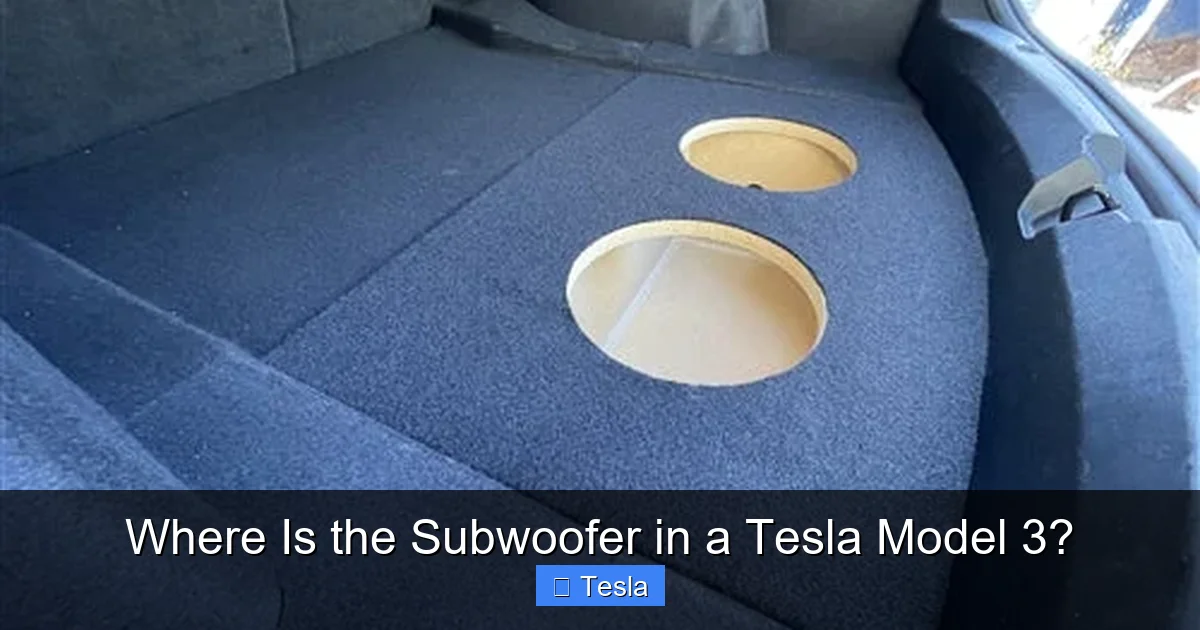
Placing a subwoofer in a wheel well might sound like a compromise, but it is a stroke of engineering genius for the Model 3. The primary driver is cargo space optimization. In an electric vehicle, every bit of storage is a major selling point. The front trunk (frunk) is smaller than a traditional engine bay, and the rear trunk is a critical space for owners. Sacrificing a significant portion of that trunk for a subwoofer box would have been a non-starter for Tesla’s design goals. The wheel well cavity was essentially “free” space—it was already there and unused for primary storage. By integrating the subwoofer there, Tesla reclaimed that volume for your groceries, luggage, or charging cables.
Visual guide about Where Is the Subwoofer in a Tesla Model 3?
Image source: thesubboxshop.com
Acoustic Advantages of the Wheel Well Location
Beyond space, there are acoustic benefits. The wheel well is a large, sealed cavity itself. By mounting the subwoofer to fire into this space, Tesla effectively creates a larger acoustic chamber than a small box in the trunk could provide. This allows the subwoofer to move more air efficiently, enhancing its output and low-frequency extension. Furthermore, the location low and to the rear of the cabin helps create a more balanced sound stage. Bass frequencies are non-directional, so having a source from the rear can help fill the cabin more evenly than a single trunk-mounted sub, which can sometimes create a “boominess” localized in the back. The sound waves travel from the wheel well, through the rear footwell area, and into the cabin, blending seamlessly with the other speakers.
Structural and Thermal Considerations
The wheel well location also has structural benefits. The subwoofer enclosure is securely fastened to the vehicle’s unibody, which is very rigid. This provides a solid mounting point that minimizes vibration and rattles—a common problem with poorly installed aftermarket subs. The plastic enclosure is also designed to handle the environmental conditions of the wheel well: exposure to water, dirt, and road salt, although it is not intended to be submerged. It’s a sealed unit. Additionally, from a thermal perspective, keeping the powerful subwoofer driver away from the cabin’s sensitive electronics and interior trim is a wise decision. The wheel well is a more forgiving environment for heat dissipation.
This design is not unique to Tesla; some high-end European cars have used similar wheel well subwoofer placements for years. However, Tesla’s implementation is particularly clean and integral to the vehicle’s design from the factory, showcasing a level of systems integration that is impressive. It’s a solution that prioritizes user utility (cargo space) and acoustic performance over the traditional, space-consuming aftermarket or OEM box-in-the-trunk approach. When you consider that the Model 3’s cabin is one of the quietest on the market thanks to its electric powertrain and excellent sound insulation, having a high-quality, well-integrated subwoofer becomes even more important to fill that quiet space with rich, full-bodied sound.
Sound Showdown: Standard vs. Premium Audio Systems
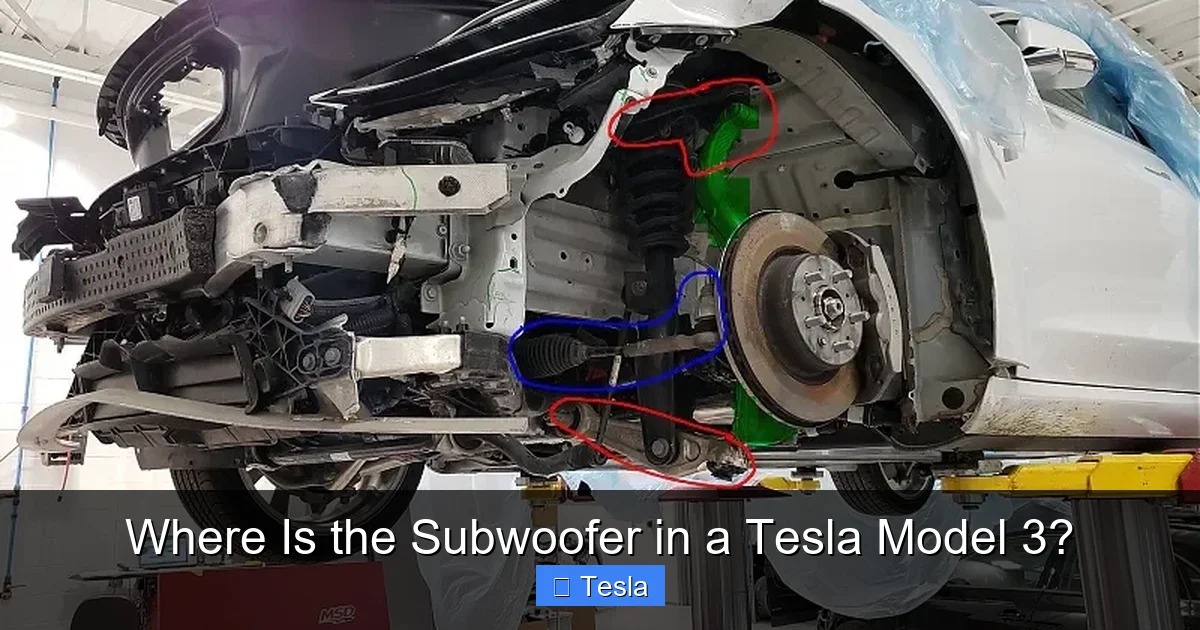
Understanding the subwoofer’s role is key to understanding the difference between Tesla’s two audio offerings. The distinction is not merely about volume or a few extra speakers; it’s a fundamental difference in engineering philosophy and capability, with the subwoofer being the most obvious hardware differentiator.
Visual guide about Where Is the Subwoofer in a Tesla Model 3?
Image source: i1.wp.com
The Standard Audio System: Competent but Constrained
The standard system in the Model 3 is perfectly adequate for daily driving and casual listening. It features a total of eight speakers, including a subwoofer of sorts, but it’s a different beast. Tesla uses a “distributed bass” approach here. Instead of one dedicated sub, they use larger speakers in the front and rear doors, along with the center dash speaker, and push them to handle lower frequencies using equalization and more power. The result is decent bass, but it lacks the depth, impact, and clean authority of a true subwoofer. At higher volumes, you’ll notice the door speakers straining, and the low end can become muddy or distorted. There is no discrete, powerful driver dedicated solely to the lowest octaves. For the average listener, it’s fine. For anyone who enjoys hip-hop, electronic music, or action movie soundtracks with deep LFE (Low-Frequency Effects) channels, the limitation will be apparent.
The Premium Audio System: A Concert Hall on Wheels
Upgrade to the Premium system, and the transformation is significant. You get a total of 14 or 15 speakers, depending on the model year, powered by a more powerful digital amplifier. The lineup includes dedicated mid-range and high-frequency drivers, an active center channel for clear dialogue, and—most importantly—the dedicated subwoofer in the rear wheel well. This subwoofer is the anchor of the system. It handles the frequencies below 80 Hz with ease, allowing the other speakers to focus on the mid and high ranges where human hearing is most sensitive to detail. The result is a system with incredible clarity, a wide and immersive soundstage, and powerful, tight bass that you can feel as much as hear. The bass is not boomy or overwhelming; it’s controlled and precise, adding weight and atmosphere without masking other instruments. The inclusion of the subwoofer, combined with the strategic placement of other speakers (including two in the rear pillars and two in the dashboard), creates a 3D audio experience that is genuinely impressive for a factory system.
Is the Premium Audio Worth the Upgrade?
This is a common question. The cost varies by market and model year, but it’s typically a several-thousand-dollar option at purchase. For the vast majority of buyers who love music and care about audio quality, the Premium Audio system is one of the most worthwhile upgrades Tesla offers. The difference is night and day. It transforms the Model 3 from a quiet commuter car into a personal listening sanctuary. The dedicated subwoofer is the star of the show in this upgrade. If you are even remotely an audiophile or simply enjoy a rich, full sound, skipping this option means missing out on a core part of the Model 3’s premium experience. Furthermore, because the system is so well-integrated, adding an aftermarket subwoofer later is more complex and expensive than if the car had a simple trunk-mounted box from the factory. Getting it right from the start is highly recommended. You can also look into how much it costs to tint a Tesla Model 3 as another popular upgrade that, like the premium audio, enhances the cabin’s comfort and ambiance.
Beyond Stock: Upgrading Your Model 3’s Bass
So, you have a Model 3 with the Premium Audio system, but you’re a basshead. You want more. Or perhaps you have the Standard system and want to add a subwoofer. Is it possible? The answer is yes, but it’s a more complex endeavor than in a traditional car due to Tesla’s unique architecture and digital audio system.
Challenges of Adding/Replacing a Subwoofer
The main challenge is integration. Tesla’s audio system is not a simple analog signal path. It’s a fully digital system controlled by the car’s central computer. The Premium system’s subwoofer is not just a speaker; it’s a calibrated part of a complete acoustic package. Simply splicing into an existing speaker wire to power an aftermarket amp and sub is not straightforward and can cause errors or damage. You need a line output converter (LOC) that can interface with Tesla’s digital signals, and these are becoming more available but require research. Additionally, finding space for an additional subwoofer enclosure is tricky. The trunk is already well-utilized. Some enthusiasts have installed small, sealed enclosures in the rear trunk, sacrificing some cargo space, or have built custom enclosures that fit around the existing rear subwoofer location, but this is advanced fabrication.
If you want to replace the factory subwoofer with a more powerful aftermarket unit, you must consider the physical constraints of the wheel well enclosure. The factory space is designed for a specific-sized driver. You would need to either find a direct-fit replacement driver or modify the factory enclosure, which risks ruining its acoustic properties and seal. A more common upgrade path for those with the Premium system is to add a second, small subwoofer in the trunk to supplement the factory one, creating a dual-sub setup for even more impact. This requires careful tuning via the car’s audio settings (if accessible) or an external processor.
The DIY vs. Professional Installation Debate
Given the complexity of interfacing with Tesla’s digital audio bus (likely MOST or Ethernet-based), professional installation is strongly recommended for any major audio upgrade. A shop experienced with Tesla vehicles will have the correct harnesses, processors, and knowledge to integrate cleanly without triggering vehicle errors or causing damage. They can also properly tune the system using measurement microphones to ensure the new subwoofer blends seamlessly with the existing speakers. A DIY project here is for advanced hobbyists only. For most owners, the best path to better bass is to ensure they purchased the Premium Audio package from the start. If that’s not an option, consulting with a reputable car audio specialist who has specific Tesla experience is the next best step. They might also suggest other modifications that improve perceived sound quality, like adding sound deadening material to doors, which is another popular Tesla Model 3 wrap consideration for those looking to customize and enhance their vehicle.
Keeping the Beat: Maintenance and Troubleshooting
The subwoofer, like any component, can eventually fail or cause issues. Because of its unique location, diagnosing problems requires a slightly different approach than in a conventional car.
Common Subwoofer Issues in the Model 3
The most common failure is a blown subwoofer driver. This can happen from excessive power (clipping from a distorted signal), physical trauma (impact from road debris in the wheel well), or simply age and wear. Symptoms include:
- Distortion or Rattling: A buzzing, grinding, or severely distorted sound from the bass notes, especially at higher volumes.
- No Sound: Complete silence from the subwoofer channel. You might notice the overall sound feels thin and lacks depth.
- Intermittent Sound: Bass cuts in and out, possibly due to a loose wiring connection or a failing voice coil.
Another issue, though not with the sub itself, is water intrusion. The wheel well is a wet environment. If the seal around the subwoofer enclosure or the plastic liner is damaged, water can enter the speaker’s magnet structure or the wiring connector, leading to corrosion and failure. This is why careful reinstallation of the wheel liner with intact seals is crucial after any work.
Diagnosis and Repair Steps
Diagnosis starts with the car’s audio settings. In the Tesla UI, go to Settings > Sound. Here you can adjust the subwoofer level (if available on your firmware) and run a balance/fade test. Fade the sound to the rear. If you still hear bass from the rear speakers but not the deep, physical thump, the subwoofer is likely the issue. If fading to the rear makes the sound very thin overall, the sub is probably not functioning.
To confirm, you must access the subwoofer as described in the previous section. Visually inspect the cone for tears or warping. Check the wiring harness for corrosion or loose pins. A simple resistance test with a multimeter on the subwoofer’s terminals (with it disconnected) can tell you if the voice coil is open (infinite resistance) or shorted (near zero resistance), both signs of failure. If the subwoofer is faulty, replacement is the only cure. You can source a factory replacement from Tesla or a compatible aftermarket driver. The repair involves removing the old unit and installing the new one, ensuring all bolts are torqued and the wiring is secure. If water damage is the culprit, you must also find and fix the source of the leak, which could be a torn wheel liner or a failed seal on the enclosure itself. Remember, working on the audio system does not typically affect the vehicle’s warranty unless you cause damage to other systems. However, if your car is still under the basic vehicle warranty and the subwoofer fails due to a manufacturing defect, Tesla service should cover the repair.
Conclusion: The Bass That’s Out of Sight, Not Out of Mind
So, where is the subwoofer in a Tesla Model 3? It’s in the rear driver’s side wheel well, a masterful piece of packaging that proves Tesla’s commitment to maximizing user space while delivering premium experiences. This location is not a compromise; it’s a deliberate, intelligent design choice that serves multiple masters: it saves trunk space, leverages existing vehicle architecture for better acoustics, and keeps the system’s components out of the way. For owners, knowing this location is practical knowledge for troubleshooting, satisfies curiosity, and deepens your understanding of the meticulous engineering that went into every square inch of your car. The next time you feel that deep bass line vibrate through your seat, you’ll know exactly where that powerful, hidden component is working tirelessly—silently, efficiently, and out of sight, just as Tesla intended. It’s a perfect metaphor for the Model 3 itself: sophisticated technology seamlessly integrated to enhance your driving experience without ever getting in your way.
Frequently Asked Questions
Is the subwoofer in a Tesla Model 3 located in the trunk?
No, it is not. In Models 3 equipped with the Premium Audio System, the subwoofer is located in the rear driver’s side wheel well (left side for left-hand drive cars). It is accessed by removing the plastic liner from inside the wheel well, not from the trunk or cabin.
Do all Tesla Model 3s have a subwoofer?
No. Only the Model 3 equipped with the optional Premium Audio System has a dedicated, standalone subwoofer. The Standard Audio System does not include a traditional subwoofer; it uses a distributed bass approach with larger door speakers.
Can I upgrade the subwoofer in my Tesla Model 3?
Yes, but it is complex. Replacing the factory subwoofer requires careful integration with Tesla’s digital audio system and physical fitment within the tight wheel well enclosure. Adding an additional subwoofer (e.g., in the trunk) is possible but also requires a line-output converter and professional tuning. It is not a simple plug-and-play upgrade like in many traditional cars.
Will modifying the subwoofer void my Tesla warranty?
Generally, modifying the audio system itself will not void the entire vehicle warranty. However, if the modification directly causes damage to another system (e.g., a short circuit affecting the vehicle’s computer), Tesla could deny a warranty claim for that related damage. Always check your specific warranty terms and consider professional installation.
How can I tell if my Model 3’s subwoofer is working properly?
Play a song with deep bass. Fade the audio to the rear using the car’s sound settings. If the sound becomes noticeably thin and you lack physical bass sensation, the subwoofer may be faulty. You can also listen for distortion, rattling, or complete silence from the low frequencies at higher volumes. Accessing the subwoofer for a visual and resistance test is the definitive check.
Does the subwoofer location affect cargo space in the Model 3?
No, this is the brilliant part. Because the subwoofer is housed in the rear wheel well, it does not take up any space in the main trunk compartment. This allows Tesla to provide a full, usable cargo area while still including a powerful subwoofer in the Premium Audio package. For more on maximizing your Model 3’s utility, you might read about where batteries are located in other EVs to see how packaging differs.