When Should I Use Sport Mode on a Jeep Cherokee?

Contents
- 1 Key Takeaways
- 2 📑 Table of Contents
- 3 Unleashing a More Responsive Jeep Cherokee: What Is Sport Mode?
- 4 The Golden Scenarios: When to Definitely Flip the Switch
- 5 The Other Side of the Coin: Fuel Economy and When NOT to Use It
- 6 Debunking Myths: What Sport Mode Does NOT Do
- 7 How to Engage and Disengage Sport Mode in Your Cherokee
- 8 Finding Your Personal Balance: Making Sport Mode a Habit
- 9 Frequently Asked Questions


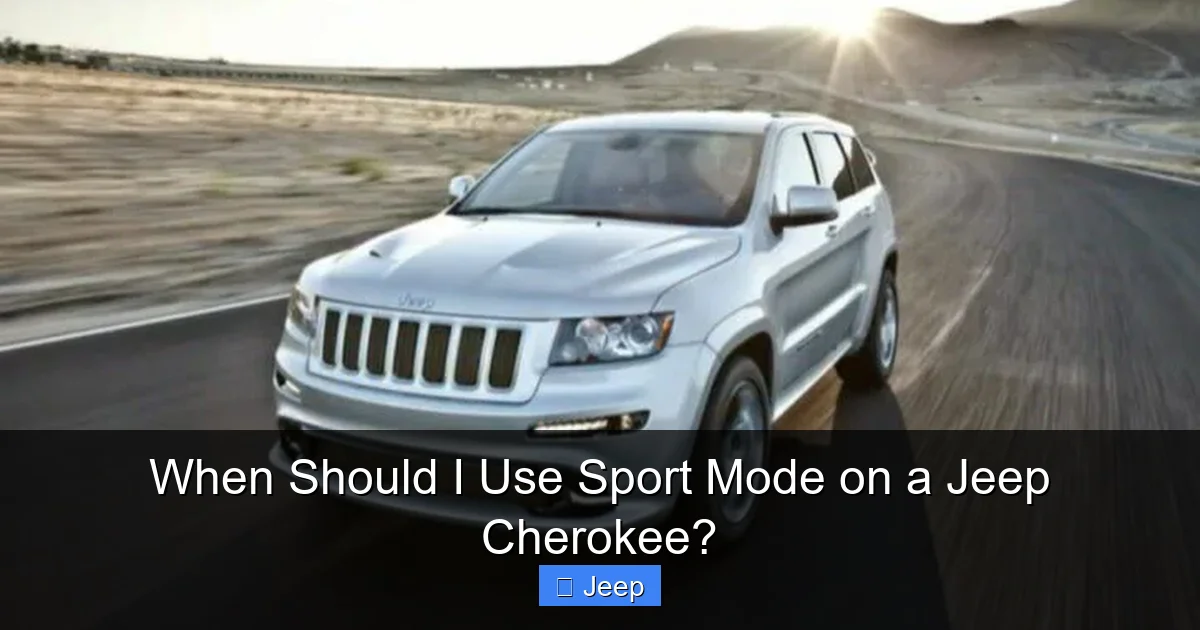
Sport Mode in your Jeep Cherokee sharpens throttle response, holds gears longer, and tightens steering for a more engaged driving experience. You should use it for highway merging, winding roads, or when you want a more responsive feel, but it reduces fuel efficiency. It’s not for everyday crawling or severe off-road, and it won’t magically increase horsepower.
Key Takeaways
- Sport Mode is for dynamic driving: It optimizes the Cherokee’s transmission, throttle, and steering for a sportier, more responsive feel during spirited driving.
- Use it for highway merging and passing: The quicker throttle response and delayed upshifts give you immediate power for safer, faster maneuvers.
- Ideal for curvy backroads: The steering becomes heavier and more precise, helping you maintain better control through corners.
- Not a 4×4 or off-road mode: Sport Mode does not change the Cherokee’s drive settings (like 4WD) or alter its fundamental off-road capability.
- Expect lower fuel economy: Holding gears at higher RPMs consumes more fuel; use it strategically, not for entire commutes.
- Great for towing/hauling on highways: The transmission stays in lower gears to maintain power and reduce hunting when carrying a load.
- It’s safe to engage while driving: You can toggle Sport Mode on the fly without stopping, making it convenient for changing conditions.
📑 Table of Contents
- Unleashing a More Responsive Jeep Cherokee: What Is Sport Mode?
- The Golden Scenarios: When to Definitely Flip the Switch
- The Other Side of the Coin: Fuel Economy and When NOT to Use It
- Debunking Myths: What Sport Mode Does NOT Do
- How to Engage and Disengage Sport Mode in Your Cherokee
- Finding Your Personal Balance: Making Sport Mode a Habit
Unleashing a More Responsive Jeep Cherokee: What Is Sport Mode?
So, you’ve got the keys to your trusty Jeep Cherokee. It’s a fantastic all-rounder, comfortable for the school run and capable on a weekend trail. But tucked away on your steering wheel or center console is that mysterious “Sport” button or switch. What does it actually do? And more importantly, when should you press it? Think of Sport Mode as giving your Cherokee a shot of espresso. It doesn’t change the engine’s size, but it makes everything feel more alert, more connected, and ready to respond the moment you think about pressing the gas pedal.
In technical terms, Sport Mode reprograms your Cherokee’s Transmission Control Module (TCM) and sometimes the Engine Control Module (ECM). It changes the shift points—the RPMs at which the automatic transmission changes gears. In normal “Comfort” or “Eco” mode, the transmission shifts early and smoothly to prioritize fuel savings and a plush ride. In Sport Mode, it lets the engine rev higher before shifting, keeping you in the power band for stronger acceleration. Simultaneously, the throttle pedal mapping becomes more sensitive, meaning you get more engine response from the same amount of pedal press. Many models also firm up the electric power steering, giving the wheel a heavier, more substantial feel that provides better feedback from the road. It’s a holistic tweak to the vehicle’s driving character.
This feature is incredibly common across modern vehicles, from a Toyota Camry to a muscle car like a Dodge Charger. The core principle is the same: a more engaging, driver-focused experience. But in a Jeep Cherokee, which balances on-road comfort with off-road potential, knowing when to use this sportier setting is key to getting the most out of your SUV without compromising its strengths or your fuel budget.
The Golden Scenarios: When to Definitely Flip the Switch
Now for the fun part. Sport Mode isn’t a “set it and forget it” setting. It’s a tool in your driving toolkit, best used for specific situations where its benefits shine. Using it at the right time transforms your commute or adventure, while using it constantly will have you visiting the gas pump more often than necessary. Here are the prime times to engage Sport Mode in your Jeep Cherokee.

Visual guide about When Should I Use Sport Mode on a Jeep Cherokee?
Image source: jeeprunner.com
1. Highway Merging and Passing Maneuvers
This is arguably the most practical and safety-enhancing use for Sport Mode. Imagine you’re on a quiet on-ramp, and a gap in fast-moving traffic is closing quickly. In normal mode, you press the pedal, and the Cherokee might hesitate for a split second as the transmission downshifts before launching you forward. In Sport Mode, that hesitation is gone. The transmission is already primed to keep the engine in a higher rev range, and the throttle is more responsive. That immediate, predictable burst of power can be the difference between a smooth merge and a stressful, white-knuckle moment. It gives you confidence when you need it most. For consistent highway driving where you’re not constantly passing, you’d likely switch back to normal mode to save fuel.
2. Winding Backroads and Canyon Cruising
If your idea of a great drive involves a twisty, two-lane road through hills or mountains, Sport Mode is your friend. The heavier steering feel is the first thing you’ll notice. It requires a bit more effort to turn the wheel, but that effort translates directly into more communication. You feel the tires gripping, the weight shifting, and the road surface imperfections through the wheel. This heightened feedback allows for smoother, more precise inputs. Furthermore, the transmission’s reluctance to upshift means you can power out of a corner without the car “thinking” about shifting right at the apex, which can upset the car’s balance. You stay in control, in the gear you want, for the entire cornering sequence. It makes driving on challenging roads more enjoyable and less of a chore.
3. Towing or Hauling a Heavy Load (On Pavement)
Your Jeep Cherokee is rated to tow, and if you’re pulling a trailer, a boat, or carrying a full roof rack with gear, Sport Mode can be a huge help—but with a caveat. The main benefit here is transmission behavior. A heavy load creates more resistance and can cause a transmission in normal mode to “hunt” for gears, constantly shifting up and down on slight inclines or changes in throttle. This hunting is inefficient, wears the transmission over time, and can be annoying. Sport Mode locks the transmission into a lower gear for longer, providing steady, consistent power and eliminating that frustrating gear-hunting. However, always remember that towing significantly increases strain on your engine and drivetrain. While Sport Mode helps manage that strain on the transmission, you must also be vigilant about other maintenance needs, like ensuring you’re using the correct engine oil for heavy-duty use and adhering to severe service intervals. Use Sport Mode for the highway portions of your trip but consider normal mode for long, flat stretches to save fuel.
4. When You Want a More Engaging “Feel”
Sometimes, you just want to feel more connected to your drive. Maybe it’s a sunny Sunday afternoon and you’re not in a hurry. Engaging Sport Mode changes the entire personality of your Cherokee. The engine note seems sharper because it revs higher, the steering is more substantial, and the car feels quicker and more eager. It turns an appliance into a driver’s car for the duration of your trip. This is about driver enjoyment, pure and simple. It’s the automotive equivalent of switching from a relaxed walk to a purposeful jog. You’re not necessarily going faster, but you’re more involved in the process of going.
The Other Side of the Coin: Fuel Economy and When NOT to Use It
If Sport Mode is the “go” pedal’s enthusiastic cousin, then Normal/Eco mode is the pragmatic accountant. There’s a direct trade-off. By keeping engine revolutions higher and not shifting to the tallest, most efficient gears, Sport Mode inevitably burns more fuel. The exact penalty varies by model year and engine size, but you can expect a noticeable drop in MPG, especially in city driving with frequent acceleration. A drop of 1-3 MPG is common, and in aggressive driving, it can be more.

Visual guide about When Should I Use Sport Mode on a Jeep Cherokee?
Image source: medias.fcacanada.ca
Therefore, you should avoid using Sport Mode in the following situations:
- Stop-and-Go City Traffic: Constantly revving the engine higher in bumper-to-bumper traffic is a waste of fuel and generates unnecessary heat. Stick to normal mode here.
- Long, Steady Highway Cruises: On a flat interstate at a constant speed, your Cherokee’s normal programming will select the highest gear possible for maximum efficiency. Sport Mode will keep it in a lower, less economical gear.
- When Fuel is a Primary Concern: If you’re monitoring your fuel budget closely or are on a very long trip, use Sport Mode only for specific passing maneuvers and then switch back.
- Severe Off-Road Crawling: This is critical. Sport Mode is an on-road performance setting. For slow, technical off-road maneuvers where you need precise, low-speed control (rock crawling, deep mud), you want the transmission to shift smoothly and predictably at low speeds. Normal mode is better for this. For off-road, you should be using the Cherokee’s dedicated off-road systems like Selec-Terrain, not Sport Mode. Sport Mode does not enhance 4×4 capability.
Debunking Myths: What Sport Mode Does NOT Do
There are some persistent misconceptions about what these “sport” buttons actually accomplish. Let’s clear the air for your Jeep Cherokee.
Visual guide about When Should I Use Sport Mode on a Jeep Cherokee?
Image source: jeepabc.com
Myth 1: It Adds Horsepower or Torque
It does not. Your engine produces the same peak horsepower and torque in Sport Mode as it does in Normal mode. The difference is in how and when that power is delivered. It feels stronger because you’re accessing the power higher in the rev range more readily, but the engine’s maximum output hasn’t changed. Don’t expect a magic power boost; expect a smarter, more immediate use of the power you already have.
Myth 2: It’s the Same as Engaging 4WD or Lockers
Absolutely not. Sport Mode is solely about the on-road driving dynamics—throttle, shift, and steering. It has zero effect on your Cherokee’s four-wheel-drive system. Your part-time 4WD models still require manual engagement of 4WD High or Low via the lever/switch. Your Active Drive II (full-time 4WD) systems continue to operate their center differential normally. Sport Mode does not lock any differentials or change torque split. For serious off-road traction, you must use the proper Selec-Terrain setting (like “Rock” or “Snow”) and, if equipped, the rear locker.
Myth 3: It’s Harmful to the Engine or Transmission
Using Sport Mode will not damage your Cherokee’s components if used as intended. The transmission and engine are designed to operate at higher RPMs for sustained periods. Race cars do it all day. The only “harm” comes from the increased wear associated with higher engine cycles and more aggressive driving, which is true of any spirited driving, with or without the Sport button. This is why adhering to a disciplined oil change schedule becomes slightly more important if you frequently use Sport Mode. The hotter, higher-RPM operation can break down oil viscosity faster. But the mode itself is a safe, manufacturer-engineered feature.
How to Engage and Disengage Sport Mode in Your Cherokee
The process is refreshingly simple. In most modern Jeep Cherokee models (2014 and newer), you’ll find a button with a checkered flag icon or the word “SPORT” on the steering wheel, shift lever, or center console. Just press it while driving. You’ll often see a confirmation on your instrument cluster—a light might illuminate, or the display might change to show “Sport” mode. There’s no need to come to a stop.
To disengage, you can usually press the button again, and the system will revert to its previous setting (Normal, Eco, etc.). Some models automatically return to Normal mode when you turn the car off, while others retain the last setting. Check your owner’s manual for the exact behavior of your specific model year and trim (Sport, Latitude, Limited, Trailhawk, etc.).
It’s worth noting that the activation method varies across brands. While your Cherokee uses a simple button, other vehicles might require a different sequence. For instance, learning how to use Sport Mode in a Toyota Corolla involves a different dash-mounted switch. But the fundamental result—a sharper driving character—remains the same.
Finding Your Personal Balance: Making Sport Mode a Habit
The best way to master the use of Sport Mode is through experimentation. Take a familiar stretch of road—maybe your regular highway on-ramp or a favorite backroad. Drive it first in Normal mode, noting the transmission shift points, throttle response, and steering weight. Then, turn on Sport Mode and drive it again. The differences will be immediately apparent. You’ll hear the engine rev higher before shifting, feel the steering wheel’s increased weight, and notice the more immediate acceleration.
Over time, you’ll develop an intuition for it. You’ll find yourself instinctively hitting the Sport button as you approach a slow-moving truck on a two-lane road, knowing you’ll need a quick, confident pass. You’ll use it for an enjoyable drive through the hills on the weekend. And you’ll consciously switch back to Normal mode for your daily slog through traffic or a long, fuel-conscious road trip. It’s about matching the car’s behavior to your immediate need: efficiency for commuting, engagement for driving.
Frequently Asked Questions
Does using Sport Mode damage my Jeep Cherokee’s engine or transmission?
No. Sport Mode is a factory-calibrated setting designed to be used regularly. It does not cause damage, but the higher RPMs and more aggressive driving associated with its use can lead to increased wear over time, which is why following your maintenance schedule, especially oil changes, is important.
Can I leave Sport Mode on all the time?
You can, but it’s not recommended. You will experience a significant and constant decrease in fuel economy. The transmission will also hold gears longer than necessary during calm driving, which can feel less smooth and be slightly more wearing over the long term.
Is Sport Mode the same as 4WD Low Range?
Absolutely not. Sport Mode is an on-road performance setting for throttle, transmission, and steering. 4WD Low Range is a severe off-road gearing that multiplies torque for slow, controlled crawling over obstacles. Using Sport Mode does not engage any part of the 4×4 system.
Will Sport Mode make my Cherokee faster in a straight line?
It will feel faster and more responsive due to quicker throttle response and better gear selection for acceleration. However, it does not increase the engine’s peak horsepower. Its benefit is most felt in the 0-60 mph range and during passing maneuvers, not in achieving a higher top speed.
Does Sport Mode affect the Cherokee’s off-road capability?
Negatively, if used off-road. For slow-speed technical crawling, you want the transmission to shift smoothly and early at low RPMs. Sport Mode’s tendency to hold gears and rev higher can make delicate off-road control more difficult. Always use the proper Selec-Terrain mode (like “Rock” or “Mud”) for off-roading.
Can I engage Sport Mode while the car is moving?
Yes. This is one of its best features. You can be cruising in Normal mode and, when you need a burst of power for passing, simply press the Sport button. The transmission will immediately begin adapting its shift logic for more performance.