
When Did Subaru Switch to a Timing Chain?

Subaru made a pivotal shift from timing belts to timing chains in most of its engines starting around 2010–2012, significantly improving long-term reliability and reducing maintenance needs. This transition marked a major engineering milestone, especially in models like the Forester, Outback, and Impreza, offering drivers peace of mind and fewer service interruptions.
If you’ve ever owned or shopped for a Subaru, you’ve probably heard the phrase “timing belt” thrown around—especially when discussing engine maintenance. For decades, Subaru was known for using timing belts in its iconic boxer engines. But somewhere along the way, things changed. The question many Subaru owners and enthusiasts now ask is: When did Subaru switch to a timing chain?
The answer isn’t as simple as a single year or model. Instead, it’s a gradual shift that unfolded over several years, influenced by advancements in engine technology, consumer demand for lower maintenance, and Subaru’s commitment to long-term reliability. Understanding this transition helps explain why newer Subarus are often praised for their durability and why maintenance schedules have become less stressful for owners.
In this article, we’ll dive deep into the timeline of Subaru’s switch from timing belts to timing chains, explore the reasons behind the change, and help you identify whether your Subaru uses a belt or a chain. Whether you’re driving a 2008 Forester or a 2023 Outback, knowing this detail can save you thousands in unexpected repairs and give you confidence in your vehicle’s longevity.
Key Takeaways
- Timing Chain Transition Began Around 2010–2012: Subaru started phasing out timing belts in favor of timing chains in most of its horizontally opposed (boxer) engines during this period.
- Improved Engine Longevity and Reliability: Timing chains are more durable than belts and typically last the lifetime of the engine under normal conditions.
- Lower Maintenance Costs Over Time: Unlike timing belts that require replacement every 60,000–100,000 miles, timing chains rarely need servicing, saving owners money.
- Not All Models Switched at Once: The transition varied by engine type and model year, with some performance and older engines retaining belts longer.
- Timing Chains Are Not Maintenance-Free: While longer-lasting, chains can still stretch or wear, especially with poor oil quality or infrequent changes.
- Check Your Owner’s Manual: Always verify your specific Subaru model and engine type to confirm whether it uses a timing belt or chain.
- Hybrid and Performance Models May Differ: Some turbocharged or hybrid variants still use timing belts due to space or design constraints.
📑 Table of Contents
The Evolution of Subaru’s Engine Design
Subaru has long been synonymous with the boxer engine—a horizontally opposed design where pistons move in and out like a boxer’s fists. This layout gives Subaru vehicles their signature low center of gravity, balanced handling, and smooth power delivery. But for much of the brand’s history, these engines relied on timing belts to synchronize the crankshaft and camshaft.
Timing belts are made of reinforced rubber and need regular replacement—typically every 60,000 to 100,000 miles. If a belt fails, the consequences can be catastrophic: valves can collide with pistons, leading to bent valves, damaged cylinder heads, and expensive engine repairs. This maintenance requirement became a well-known part of Subaru ownership, especially for models like the Impreza, Legacy, and Forester from the 1990s through the mid-2000s.
As automotive technology advanced, manufacturers began exploring more durable alternatives. Timing chains, made of metal and resembling bicycle chains, offered a solution. They’re stronger, more resistant to wear, and can last much longer than belts—often the entire life of the engine under normal conditions. Other automakers like Honda, Toyota, and BMW had already made the switch in many of their engines, and Subaru knew it was time to catch up.
The Push for Lower Maintenance and Higher Reliability
By the late 2000s, Subaru was gaining a reputation not just for all-wheel drive and rugged capability, but also for requiring frequent maintenance. The timing belt replacement—often costing $500 to $1,000 depending on labor and parts—was a major pain point for owners. It wasn’t just the cost; it was the inconvenience. Many Subaru engines require partial engine disassembly to access the timing belt, making the job time-consuming and labor-intensive.
Subaru listened to customer feedback and recognized that reducing maintenance frequency would make their vehicles more appealing, especially to families and long-term owners. The company also faced increasing competition from brands offering “maintenance-free” engine components. Switching to timing chains aligned with Subaru’s broader goal: building vehicles that are reliable, durable, and easy to own over the long haul.
Engineering Challenges in the Boxer Layout
One reason Subaru held onto timing belts longer than some competitors was the unique design of the boxer engine. The flat, wide layout makes engine compartments tight, and accessing internal components like the timing system can be more complex. Installing a timing chain requires more space and precision, and Subaru had to redesign certain engine blocks and covers to accommodate the change.
Additionally, timing chains produce more noise and vibration than belts, which could affect the smooth, quiet operation Subaru is known for. Engineers had to develop quieter chain guides, tensioners, and dampeners to maintain the brand’s reputation for refined driving dynamics. This took time, testing, and innovation—factors that contributed to the gradual rollout of timing chains across the lineup.
When Did Subaru Make the Switch?
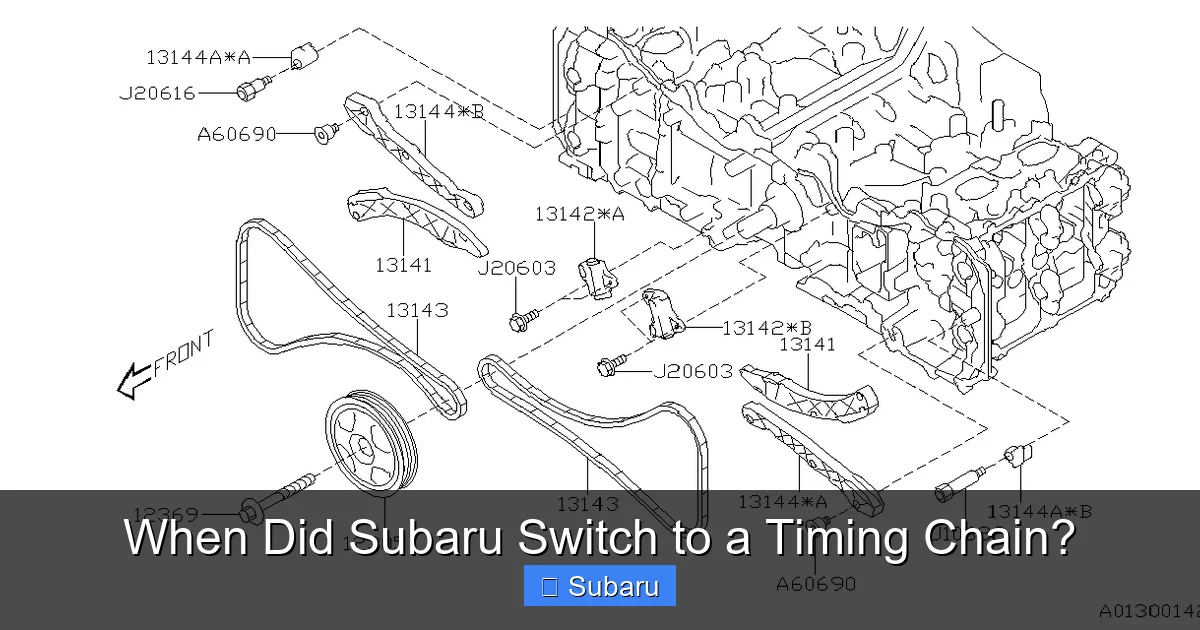
Visual guide about When Did Subaru Switch to a Timing Chain?
Image source: images.simplepart.com
So, when exactly did Subaru switch to a timing chain? The answer lies in a phased transition that began around 2010 and continued through 2012, depending on the engine and model. It wasn’t a single “switch” but a strategic shift across multiple platforms.
The first major step came with the introduction of Subaru’s FB-series engines, which started replacing the older EJ-series in the early 2010s. The FB engines were designed from the ground up with modern efficiency, emissions, and durability in mind—and timing chains were a key part of that vision.
The FB Engine Family: A Game Changer
The FB engine family debuted in 2010 with the 2.5-liter FB25 engine, first appearing in the 2011 Subaru Forester. This was a significant milestone: it was the first mass-produced Subaru engine to use a timing chain instead of a belt. The FB25 offered improved fuel economy, reduced emissions, and—most importantly—eliminated the need for regular timing belt replacements.
Following the FB25, Subaru introduced the 2.0-liter FB20 engine in the 2012 Impreza and Crosstrek, also equipped with a timing chain. These engines were lighter, more efficient, and built for long-term reliability. By 2013, most of Subaru’s mainstream models—including the Legacy, Outback, Forester, and Impreza—were using FB-series engines with timing chains.
Model-by-Model Breakdown
To help you understand whether your Subaru uses a timing belt or chain, here’s a quick guide by model and year:
– Forester: Switched to timing chains in 2011 with the FB25 engine. Earlier models (2008–2010) used the EJ25 engine with a timing belt.
– Outback and Legacy: Transitioned in 2013 with the FB25 engine. Models from 2010–2012 still used the EJ25 with a belt.
– Impreza and Crosstrek: Moved to timing chains in 2012 with the FB20 and FB25 engines.
– WRX and STI: These performance models retained the EJ25 turbo engine with a timing belt until 2014. The 2015 WRX introduced the FA20 turbo engine, which also uses a timing chain.
– BRZ: Uses the FA20 naturally aspirated engine with a timing chain from its 2013 debut.
It’s important to note that not all engines made the switch at the same time. Subaru’s turbocharged and performance-oriented engines lagged behind due to higher stress levels and design complexity. For example, the EJ257 engine in the 2010–2014 WRX STI still required a timing belt replacement every 60,000–100,000 miles.
Why the Gradual Transition?
Subaru didn’t switch all engines at once for several reasons. First, the company wanted to ensure the new timing chain systems were thoroughly tested under real-world conditions. Second, retooling production lines and redesigning engines is expensive and time-consuming. Finally, Subaru needed to manage inventory and phase out older engines without disrupting supply.
The gradual rollout also allowed Subaru to gather data and refine the design. Early FB engines had some reported issues with chain noise and tensioner wear, but these were addressed in later revisions. By 2015, timing chains had become the standard across nearly all Subaru models—except for a few outliers.
Timing Chains vs. Timing Belts: What’s the Difference?
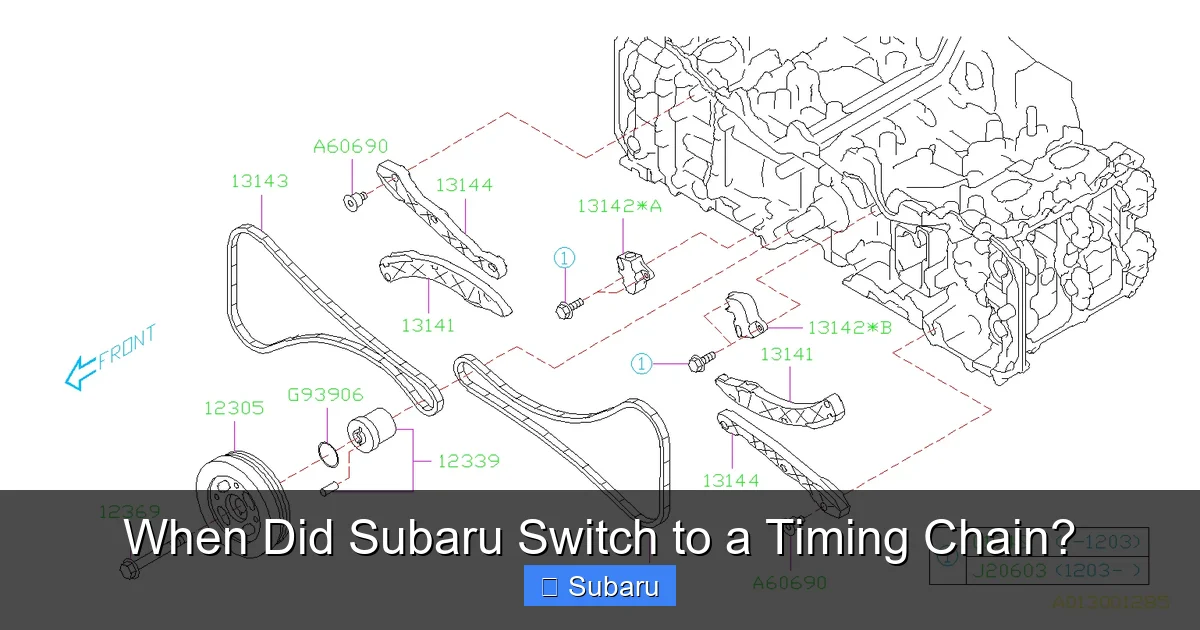
Visual guide about When Did Subaru Switch to a Timing Chain?
Image source: images.simplepart.com
To fully appreciate Subaru’s switch, it’s helpful to understand the fundamental differences between timing chains and timing belts.
Construction and Durability
Timing belts are made of high-strength rubber with fiberglass or Kevlar reinforcement. They’re lightweight, quiet, and cost-effective to produce. However, rubber degrades over time, especially when exposed to heat, oil, and moisture. Even with proper maintenance, belts have a finite lifespan.
Timing chains, on the other hand, are made of metal—typically steel—and resemble the chain on a bicycle. They’re much more durable and resistant to wear. Under normal driving conditions, a timing chain can last 200,000 miles or more, often outlasting the engine itself.
Maintenance Requirements
One of the biggest advantages of timing chains is reduced maintenance. While timing belts require replacement every 60,000 to 100,000 miles (and sometimes sooner in harsh conditions), timing chains are often described as “lifetime” components. Subaru doesn’t specify a replacement interval for timing chains in most of its newer engines, though they still require proper lubrication and occasional inspection.
That said, timing chains aren’t completely maintenance-free. Poor oil quality, infrequent oil changes, or extreme driving conditions can cause chain stretch, guide wear, or tensioner failure. In rare cases, a worn chain can lead to timing issues, misfires, or even engine damage—though this is far less common than belt failure.
Performance and Noise
Timing belts are quieter and produce less vibration, which contributes to a smoother engine feel. Timing chains, while more durable, can be noisier, especially as they wear. Subaru addressed this by using advanced chain guides, hydraulic tensioners, and noise-dampening materials in the engine cover.
Modern timing chains in Subaru engines are designed to operate quietly and efficiently, often indistinguishable from belts in terms of sound. In fact, many owners report that their FB-series engines are smoother and quieter than the older EJ engines—even with chains.
Cost Implications
While timing chains are more expensive to manufacture, they save owners money over time. A timing belt replacement can cost $600 to $1,200, including parts and labor. Over 200,000 miles, a Subaru with a belt might need two replacements—totaling $1,200 to $2,400. In contrast, a timing chain might never need replacement, saving owners thousands.
Additionally, timing belt failure can lead to catastrophic engine damage, with repair costs ranging from $3,000 to $7,000 or more. Timing chain failure is rare, and when it does occur, it’s often due to neglect (like skipping oil changes), not inherent design flaws.
How to Tell If Your Subaru Has a Timing Chain
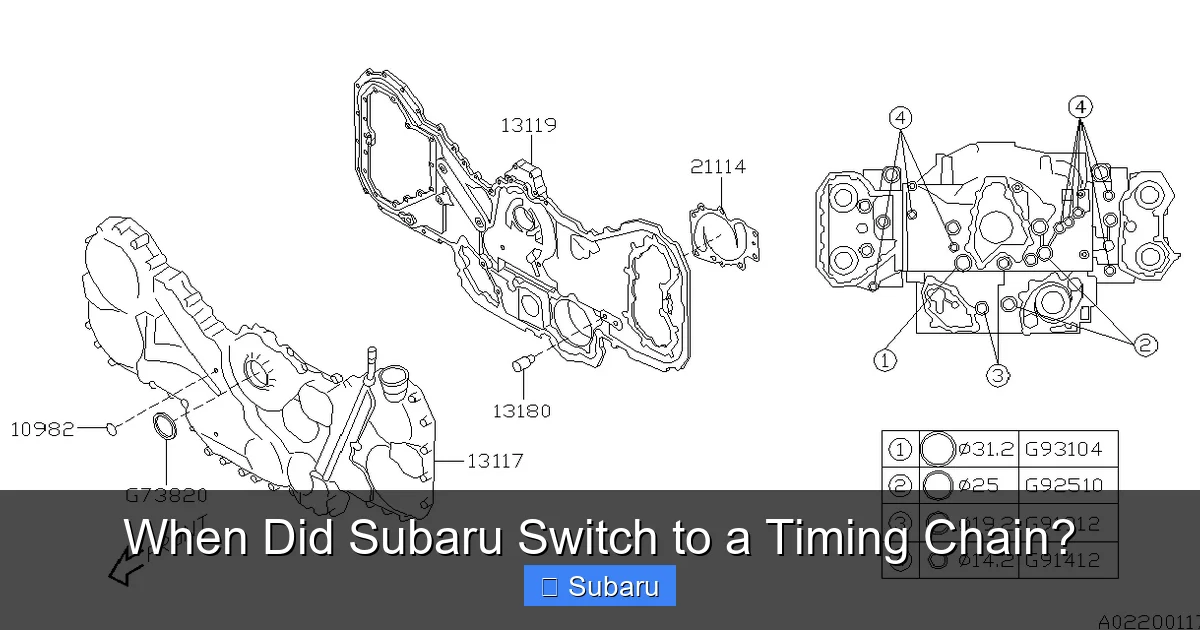
Visual guide about When Did Subaru Switch to a Timing Chain?
Image source: images.simplepart.com
If you’re unsure whether your Subaru uses a timing belt or chain, there are several ways to find out.
Check the Owner’s Manual
The easiest method is to consult your owner’s manual. Subaru clearly states whether your engine uses a timing belt or chain, along with maintenance recommendations. Look for sections on “Engine Maintenance” or “Scheduled Service.”
Identify Your Engine Type
Knowing your engine code can help. Here’s a quick reference:
– EJ-series engines (EJ20, EJ25): Use timing belts. Found in Subarus from the 1990s to early 2010s.
– FB-series engines (FB20, FB25): Use timing chains. Introduced in 2010–2012.
– FA-series engines (FA20, FA24): Use timing chains. Found in BRZ, WRX (2015+), and newer models.
You can usually find the engine code on a sticker under the hood or by checking your vehicle’s VIN through Subaru’s online parts catalog.
Look for Service Stickers or Records
If you bought your Subaru used, check for service records or stickers under the hood. A timing belt replacement sticker is a clear sign your car has a belt. If there’s no sticker and the car is a 2012 or newer model, it likely has a chain.
Ask a Subaru Dealer or Mechanic
When in doubt, visit a Subaru dealership or trusted mechanic. They can quickly identify your engine type and confirm whether it uses a belt or chain.
Maintaining Your Subaru’s Timing System
Even though timing chains are more durable, they still benefit from proper care.
Follow the Oil Change Schedule
Timing chains rely on engine oil for lubrication. Dirty or low oil can accelerate wear. Subaru recommends oil changes every 6,000 miles for most models, or every 3,000 miles if you drive in severe conditions (short trips, extreme temperatures, towing).
Use the Right Oil
Always use Subaru-approved synthetic or high-quality conventional oil. Avoid cheap or off-brand oils, which may not provide adequate protection for timing components.
Listen for Unusual Noises
While timing chains are generally quiet, a rattling or ticking noise from the engine—especially at startup—could indicate chain stretch or tensioner issues. Have it checked promptly.
Don’t Ignore Warning Lights
If your check engine light comes on, don’t ignore it. Timing issues can trigger misfire codes or camshaft/crankshaft correlation errors. Early diagnosis can prevent major damage.
The Future of Subaru Engines
As Subaru continues to evolve, timing chains are here to stay. The brand’s newer engines—like the FA24 in the 2022+ WRX—use advanced timing chains with improved durability and efficiency. Subaru is also investing in hybrid and electric powertrains, where timing systems may become obsolete altogether.
However, for now, timing chains represent a major step forward in Subaru’s quest for reliability and owner satisfaction. The switch from belts to chains has made Subarus easier to own, less expensive to maintain, and more appealing to a broader audience.
Conclusion
So, when did Subaru switch to a timing chain? The transition began around 2010–2012 with the introduction of the FB-series engines, marking a turning point in Subaru’s engineering philosophy. By replacing timing belts with more durable timing chains, Subaru reduced maintenance burdens, improved long-term reliability, and gave owners greater peace of mind.
While not every model switched at the same time—and some performance engines retained belts a bit longer—the shift has been overwhelmingly positive. Today, most Subarus come equipped with timing chains that are built to last the life of the vehicle.
If you’re driving a 2012 or newer Subaru, chances are you’re benefiting from this change. And if you’re shopping for a used Subaru, knowing whether it has a belt or chain can help you make a smarter, more informed decision.
In the end, Subaru’s move to timing chains reflects a commitment to innovation, customer satisfaction, and the enduring spirit of the boxer engine. It’s one of the many reasons why Subarus continue to be beloved by drivers around the world.
Frequently Asked Questions
When did Subaru start using timing chains?
Subaru began switching to timing chains around 2010–2012 with the introduction of the FB-series engines. The 2011 Forester with the FB25 engine was one of the first models to feature a timing chain.
Do all Subarus have timing chains now?
Most Subaru models from 2012 onward use timing chains, but some older or performance models—like the 2010–2014 WRX STI—still use timing belts. Always check your specific model and engine type.
Is a timing chain better than a timing belt?
Yes, timing chains are more durable and typically last the life of the engine, while timing belts require replacement every 60,000–100,000 miles. Chains also reduce long-term maintenance costs.
Can a timing chain fail?
While rare, timing chains can fail due to poor maintenance, low oil, or extreme wear. Symptoms include engine noise, misfires, or difficulty starting. Regular oil changes help prevent issues.
How do I know if my Subaru has a timing belt or chain?
Check your owner’s manual, look for a service sticker under the hood, or identify your engine code (EJ = belt, FB/FA = chain). You can also ask a Subaru dealer or mechanic.
Do I still need to maintain a timing chain?
Yes, while timing chains don’t need replacement like belts, they require proper lubrication. Follow Subaru’s oil change schedule and use quality oil to ensure longevity.