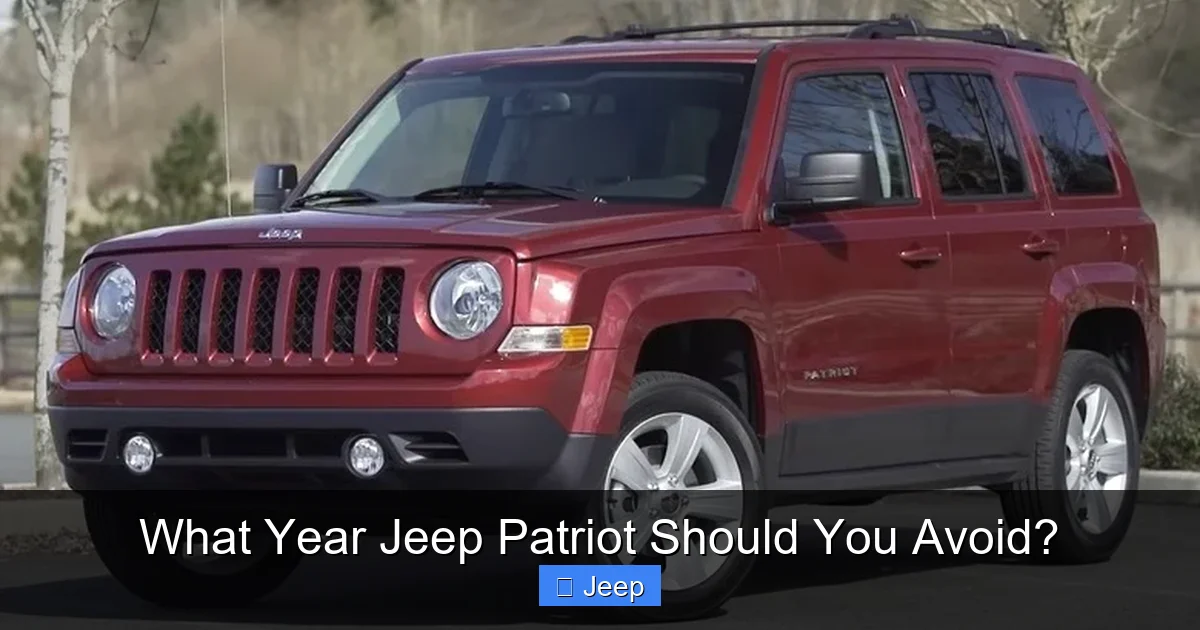
What Year Jeep Patriot Should You Avoid?

Contents
- 1 Key Takeaways
- 2 📑 Table of Contents
- 3 The Jeep Patriot: An Affordable Entry with a Costly Secret
- 4 The Blacklist: Years to Steer Clear Of at All Costs
- 5 Why These Years Fail: The Core Engineering Problems
- 6 How to Vet a Used Jeep Patriot (If You Must)
- 7 Better Alternatives in the Compact SUV Arena
- 8 The Bottom Line: Is Any Jeep Patriot Worth It?
- 9 Frequently Asked Questions


When shopping for a used Jeep Patriot, the model years to absolutely avoid are the 2007-2009 early models and the 2011 and 2014-2017 ranges. These years are plagued by severe transmission failures, chronic electrical gremlins, and suspension problems that lead to costly repairs. While the 2010 and 2012-2013 models are significantly better, no Patriot is a paragon of reliability. A pre-purchase inspection by a trusted mechanic is non-negotiable for any used Patriot you consider.
Key Takeaways
- The absolute worst years are 2007-2009 and 2011: These model years suffer from catastrophic CVT transmission failures and major electrical system defects that are expensive to fix.
- 2014-2017 models have their own serious flaws: While the transmission was improved, these later models have pervasive issues with power steering failure and severe rust problems, especially in northern climates.
- The “best” years (2010, 2012-2013) are only “best” by comparison: Even the relatively better years have a reputation for below-average reliability, poor interior quality, and weak performance.
- A pre-purchase inspection is mandatory: Never buy a used Patriot without a thorough inspection by an independent mechanic who can check for transmission slippage, rust, and electrical faults.
- Consider more reliable alternatives: For a used compact SUV, models like the Honda CR-V or Toyota RAV4 from the same era offer far superior long-term reliability and lower cost of ownership.
- Parts and expertise are widely available: One small silver lining is that Patriot parts are inexpensive and shared with other Jeep/Dodge/Chrysler vehicles, and any mechanic knows them.
- Its value proposition is purely upfront cost: The Patriot’s only real advantage is a very low used purchase price, which is quickly erased by inevitable repair bills.
📑 Table of Contents
The Jeep Patriot: An Affordable Entry with a Costly Secret
Let’s be real for a second. The allure of a used Jeep Patriot is strong. You see them priced shockingly low on dealer lots and online listings. They have that classic, boxy Jeep look that says “adventure” without the price tag of a Wrangler. For budget-conscious buyers needing a compact SUV with decent cargo space and available four-wheel drive, it seems like a steal. But here’s the harsh truth your wallet will learn the hard way: the Jeep Patriot has one of the most checkered reliability records in the entire used car market. It’s not just a matter of “some years are better.” For the Patriot, the question “What year Jeep Patriot should you avoid?” has a very long and specific answer. Buying the wrong year isn’t just a minor inconvenience; it’s a direct ticket to a garage’s waiting list and a rapidly emptying bank account.
This article isn’t about scaring you away from every single Patriot on the road. There are owners who have had decent luck. But we’re here to talk about odds, probabilities, and the overwhelming data from owner surveys, mechanic reports, and recall databases. Our goal is to give you the exact years to walk away from, the specific failures that make them lemons, and the critical steps you must take if you’re still considering one. Think of this as your essential survival guide for navigating the used Patriot minefield.
The Blacklist: Years to Steer Clear Of at All Costs
If you take one thing from this guide, make it this: the Jeep Patriot model years from 2007 to 2009 and the 2011 model year are fundamentally compromised vehicles. They represent the peak of the Patriot’s engineering failures. Then, the 2014 through 2017 models introduce a different, but equally devastating, set of problems. Let’s break down why these specific years are toxic.

Visual guide about What Year Jeep Patriot Should You Avoid?
Image source: jeepmodified.com
The First Generation Disasters: 2007-2009
The Jeep Patriot debuted for the 2007 model year on the same platform as the Dodge Caliber and Jeep Compass—a fact that should immediately raise red flags. The 2007-2009 Patriots, particularly those with the 2.4L 4-cylinder engine mated to the Continuously Variable Transmission (CVT), are arguably the most notorious. This Jatco-built CVT was not up to the task. It is infamous for premature wear, shuddering, and complete failure, often between 80,000 and 120,000 miles. The repair cost? A remanufactured or new CVT can easily run $4,000 to $6,000, frequently exceeding the car’s value.
But the transmission wasn’t the only culprit. These early models are also plagued by:
- Electrical System Failures: The Totally Integrated Power Module (TIPM) is a known failure point. This computer controls everything from the windows and locks to the fuel pump and wipers. When it fails, your car can become a brick. Symptoms include intermittent electrical loss, no-start conditions, and warning lights galore. Replacing a TIPM is another $800-$1,200 hit.
- Engine Issues: The 2.4L World Engine, while generally durable, had problems with oil consumption and, in some cases, premature timing chain wear leading to expensive engine repairs.
- Rust: These early Patriots are also notorious for rusting through frame components and body panels, especially in states that use road salt.
If you see a 2008 or 2009 Patriot for sale for $2,500, the math is simple: you need to budget at least $5,000 for a transmission in the next few years. It’s a financial trap.
The 2011 Model Year: A One-Year Wonder of Woes
You might think a mid-cycle refresh would improve things. For 2011, Jeep did give the Patriot a minor facelift. However, this model year stands out as a singularly bad one, even among its peers. It seems to have inherited all the worst traits of the early models while introducing some new ones. The CVT problems persisted, but reports of transmission failure became even more widespread and occurred at lower mileage.
The 2011’s specific Achilles’ heel often cited is the Power Steering System. Many 2011 Patriots suffer from power steering pump failures and leaks, leading to a heavy, dangerous steering feel and a repair bill of hundreds of dollars. Furthermore, the electrical gremlins, particularly with the TIPM, reached a fever pitch in this model year. Consumer reports and owner forums are filled with 2011 Patriots that become undrivable due to a combination of these issues. It’s a year where the problems aren’t just common; they are nearly universal.
The Rust Bucket Brigade: 2014-2017
In 2014, Jeep finally replaced the problematic CVT with a more conventional 6-speed automatic transmission (from Aisin). This was a monumental improvement for drivetrain reliability. So why are 2014-2017 Patriots still on the “avoid” list? Two words: Rust and Power Steering.
These later Patriots, especially those built at the Belvidere, Illinois plant, developed a catastrophic rust problem. The subframes and rear trailing arms, critical structural and suspension components, are rusting through to the point of complete failure. This isn’t surface rust; it’s the metal dissolving. Repair involves replacing entire subassemblies, costing thousands. The National Highway Traffic Safety Administration (NHTSA) has investigated these issues. A simple visual inspection under the car is often enough to reveal a rusted, compromised chassis that is unsafe to drive.
Compounding the rust issue, the power steering pump failures that started in 2011 continued through the 2017 model year. So, you could have a Patriot with a sound transmission but a rotting frame and a failing steering system. It’s a lose-lose scenario.
Why These Years Fail: The Core Engineering Problems
It’s helpful to understand the “why” behind these failures. The Patriot was built to a very low price point. Cost-cutting was the primary design driver, not durability or driver satisfaction.

Visual guide about What Year Jeep Patriot Should You Avoid?
Image source: dashlights.net
The CVT Catastrophe
CVTs are great in theory—smooth and efficient. But the one put in the Patriot was a cheap, early-generation unit not designed for the torque of the 2.4L engine or the driving habits of American consumers (sudden acceleration, highway merging). The belts and pulleys wore out quickly. The software logic was poor, leading to annoying rubber-band-like acceleration and overheating. When it failed, it often failed spectacularly, contaminating the entire cooling system with metal shavings and requiring a complete replacement of the transmission and cooler lines.
The Electrical Nightmare (The TIPM)
The TIPM is a classic case of over-integration and under-engineering. It’s a single, expensive module that controls dozens of functions. When its internal relays or circuits fail, you lose multiple systems at once. diagnosing it is difficult because the symptoms are random and intermittent (e.g., “my horn doesn’t work and my wipers run on their own”). It’s a design that guarantees high warranty costs and owner frustration.
The Rust Invasion
The rust problem points to a failure in the manufacturing process—either inadequate rust-proofing at the factory or the use of lower-grade steel that wasn’t properly treated. The fact that it targeted specific structural parts suggests a material or coating defect. For a vehicle marketed as a potential off-roader, a rusted frame is the ultimate irony and a serious safety hazard.
General Cheapness
Beyond the big-ticket items, everything feels flimsy. The interior plastics are hard and brittle, cracking in sunlight. Suspension components (control arms, bushings) wear out quickly. The sound insulation is minimal, making for a noisy cabin. The base 2.0L engine (2007-2010) is painfully underpowered. It all adds up to a car that feels like it’s falling apart around you, even if the major components are still running.
How to Vet a Used Jeep Patriot (If You Must)
So, you’ve found a 2013 Patriot with 120,000 miles for $4,000 and you’re tempted. What do you do? You don’t just kick the tires. You proceed with military-grade caution.

Visual guide about What Year Jeep Patriot Should You Avoid?
Image source: dashlights.net
The Non-Negotiable Pre-Purchase Inspection (PPI)
This is not optional. Spend $150-$250 on a thorough inspection by a reputable, independent mechanic (not the dealer selling it). Tell them specifically: “Please check for CVT condition (look for leaks, check fluid condition, road test for shudder/slippage), inspect the entire undercarriage for rust on the frame and trailing arms, scan for any TIPM-related electrical codes, and check the power steering system for leaks and pump noise.” A good mechanic will put the car on a lift and give you a detailed report. If the seller refuses a PPI, walk away immediately. That’s the biggest red flag of all.
What to Look For During Your Own Check
Before you even spend on a PPI:
- Test Drive Vigorously: Drive it on a highway. Accelerate from 50 to 70 mph. Does the engine rev high while the car accelerates slowly? That’s CVT slippage. Does the steering feel heavy or make whining noises? Power steering issue. Does the transmission shift roughly or delay? Big problem.
- Check All Electronics: Roll down all windows, use all locks, test the wipers, horn, and infotainment system. Intermittent failures are a sign of a dying TIPM.
- Inspect the Undercarriage: If you can, get under the car with a flashlight. Look at the frame rails, the rear axle mounting points (trailing arms). Any flaking, bubbling, or holes in the metal? Walk away.
- Check Fluids: Transmission fluid should be red or pink and smell slightly sweet. If it’s dark brown or black and smells burnt, the CVT is on its last legs.
Better Alternatives in the Compact SUV Arena
Given the Patriot’s well-documented issues, you should seriously consider spending your money elsewhere. For the same price range (say, $5,000-$10,000), you can find used compact SUVs that will cost you far less in repairs over the next five years. While no used car is perfect, some are in a different league.
For example, a Honda CR-V (2007-2011) or a Toyota RAV4 (2006-2012) from the same era will have vastly superior reliability, better fuel economy, and hold their value better. Their transmissions (standard automatics) are bulletproof. Their interiors feel more solid. They simply won’t nickel-and-dime you to death. You might pay $1,000-$2,000 more upfront, but you’ll save $5,000 in repairs. That’s a smart trade.
If you need true four-wheel drive and want something with a bit more character, a used Subaru Forester (2009-2013) with a manual transmission is a fantastic, reliable choice. You can also look at the Ford Escape/Mazda Tribute (2008-2012) with the 2.5L engine and 6-speed automatic, which are known workhorses. The point is: the used compact SUV market is full of competent, reliable options. Choosing a Patriot, especially a bad-year one, is choosing financial stress.
If you are set on a Jeep for its off-road brand image, you need to budget significantly more for a used Jeep Wrangler (JK/JKU, 2007-2018). While not without its own issues (especially the automatic transmission in 2012-2013), its solid axles and simple design make it far more repairable and durable long-term than the unibody Patriot. Just be sure to read our guide on what year Jeep Wrangler should you avoid first.
The Bottom Line: Is Any Jeep Patriot Worth It?
The only scenario where a Jeep Patriot makes sense is this: you find a 2012 or 2013 model (the absolute peak of the generation) with a 6-speed automatic, under 100,000 miles, with a clean title, a complete service history, and a flawless pre-purchase inspection report. And even then, you buy it knowing its resale value is garbage and its long-term reliability is merely “adequate.” You’re buying the absolute cheapest possible transportation for the next 3-5 years, and you have a separate repair fund.
For everyone else—families, daily commuters, first-time buyers—a Patriot is a gamble you will likely lose. The cost of ownership, when you factor in the near-certain transmission, electrical, or rust repairs, makes it one of the worst values on the used car market. The years to avoid are not a short list; they are the vast majority of the model’s production run. Protect your hard-earned money. Walk past the shiny, cheap Patriot on the lot and test drive something else. Your future self, with a working car and a full bank account, will thank you.
Frequently Asked Questions
Is a 2010 Jeep Patriot reliable?
The 2010 model year is one of the better Patriots, as it avoided the worst of the CVT issues by offering the more reliable 6-speed manual or the 6-speed automatic (on V6 models). However, it still suffers from common Patriot problems like TIPM electrical failures, general cheap interior components, and potential rust. It’s “reliable” only in comparison to the catastrophic 2007-2009 and 2011 models.
What is the most common problem with a Jeep Patriot?
The single most common and expensive problem across the Patriot’s lineup is CVT transmission failure in the 2007-2013 4-cylinder models. Following that, the Totally Integrated Power Module (TIPM) failure causes widespread electrical issues. In later models (2014-2017), severe subframe rust and power steering pump failures become the dominant, costly problems.
Should I buy a high-mileage Jeep Patriot as a first car?
We strongly advise against it. A high-mileage Patriot (150,000+ miles) is a Russian roulette of impending major repairs. The cost of a transmission or subframe replacement will likely exceed the car’s value. For a first car, you need predictability. A used Honda Civic, Toyota Corolla, or Ford Focus will be far cheaper to maintain and far less likely to leave you stranded with a $5,000 bill.
Can you daily drive a Jeep Patriot?
You can, but you do so at your own financial risk. Daily driving a problematic Patriot means you are constantly aware of potential noises, warning lights, and driving quirks. It’s not a peaceful ownership experience. You’re also likely to spend more time and money on repairs than on fuel. It’s a stressful way to commute.
What engine is best in a Jeep Patriot?
The 2.4L 4-cylinder paired with the 6-speed manual transmission (2007-2014) or the 6-speed automatic (2014-2017, on V6 models) is the best combination. It avoids the CVT entirely. The 2.0L engine is underpowered and not significantly more reliable. The 3.7L V6 offers more power but worse fuel economy and still has the same electrical and rust issues as the 4-cylinder models.
How long do Jeep Patriot transmissions last?
For the CVT (2007-2013 4-cylinders), the average lifespan is often less than 120,000 miles, with many failing much sooner. For the 6-speed automatic (2014-2017 V6 models and some 4-cylinders), the transmission is much more robust and can easily last 200,000+ miles with basic maintenance. However, the later models’ rust and power steering issues often claim the vehicle before the transmission does.