
What Oil Does a 2011 Bmw 328i Take?

Using the correct oil in your 2011 BMW 328i isn’t just a suggestion—it’s critical for engine health and performance. BMW recommends a full synthetic 0W-30 or 0W-40 viscosity oil that meets their stringent LL-04 or LL-01 specifications. Always verify with your owner’s manual and use exactly 6.3 quarts during a change to ensure proper lubrication and avoid costly damage.
So, you’ve got a sleek, powerful 2011 BMW 328i in your driveway. That F30-generation sedan represents a perfect blend of driving dynamics and luxury. But to keep that brilliant turbocharged 2.0-liter four-cylinder (the N20B20 engine) humming like a finely-tuned instrument, you have to feed it exactly what it craves. Asking “What oil does a 2011 BMW 328i take?” is one of the most important maintenance questions you can ask. The wrong answer isn’t just a minor inconvenience—it can lead to increased wear, poor performance, warning lights, and in the worst case, catastrophic engine failure. This guide will cut through the confusion and give you the definitive, step-by-step answer you need.
We’re going to demystify the codes, the viscosities, and the specifications. You’ll learn not just *what* to put in your 328i, but *why* it matters, how to check it yourself, and how to avoid the common pitfalls that trap many well-meaning owners. Think of this as your personal conversation with a BMW master technician, minus the labor charge. Let’s dive in.
Key Takeaways
- Required Viscosity: Your 2011 BMW 328i requires a full synthetic oil with a viscosity of 0W-30 or 0W-40. This ensures optimal flow in cold starts and protection at high temperatures.
- BMW Approval is Non-Negotiable: The oil must carry official BMW approval, specifically the LL-04 (for most markets) or older LL-01 specification. Look for these codes on the oil bottle.
- Exact Oil Capacity: The engine, including the filter, holds exactly 6.3 quarts (6.0 liters) of oil. Underfilling or overfilling by even a quart can cause serious problems.
- Change Interval: With approved synthetic oil, BMW’s official Service Interval Indicator typically calls for a change every 10,000 miles or once per year, but severe driving may require more frequent changes.
- Synthetic Oil is Mandatory: The N20B20 engine in your 328i is designed specifically for full synthetic oil. Conventional oil will not provide adequate protection and will void your warranty.
- Always Consult Your Owner’s Manual: While this guide is accurate, your vehicle’s specific build date and region may have slight variations. The manual is the final authority.
📑 Table of Contents
- Why the Right Oil is Non-Negotiable for Your BMW 328i
- Decoding the Oil Viscosity: 0W-30 vs. 0W-40 for Your 328i
- BMW-Approved Oils: The LL-04 and LL-01 Specifications Explained
- Oil Capacity, Change Intervals, and the Service Indicator
- How to Perform a DIY Oil Change (Step-by-Step Guide)
- Common Oil-Related Mistakes That Can Harm Your 328i
- The Bottom Line: Protecting Your Investment
Why the Right Oil is Non-Negotiable for Your BMW 328i
Before we get to the specific bottle to buy, it’s crucial to understand why BMW is so particular about engine oil. Your 2011 328i’s N20 engine is a marvel of modern engineering. It features a twin-scroll turbocharger, high-pressure fuel injection, and variable valve timing (Valvetronic). These systems operate with incredibly tight tolerances and generate immense heat and pressure.
The oil in this engine does far more than just lubricate. It is a critical component of the cooling system, carrying heat away from the turbo and cylinder walls. It acts as a hydraulic fluid to operate the complex variable valve timing mechanisms. It contains detergents to keep the tiny passages clean and anti-wear additives to protect the metal surfaces from grinding together. Using an oil that doesn’t meet BMW’s exact specifications means these systems won’t get the protection they need. The result can be sludging, premature turbo wear, failed VANOS (variable camshaft timing) units, and ultimately, a very expensive paperweight where your engine used to be.
This is precisely why BMW Longlife approvals (like LL-04) exist. They are not marketing fluff; they are grueling, proprietary tests that an oil must pass to earn the badge. These tests simulate extreme conditions, extended drain intervals, and specific compatibility with BMW’s engine materials and emission systems. When you see “BMW LL-04” on a bottle, it means that formulation has been proven to keep your specific engine healthy for the long haul.
The High-Stakes World of Engine Specifications
Think of it like this: you wouldn’t put regular gasoline in a high-performance race car that requires 100-octane fuel. The octane rating prevents destructive pre-ignition. Similarly, the BMW oil specification prevents destructive internal conditions. The “0W” part of the viscosity rating ensures the oil is thin enough to flow instantly to every critical bearing when you start your car on a freezing morning, preventing that brutal “dry start” wear that accounts for a significant portion of an engine’s lifetime wear. The “-30” or “-40” part ensures the oil remains thick enough to maintain a protective film between metal parts when the engine is at full operating temperature, which for a turbocharged BMW can be well over 250°F (121°C).
Using a 5W-30 oil, which is common in many American V6 engines, might *seem* close, but it’s a different product. Its cold-flow properties and high-temperature shear stability are engineered for different tolerances and operating conditions. In your BMW, it could lead to slightly slower turbo lubrication on startup and potentially thinner film protection at sustained high RPMs. It’s a risk not worth taking when the correct 0W oils are readily available.
Decoding the Oil Viscosity: 0W-30 vs. 0W-40 for Your 328i
This is the most common point of confusion. Your owner’s manual, and most official BMW literature, specifies 0W-30. However, you’ll also see 0W-40 recommended for many BMWs, and you might hear conflicting advice from forums or quick-lube shops. So which one is right for your 2011 328i?
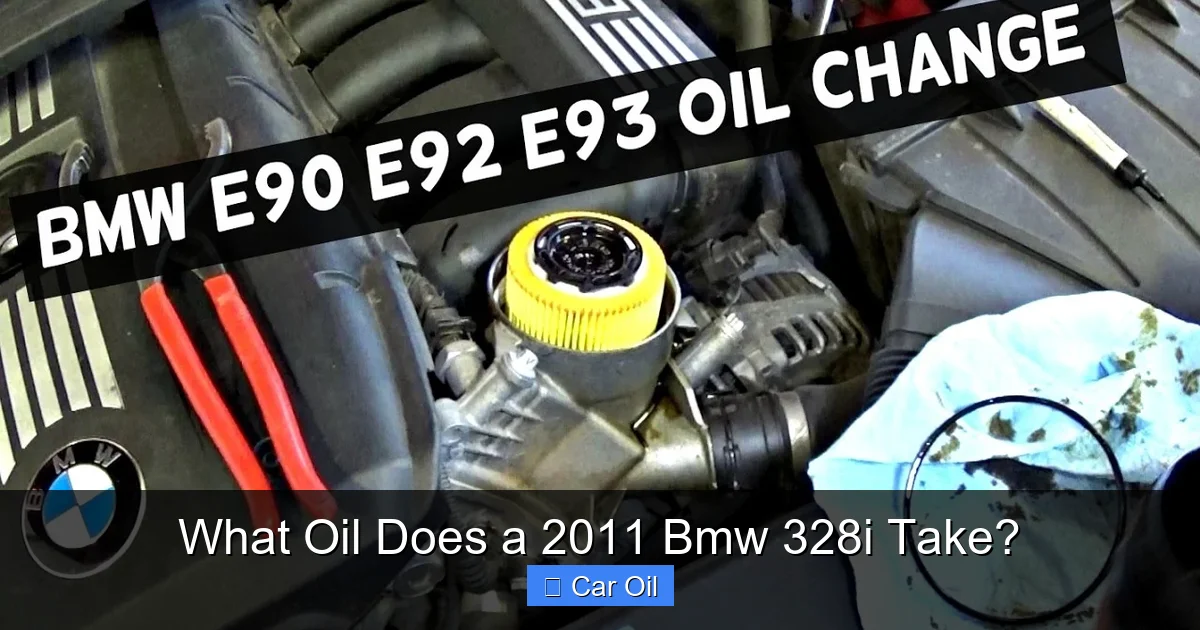
Visual guide about What Oil Does a 2011 Bmw 328i Take?
Image source: i.ytimg.com
The short, definitive answer is: Both are acceptable and approved by BMW for this engine, provided they carry the correct BMW Longlife specification. The choice often comes down to your driving style and climate.
Understanding the Numbers: 0W-30 and 0W-40
The “0W” stands for “0 Winter.” The “W” means it’s a winter-grade oil. The “0” is its cold-crank viscosity, a measure of how easily it flows at startup in extreme cold. A “0W” oil must flow at temperatures as low as -40°C (-40°F). This is excellent for cold starts anywhere.
The second number (30 or 40) is the oil’s high-temperature viscosity. This is its thickness at the engine’s normal operating temperature (around 100°C/212°F). A 0W-40 is thicker at high temperatures than a 0W-30. This can be beneficial for:
- High-Stress Driving: If you frequently drive your 328i hard, on track days, or in very hot climates, the extra film strength of a 0W-40 can provide a marginal safety benefit.
- Older Engines: As an engine accumulates miles, internal clearances can ever so slightly widen. A 0W-40’s slightly higher viscosity can help maintain oil pressure and protect these worn parts better.
The 0W-30 is the factory-specified “all-around” oil. It’s designed to provide the best balance of fuel economy (thinner oil creates less internal drag), cold-weather performance, and high-temperature protection for a new or low-mileage engine in typical daily driving conditions.
The Official BMW Stance and What to Buy
BMW’s official specification for the N20 engine in the 2011 328i is BMW Longlife-04 (LL-04). This specification explicitly approves both 0W-30 and 0W-40 viscosities. You must choose an oil that states “BMW LL-04” on the bottle. There is also an older specification, LL-01, which is also acceptable but is being phased out in favor of LL-04. For a 2011 model, either LL-01 or LL-04 is fine, but LL-04 is the current standard and is backwards compatible.
Practical Recommendation: For most owners in moderate climates with normal driving habits, a high-quality full synthetic 0W-30 meeting BMW LL-04 is the perfect, factory-spec choice. If you live in a consistently very hot climate (like Arizona or Florida) or do a lot of high-speed driving, a full synthetic 0W-40 meeting BMW LL-04 is an excellent, fully-approved alternative. Do not mix and match viscosities; stick to one type for your fill.
BMW-Approved Oils: The LL-04 and LL-01 Specifications Explained
This is the most critical section. The viscosity is important, but the approval specification is what truly matters. You must buy an oil that carries the official BMW Longlife approval. Here’s what to look for on the bottle:
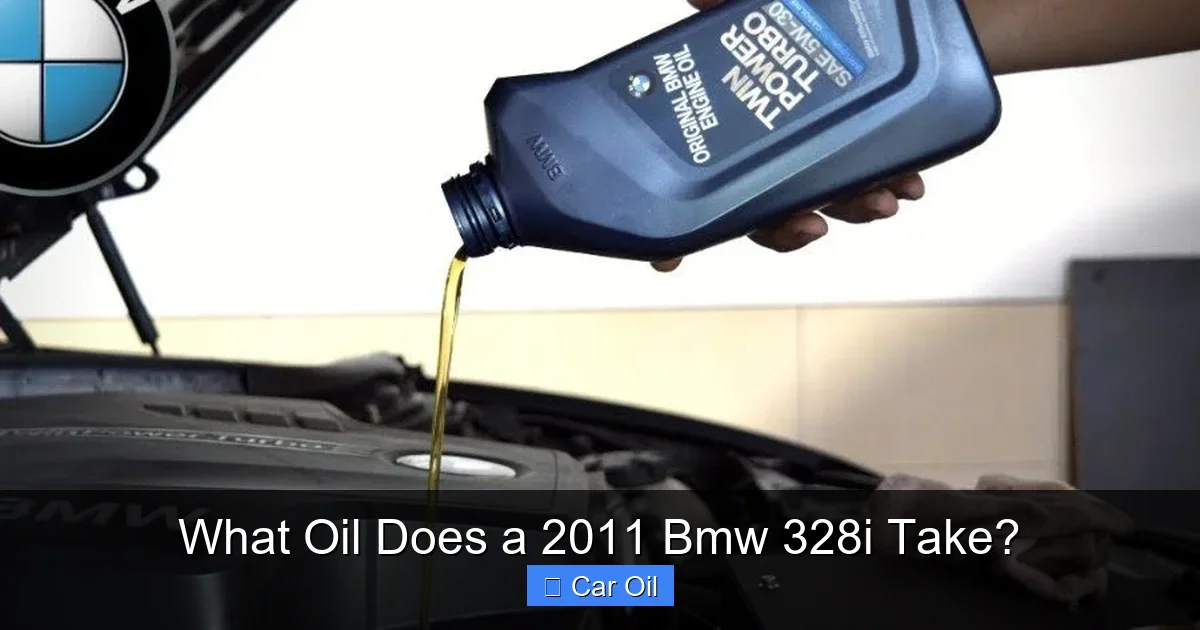
Visual guide about What Oil Does a 2011 Bmw 328i Take?
Image source: carfluidpro.com
- BMW Longlife-04 (LL-04): This is the primary specification for your 2011 328i. It is designed for extended drain intervals (up to 2 years/30,000 km in some markets, though BMW’s official indicator is still the primary guide) and is compatible with all BMW gasoline engines from 2002 onward, including your N20. It also meets the requirements for modern emission systems. This is the gold standard.
- BMW Longlife-01 (LL-01): This is the predecessor to LL-04. It was used extensively in the 2000s. It is perfectly suitable for your 2011 328i and is often easier to find and less expensive. If you find a great deal on a full synthetic 0W-30 or 0W-40 that says “BMW LL-01,” it is 100% acceptable for your car.
What to AVOID: Any oil that does not explicitly list “BMW LL-04” or “BMW LL-01.” This includes generic “European Car” oils that may not have gone through the specific BMW tests, or oils with other approvals like Mercedes 229.5 or VW 502/507. While these are high-quality oils for other engines, they are not formulated or tested for BMW’s specific requirements. Also, avoid any “Energy Conserving” oils, as their friction modifiers can be incompatible with BMW’s manual transmissions and differentials when used in the engine.
Where to Find Approved Oils and Trusted Brands
You don’t need to buy expensive “BMW-branded” oil from the dealership. Many major oil manufacturers produce formulations that meet the LL-04 spec. Here are some readily available brands and their product lines that are commonly certified:
- Castrol: Castrol EDGE Professional (LL-04) is the most common factory-fill oil for modern BMWs. Castrol EDGE (non-Professional) is also widely available and approved.
- Mobil 1: Mobil 1 Extended Performance and Mobil 1 ESP (Extended Service Period) both carry the LL-04 approval.
- Pennzoil: Pennzoil Platinum Euro L is formulated for European vehicles and carries the LL-04 specification.
- Liqui Moly: A favorite among European car enthusiasts, their Leichtlauf High Tech 0W-30 and 0W-40 are LL-04 approved.
- Red Line Oil: Their 0W-40 is a premium, ester-based synthetic that exceeds many OEM specs, including BMW’s.
When shopping, your single most important task is to read the label on the back of the bottle. Find the specifications list. You should see “BMW Longlife-04” or “BMW LL-01” clearly printed. If it’s not there, don’t buy it for your 328i.
Oil Capacity, Change Intervals, and the Service Indicator
Now that you know what to buy, let’s talk about how much and how often.
Visual guide about What Oil Does a 2011 Bmw 328i Take?
Image source: i.ytimg.com
The Exact Oil Capacity: 6.3 Quarts
For a 2011 BMW 328i with the N20B20 engine, the total oil capacity with a new oil filter is 6.3 quarts (6.0 liters). This is a precise number. When performing a DIY oil change, you will typically drain about 5.5-5.8 quarts from the sump. The remainder stays trapped in the engine (in the turbo, galleries, etc.). You must add 6.3 quarts total after replacing the filter and draining. Do not just pour in 6.3 quarts without checking the dipstick. The proper procedure is to add 6.0 quarts, run the engine for 30 seconds, let it sit for a minute, then check the dipstick and add the final 0.1-0.3 quarts as needed to reach the “MAX” mark. Overfilling by more than 0.5 quarts can cause aeration (foaming), increased pressure, and seal leaks.
If you’re comparing capacities across models, you might find that a BMW X3 with the same N20 engine also takes 6.3 quarts. This consistency is helpful if you work on multiple BMWs.
Service Interval Indicator: Your Primary Guide
Your 2011 328i is equipped with a Condition-Based Service (CBS) system. This computer calculates your oil life based on engine RPM, temperature, and driving style. When it’s time for a change, a yellow “Service” light will illuminate on your dashboard, often with a message like “Service: Oil Change.” This is your primary, manufacturer-recommended interval.
For most drivers, this works out to roughly 10,000 miles or once per year. However, “severe” driving—defined as frequent short trips (under 10 minutes), extremely cold or hot climates, dusty conditions, towing, or sustained high-speed driving—can shorten this interval. The CBS system is generally good, but if your driving is severe, consider changing the oil every 7,500 miles as a precaution. Never exceed the CBS interval by more than 1,000-2,000 miles.
Remember, the CBS system monitors oil level and quality. If it detects a low oil level or degraded oil, it will alert you sooner. This is why using the correct LL-04 oil is so important—it’s formulated to last the entire interval without breaking down.
How to Perform a DIY Oil Change (Step-by-Step Guide)
If you’re mechanically inclined, changing the oil on your 328i is a straightforward, rewarding task that can save you significant money. Here’s a concise guide. Always prioritize safety: use jack stands on solid ground, wear gloves, and dispose of old oil properly.
Tools and Materials Needed
- 6.3 quarts of full synthetic 0W-30 or 0W-40 meeting BMW LL-04/LL-01
- New OEM or high-quality Mann, Mahle, or Bosch oil filter (part number often 11 42 7 575 708 for N20)
- New drain plug washer (copper or aluminum crush washer)
- 17mm socket/wrench for drain plug
- Oil filter wrench (for the cartridge-style filter housing)
- Funnel
- Drain pan (at least 8 quarts capacity)
- Torque wrench (recommended)
- Jack and jack stands or ramps
The Procedure
- Warm the Engine: Run the engine for 5-10 minutes to warm the oil, which helps it drain more thoroughly. Be careful, as components will be hot.
- Lift and Secure: Safely raise the front of the car and support it on jack stands. Never work under a car supported only by a jack.
- Locate and Remove Drain Plug: The drain plug is on the oil sump, towards the front of the car. Place your drain pan underneath. Use your 17mm socket to remove the plug. Be prepared for hot oil to flow out quickly. Let it drain completely.
- Replace the Washer: Clean the drain plug and the sealing surface. Install a new crush washer on the plug. Hand-tighten the plug, then use your torque wrench to tighten to 25 Nm (18.4 ft-lb). Do not overtighten.
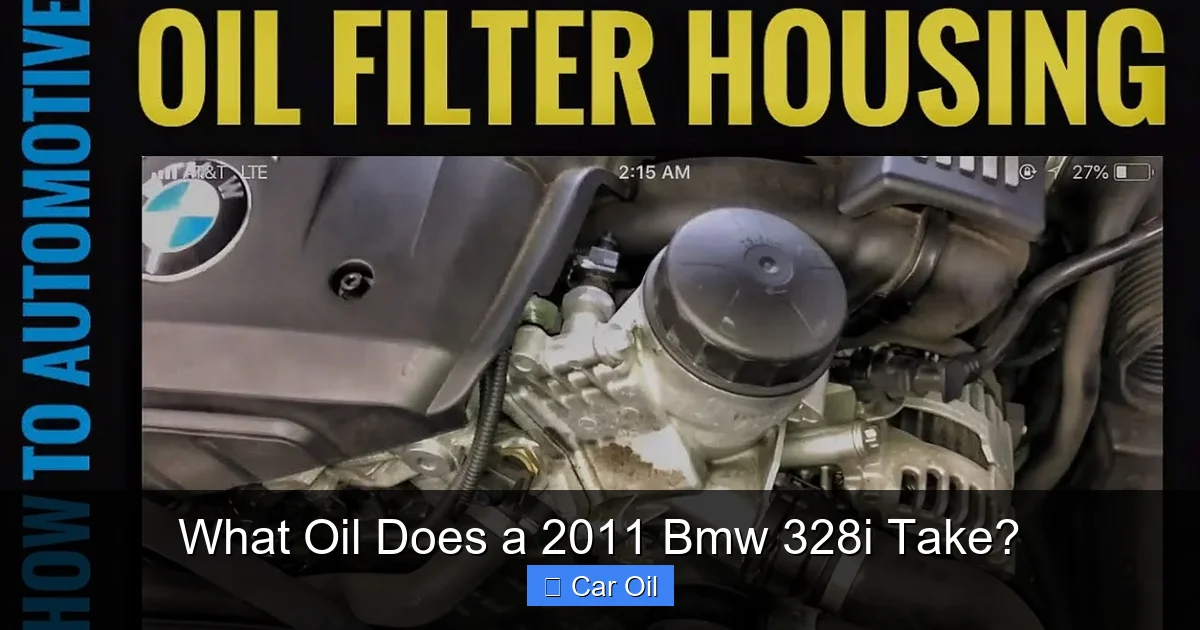
- Replace the Oil Filter: The N20 uses a cartridge-style filter inside a metal housing on the front of the engine. Remove the housing cover (usually with a 3/8″ drive socket or special wrench). Pull out the old filter element. Clean the housing and the sealing O-ring on the cover. Lubricate the new filter’s O-ring with a dab of new oil. Install the new filter and the cover. Torque the cover bolts to 25 Nm (18.4 ft-lb). This is critical to prevent leaks.
- Add New Oil: Remove the oil filler cap on the valve cover. Insert a funnel. Add 6.0 quarts of fresh oil slowly.
- Check Level and Top Off: Start the engine and let it idle for about 30 seconds. The CBS oil level sensor will activate. Turn off the engine and wait 1-2 minutes for oil to settle. Check the dipstick. Add the remaining oil in small increments (0.1-0.2 quarts at a time) until the level is exactly at the “MAX” mark. Do not overfill.
- Final Check: Start the engine and let it idle. Check for any leaks around the drain plug and filter housing. After a minute, re-check the dipstick to ensure the level is still correct. Lower the car, and you’re done! Reset the service indicator via the iDrive menu if needed, though the CBS system will often reset itself after a few drive cycles with the new oil.
Common Oil-Related Mistakes That Can Harm Your 328i
Even with the right oil, mistakes happen. Here are the most common pitfalls and how to avoid them.
Mistake 1: Using the Wrong Specification or Viscosity
This is the #1 error. Using a generic 5W-30 or an oil without BMW LL-04/LL-01 is a gamble. It may work for a while, but the long-term effects on the turbo, VANOS, and emission systems can be devastating. Always verify the specification on the bottle.
Mistake 2: Overfilling or Underfilling
Overfilling by more than a quart causes the crankshaft to churn through the oil, creating foam (aeration). Aerated oil cannot lubricate properly, leads to increased wear, and can cause oil pressure warnings. Underfilling is even more immediately dangerous, leading to instant lack of lubrication and engine seizure. Always measure with the dipstick after following the proper fill procedure.
Mistake 3: Neglecting the Oil Filter
Using a cheap, low-quality filter is a false economy. A poor filter can allow particulate contamination into your clean oil or have a weak anti-drain back valve, causing dry starts. Stick to OEM (BMW) or reputable brands like Mann, Mahle, or Bosch.
Mistake 4: Ignoring Oil Level Warnings
Your 328i has an oil level sensor. If you see a low oil level warning on the iDrive screen, stop the engine as soon as it is safe. Driving with low oil is a guaranteed path to engine destruction. Check the level manually with the dipstick (located under the engine cover) and top off immediately with the correct oil. If the level is dropping quickly, you have a leak or consumption issue that needs diagnosis. Understanding what an oil leak means is crucial for preventing major damage.
Mistake 5: Extending Drain Intervals Too Far
The 10,000-mile interval is a maximum. If your driving is mostly short trips in cold weather, the oil doesn’t get hot enough to burn off fuel dilution and moisture, which degrades it faster. If you’re unsure, changing at 7,500 miles is a safe, inexpensive insurance policy against sludge formation.
The Bottom Line: Protecting Your Investment
Your 2011 BMW 328i is a performance machine that demands respect in its maintenance. The oil you choose is its lifeblood. There is no room for compromise. The formula is simple:
- Buy: A full synthetic oil (0W-30 or 0W-40) that explicitly states “BMW LL-04” or “BMW LL-01” on the bottle.
- Use: Exactly 6.3 quarts (with filter) and follow the proper fill procedure. Never guess.
- Change: According to the CBS system or every 10,000 miles/1 year, adjusting for severe driving.
- Filter: Always use a high-quality OEM or equivalent filter.
By following this guide, you will provide the absolute best protection for your N20 engine. You’ll enjoy smoother operation, better fuel economy, and the peace of mind that comes from knowing you’re preserving one of your most valuable assets. A $50 oil change is the cheapest insurance you can buy against a $5,000+ engine repair. Do it right, and your 328i will reward you with years of driving bliss.
Frequently Asked Questions
Can I use a 5W-30 oil in my 2011 BMW 328i?
No. While 5W-30 is common in many vehicles, your 328i’s N20 engine specifically requires 0W-30 or 0W-40. The “0W” viscosity ensures better cold-start flow and protection for the turbocharger, which is critical for this engine. Using 5W-30 does not meet BMW’s specifications and can lead to increased wear.
What happens if I use oil without the BMW LL-04 specification?
Using non-approved oil is a significant risk. It may not have the correct additive package to protect the turbocharger, VANOS system, and catalytic converters. Over time, this can lead to sludging, varnish buildup, premature part failure, and potentially voiding any remaining warranty coverage. Always use an oil with the official BMW Longlife approval.
How often should I really change my oil if I mostly do short trips?
If your driving consists mainly of short trips (under 10-15 minutes) where the engine never fully warms up, you are in the “severe service” category. In this case, you should change your oil every 7,500 miles or once per year, even if the CBS system hasn’t alerted you. Short trips cause fuel dilution and moisture buildup, which degrades oil faster.
Is it okay to mix different brands of full synthetic 0W-30 that are both LL-04 approved?
For a top-off between changes, mixing a quart of a different, but equally approved, brand is generally not a problem. All LL-04 oils must meet the same minimum performance standards. However, for a full drain and fill, it’s best to stick to one brand and formulation to ensure consistent additive chemistry.
My owner’s manual says 0W-30, but my local shop recommends 0W-40. Which should I use?
Both are correct and BMW-approved for your 2011 328i. For typical daily driving in a moderate climate, 0W-30 is the factory-spec fluid and is perfect. If you live in a very hot climate, do a lot of highway driving, or have higher mileage (over 100k), 0W-40 offers slightly better high-temperature shear stability. Choose one and stick with it.
How do I reset the oil service reminder after changing the oil myself?
The CBS system will often reset itself after a few drive cycles once it senses the new oil. However, to reset it manually: Turn the ignition on (do not start engine). Press the “Menu” button on the steering wheel. Navigate to “Service” or “Vehicle Info” > “Service Requirements.” Select “Update Service” or “Reset.” Follow the prompts to confirm the reset for the oil service. The exact steps can vary slightly by iDrive version; consult your owner’s manual for the precise procedure for your car.