What Is the Oil Filter Number for a 2022 Toyota Tacoma?

Contents
- 1 Key Takeaways
- 2 📑 Table of Contents
- 3 Understanding Oil Filter Numbers: It’s Not Just a Random Code
- 4 The 2022 Toyota Tacoma: Two Engines, Two Filters
- 5 Where to Find the Information & How to Be 100% Sure
- 6 OEM vs. Aftermarket: Which Filter Should You Choose?
- 7 The Installation: It’s Not Just Screwing It On
- 8 Why This All Matters: The High Cost of the Wrong Filter
- 9 Beyond the Filter: Completing the Perfect 2022 Tacoma Oil Change
- 10 Conclusion: Knowledge is the Best Tool
- 11 Frequently Asked Questions

LED Indicator Light
Car Neck Pillow

Car Glass Cleaner

Carburetor Cleaner
Finding the correct oil filter number for your 2022 Toyota Tacoma is critical for engine health. The specific part depends on your Tacoma’s engine: the 2.4L 4-cylinder uses a different filter than the 3.5L V6. Using the wrong filter can lead to poor oil flow, contamination, and severe engine damage. Always verify your engine size before purchasing, and consider high-quality OEM or reputable aftermarket brands with proven compatibility for your specific model year and engine.
So, you’re gearing up for an oil change on your trusty 2022 Toyota Tacoma. You’ve got the right oil picked out—maybe you already know the exact kind of oil it takes—but now you’re staring at the aisle at the auto parts store, faced with a wall of oil filters. The question burns: What is the oil filter number for a 2022 Toyota Tacoma? It seems simple, but getting it wrong is one of those small mistakes that can lead to big, expensive problems. Let’s cut through the noise and get you the precise information you need, along with the why and how behind it.
First, a crucial truth: there is no single “oil filter number for a 2022 Toyota Tacoma.” I know, the title of this article is a bit of a tease. But it’s the most common way people search for this information. The reality is, your Tacoma’s filter is determined by one primary factor: the engine under the hood. For the 2022 model year, Toyota offered two distinct engines for the Tacoma, and they each have their own dedicated filter. Using the wrong one is like trying to fit a square peg in a round hole—it might seem to go in, but it won’t seal properly or filter correctly, leading to catastrophic engine wear. Let’s break it down by engine.
Key Takeaways
- Engine Size is Everything: The 2022 Tacoma comes with a 2.4L 4-cylinder or a 3.5L V6, and each requires a unique oil filter part number.
- OEM vs. Aftermarket: Genuine Toyota parts (OEM) guarantee compatibility, but many high-quality aftermarket brands like WIX, Fram, and Mobil 1 offer direct cross-references.
- Locate the Source: The definitive oil filter number is on the old filter itself after removal or in your owner’s manual under the lubricant specifications section.
- Don’t Guess by Year Alone: A filter for a 2021 or 2023 Tacoma may not fit a 2022 due to mid-cycle changes; always confirm fitment for your exact engine and model year.
- Installation Matters: Proper installation—including cleaning the mounting surface, hand-tightening plus a 3/4 turn, and checking for leaks—is as important as the filter number itself.
- Maintenance is Holistic: Using the correct filter is one part of a complete oil change service that also includes the right oil viscosity, capacity, and a new crush washer.
📑 Table of Contents
- Understanding Oil Filter Numbers: It’s Not Just a Random Code
- The 2022 Toyota Tacoma: Two Engines, Two Filters
- Where to Find the Information & How to Be 100% Sure
- OEM vs. Aftermarket: Which Filter Should You Choose?
- The Installation: It’s Not Just Screwing It On
- Why This All Matters: The High Cost of the Wrong Filter
- Beyond the Filter: Completing the Perfect 2022 Tacoma Oil Change
- Conclusion: Knowledge is the Best Tool
Understanding Oil Filter Numbers: It’s Not Just a Random Code
Before we list the numbers, let’s demystify what these part numbers actually are. An oil filter part number is a unique alphanumeric code assigned by the manufacturer (Toyota, WIX, Fram, etc.) that specifies that filter’s exact dimensions, thread size, gasket type, and filtration media. Think of it as the filter’s social security number. It ensures that the filter you buy will physically fit your engine’s oil filter housing and perform its job of trapping contaminants without restricting oil flow.
You’ll encounter two main types of numbers:
- OEM (Original Equipment Manufacturer) Numbers: These are the part numbers from Toyota itself. For example, Toyota’s part might be “90915-YZZF1.” Using a genuine Toyota filter guarantees it meets Toyota’s original specifications for your vehicle.
- Aftermarket Cross-Reference Numbers: Brands like Mobil 1, K&N, WIX, and Fram produce filters that are designed to be direct replacements for the OEM unit. They will have their own part number (e.g., “Mobil 1 M1-110A”) but will list the vehicles it fits, including the Toyota Tacoma. Reputable manufacturers provide extensive cross-reference guides to match their number to the OEM application.
Our goal is to match your 2022 Tacoma’s engine to the correct OEM number, and then show you the equivalent high-quality aftermarket options.
Why VIN Decoding is Your Ultimate Safety Net
While engine size is the key, the absolute most fail-proof method to identify your correct oil filter is by using your Vehicle Identification Number (VIN). The VIN is a 17-digit code that encodes your truck’s specific factory configuration, including engine type, transmission, and even specific component revisions. You can enter your VIN into any major auto parts store website (like AutoZone, O’Reilly, Advance Auto Parts) or the Toyota parts catalog website, and it will return the precise, guaranteed-correct parts for your vehicle, including the oil filter. This eliminates any guesswork, especially if you have a special edition or are unsure about a previous engine swap. It’s the gold standard for parts lookup.
The 2022 Toyota Tacoma: Two Engines, Two Filters
For the 2022 model year, the Toyota Tacoma was available with two powertrain options. Identifying which one is under your hood is the first step. Here’s how to tell:
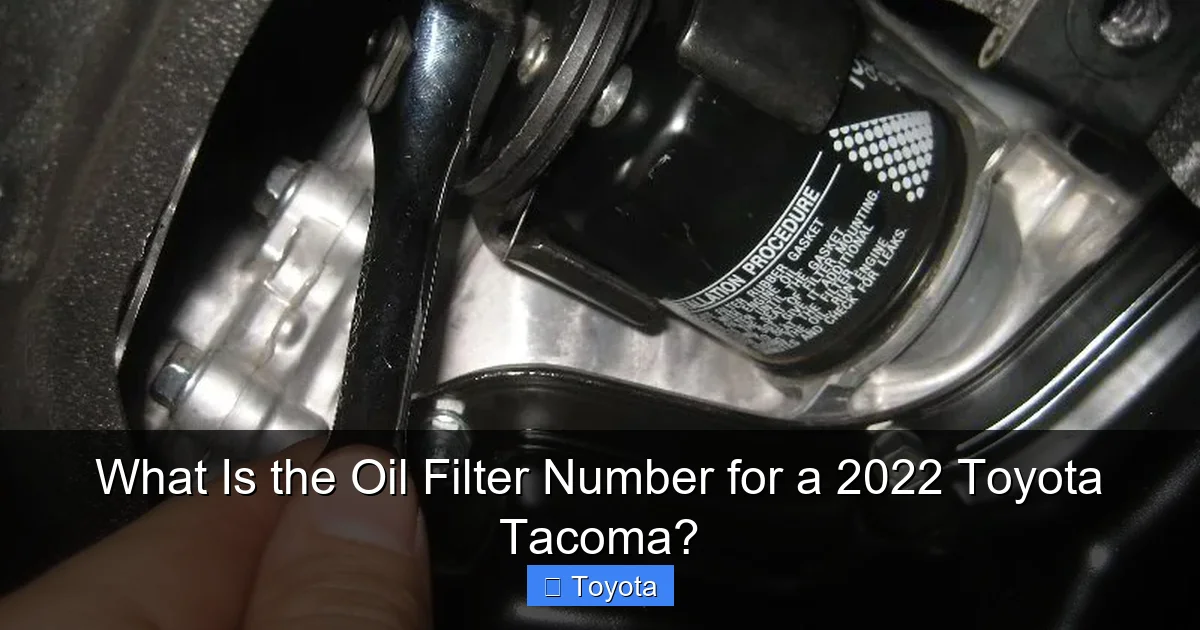
Visual guide about What Is the Oil Filter Number for a 2022 Toyota Tacoma?
Image source: paulstravelpictures.com
- 2.4L 4-Cylinder (2RZ-FE or similar designation): This is the standard engine for most base and mid-trim Tacomas. You’ll find it in models like the SR, SR5, and many TRD Sport and TRD Off-Road trucks. It’s a reliable, fuel-efficient 4-cylinder.
- 3.5L V6 (2GR-FKS): This is the optional, more powerful engine, commonly found in the Limited trim and many TRD Pro models. It’s a V6 that provides significantly more horsepower and torque.
You can confirm your engine by checking the owner’s manual, looking at the badge on the tailgate (it may say “4-Cylinder” or “V6”), or simply popping the hood and looking at the engine cover. The V6 is visibly larger and has six cylinders arranged in a V-shape, while the 4-cylinder is smaller and inline.
Filter Number for the 2.4L 4-Cylinder Engine
If your 2022 Tacoma has the standard 2.4-liter 4-cylinder engine, you need an oil filter that matches its specific requirements. The OEM Toyota part number for this application is:
OEM Toyota Part Number: 90915-YZZF1
This is the genuine Toyota filter. Now, for the aftermarket equivalents—these are the numbers you’ll find at any parts store. They are all designed to be direct replacements for the 90915-YZZF1:
- WIX Filters: WIX 51028
- Fram: Fram PH3614 (or the newer PH9614 for the “Extra Guard” series)
- Mobil 1: Mobil 1 M1-110A
- K&N: K&N HP-1008 (Performance Gold series)
- Bosch: Bosch 3323
- Purolator: Purolator PL14610
Any of these filters, when purchased new, are correct for your 2.4L 2022 Tacoma. Always double-check the box to ensure it lists compatibility with the 2022 Tacoma 2.4L.
Filter Number for the 3.5L V6 Engine
For the more potent 3.5-liter V6 engine, the requirements are different due to higher oil flow rates and pressure. The OEM Toyota part number is:
OEM Toyota Part Number: 90915-YZZD1
Notice it’s different from the 4-cylinder’s number. This V6 filter is often slightly larger. The aftermarket cross-references for this specific filter are:
- WIX Filters: WIX 51024
- Fram: Fram PH3612 (or PH9612)
- Mobil 1: Mobil 1 M1-108A
- K&N: K&N HP-1007
- Bosch: Bosch 3322
- Purolator: Purolator PL14609
Again, verify the box states it fits the 2022 Tacoma with the 3.5L V6 engine. This is a critical distinction; never use a 4-cylinder filter in a V6 or vice-versa.
Where to Find the Information & How to Be 100% Sure
We’ve given you the numbers, but how do you verify them for your specific truck? Here are your best methods, in order of reliability.

Visual guide about What Is the Oil Filter Number for a 2022 Toyota Tacoma?
Image source: m.media-amazon.com
Method 1: The Old Filter (The Most Certain)
The single most reliable source is the filter currently on your truck. When you remove the old oil filter during your change, look at the base of it. Stamped or printed directly on the filter canister or the base plate will be its part number. This is irrefutable proof of what fit your truck when it was built. Compare this number to the new filter you purchase. If it matches, you’re perfect. This is especially useful if you have a truck that has had engine work done or if you’re ever in doubt.
Method 2: Your Owner’s Manual
Your Tacoma’s owner’s manual has a comprehensive “Lubrication System” or “Specifications” section. It will list the recommended oil viscosity (like 0W-20) and the oil filter specification. It might not give you the exact part number like “90915-YZZF1,” but it will often say “Toyota Genuine Oil Filter” or list a specification code. You can then take that code to a Toyota dealer’s parts department, and they can look up the exact number. This is a factory-direct source of truth.
Method 3: Online Parts Catalogs & VIN Lookup
As mentioned earlier, this is the modern, foolproof method. Go to a website like:
- Toyota Parts Deal (Toyota’s official online parts catalog)
- AutoZone.com, OReillyAuto.com, or AdvanceAutoParts.com
- RockAuto.com (a fantastic resource for cross-references)
Enter your 2022 Tacoma’s VIN, or select “2022,” “Toyota,” “Tacoma,” and then your specific engine (2.4L or 3.5L). The site will populate a list of compatible parts. The oil filter listed will be the correct one. This method also shows you all the aftermarket equivalents available for that specific application.
OEM vs. Aftermarket: Which Filter Should You Choose?
Now that you know the number, you face another choice: Genuine Toyota or a trusted aftermarket brand? Both can be excellent choices.

Visual guide about What Is the Oil Filter Number for a 2022 Toyota Tacoma?
Image source: toyota.com.kh
The Case for Genuine Toyota (OEM)
When you buy a genuine Toyota oil filter (with the Toyota logo and the correct part number), you are getting the exact filter that was on your truck when it rolled off the assembly line. Toyota engineers designed and tested this filter specifically for your Tacoma’s engine. You have absolute certainty of fit, sealing, and filtration efficiency meeting Toyota’s standards. For many owners, this peace of mind is worth the slightly higher cost. There is no guesswork about media quality or construction standards; it’s the original.
The Case for Premium Aftermarket Brands
Major aftermarket brands like Mobil 1, WIX, and K&N invest millions in research and development to create filters that meet or exceed OEM specifications. Often, they use superior materials—like synthetic filtration media, stronger anti-drain back valves, and more robust canisters—than the basic OEM filter. For example, a Mobil 1 M1-110A (for the 2.4L) is a premium synthetic filter known for excellent flow and protection. The key is choosing a reputable brand and ensuring the part number is the exact cross-reference listed above. You are not buying a “generic” filter; you are buying a filter engineered for your specific application by a top-tier manufacturer. This path often offers better value and sometimes higher performance.
What to avoid: No-name, ultra-cheap filters from discount bins. Their construction can be inconsistent, their gaskets may not seal, and their filtration media can be ineffective or even shed particles into your engine. When it comes to filters, you generally get what you pay for.
The Installation: It’s Not Just Screwing It On
Having the right filter number is only half the battle. Proper installation is equally critical to prevent leaks and ensure proper function.
Essential Prep Work
Before you even touch the new filter, ensure you have everything ready. You’ll need:
- The correct new oil filter (verified number!)
- A new crush washer (usually included with the filter or sold separately—always use a new one)
- Your chosen engine oil (correct viscosity and amount)
- A socket or wrench for the oil drain plug
- An oil filter wrench (if needed for your filter type)
- A drain pan
- Gloves and safety glasses
Step-by-Step Installation Tips
1. Drain the Oil: Warm up the engine briefly, then safely drain the old oil. This makes removing the old filter easier and cleaner.
2. Remove the Old Filter: Place your drain pan under it. Use the appropriate wrench to loosen the old filter. Be prepared for some residual oil to spill. Once loose, finish unscrewing it by hand. Let all oil drain from the filter into the pan.
3. Inspect and Clean: Look at the mounting surface on the engine where the filter seats. Wipe it clean with a lint-free rag. Any old oil or debris here can prevent a good seal and cause a leak.
4. Prepare the New Filter: Lightly coat the new filter’s rubber gasket with fresh engine oil. This helps it seat properly and makes future removal easier. Do not use grease or petroleum jelly.
5. Install by Hand First: Screw the new filter onto the engine’s mounting stud by hand. Turn it clockwise. It should thread on smoothly with no cross-threading. Once the gasket makes contact, tighten it.
6. The Final Torque: The universal rule for most cartridge and spin-on filters is: hand-tighten until the gasket contacts the base, then tighten an additional 3/4 of a turn. Some filters specify a specific torque (e.g., 18 ft-lbs). Check your filter’s box or instructions. Overtightening can damage the gasket or the housing; undertightening causes leaks. The “3/4 turn after contact” rule is a safe bet for most Tacomas if no specific torque is given.
7. Reassemble and Check: Reinstall the drain plug with a new washer, tighten to spec (usually around 25-30 ft-lbs). Add fresh oil. Start the engine and let it run for about 30 seconds. Check for any drips from the filter and drain plug. Turn off the engine, wait a minute, and check the oil level with the dipstick. Add oil if necessary to reach the full mark.
Why This All Matters: The High Cost of the Wrong Filter
It’s worth drilling down on why getting this right is non-negotiable. Your engine’s oil system is a high-pressure, high-temperature circulatory system. The oil filter is its kidney. A properly fitting, high-quality filter with the correct flow characteristics ensures clean oil reaches every bearing, cam lobe, and piston ring.
Using the wrong filter can cause several catastrophic failures:
- Leaks: An incorrect gasket or thread size will not seal, leading to a constant drip or, worse, a complete blow-off that dumps all your oil within minutes, resulting in immediate engine seizure.
- Starvation: A filter with too restrictive of a media or an incorrect bypass valve setting can impede oil flow. The engine might not get enough oil pressure, especially at high RPMs, leading to bearing wear and failure.
- Contamination: A poorly made filter can have inferior media that sheds fibers or allows unfiltered oil (with metal shavings, soot, etc.) to circulate, acting as an abrasive that grinds your engine’s internals to dust over time.
- Drain-Back Issues: A faulty anti-drain back valve can cause the filter to empty when the engine is off. On your next start-up, there’s a delay while the filter refills, causing a brief period of oil starvation until pressure builds.
An engine rebuild or replacement costs thousands. A correct oil filter and a proper oil change cost less than $100. The choice is clear. For a deeper understanding of your entire lubrication system, reading about what oil in a car is actually for can provide valuable context on why filtration is so critical.
Beyond the Filter: Completing the Perfect 2022 Tacoma Oil Change
You’ve got the right filter number. Now, let’s ensure the rest of the service is perfect. A holistic approach to maintenance is what keeps a Tacoma running for 300,000 miles.
Oil Specification and Capacity
For the 2022 Tacoma, Toyota recommends:
- 2.4L 4-Cylinder: 0W-20 synthetic oil. Capacity is approximately 6.6 quarts (6.2 liters) with filter change.
- 3.5L V6: 0W-20 synthetic oil. Capacity is approximately 6.3 quarts (6.0 liters) with filter change.
Always use an oil that meets Toyota’s specification, typically looking for the API “SP” or “SN” resource-conserving label. Brands like Mobil 1, Castrol EDGE, and Pennzoil Platinum are excellent choices that meet these specs. If you’re curious about the broader role of oil and how to choose, our guide on what oil should I use for my car is a great resource.
The Importance of the Crush Washer
Never reuse the old metal crush washer from your drain plug. It’s designed to deform once to create a perfect seal. Reusing it guarantees a leak. Always install a new washer with every oil change. They are cheap and come in packs or are often included with oil filters.
Reset Your Maintenance Light
After completing the oil change, you’ll need to reset the maintenance required light (sometimes called the “maintenance minder”). The procedure for a 2022 Tacoma typically involves turning the ignition on (without starting), setting the odometer to “Trip A,” turning the key off, then holding the trip meter reset button while turning the key back to the “on” position until the light blinks and goes off. Consult your owner’s manual for the exact, step-by-step procedure for your trim.
By following this guide—identifying your engine, verifying the correct filter number (90915-YZZF1 for 2.4L, 90915-YZZD1 for 3.5L), choosing a quality filter, and installing it correctly—you are performing one of the most important maintenance tasks for your 2022 Toyota Tacoma. It’s a simple job that yields massive returns in reliability and longevity. If you’re ever unsure about locating the filter itself, a visual guide on where the oil filter is on a Toyota Tacoma can be a helpful companion to this article.
Conclusion: Knowledge is the Best Tool
So, what is the oil filter number for a 2022 Toyota Tacoma? The answer is: it depends on your engine. For the 2.4L 4-cylinder, it’s 90915-YZZF1 (or any of its listed cross-references). For the 3.5L V6, it’s 90915-YZZD1. This specificity isn’t arbitrary; it’s engineering. Your Tacoma is a capable, rugged truck designed for adventure and hard work. Keeping its heart—the engine—clean with the correct filter is one of the easiest and most effective ways to ensure it rewards you with years of dependable service.
Don’t let a simple part number trip you up. Use your VIN for absolute certainty. Invest in a quality filter from a brand you trust. And take pride in doing this maintenance yourself, knowing exactly what’s going into your truck and why. That connection and knowledge are what truly make a vehicle yours. Now, get out there, get the right part, and enjoy the peace of mind that comes with a job done right.
Frequently Asked Questions
Can I use a 2021 or 2023 Tacoma oil filter on my 2022 model?
While many filters for the same engine family may physically fit, you should not assume compatibility across model years without verification. Mid-cycle changes can occur. Always confirm the filter is listed for your specific 2022 Tacoma engine (2.4L or 3.5L) by checking the part number cross-reference or using your VIN.
Is a more expensive “performance” oil filter worth it for my Tacoma?
For most daily-driven Tacomas, a high-quality standard filter from a brand like WIX or Fram is perfectly adequate. Premium “performance” filters (like Mobil 1 or K&N Gold) often use superior synthetic media and construction, which can offer better filtration and durability, especially under severe conditions or extended change intervals. The extra cost is worth it for added peace of mind if you tow, drive in extreme temperatures, or plan to keep the truck long-term.
What happens if I accidentally install the wrong oil filter?
The consequences can be severe. A filter that doesn’t seal will leak oil rapidly, potentially leading to complete oil loss and engine seizure. A filter with incorrect flow characteristics can cause oil starvation (low pressure) or poor filtration, both of which cause accelerated engine wear and eventual failure. Always double-check fitment before starting the engine after a change.
Do I need to pre-lube the oil filter gasket before installation?
Yes, always. Before installing the new filter, lightly coat the rubber sealing gasket with fresh engine oil from your fill. This helps create an immediate seal when the engine starts and prevents the gasket from sticking to the housing, making future removal easier. Never use grease or other substances.
My Tacoma has a cartridge-style filter, not a spin-on. Is the number different?
No, the 2022 Tacoma uses a standard spin-on oil filter for both engine options. You will not encounter a cartridge-style filter on this model year. The part numbers provided (90915-YZZF1 and 90915-YZZD1) are for spin-on filters that screw onto a threaded stud on the engine.
Can I just look up the filter by tire size or trim level (like TRD Off-Road)?
No, tire size and trim level do not determine the oil filter. The only determining factor is the engine displacement (2.4L vs. 3.5L). A TRD Off-Road could have either engine, depending on the order. Always identify your engine first, as that is the sole specification needed for the correct filter number.