
What Is 45 Percent Window Tint?

A 45% window tint allows 45% of visible light to pass through the glass, blocking 55%. For BMW owners, it’s a popular “factory tint” shade that offers a subtle, sleek look while providing significant heat and glare reduction without overly darkening the cabin. It’s typically legal for front side windows in many states, making it a practical and stylish upgrade.
Key Takeaways
- VLT is Key: 45% refers to Visible Light Transmission, meaning 45% of light passes through; it blocks 55%.
- BMW Factory Match: This shade closely matches the original factory tint on many newer BMW models’ rear windows.
- Legal for Front Sides: In most U.S. states, 45% tint is legal for front driver/passenger windows, but always verify local laws.
- Balanced Performance: It offers excellent heat and UV rejection while maintaining good nighttime visibility and a clean aesthetic.
- Not for Privacy: It provides minimal privacy; you can see clearly into the car from the outside during the day.
- Professional Install Recommended: Proper installation is crucial for a flawless, bubble-free finish, especially on BMW’s complex curved glass.
📑 Table of Contents
- What Does “45 Percent Window Tint” Actually Mean?
- The Look and Feel: What 45% Tint Looks Like on a BMW
- Performance Benefits: More Than Just Looks
- Legality and BMW: Navigating the Tint Laws
- Installation for Your BMW: Why Professional Matters
- Comparing 45% to Other Popular Tint Shades
- Making the Final Decision for Your BMW
What Does “45 Percent Window Tint” Actually Mean?
So, you’re looking at your BMW and thinking about tint. You see numbers like 5%, 20%, 35%, and 45%. What does it all mean? Let’s cut through the confusion right now. When we talk about “45 percent window tint,” we are talking about its Visible Light Transmission (VLT) percentage. Think of VLT as a window’s “openness” to light.
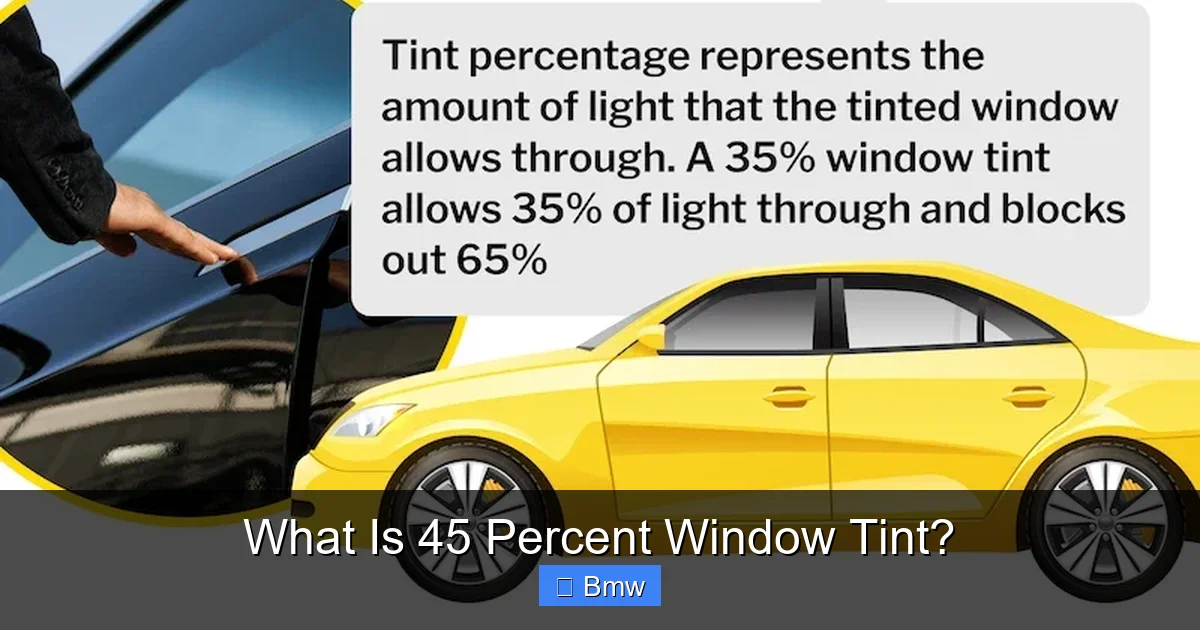
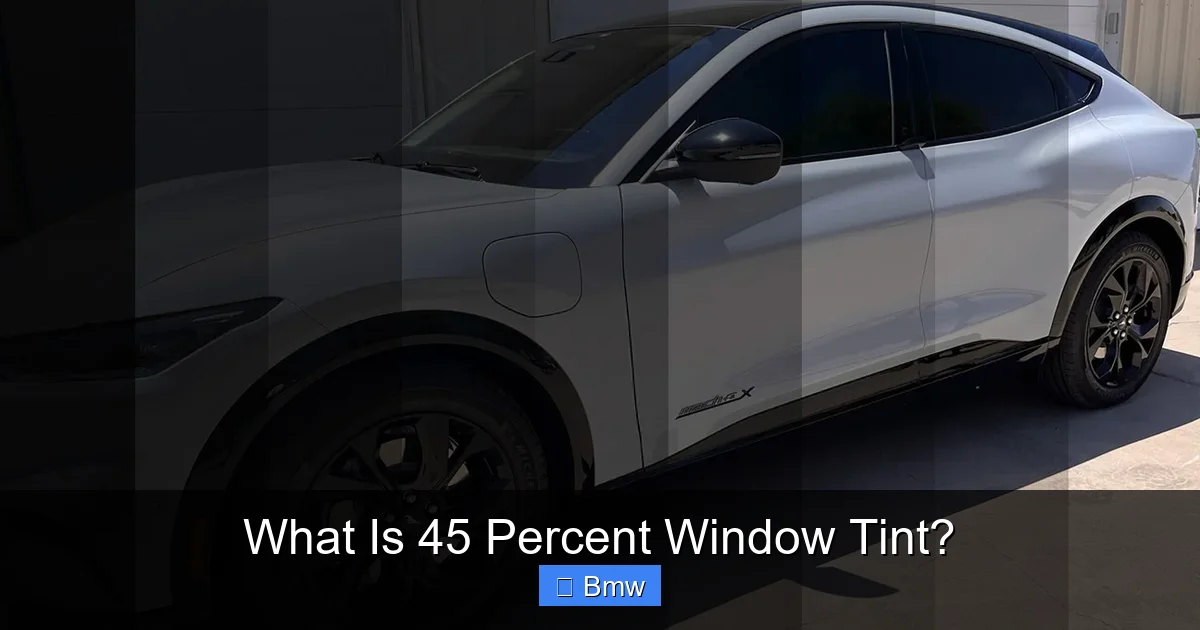
A 45% VLT tint means that 45% of the sun’s visible light rays are allowed to pass through the glass. The other 55% is rejected—either reflected or absorbed by the tint film. It’s a medium-dark shade. To put it in perspective, clear glass is about 90% VLT (very transparent), while a limousine tint is around 5% VLT (extremely dark, you can’t see in at all). Forty-five percent sits nicely in the middle, offering a noticeable but not extreme darkening effect.
For BMW owners, this number is particularly important because it often corresponds to the shade already applied to the rear windows from the factory. If you want a uniform, OEM-like appearance across all side windows, matching that factory rear tint is a common goal. We’ll dive deep into what that looks like and why it matters for your specific BMW.
The Look and Feel: What 45% Tint Looks Like on a BMW
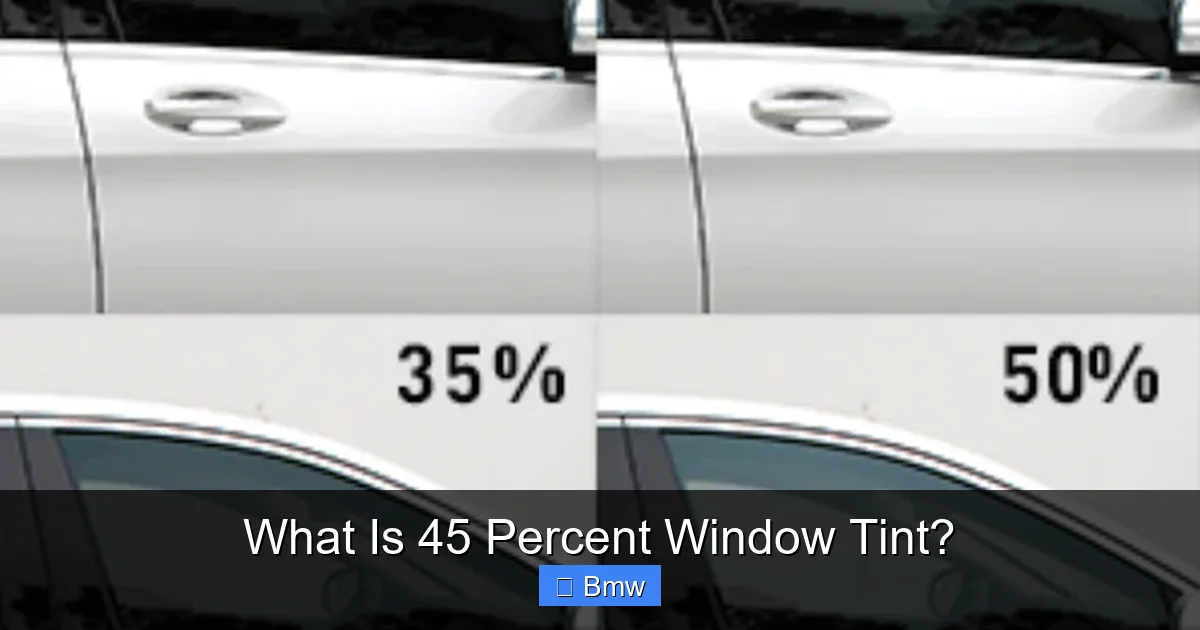
Imagine your BMW’s rear windows. That slightly darkened glass you see on a 3 Series, X5, or 5 Series from the last decade? There’s a very high chance that’s a 45% factory tint. It’s BMW’s standard for a reason—it just looks right. It gives the car a more cohesive, sportier, and premium profile without looking like a “gangster car” or a vehicle trying too hard.
Visual guide about What Is 45 Percent Window Tint?
Image source: lh4.googleusercontent.com
A Subtle, Clean Aesthetic
Forty-five percent tint is what we call a “cosmetic” or “clean” tint. From the outside, the windows look lightly shaded, especially compared to the stark contrast of a 20% or 35% tint over a lighter factory front window. It reduces the harsh glare of the glass and makes the car’s body lines and window trim stand out more elegantly. The cabin doesn’t appear cavernously dark; you can still see the headliner and interior contours quite clearly. For a brand like BMW, which emphasizes design and proportion, this subtlety is key. It enhances the car’s presence without overshadowing its design.
The “Factory Match” Phenomenon
This is the biggest reason BMW enthusiasts seek out 45% tint. Many BMW models, particularly from the F30 (3 Series), G01 (X3), G30 (5 Series), and G11/G12 (7 Series) generations, come with a light tint on the rear passenger windows and rear glass from the factory. The front doors, however, are usually clear or have a very light metallic coating for privacy glass in some markets. If you tint the front doors to 45%, you achieve a seamless, uniform look from front to back. The windows will all appear the same shade. This uniformity is a hallmark of a well-maintained, upgraded BMW. It looks intentional and high-end, rather than like an afterthought.
Performance Benefits: More Than Just Looks
While the aesthetic is a huge driver, the functional benefits of 45% tint are substantial and directly impact your driving comfort and the car’s interior health. Let’s break down what this shade actually blocks.
Visual guide about What Is 45 Percent Window Tint?
Image source: thetintguy.com
Heat Rejection: A Cooler Cabin
Sunlight carries heat. A lot of it. Standard window glass does little to block infrared (IR) radiation, which is what you feel as heat. Quality 45% window film, especially ceramic films, can block a significant percentage of solar heat. While a darker film like 20% might block slightly more total heat due to its density, a high-performance 45% ceramic film can reject 50-60% of solar heat. For a BMW with a leather interior or a dark dashboard, this is a game-changer. It prevents the cabin from turning into an oven on a summer day, reducing the workload on your air conditioning system, which can slightly improve fuel efficiency (or range in an i-series BMW). Getting into a car that’s 20-30 degrees cooler is a luxury you’ll appreciate every single day.
UV Radiation Protection: Shielding Your Interior
This is non-negotiable for any car owner, especially for a premium vehicle. The sun’s ultraviolet (UV) rays are the primary culprit behind faded upholstery, cracked dashboards, and deteriorating leather. A good window film acts as a sunscreen for your car’s interior. All quality automotive tints block 99%+ of UV-A and UV-B rays, regardless of their visible light shade. Whether you choose 5% or 70%, the UV protection is the same. So, with 45% tint, you get the heat and glare benefits while fully protecting your BMW’s valuable interior from sun damage for years to come. This preserves resale value and keeps your cabin looking new.
Glare Reduction for Safer Driving
Glare from the sun or bright headlights at night can cause eye strain and reduce reaction time. Forty-five percent tint cuts down on this direct, harsh light. It softens the brightness without creating the tunnel vision or significant night-driving impairment that darker tints can cause. For a driver-focused car like a BMW, reducing glare means less squinting, more comfortable vision, and potentially safer driving conditions during sunrise, sunset, and in bright overcast conditions. It’s a sweet spot for functional visibility.
This is the most critical section for any BMW owner considering tint. Window tint laws are not federal; they are set by each state (and sometimes counties or cities). You must follow the laws of the state where your car is registered and the states you frequently drive through. The law almost always specifies a minimum VLT percentage for the front driver and passenger side windows. The rear windows and rear windshield usually have much more lenient rules.
Visual guide about What Is 45 Percent Window Tint?
Image source: shadedknightaz.com
Front Side Window Laws: Where 45% Stands
For front side windows, 45% is on the lighter end of the spectrum and is legal in the majority of U.S. states. States like California, Colorado, Florida, New York, and Texas typically allow a minimum of 70% or more for front windows, so 45% would be illegal there. However, states like Michigan, Ohio, Indiana, and many others allow 45% or darker (like 35% or 30%) for front sides. You must check your specific state’s DMV or highway patrol website for the exact number. For example, if you live in a state with a 70% front window limit, you could legally tint your front windows to 70% and your rear (factory 45%) windows to 45%, creating a two-tone look that is factory-accurate but not uniform. The dream of a uniform 45% all-around is only legally possible in states that allow 45% or darker for the front.
The “AS-1” Mark and Windshield
Almost universally, tinting the front windshield below the manufacturer’s AS-1 line (the small marking at the top of the windshield) is illegal, with few exceptions for medical conditions. A 45% tint on the windshield is a non-starter. You can often get a clear or very light (70%+) film on the windshield for UV/heat protection, but it must be non-reflective and comply with state law. Always confirm.
BMW Factory Tint and the Law
Here’s a crucial point: factory-installed tint is legal in all 50 states. BMW applies the tint at the factory to meet the federal motor vehicle safety standards and the most stringent state laws (usually California’s). If your BMW has factory 45% rear tint, it’s 100% legal. The issue only arises when you, as the owner, apply aftermarket film. You are responsible for ensuring your modifications comply with your local laws. This is why knowing your state’s VLT limit is the first step before buying any film.
Installation for Your BMW: Why Professional Matters
You might be tempted by a DIY tint kit to save money. For your BMW, we strongly advise against it. Professional installation is an investment in a perfect, lasting result. BMW windows are not simple flat panes; they are complex curves with subtle bends, especially on models like the 4 Series Gran Coupe or the iX. A poor DIY job will result in bubbles, creases, peeling edges, and a look that cheapens your entire car.
The Complexity of Modern BMW Glass
Modern BMWs use advanced glass, sometimes with embedded antennas or sensors for rain/light systems (like the automatic dimming mirrors found on many models). A professional installer knows how to work around these components. They use precise patterns and heat-forming techniques to shrink the film to the exact contour of your window. This process, called “shrinking,” requires skill and a heat gun. Getting it wrong means a wavy, imperfect finish. The pros also use a water-and-soap solution and proper squeegeeing techniques to eliminate all moisture and air pockets. The result is a crystal-clear, seamless application that looks like it came from the factory.
Choosing the Right Film Type
For a 45% shade, you have choices:
- Dyed Film: The most affordable. Provides good glare reduction and the desired darkness. However, the dye can fade over time (purpling or bubbling), and its heat rejection is mediocre. Not recommended for a premium car like a BMW where longevity is key.
- Metalized Film: Better heat rejection than dyed film due to metallic particles. Can interfere with radio, GPS, and keyless entry signals (a big concern for BMW’s Comfort Access system). Can also cause a slight mirror-like reflectivity from the inside.
- Ceramic Film: The top-tier choice. Uses non-conductive ceramic particles. It offers superior, stable heat rejection (the best IR blocking), exceptional UV protection, no signal interference (crucial for BMW’s key fobs and antennas), and it won’t fade or discolor over time. It also has a lower reflectivity, maintaining a clean look. For a BMW, ceramic is the recommended and most common choice for a 45% application, despite the higher cost.
Comparing 45% to Other Popular Tint Shades
Where does 45% fit in the grand scheme of things? Let’s compare it to two other very common shades to help you decide if it’s truly right for you.
45% vs. 35% Tint
This is the most common comparison. A 35% VLT tint is darker—it allows only 35% of light through, blocking 65%. The visual difference is noticeable. A 35% tint will provide more privacy (harder to see into the cabin during the day), slightly more heat rejection (due to being denser), and a more aggressive, “sport” look. However, it will also reduce nighttime visibility more than 45% and is illegal for front windows in many more states. If your BMW’s factory rear tint is 45%, putting 35% on the front will create a two-tone appearance (darker fronts, lighter rears), which some like and others find inconsistent. Choose 35% if you want maximum privacy and a bolder look, and your state allows it for front windows.
45% vs. 70% Tint
Seventy percent is very light. It’s often called a “clear” or “UV” film. It offers minimal darkening—your windows will look almost stock. Its primary purpose is UV and some heat protection without changing the car’s appearance at all. It’s legal everywhere for front windows. Choose 70% if you want protection without any aesthetic change or if you live in a state with very strict tint laws (like California or New York) and must keep front windows at 70% or lighter. The downside is almost zero glare reduction or privacy benefit.
For a BMW owner wanting a uniform, factory-matched look with good functional benefits, 45% is the Goldilocks zone—not too light, not too dark, but just right for a balanced upgrade.
Making the Final Decision for Your BMW
So, should you put 45% window tint on your BMW? Let’s summarize the decision matrix.
You Should Choose 45% Tint If:
- Your goal is a uniform, OEM-like appearance that matches your car’s factory rear tint.
- You want significant heat and glare reduction without compromising nighttime safety or creating a “tunnel” effect.
- You live in a state where 45% is legal for front side windows (or you are only tinting the rear to match factory).
- You value a clean, subtle, premium aesthetic over maximum privacy.
- You are investing in a high-quality ceramic film for longevity and performance.
Consider a Different Shade If:
- You live in a state with a 70% front window limit (then you’d do 70% front / 45% rear for uniformity, or 70% all around for zero aesthetic change).
- Your top priority is maximum privacy (look at 20% or 35%).
- Your BMW has a very light factory rear tint (some older models have 70% or 80% rear glass). In that case, matching it with 45% front would create a stark two-tone look. You’d need to check your specific model’s factory specs.
- Budget is the primary concern and you’re considering a cheap dyed film (we advise against this for a BMW).
Ultimately, 45% window tint is one of the most popular and sensible choices for a BMW. It delivers on the promise of a sophisticated, driver-focused upgrade that respects the car’s original design intent while materially improving comfort and protecting your investment. Do your homework on local laws, choose a reputable installer who uses quality ceramic film, and you’ll enjoy the benefits for the life of your car.
Frequently Asked Questions
Is 45% tint dark enough to provide privacy?
No, 45% tint offers minimal privacy. During the day, people can see clearly into your BMW’s cabin, especially if the interior is well-lit. It is primarily a cosmetic and functional shade for heat/glare reduction, not for seclusion.
Will 45% tint match my BMW’s factory rear tint?
Very likely, yes. Most BMWs from the early 2010s to present have a factory-applied 45% VLT tint on the rear side windows and rear glass. You should confirm your specific model year, but it’s a near-universal factory standard for the rear.
Can I tint my BMW’s windshield with 45% film?
No. Tinting the windshield below the AS-1 line is illegal in all 50 states. You may apply a clear or very light (70%+) non-reflective film to the entire windshield for UV protection in some states, but never a dark tint like 45%.
Does 45% ceramic tint block heat as well as a darker 20% tint?
A high-quality 45% ceramic film can block a very similar amount of *infrared (IR) heat* as a darker dyed or metalized film. The heat rejection capability is more about the film’s technology (ceramic) than its visible light shade. However, a darker film will feel subjectively cooler because it blocks more total light energy.
My BMW has a rain-sensing wiper and antenna in the rear window. Can I still tint it?
Yes. Professional installers are accustomed to working with modern, complex glass. They use specific techniques and sometimes trim the film carefully around the antenna strip and sensor areas to ensure full functionality is maintained. This is a key reason to hire an expert.
How long does professional 45% tint installation take on a BMW?
A full installation on all side and rear windows for a typical BMW sedan or SUV usually takes between 2 to 4 hours. The time depends on the model’s window complexity, the installer’s experience, and whether the rear window requires extensive heat-shrinking. You should plan to leave your car for the morning or afternoon.
