What Is the Nissan Equivalent to the Toyota Sequoia?

Contents
- 1 Key Takeaways
- 2 📑 Table of Contents
- 3 Finding the Full-Size Match: Nissan vs. Toyota’s Biggest SUVs
- 4 The Platform Truth: Built on Truck Foundations
- 5 Powertrain and Performance: V8 vs. Hybrid V6
- 6 Interior Space, Comfort, and Cargo: Room for Everything
- 7 Capability and Towing: Heavy-Duty Duty
- 8 Pricing, Trims, and Value: Where Dollars Meet Dreams
- 9 Reliability, Ownership, and The Long Haul
- 10 Conclusion: Which Full-Size SUV is Your Equivalent?
- 11 Frequently Asked Questions
Car Body Cover
Interior Cleaner Spray
Car Phone Holder

Car Storage Net
The direct Nissan equivalent to the Toyota Sequoia is the Nissan Armada. Both are full-size, body-on-frame SUVs built on their respective brand’s full-size pickup truck platforms (Titan for Nissan, Tundra for Toyota). They offer similar passenger and cargo capacity, powerful V8 engines, and high towing capabilities, making them direct competitors in the large SUV segment.
Key Takeaways
- The Nissan Armada is the direct equivalent: It is Nissan’s flagship full-size SUV, sharing its platform and many components with the Nissan Titan full-size pickup, just as the Sequoia shares with the Tundra.
- Body-on-frame construction defines both: Unlike unibody crossovers, both the Armada and Sequoia use a traditional truck frame for maximum toughness and towing prowess.
- Power comes from a single, potent V8: Both models rely on a naturally aspirated 5.6-liter V8 engine, prioritizing low-end torque for hauling over fuel efficiency.
- Spacious interiors for 8 are standard: Both prioritize three-row family passenger space, with the Armada often noted for its particularly plush, Nissan Patrol-derived cabin.
- Towing and payload are class-leading: Expect maximum towing capacities around 8,500-9,000 lbs and substantial payload ratings in both vehicles.
- Fuel economy is a shared weakness: The large-displacement V8s result in similar, modest EPA ratings (often 13-16 MPG combined), a key consideration for buyers.
- Pricing and value propositions differ: The Armada typically starts lower but can escalate quickly with options, while the Sequoia’s pricing and value story have shifted with its recent hybrid-only redesign.
📑 Table of Contents
- Finding the Full-Size Match: Nissan vs. Toyota’s Biggest SUVs
- The Platform Truth: Built on Truck Foundations
- Powertrain and Performance: V8 vs. Hybrid V6
- Interior Space, Comfort, and Cargo: Room for Everything
- Capability and Towing: Heavy-Duty Duty
- Pricing, Trims, and Value: Where Dollars Meet Dreams
- Reliability, Ownership, and The Long Haul
- Conclusion: Which Full-Size SUV is Your Equivalent?
Finding the Full-Size Match: Nissan vs. Toyota’s Biggest SUVs
When you need a truly massive SUV—one that can swallow a big family, all their gear, and still have the guts to pull a large boat or trailer—you enter the rarefied air of full-size, body-on-frame SUVs. The Toyota Sequoia has long been a benchmark in this category, known for its legendary reliability and solid capability. But what if your loyalty or preference leans toward the Nissan brand? You might be asking, “What is the Nissan equivalent to the Toyota Sequoia?” The answer is clear and singular: the Nissan Armada.
This isn’t a case of comparing a midsize to a full-size. The Armada and Sequoia are direct rivals, engineered from the ground up to tackle the same jobs. They are the two largest, most capable SUVs in their respective lineups, built on the foundations of their brands’ full-size pickup trucks. In this deep dive, we’ll break down every dimension—from platform and powertrain to interior space, towing numbers, and overall value—to help you understand precisely how these automotive giants stack up against one another.
The Platform Truth: Built on Truck Foundations
Sharing DNA with the Titan and Tundra
To understand the equivalence, you must start with the skeleton. Both the Nissan Armada and the Toyota Sequoia are body-on-frame vehicles. This means a separate, rigid ladder frame carries the body, a construction method borrowed from heavy-duty trucks. This design is inherently tougher for heavy loads and off-road stress but typically results in a less smooth ride than a unibody crossover.

Visual guide about What Is the Nissan Equivalent to the Toyota Sequoia?
Image source: carsession.com
The Armada’s foundation is the Nissan Titan full-size pickup. For the 2024 model year, the Armada received a significant refresh, aligning it more closely with the latest Titan’s styling and engineering updates. This relationship means the Armada inherits the Titan’s robust frame, suspension components, and its powerful 5.6-liter V8 engine. It’s a truck-based SUV in the purest sense.
Similarly, the Toyota Sequoia is built on the same TNGA-F platform as the Toyota Tundra full-size pickup. For the 2023 model year, Toyota gave the Sequoia a complete redesign, moving it to this new, more sophisticated platform. Crucially, this redesign also saw the Sequoia drop its traditional V8 for a twin-turbo V6 hybrid powertrain (i-FORCE MAX), a major shift in its character.
Practical Implication: This platform sharing means both SUVs are designed first and foremost for capability. They have high ground clearance, solid axles (in the case of the Armada; Sequoia uses independent rear suspension), and frames built to withstand significant torque and weight. If your priority is maximum towing and payload, these are the right tools for the job.
Powertrain and Performance: V8 vs. Hybrid V6
The Heart of the Matter: Engine and Transmission
This is where the two models diverge most significantly in recent years, creating a key differentiator for buyers.
Visual guide about What Is the Nissan Equivalent to the Toyota Sequoia?
Image source: i0.wp.com
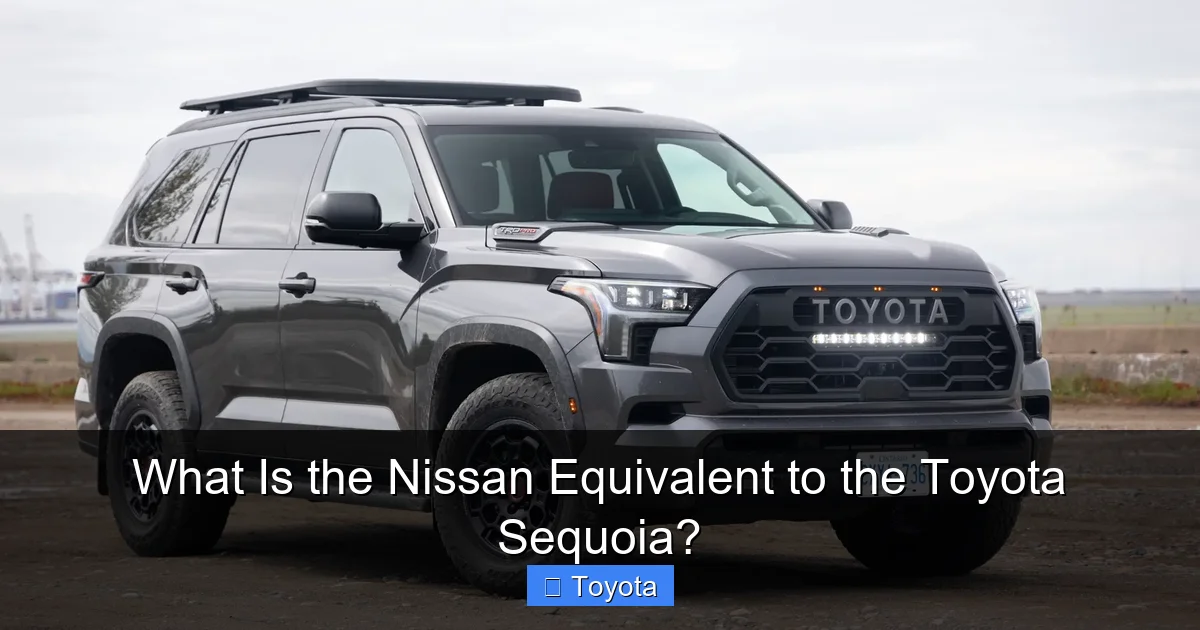
The Nissan Armada stays firmly in the traditional camp. It is powered by a 5.6-liter V8 engine (VK56VD) producing 400 horsepower and 413 lb-ft of torque. This is a long-serving, proven engine known for its smooth, linear power delivery and robust low-end grunt. It’s paired with a 9-speed automatic transmission. Power is sent to the rear wheels by default, with an available 4×4 system featuring a two-speed transfer case with low-range gearing for serious off-roading.
The Toyota Sequoia, post-2023, has embraced hybridization. Its powertrain is a twin-turbo 3.4-liter V6 paired with an electric motor, collectively dubbed i-FORCE MAX. This system generates a total system output of 437 horsepower and 583 lb-ft of torque—a staggering amount of torque, significantly more than the Armada’s V8. It uses a 10-speed automatic transmission. The Sequoia is rear-wheel-drive standard, with an available part-time 4×4 system.
Performance Comparison:
- Towing: Both are rated to tow up to 9,000 pounds when properly equipped. The Sequoia’s hybrid system provides immense, instant torque that may feel more effortless when getting a heavy trailer moving.
- Acceleration: The Sequoia’s hybrid system gives it a clear advantage in 0-60 mph times, feeling more responsive and modern.
- Fuel Economy: Here, the Sequoia’s hybrid advantage is real, though still modest. The 2024 Sequoia hybrid is EPA-rated at an estimated 20 MPG combined (20 city/22 highway for 2WD). The Armada V8 manages an estimated 16 MPG combined (14 city/20 highway for 2WD). That’s a meaningful gap for a vehicle in this class.
- Character: The Armada offers the classic, smooth, and quiet rumble of a big V8. The Sequoia offers quieter, more electric-assisted acceleration with less engine noise under light load.
Tip: If you are coming from a Nissan Rogue or similar efficient crossover, the drop in MPG with either the Armada or Sequoia will be substantial. Plan for the fuel cost reality of a full-size SUV.
Interior Space, Comfort, and Cargo: Room for Everything
Three-Room Living for Eight
Both vehicles are masters of space. They are configured exclusively as 8-passenger SUVs (2-3-3 seating), with no 7-passenger option (which would replace the second-row bench with captain’s chairs). This maximizes passenger volume.

Visual guide about What Is the Nissan Equivalent to the Toyota Sequoia?
Image source: daxstreet.com
Passenger Space: Measurements are very close. The Armada is often praised for its incredibly plush, Nissan Patrol-inspired seats, particularly the front “NASA-inspired” zero-gravity seats available on higher trims. The Sequoia’s cabin is all-new for 2023, featuring higher-quality materials, a massive 14-inch touchscreen, and a more modern, open dashboard design. Both offer ample headroom and legroom in all three rows, though the third row is best suited for children or shorter adults on moderate journeys.
Cargo Capacity:
- Nissan Armada: Behind the third row: ~17.2 cubic feet. Fold third row: ~49 cubic feet. Fold second and third rows: ~97.7 cubic feet.
- Toyota Sequoia: Behind the third row: ~22.3 cubic feet. Fold third row: ~49 cubic feet. Fold second and third rows: ~119 cubic feet.
The Sequoia holds a slight edge, especially with all seats folded, thanks to its more efficient packaging and slightly longer overall body.
Practical Example: Loading up for a family camping trip? Both can handle a week’s worth of gear with the third row up. For a major move or to haul large flat-pack furniture, the Sequoia’s extra ~20 cubic feet of total cargo space with seats down could be the deciding factor.
Capability and Towing: Heavy-Duty Duty
More Than Just a Number
The towing and payload ratings are where these trucks-in-SUV-clothing shine. Both are rated for a maximum 9,000 lbs of conventional towing when equipped with the proper factory tow package (which includes a heavy-duty radiator, transmission cooler, and integrated trailer brake controller).
However, the real-world experience differs slightly:
- Towing Feel: The Sequoia’s hybrid system provides massive, low-RPM torque that makes getting a heavy trailer started feel exceptionally smooth and confident. The Armada’s V8 requires a bit more throttle to get moving but delivers a classic, powerful surge.
- Payload: Payload (the weight you can put *inside* the vehicle) is also critical. The Armada’s maximum payload is typically in the range of 1,700-1,900 lbs. The Sequoia’s is similar, around 1,940 lbs. This is the total weight of passengers and cargo. A family of eight with gear can easily approach 1,500 lbs, so payload capacity is a serious consideration.
- Off-Road & 4×4: Both offer capable 4×4 systems. The Armada’s system includes a true two-speed transfer case with a low-range gear, which is excellent for serious rock crawling or deep mud/sand. The Sequoia’s available 4×4 is more of a sophisticated part-time system for snow, dirt, and light trails; it does not have a traditional low-range. For dedicated off-roading, the Armada has a hardware edge. For slippery roads and moderate trails, the Sequoia’s system is highly competent.
Key Tip: When comparing, always look at the specific window sticker (Monroney label) of the exact vehicle you’re considering. Towing and payload capacities can vary slightly based on drivetrain (2WD vs. 4×4), wheel size, and optional equipment. For a deep dive into Nissan’s truck capabilities, you might explore the Nissan Frontier’s towing capacity to see how Nissan engineers its trucks for hauling.
Pricing, Trims, and Value: Where Dollars Meet Dreams
Decoding the Sticker Price
Price is a major battleground, and the strategies differ.
The 2024 Nissan Armada starts at a lower Manufacturer’s Suggested Retail Price (MSRP) than the Sequoia. The base S 2WD model begins around $55,000. However, the Armada’s trim ladder climbs quickly. The top-of-the-line Platinum or reserved 4WD models can easily exceed $75,000. Nissan packs a lot of standard features even in the base model (like the powerful V8 and 8-passenger seating), but many desirable tech and luxury upgrades require moving up several trim levels.
The 2024 Toyota Sequoia, being all-hybrid and all-new, starts higher. The base SR 2WD model begins around $60,000. Toyota’s trim structure is also steep, with the top Limited and Platinum trims reaching well over $80,000. A key value point for the Sequoia is that the hybrid powertrain is standard across all trims, so you’re not paying extra for that technology. The standard Toyota Safety Sense 3.0 suite is also very comprehensive.
Value Proposition: The Armada can feel like more “truck for the money” at its base, with a standard V8. The Sequoia’s starting price reflects its advanced hybrid system and newer platform. Depreciation historically favors the Toyota slightly, but both are large, niche vehicles that don’t hold value as strongly as, say, a Toyota RAV4. For insights into Toyota’s broader value, you might check the invoice price of a Toyota RAV4 to understand negotiation baselines in the Toyota lineup.
Reliability, Ownership, and The Long Haul
Durability and Warranty Considerations
This is a core part of the Toyota Sequoia’s legend. For decades, Sequoias (and their platform-mates, the Land Cruiser and Tundra) have been synonymous with bulletproof reliability and longevity. The 2023+ hybrid powertrain is new, so long-term data is pending, but Toyota’s hybrid systems in cars and trucks have an excellent track record.
The Nissan Armada’s reputation for reliability is solid but not quite at the same legendary tier as Toyota’s full-size trucks. The 5.6L V8 is a known quantity and generally reliable, but some owners report higher maintenance costs as mileage climbs. The 9-speed automatic has been generally well-behaved in the Titan/Armada.
Warranty: This is a critical point of comparison.
- Nissan Armada: Offers a 5-year/100,000-mile limited warranty and a 5-year/100,000-mile powertrain warranty. For specifics on what the powertrain covers, a resource like this Nissan powertrain warranty guide is invaluable.
- Toyota Sequoia: Offers a more basic 3-year/36,000-mile limited warranty and a 5-year/60,000-mile powertrain warranty. Toyota does offer a hybrid battery warranty of 8 years/100,000 miles in most states.
The Nissan warranty is significantly more generous in terms of time and mileage for the overall vehicle, which can be a major selling point for buyers planning to keep their SUV for the long term. Always read the warranty booklet for exact terms and exclusions.
Conclusion: Which Full-Size SUV is Your Equivalent?
So, we return to the original question: What is the Nissan equivalent to the Toyota Sequoia? The answer is definitively the Nissan Armada. They are direct competitors, engineered for the same purpose: to be the biggest, strongest, most capable SUVs in their brand’s stable, ready to haul people and heavy loads with authority.
The choice between them now hinges on your priorities. Choose the Nissan Armada if: You desire the classic, smooth power of a big V8; you prioritize a more traditional, truck-like 4×4 system with low-range gearing for serious off-road adventures; you want a lower starting price and a more generous base warranty; or you simply prefer Nissan’s brand of plush, spacious comfort.
Choose the Toyota Sequoia if: You want the most advanced, efficient (relatively speaking) powertrain with the hybrid’s instant torque; you value Toyota’s unparalleled reputation for long-term reliability and resale value; you prefer a radically modern, tech-forward interior with a huge standard touchscreen; or you don’t require a dedicated low-range transfer case for your off-road needs.
Both are exceptional, capable, and imposing machines. The “equivalent” is clear, but the “better” choice lives in the details of your personal needs, driving preferences, and long-term ownership plans. Test drive both back-to-back. Feel the V8’s rumble versus the hybrid’s silent launch. Sit in all three rows. The answer will become perfectly clear.
Frequently Asked Questions
Is the Nissan Armada the same size as the Toyota Sequoia?
Yes, they are extremely close in overall dimensions, passenger volume, and cargo capacity. Both are classified as full-size SUVs with standard 8-passenger seating. The Sequoia has a slight edge in total cargo space behind the third row and with all seats folded.
Which has more towing capacity, the Nissan Armada or Toyota Sequoia?
Both are rated for a maximum of 9,000 pounds when properly equipped with their factory tow packages. In real-world towing, the Sequoia’s hybrid system provides more low-end torque, which many drivers find makes the towing experience feel more effortless, but the rated capacity is identical.
Does the Nissan Armada get better gas mileage than the Toyota Sequoia?
No. The Toyota Sequoia’s standard hybrid powertrain gives it a significant fuel economy advantage. The Sequoia is EPA-rated at an estimated 20 MPG combined, while the Armada’s V8 is rated at an estimated 16 MPG combined. This gap is consistent across city and highway driving.
Can you take a Nissan Armada or Toyota Sequoia off-roading?
Both are capable off-pavement, but with a key difference. The Nissan Armada’s 4×4 system includes a two-speed transfer case with low-range gearing, making it more suited for serious rock crawling and extreme terrain. The Toyota Sequoia’s available 4×4 is a sophisticated part-time system excellent for snow, mud, and moderate trails but lacks a traditional low-range gear.
Which is more reliable, the Nissan Armada or Toyota Sequoia?
Toyota has a longstanding reputation for superior long-term reliability, especially in its truck-based vehicles like the Sequoia. The Sequoia’s new hybrid powertrain is based on Toyota’s proven hybrid technology. The Nissan Armada’s V8 is a reliable engine, but the brand’s overall reliability ratings for its full-size trucks and SUVs typically trail Toyota’s. The Armada’s more generous warranty helps offset some of this concern.
Is the Nissan Armada based on a truck?
Absolutely. The Nissan Armada is built on the same body-on-frame platform as the Nissan Titan full-size pickup truck. This truck-based architecture is what gives it its high towing capacity, payload capability, and rugged character, directly paralleling how the Toyota Sequoia is based on the Toyota Tundra.