
How to Open a Bmw Trunk from the Outside

Being locked out of your BMW’s trunk can be incredibly frustrating, but you have several reliable options to regain access from the outside. Modern BMWs primarily use electronic releases via the key fob, trunk button, or foot-activated kick sensor. For older models or electronic failures, a hidden mechanical key slot or an interior emergency pull cord (accessible through the rear seat) are your backups. If the battery is completely dead, locating and using the vehicle’s jump start terminal can often restore enough power for the electronic release. This guide covers every method in detail for all BMW generations.
Key Takeaways
- Your primary method is the key fob: Press and hold the trunk icon button on your BMW key fob for 1-2 seconds to activate the electric release.
- The exterior trunk button is a direct electronic release: Located on the trunk lid or driver’s door, it works as long as the car’s battery has some charge and the key is nearby.
- The “Kick Sensor” (Comfort Access) opens hands-free: Wave your foot under the rear bumper sensor to automatically open the trunk, but only if your key is inside the car.
- A hidden mechanical key slot exists on many older BMWs: Look for a small, round cover on the trunk lid near the license plate that hides a traditional key cylinder.
- Access through the rear seat is a universal last-resort method: Folding down the rear seats and pulling the interior trunk release cord or handle will open the lid from inside the cabin.
- A dead car battery requires jump start terminal access: Locate the positive terminal in the engine bay, provide temporary power, and then use the key fob or door button to open the trunk.
- Always check for a physical key inside your fob first: Many BMW key fobs have a removable mechanical key for emergencies; knowing how to use it saves time and stress.
📑 Table of Contents
- Introduction: Not All Trunk Openings Are Created Equal
- The Evolution of BMW Trunk Mechanisms: From Key Cylinders to Kick Sensors
- Method 1: The Key Fob – Your First and Best Option
- Method 2: Exterior & Door Release Buttons
- Method 3: The “Kick Sensor” (Comfort Access)
- Method 4: The Mechanical Key & Hidden Slot
- Method 5: The Interior Emergency Release – The Universal Last Resort
- Method 6: The Dead Battery Scenario – Jump Starting the System
- Model-Specific Considerations & Pro Tips
- Conclusion: Knowledge is Your Best Tool
Introduction: Not All Trunk Openings Are Created Equal
You’re standing by your BMW, groceries in hand, ready to pop the trunk. You press the button on your key fob. Nothing. You try the button on the driver’s door. Still nothing. A moment of panic sets in. “How do I open a BMW trunk from the outside?” is a question every BMW owner eventually asks, and the answer isn’t always simple. Unlike some cars with a single, obvious method, BMW’s approach to trunk access has evolved dramatically over decades, blending sophisticated electronics with clever mechanical fallbacks.
This comprehensive guide is your definitive resource. We’ll walk through every single method, from the effortless press of a modern key fob to the gritty, manual techniques for when electronics fail. We’ll cover differences between model generations, troubleshoot common problems like a dead battery, and give you the confidence to handle this situation without a service call. Whether you drive a classic E30 or a latest-generation G-series, you’ll find the solution here.
The Evolution of BMW Trunk Mechanisms: From Key Cylinders to Kick Sensors
To understand the solutions, it helps to know the history. BMW’s trunk release technology has three distinct eras, and identifying which one your car belongs to is the first step.
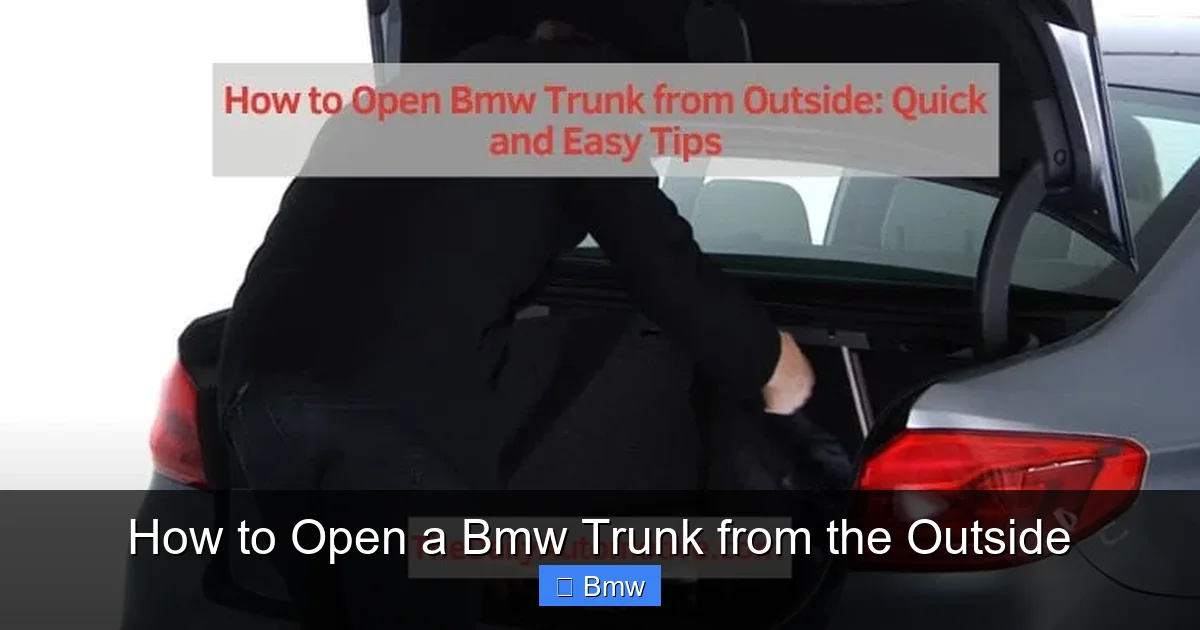
Visual guide about How to Open a Bmw Trunk from the Outside
Image source: thedailyautomotive.com
The Mechanical Era (Pre-1990s, some early 90s)
Early BMWs, like the E30 3 Series or E28 5 Series, are straightforward. They have a physical key cylinder on the trunk lid itself. You insert the key and turn it. There’s no electronics, no key fob button (the fob was just for the doors). If you lost the trunk key, you were truly locked out unless you accessed it from the inside. This simplicity is both a blessing and a curse—no electronic failures, but also no convenience features.
The Electronic Button Era (Mid-1990s to Early 2000s)
With the E39 5 Series (1995) and E46 3 Series (1998), BMW introduced the central locking system integrated with the key fob. The trunk release became an electronic solenoid. The primary method was pressing and holding the trunk icon button on the key fob. A secondary button appeared on the driver’s door panel and sometimes directly on the trunk lid. Crucially, many models from this era still retained a hidden mechanical key slot as a backup, often concealed by a small round plastic cap near the license plate. This was the golden age of the “secret” trunk key.
The Keyless & Sensor Era (Mid-2000s to Present)
Modern BMWs (F-series, G-series, and later E-series) have largely done away with physical key slots on the exterior. The system is now fully integrated with the Comfort Access keyless entry system. The key fob still has the trunk button, but the car also features a “kick sensor” under the rear bumper. Wave your foot under it, and the trunk opens automatically—provided the key fob is detected inside the vehicle (a safety feature to prevent accidental opening). The exterior button on the trunk lid or door remains, but it’s a capacitive touch sensor, not a mechanical switch. The fallback is now almost exclusively the interior emergency release accessed via the rear seats.
Method 1: The Key Fob – Your First and Best Option
This is the method BMW intends you to use 99% of the time. It’s fast, secure, and works from a reasonable distance.
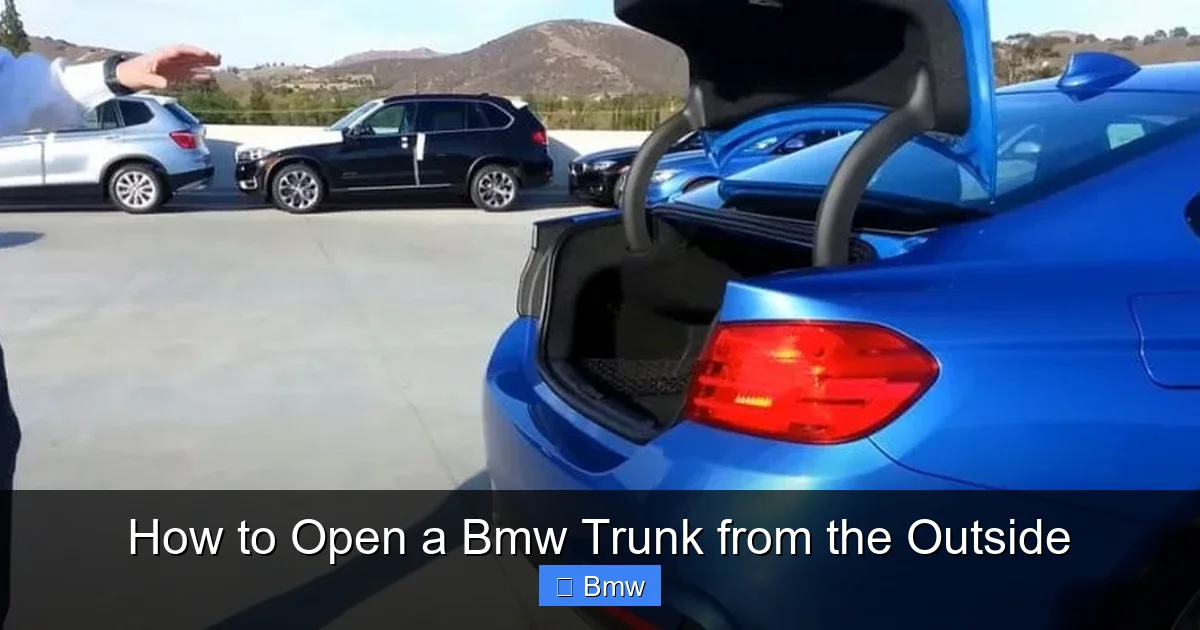
Visual guide about How to Open a Bmw Trunk from the Outside
Image source: thedailyautomotive.com
How to Do It Correctly
Take your BMW key fob out of your pocket or bag. Locate the button with the trunk icon (usually a rectangle with an arrow pointing up and out). You must press and hold this button for approximately 1-2 seconds. A quick tap will not work; it needs to be a sustained press. You should hear the trunk solenoid engage with a distinct “clunk” or “thump” and see the trunk lid pop open slightly. If you have a key fob with a retractable metal key, make sure the key is fully inserted into the fob; sometimes a partially extended key can interfere with the signal.
Troubleshooting a Non-Responsive Fob
If holding the button does nothing, first check the obvious: Is the key fob battery dead? A weak battery may still lock/unlock the doors but lack the power for the trunk solenoid. Replace the coin cell battery (usually CR2032). Second, ensure you are within range (typically 15-30 feet) and there are no major signal obstructions like a large metal object or a reinforced concrete wall between you and the car. Third, confirm your key fob is correctly paired with the car. If you’ve recently changed the battery in the car or had work done, the system may need a reset. Consult your owner’s manual for the specific “re-synchronization” procedure, which often involves pressing the fob buttons in a sequence while near the vehicle.
Method 2: Exterior & Door Release Buttons
Your BMW has secondary electronic release buttons. Their location and function vary by model.
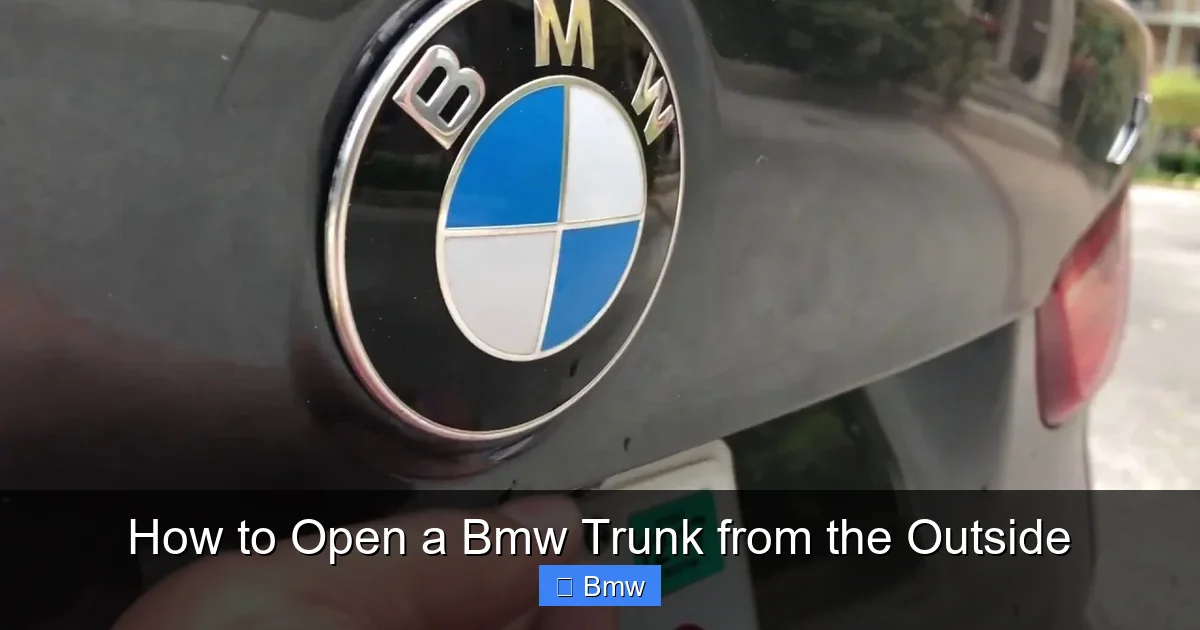
Visual guide about How to Open a Bmw Trunk from the Outside
Image source: thecarhow.com
The Trunk Lid Button
Many BMWs have a small, recessed button directly on the trunk lid, often near the BMW roundel emblem or the license plate. It may be a physical button you press or a capacitive touch sensor. This button works identically to the key fob—press and hold. Its main advantage is convenience when you’re already at the back of the car. Its limitation is the same as the fob: it requires the car’s battery to have sufficient charge and the key fob to be within the vehicle’s detection zone (usually inside the car or very close by).
The Driver’s Door Panel Button
Virtually all BMWs with electronic trunk releases have a dedicated trunk button on the driver’s door panel, typically near the other window and lock controls. This is an excellent alternative if your key fob is buried in a bag inside the car. The requirement is the same: the key fob must be inside the vehicle for the system to authorize the trunk release. This is a security feature to prevent theft.
Method 3: The “Kick Sensor” (Comfort Access)
For BMWs equipped with the optional Comfort Access keyless entry system (standard on many higher trims), opening the trunk is truly hands-free.
How the Kick Sensor Works
There is a sensor, usually shaped like a rectangular or oval recess, located in the center of the rear bumper, below the license plate. The system is designed to detect a specific kicking motion under the bumper. Stand near the rear of the car with your key fob in your pocket. Swing your foot gently under the bumper in a kicking motion (you don’t need to make contact). The sensor detects the motion and the presence of the authorized key fob. The trunk will automatically unlatch and pop open. You often hear a series of beeps or see the tail lights flash as confirmation.
Critical Limitations and Safety Notes
This system has two vital limitations. First, the key fob MUST be inside the vehicle for the kick sensor to work. This prevents someone from walking by your car with a key fob in their pocket and opening your trunk. If your key is in your hand or on your person outside the car, the kick sensor will not function. Second, the sensor can be finicky. It may not work if you’re too far to the side, if there’s excessive mud or snow covering the sensor, or if the system is disabled in the iDrive menu. Always have the key fob button as your backup plan for this method.
Method 4: The Mechanical Key & Hidden Slot
This is the classic “secret” method for many BMWs from the mid-90s through the late 2000s. It’s your go-to when electronics fail.
Finding the Hidden Key Slot
Look closely at your trunk lid, specifically around the license plate area. You are searching for a small, round, plastic plug or cap, about the size of a dime or a pencil eraser. It’s often black and blends in with the surrounding plastic. Using a flathead screwdriver, a coin, or even your fingernail, carefully pry this cap off. Underneath, you will find a traditional key cylinder. This is not for your main car key, but for a separate, smaller mechanical key that should have come with your vehicle, usually stored inside the key fob housing or in the wallet with the manual.
Using the Emergency Key
Insert the small mechanical key into the cylinder and turn it clockwise (the direction may be marked with an arrow). You will feel resistance and then a click as the trunk latch releases. The lid will pop up slightly. If your BMW does not have this hidden slot (most post-2010 models do not), this method is not available. For those models, you must use the interior emergency release. It’s crucial to locate this hidden slot and ensure you have the emergency key before you’re locked out. Test it once when you have the car unlocked to familiarize yourself.
Method 5: The Interior Emergency Release – The Universal Last Resort
Every BMW built for the last 30+ years has a federally mandated manual trunk release inside the passenger compartment. This is your failsafe when all exterior methods fail due to a dead battery, lost key fob, or electronic malfunction.
Accessing the Rear Seat Area
First, you need to get into the trunk area from inside the car. This usually means folding down the rear seats. In most BMW sedans and coupes, there is a release lever or button in the trunk (which you can’t access!) or on the side of the trunk opening. The trick is to access these releases from the passenger compartment. Look at the top of the rear seat back, near the center. You’ll often find a small plastic flap or lever. Pulling this will release the seat back, allowing you to fold it down. In some models, you may need to crawl into the back seat and pull a cord or handle located on the underside of the trunk lid itself.
Locating and Pulling the Emergency Cord/Handle
Once the rear seats are folded down and you can see into the trunk, look for a brightly colored (usually red or yellow) cord or a large, obvious plastic handle. This is the mechanical emergency release. It is directly connected to the trunk latch mechanism by a cable. Pull this cord firmly and steadily. You should hear the trunk lid unlatch and see it pop open. This method requires no battery power, no key fob—just physical force. It is the ultimate backup, but it is not convenient as it requires you to be able to enter the vehicle and fold the seats.
Method 6: The Dead Battery Scenario – Jump Starting the System
What if your car’s main 12V battery is completely dead? The electronic trunk releases, key fob signals, and even the interior light won’t work. You’re locked out, and the interior emergency release is your only option. But what if you can’t get into the car because the doors are also electronically locked? This is a rare but serious situation.
Step 1: Provide Temporary Power
BMWs have a designated jump start terminal in the engine bay, often with a red cover and a positive (+) symbol. Locate it (consult your manual for exact location—it’s usually near the firewall on the driver’s side). You will need a second vehicle or a portable jump starter. Connect the positive cable to this terminal. Connect the negative cable to a solid, unpainted metal ground point in the engine bay, like a bolt on the strut tower or engine block. Do not connect negative to the negative terminal of the dead battery if you can avoid it. Provide power for a minute.
Step 2: Attempt Exterior Release
With even a small amount of charge restored to the car’s system, try your key fob trunk button again. The solenoid may now have enough power to engage. You can also try the door panel button. If this works, you’ve solved the problem without further intrusion. If the battery is so dead that even this fails, your only option is to access the car through the interior emergency release, which requires getting inside first. In this extreme case, you may need to call a locksmith or BMW roadside assistance to unlock a door, after which you can fold the seats and use the trunk cord.
Model-Specific Considerations & Pro Tips
While the principles above cover 95% of BMWs, there are nuances.
BMW i Series (i3, i8)
These models have a frunk (front trunk) and a rear hatch. The rear hatch operates identically to a conventional BMW trunk via key fob button or exterior handle sensor. The frunk opens via a button inside the car near the driver’s footwell or via the iDrive menu. There is no traditional key slot.
BMW X Series (X1, X3, X5, X6, X7)
SUVs often have a power liftgate with a “memory” function. The key fob button usually opens/closes it fully. There is also a button on the liftgate itself that you press to open, and press and hold to close. The kick sensor is standard on most. The interior emergency release is typically a handle or cord on the inside of the liftgate itself, accessible after folding the rear seats (which in an SUV often fold flat).
Convertibles (Z4, 4 Series Convertible)
Trunk space is limited, but the release mechanism is the same as their coupe counterparts. The key fob button is primary. Be aware that with the top down, the trunk lid is exposed; ensure it’s securely latched before driving.
Proactive Prevention
Don’t wait for a lockout. Once a year, with the car unlocked, test every method: find the hidden key slot (if applicable), locate the interior emergency cord, and practice folding the rear seats. Ensure you know where your emergency mechanical key is stored. Keep a spare key fob battery in your glove compartment. If you frequently load heavy items, consider the potential for the trunk lid to close on you—the electronic system has a safety reverse, but don’t rely on it. For ultimate peace of mind, consider keeping a slim, magnetic key box attached to a hidden part of your car’s undercarriage with a spare mechanical key inside.
Conclusion: Knowledge is Your Best Tool
Finding yourself unable to open your BMW’s trunk from the outside is more than a minor inconvenience; it’s a test of your preparedness. As we’ve seen, BMW offers a sophisticated, multi-layered system designed to get you in under almost any circumstance. Your first line of defense is the key fob button—simple, reliable, and fast. The kick sensor adds a touch of modern magic for those with the right equipment. Behind these electronics lie the timeless mechanical backups: the hidden key slot for older models and the universal interior emergency cord for all.
The key takeaway is this: familiarity breeds confidence. Take 15 minutes today, with your car unlocked and safe, to locate the specific release mechanisms for your model year. Find that little plastic cap on the trunk lid. Fold down the rear seat and pull the red cord. Knowing how it works before an emergency turns a potential crisis into a minor, five-minute task. And remember, if all else fails and the battery is dead, a temporary jump start can often resurrect the electronic systems. With this knowledge, you’ll never be stranded by a closed trunk again.
Frequently Asked Questions
My BMW key fob has a trunk button, but it doesn’t work. What could be wrong?
The most common cause is a dead battery in the key fob itself. Replace the coin cell battery (usually a CR2032). If that doesn’t work, the car’s main battery may be too weak to power the trunk solenoid, or the key fob may have lost its pairing with the vehicle and need to be resynced.
I don’t have a physical key for my BMW—just the fob. Can I still open the trunk?
Yes, absolutely. The primary method is the key fob button. If that fails and your model is newer (typically post-2010), your only exterior option is the exterior button on the trunk or door, which also requires the fob’s presence. If the battery is dead, you must use the interior emergency release by folding down the rear seats.
What is the “kick sensor” and why isn’t it opening my trunk?
The kick sensor is a hands-free release under the rear bumper. It will only work if your key fob is inside the car. It’s a security feature. If your key is in your pocket or hand, the sensor will not activate. Also, ensure the sensor area is clean and free of snow or mud, and perform a clear kicking motion under the bumper.
My BMW is from 2005. Where is the hidden mechanical key slot?
Look for a small, round, black plastic cap near your license plate on the trunk lid. Carefully pry it off with a flathead screwdriver or coin. Underneath is a key cylinder that accepts the small, square emergency key that came with your vehicle, typically stored inside the key fob case.
The battery in my BMW is completely dead, and the doors are locked. Can I still open the trunk?
This is the most difficult scenario. The electronic releases won’t work. Your only option is to gain entry to the passenger compartment first, which usually requires a locksmith or roadside assistance to unlock a door. Once inside, you can fold the rear seats and pull the interior emergency trunk release cord. To prevent this, always keep a spare mechanical key hidden on the car and know how to use it.
How do I open the trunk on a BMW X5 with a power liftgate?
Press and hold the trunk icon button on your key fob. You can also press the button on the liftgate itself (a quick press to open, press and hold to close). If equipped, use the kick sensor under the rear bumper with the key inside the car. If all electronics fail, access the interior emergency release, which is usually a large handle on the inside of the liftgate glass, accessible after folding the rear seats.
