
What Is the Maintenance Schedule for a 1999 Toyota Camry?

Keeping your 1999 Toyota Camry running strong requires following a consistent maintenance schedule based on mileage and time. This guide breaks down exactly what needs to be inspected, replaced, and serviced at key intervals like 5,000, 30,000, and 60,000 miles to prevent costly repairs, ensure reliability, and maximize the legendary longevity of your Camry’s engine and drivetrain.
Key Takeaways
- Follow the Mileage Intervals: The 1999 Camry’s schedule is primarily mileage-based, with critical services at 5k, 10k, 15k, 30k, 60k, 90k, and 120k miles. Time-based items (like fluids) also matter if you drive less.
- Oil & Filter is Non-Negotiable: Changing the oil and filter every 5,000 miles (or 6 months) is the single most important task for engine health. Use the recommended 5W-30 weight.
- Don’t Ignore the “30k/60k/90k” Major Services: These intervals involve inspecting/replacing belts, hoses, spark plugs, and fluids (coolant, transmission, brake). Catching wear here prevents breakdowns.
- Tires and Brakes Need Regular Attention: Rotate tires every 5k-7k miles. Inspect brake pads/rotors at every oil change. Replace fluid every 2 years.
- Use Genuine or Quality Parts: For a car this age, using OEM-spec or high-quality aftermarket parts (especially for timing components and sensors) is crucial for durability and performance.
- Listen and Look: The schedule is a guideline. Unusual noises, leaks, vibrations, or warning lights (like the check engine or TPMS light) require immediate diagnosis, regardless of mileage.
📑 Table of Contents
- Introduction: Your 1999 Camry’s Secret to Longevity
- The Foundation: Understanding Your Camry’s Service Intervals
- The Critical 5,000-Mile Service: Engine Health 101
- The 30,000-Mile Milestone: The First Major Check-Up
- The 60,000-Mile Service: Major System Overhaul
- Beyond 60k: The 90k and 120k Services & Ongoing Care
- Practical Tips for the 1999 Camry Owner
- Conclusion: A Reliable Future is Built on a Solid Schedule
Introduction: Your 1999 Camry’s Secret to Longevity
There’s a good reason you still see 1999 Toyota Camrys on the road today. They were built with a reputation for near-bulletproof reliability, particularly the 2.2L 4-cylinder (2AZ-FE) and 3.0L V6 (1MZ-FE) engines. But that legendary reputation wasn’t magic—it was earned through consistent, proper maintenance. The factory maintenance schedule for your specific model year is the roadmap to achieving that coveted 200,000, 300,000, or even 400,000-mile milestone. Think of this guide as your owner’s manual companion, translating the factory schedule into plain English with practical advice you can actually use.
We’ll walk through each major service interval, explain what’s being done and why it matters, and highlight common failure points for these 25-year-old vehicles. Whether you’re a DIY enthusiast with a wrench or simply want to be an informed owner when you take it to a shop, understanding this schedule is the first and most critical step in caring for your Camry. Let’s dive in and get your sedan running smoothly for years to come.
The Foundation: Understanding Your Camry’s Service Intervals
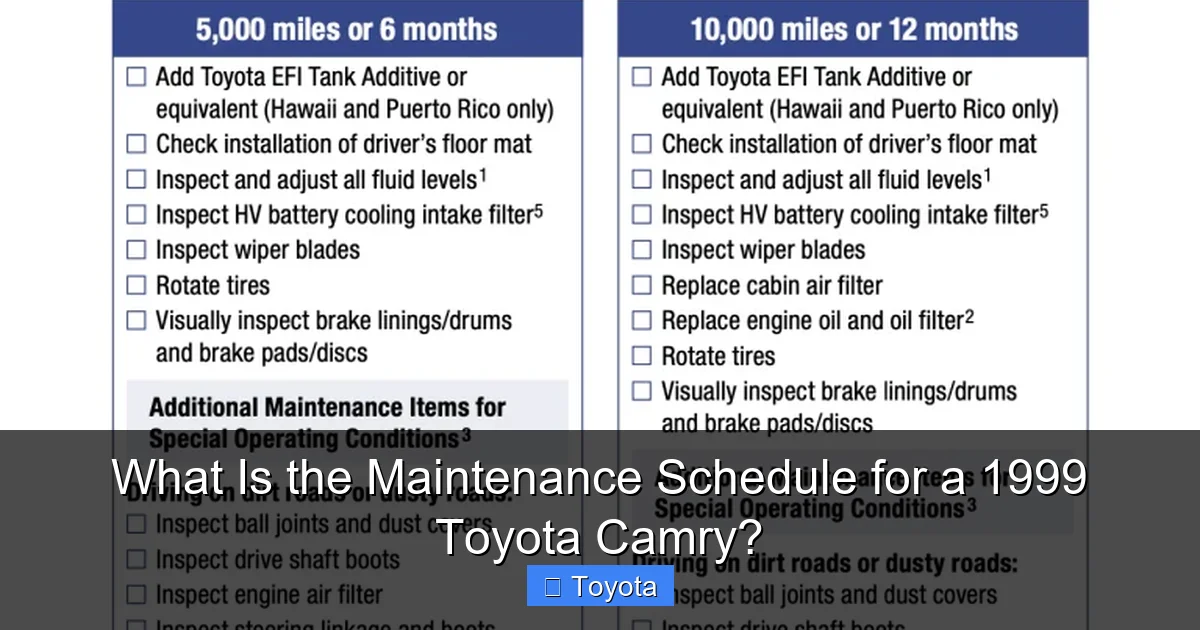
Toyota’s 1999 schedule is a hybrid of mileage-based and time-based maintenance. For most drivers, mileage is the primary trigger. However, if your Camry is a weekend driver or sits parked often, time intervals (like “every 12 months”) become equally important because fluids degrade and seals can dry out over time. The core intervals you need to know are: 5,000 miles, 10,000 miles, 15,000 miles, 30,000 miles, 60,000 miles, 90,000 miles, and 120,000 miles. Each builds upon the last.

Visual guide about What Is the Maintenance Schedule for a 1999 Toyota Camry?
Image source: maintenanceschedule.com
Reading Your Service Schedule
The original owner’s manual has a grid or checklist. Services are often labeled as “Maintenance 1,” “Maintenance 2,” etc., corresponding to these mileages. For example, “Maint 1” is the 5k service, “Maint 2” is the 10k, and “Maint 3” is the 15k/30k combo. A critical note: severe driving conditions (lots of short trips, extreme heat/cold, dusty roads, heavy loads, or towing) require you to follow the “Severe Service” schedule, which is often more frequent, especially for oil and filters. For a car this age, it’s almost always safer to assume “severe service” applies.
The Critical 5,000-Mile Service: Engine Health 101
This is the bedrock of your Camry’s longevity. Neglecting this interval is the fastest way to invite engine sludge, wear, and eventual failure.
Visual guide about What Is the Maintenance Schedule for a 1999 Toyota Camry?
Image source: maintenanceschedule.com
What’s Included:
- Oil & Filter Change: Use Toyota-approved 5W-30 oil. For high-mileage engines (>150k), a high-mileage oil with seal conditioners can help reduce minor leaks. Always replace the crush washer on the drain plug.
- Tire Rotation: Front tires wear differently than rears. Rotating them (front-to-back, or a cross pattern if tires are non-directional) ensures even wear and maximizes tread life. This is also the perfect time to check tire pressure—use the sticker on the driver’s door jamb, not the sidewall, for the correct PSI. If your Camry has the optional TPMS (Tire Pressure Monitoring System) from this era, a system reset may be needed after rotation. You can find the TPMS reset button location and procedure here.
- Basic Inspection: Check all fluid levels (engine oil, coolant, brake, power steering, windshield washer). Inspect belts and hoses for cracks, fraying, or bulges. Look for any leaks under the car.
Pro Tip:
When you change the oil, take an extra 5 minutes to visually inspect the old oil on the dipstick and the drain plug magnet. Metal shavings can indicate internal engine wear. Also, note the oil’s color and consistency—very dark, sludgy oil suggests the interval was too long.
The 30,000-Mile Milestone: The First Major Check-Up
This service expands significantly on the 5k/10k/15k services. It’s where you start addressing wear-and-tear items that aren’t checked as frequently.
What’s Included (Beyond Previous Services):
- Air Filter Replacement: A clogged air filter strangles your engine, reducing power and fuel economy. It’s cheap and easy to replace. You can often inspect it at 15k and change at 30k.
- Cabin Air Filter Replacement: If equipped (not all 1999 models had them), this filters the air you breathe. A must for allergy sufferers and general cabin air quality.
- Spark Plug Inspection/Replacement: The factory gap for the 4-cylinder is 0.043-0.047″. The V6 uses platinum plugs that often last 60k. Inspect for wear, fouling (oil, carbon), or cracking. Replacing them at 30k is cheap insurance.
- Fuel Filter Replacement: Often overlooked. A clogged fuel filter strains the fuel pump and can cause hard starting or stalling. Located along the frame rail, it’s a moderate DIY job.
- Brake Fluid Flush: Brake fluid is hygroscopic—it absorbs moisture from the air over time, lowering its boiling point and corroding brake system components. A complete flush and bleed is recommended every 2 years or 30k miles, whichever comes first.
- Coolant System Check: Inspect radiator, hoses, and thermostat housing for leaks or cracks. Test coolant strength. The original green Toyota coolant should be replaced every 30k miles or 3 years.
Why This Matters:
At 30k miles, your Camry is likely out of its bumper-to-bumper warranty. This service is about proactive prevention. Replacing a $30 fuel filter prevents a $500 fuel pump job. Flushing $50 worth of brake fluid prevents a $1000 caliper or master cylinder replacement due to corrosion.
The 60,000-Mile Service: Major System Overhaul
This is the big one. If you’ve kept up to this point, your Camry is in great shape. This service addresses long-life components that are now reaching the end of their first service cycle.
What’s Included (All Previous +):
- Timing Belt & Components Replacement (4-Cylinder Models ONLY): THIS IS THE MOST CRITICAL ITEM ON THE LIST. The 2.2L 4-cylinder engine has an interference design. If the timing belt breaks, the pistons will collide with the valves, causing catastrophic engine damage costing thousands to repair. The belt, tensioner, and idler pulleys must be replaced together. The V6 models (3.0L) use a timing chain, which is generally considered lifetime but should still be inspected for stretch and wear at this interval. If you have a 4-cylinder and don’t know the belt’s history, replace it immediately.
- Transmission Fluid & Filter Service: The 4-speed automatic (A140E/A241E) or 5-speed manual needs fresh fluid. For automatics, a drain-and-fill (replacing ~40% of fluid) is good; a full flush is better. For manuals, a drain-and-fill with the correct Toyota gear oil (or Dexron III/Mercon for some automatics) is key. Check your manual for the exact spec. If your Camry has a transmission dipstick, check the fluid condition—it should be red and smell slightly sweet, not burnt or dark brown.
- Differential/Transfer Case Fluid (AWD Models): If you have the rare AWD version, the rear differential fluid must be changed.
- Drive Belt(s) Replacement: The serpentine or accessory drive belt that runs the alternator, power steering, and A/C compressor should be replaced. Inspect for glazing or cracks.
- PCV Valve Replacement: A simple, inexpensive part that can cause rough idle and oil consumption if clogged.
- Complete Fluid Flush: In addition to brake fluid, consider coolant (if not done at 30k) and possibly power steering fluid (if it’s not “lifetime”).
A Word on the Fuel System:
At this age, fuel injectors can get clogged with deposits. While not on the strict schedule, a professional fuel system cleaning (injector, throttle body, intake valves) can restore performance and fuel economy. If you notice rough idle, hesitation, or poor gas mileage, it’s a good candidate.
Beyond 60k: The 90k and 120k Services & Ongoing Care
After the major 60k service, the schedule repeats and reinforces key items. The 90k service is largely another 30k-style check, while the 120k service is a repeat of the major 60k items, plus a few more.
At 90,000 Miles:
- Repeat the 30k service items: spark plugs, fuel filter, air filter, cabin filter, brake fluid flush, coolant check/replacement.
- Inspect Valve Clearance (4-Cylinder): The 2.2L has hydraulic lifters, which are generally maintenance-free, but a check never hurts on a high-mileage engine. The V6 may have shim-type valves that require adjustment.
- Inspect & Lubricate Ball Joints, Tie Rod Ends, and Driveshaft: Check for wear and play. These are critical steering and suspension components.
At 120,000 Miles (and Beyond):
- Repeat the 60k major service: timing belt (4-cyl), transmission fluid, drive belt, PCV valve, and all fluid flushes.
- Spark Plug Wires/Coil-On-Plug Boots: If equipped (later 1999 models may have coil packs), inspect for cracks, arcing, or resistance failure.
- Major Suspension & Steering Inspection: Bushings (control arm, strut mount), shocks/struts, and wheel bearings should be thoroughly inspected. The original struts are likely worn out by now.
- Consider Major Engine Seals: At this age, valve cover gaskets, oil pan gaskets, and main seals may start to leak. Replacing them during a timing belt job is efficient.
The Never-Ending List:
Beyond specific mileages, some items are perpetual:
- Oil & Filter: Every 5k miles.
- Tire Rotation & Pressure Check: Every 5k-7k miles.
- Brake Inspection: At every oil change. Pads, rotors, calipers, and hardware.
- Battery: Test annually after 3 years. Replace every 4-5 years. Check terminals for corrosion.
- Wiper Blades: Replace twice a year.
- Engine Belts & Hoses: Visual inspection at every service. Replace every 7-10 years or 90k-120k miles, even if they look okay.
Practical Tips for the 1999 Camry Owner
Your Camry is a tool for transportation. Keeping it reliable is about smart habits, not just following a list.
1. Keep Meticulous Records
Use a notebook or a digital spreadsheet. Log the date, mileage, what was done, and who did it (or the part number if you DIY). This history is invaluable for future troubleshooting and proving maintenance to a potential buyer. It also helps you remember when the last timing belt was changed—a critical piece of information.
2. Use the Correct Fluids and Parts
Don’t guess. The owner’s manual specifies everything: oil viscosity (5W-30), coolant type (Toyota Super Long Life Coolant or equivalent), transmission fluid (Type T-IV or Dexron III/Mercon depending on model), and brake fluid (DOT 3). Using the wrong fluid can cause damage. For parts, OEM Toyota or high-quality brands (NGK spark plugs, Denso fuel filters, Gates belts/tensioners) are worth the small premium for peace of mind. For example, a replacement alternator for a 2000 Camry (nearly identical to the ’99) is a common repair; buying a remanufactured unit with a good warranty is a smart move.
3. Address Small Problems Before They Grow
A slow coolant leak from a radiator hose will eventually leave you stranded. A minor oil seep from a valve cover gasket will get worse and could lead to a misfire if it hits the spark plugs. A squealing belt is a sign of wear or a failing tensioner. A slight vibration at speed could be a balancing weight off or a worn CV joint. Catch these early. The cost to fix a $50 hose now is far less than the $3000+ engine repair from overheating.
4. Find a Trusted Mechanic
For complex jobs like the timing belt on the 4-cylinder, unless you are a skilled DIYer, professional installation is highly recommended. Mis-timing the belt by even one tooth will destroy the engine. Build a relationship with an independent shop that specializes in Toyota or Asian imports. They will know the quirks of these 90s Camrys better than a generic lube shop.
5. Don’t Forget the Little Things
Check and top off all fluids monthly. Check tire pressure monthly. Wash the undercarriage in winter if you drive on salted roads to prevent corrosion. Replace the engine air filter more often if you drive in dusty conditions. These small acts add up to a car that feels and performs better.
Conclusion: A Reliable Future is Built on a Solid Schedule
Your 1999 Toyota Camry is a testament to a time when cars were built to be fixed and maintained. That durability is not a guarantee; it’s a reward for diligent care. By adhering to the mileage-based maintenance schedule outlined here—especially the non-negotiable oil changes, tire rotations, and the life-saving timing belt replacement on 4-cylinder models—you are actively investing in your Camry’s future. You’re not just performing routine service; you’re preventing the most common and costly failures that can end the life of any vehicle, regardless of its reputation.
Think of your maintenance log as a diary of reliability. Each entry is a step toward that magical odometer reading. It’s the difference between your Camry being a source of constant worry or a trusted, familiar companion that starts every time, gets you where you need to go, and costs you only in predictable, manageable maintenance. Start today: check your mileage, look at your last service record, and make a plan for the next interval. Your future self, and your wallet, will thank you.
Frequently Asked Questions
What happens if I miss the 60,000-mile timing belt service on my 4-cylinder 1999 Camry?
You risk immediate and catastrophic engine failure. The 2.2L 4-cylinder is an interference engine, meaning a broken timing belt causes the pistons to collide with the open valves, bending them and destroying the cylinder head. The repair cost exceeds the car’s value. If the belt’s history is unknown, replace it immediately.
Can I use regular oil in my 1999 Camry instead of 5W-30 synthetic blend?
For the 1999 model, Toyota recommended conventional 5W-30. However, using a high-quality synthetic blend or full synthetic oil provides better protection against heat and wear, especially in extreme temperatures or with older engines. The most important factor is changing it every 5,000 miles, regardless of oil type.
My Camry has a slight oil leak. Is this normal for a 1999 model with high miles?
Minor oil seepage from valve cover gaskets, oil pans, or main seals is common as rubber and seals age on high-mileage vehicles (150k+). It’s often more of an annoyance than a critical issue unless it’s a heavy, steady drip that causes low oil levels. Monitoring oil level between changes is essential. Using a high-mileage oil with seal conditioners can often slow or stop minor leaks.
How do I know if my transmission fluid needs to be changed?
Check the dipstick (if equipped). Healthy fluid is bright red and has a slightly sweet smell. If it’s dark brown or black, smells burnt, or feels gritty, it needs service immediately. Even if it looks okay, a drain-and-fill every 30,000-60,000 miles is proactive maintenance for a 25-year-old transmission to ensure smooth shifts and longevity.
Is the 30,000-mile service really necessary, or can I just keep changing the oil?
The 30k service is absolutely necessary. Oil changes are just one part of engine health. This service addresses air intake (filter), fuel delivery (filter), ignition (sparks), and critical fluid systems (brake, coolant). Neglecting these leads to poor performance, poor fuel economy, brake failure, or overheating—all of which are far more expensive than the service itself.
My check engine light is on. Is it safe to drive until my next scheduled service?
It depends on the severity. A solid yellow light means a system is not optimal—get it scanned for codes soon (many auto parts stores do this for free). A flashing red light means a severe misfire that can damage the catalytic converter—stop driving immediately. Never ignore a check engine light; it’s your car’s way of telling you something is wrong, often related to emissions or engine performance that can affect other components if left unchecked.
