
What Is the Blue Book Value of a 2018 Toyota Camry Le?

The Kelley Blue Book (KBB) value for a 2018 Toyota Camry LE typically ranges from $18,000 to $22,000 for a well-maintained, average-mileage vehicle. This value fluctuates based on condition, mileage, optional features, and regional market demand. Understanding these factors and using KBB’s valuation tools correctly is crucial for getting a fair price whether you’re buying or selling this popular midsize sedan.
Key Takeaways
- KBB Provides Multiple Values: Understand the difference between Trade-In, Private Party, and Suggested Retail values for accurate pricing.
- Condition is King: A vehicle’s mechanical and cosmetic condition is the single biggest factor affecting its final value, often more than mileage.
- Mileage Matters, But Context is Key: Average mileage for a 2018 model is ~12,000 miles/year. Significantly more or less will adjust the value up or down.
- LE Trim is the Baseline: The LE is the base trim. Any added packages (like the Premium or Audio packages) will increase its value over the standard configuration.
- Regional Demand Influences Price: A Camry may fetch more in regions where sedans are preferred over trucks/SUVs.
- Vehicle History is Critical: A clean Carfax or AutoCheck report with no accidents is essential for top value. Any history will reduce the price.
- Timing and Market Conditions: Values can shift with new model releases, economic conditions, and seasonal demand for used cars.
📑 Table of Contents
- Understanding the Blue Book: What Is Kelley Blue Book?
- The 2018 Toyota Camry LE: A Benchmark of Reliability
- What’s the Actual Number? Current Value Ranges for a 2018 Camry LE
- How to Get Your Own Accurate KBB Value: A Step-by-Step Guide
- Factors That Can Boost or Reduce Your Camry’s Value
- Buying vs. Selling: How to Use This Information Strategically
- The Long-Term Outlook: Will My 2018 Camry Hold Its Value?
- Conclusion: Your Camry’s Value is a Data-Driven Story
Understanding the Blue Book: What Is Kelley Blue Book?
Before we dive into the specific number for a 2018 Toyota Camry LE, let’s clear up a common point of confusion. When people say “Blue Book value,” they are almost always referring to Kelley Blue Book, the most recognized and widely used vehicle valuation and research source in the United States. Founded in 1926, KBB became the industry standard by providing objective, data-driven pricing based on millions of actual sales transactions, auction results, and current market trends.
It’s not a physical book you buy anymore (though they still publish one!). It’s a powerful online platform and suite of tools. Their valuations are not a guess; they are a calculated estimate of what a typical buyer would pay for a specific vehicle in a specific condition in a specific location. For our 2018 Camry LE, KBB aggregates data from thousands of similar sales to arrive at its figures. Think of it as the starting point for negotiation, not the final, absolute price.
The Three Pillars of KBB Valuation
KBB doesn’t give just one number. It provides a spectrum of values tailored to different transaction types. This is the first critical concept to grasp.
- Trade-In Value: This is the rough estimate of what a dealership will offer you for your car as part of a new car purchase. It assumes the car is in “Good” condition and is the lowest of the three values because the dealer must recondition and re-sell the vehicle for a profit.
- Private Party Value: This is what you can realistically expect to sell your car for to an individual. It’s higher than the Trade-In value because you’re cutting out the middleman. This is the most relevant figure for someone selling their Camry on their own.
- Suggested Retail Value (or Typical Listing Price): This is the price a reputable dealer might ask for a similar vehicle on their lot. It’s the highest of the three, as it includes the dealer’s profit margin, reconditioning costs, and often a warranty. This is the target for a buyer aiming for a fair dealer price.
So, when someone asks, “What’s the Blue Book value?” the correct response is, “For what type of sale?” The difference between Private Party and Retail can easily be $2,000-$3,000 on a car like the Camry.
The 2018 Toyota Camry LE: A Benchmark of Reliability
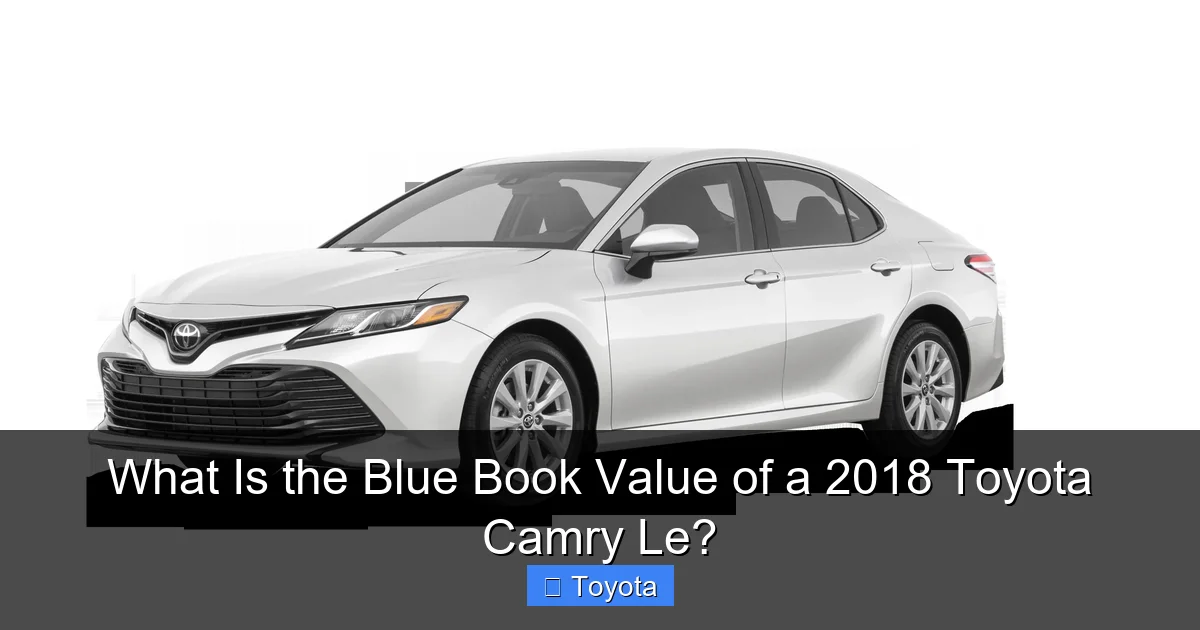
To understand its value, you must understand the vehicle. The 2018 model year was significant for the Camry. It was the final year of the XV70-generation Camry before a major redesign for 2018? Wait, let’s correct that. The 2018 model year was actually the first year of an all-new, completely redesigned generation (the XV70). This is a key point for value! A first-year, all-new model often holds value slightly better initially due to the “new design” appeal, but long-term reliability is still being proven. The Toyota Camry, however, has a decades-long reputation for bulletproof reliability, which heavily buttresses its used-car value.
Visual guide about What Is the Blue Book Value of a 2018 Toyota Camry Le?
Image source: file.kelleybluebookimages.com
The Toyota Camry LE is the entry-level trim in this new generation. It’s not a bare-bones model by any means. For 2018, the LE came standard with:
- A 2.5L 4-cylinder engine (203 hp) mated to an 8-speed automatic transmission.
- Toyota Safety Sense P (TSS-P): This is huge. It included Pre-Collision System with Pedestrian Detection, Lane Departure Alert with Steering Assist, Automatic High Beams, and Dynamic Radar Cruise Control. Having this suite as standard equipment in a 2018 midsize sedan was a major selling point and value booster.
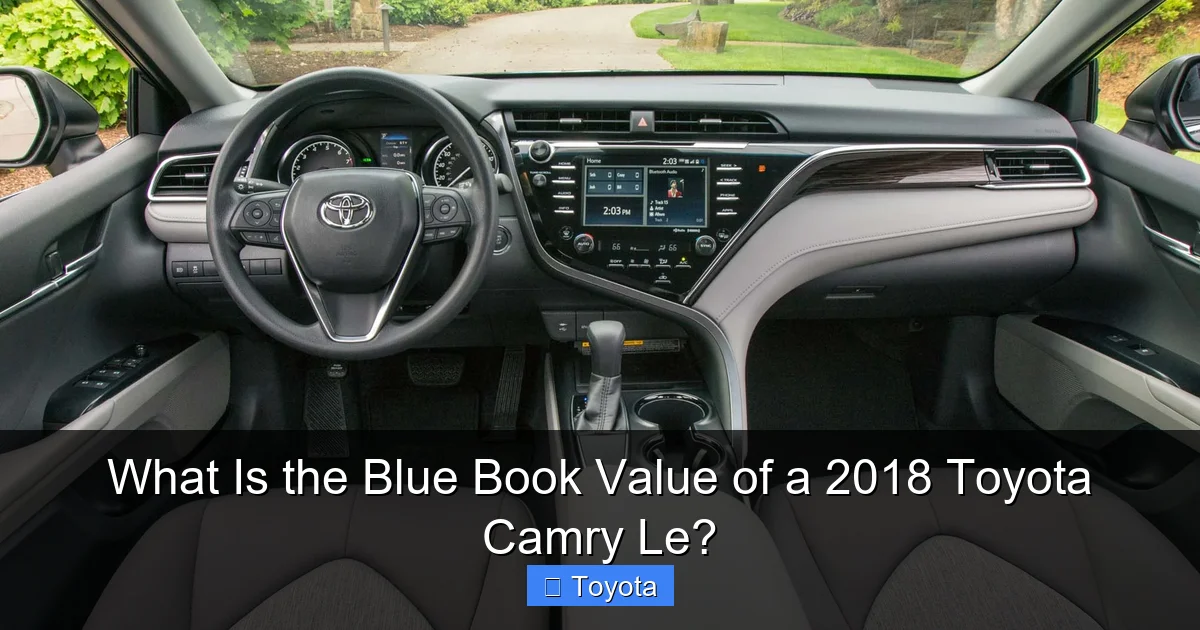
- 7-inch touchscreen infotainment with Apple CarPlay and Android Auto (a new feature for 2018).
- LED headlights and taillights.
- Dual-zone automatic climate control.
Optional on the LE included a Premium Package (adding a sunroof, heated front seats, and a 9-speaker JBL audio system) and a Cold Weather Package. Any of these packages added at the time of purchase will increase the car’s current value.
This baseline of excellent standard features, combined with Toyota’s reputation, means the Camry LE has a very strong and consistent floor under its value. It’s not a niche car; it’s a high-volume, high-demand commodity in the used market, which creates a stable pricing environment.
What’s the Actual Number? Current Value Ranges for a 2018 Camry LE
Now, for the numbers you’re here for. As of late 2023/early 2024, KBB’s valuations for a 2018 Toyota Camry LE in “Good” condition with average mileage (roughly 12,000 miles per year, so ~72,000 miles for a 6-year-old car) are approximately:
Visual guide about What Is the Blue Book Value of a 2018 Toyota Camry Le?
Image source: st.motortrendenespanol.com
- Trade-In Value: $18,200 – $19,500
- Private Party Value: $19,800 – $21,200
- Suggested Retail Value: $21,500 – $23,000
Important: These are national averages. Your specific price will vary. Let’s break down the levers that swing these numbers.
The Mileage Multiplier: How Many Miles Is Too Many?
The industry benchmark is 12,000 miles per year. For a 2018 model, that’s 72,000 miles. If your Camry LE has:
- Below 60,000 miles: Expect a premium. Every 10,000 miles below average can add $500-$1,000 to the value in a private party sale.
- 60,000 – 84,000 miles: This is the sweet spot, considered “average.” Use the base ranges above.
- Above 90,000 miles: Value begins to drop more noticeably. Once you cross the 100,000-mile threshold, the depreciation curve steepens, potentially knocking $1,500-$2,500 off the private party value, all else being equal.
However, a car with 80,000 miles and a full, documented service history from a dealer or reputable mechanic will often be valued more highly than a 60,000-mile car with spotty or no records. Maintenance history can offset higher mileage.
Condition: The Great Equalizer
KBB’s condition ratings are: Excellent, Very Good, Good, Fair, and Poor. Most used cars fall into “Good” or “Very Good.” Here’s what separates them:
- Excellent: Like-new inside and out. No cosmetic flaws, all maintenance records, no accidents. Rare for a 6-year-old daily driver. Can command a 5-10% premium.
- Very Good: Minor cosmetic blemishes (small door ding, slight wear on driver’s seat), all required maintenance up to date, clean history. This is the target for a seller. Values are at the top of the range.
- Good: Normal wear and tear for its age. May have a few minor scratches, normal seat wear, but mechanically sound and accident-free. This is the standard baseline.
- Fair/Poor: Needs work, has cosmetic damage (dents, cracked bumper), or an accident on its record. Values drop quickly, often by 15-25% or more.
To get top dollar, a seller should detail the car, fix minor issues (like a chipped windshield or burned-out bulb), and have all maintenance records organized. A buyer should inspect meticulously and adjust their offer based on any deficiencies.
How to Get Your Own Accurate KBB Value: A Step-by-Step Guide
Don’t just take my word for it. Getting a personalized, accurate KBB value is easy and free. Here’s how to do it right.
Visual guide about What Is the Blue Book Value of a 2018 Toyota Camry Le?
Image source: file.kelleybluebookimages.com
Step 1: Gather Your Vehicle’s Exact Information
You’ll need the Vehicle Identification Number (VIN). You can find it on the dashboard near the windshield, the driver’s side door jamb, or your insurance/registration documents. The VIN tells KBB the exact configuration: engine, transmission, factory-installed options, and even the original color. Entering the VIN eliminates guesswork. If you don’t have the VIN, you can manually select the year, make, model, and trim (2018 Toyota Camry LE).
Step 2: Be Brutally Honest About Condition
This is where most people go wrong. They rate their car as “Excellent” when it’s clearly “Good.” Read KBB’s condition descriptions carefully. Does your car have any scratches larger than a credit card? Any dings? Is the interior clean but with normal seat bolster wear? That’s “Good.” “Excellent” means it looks showroom fresh. Under-rating your condition hurts your price; over-rating leads to a listing that won’t sell. If you’re unsure, lean toward “Good.”
Step 3: Input Your Exact Mileage
Be precise. The difference between 71,999 and 72,001 miles is negligible, but the difference between 70,000 and 90,000 is substantial.
Step 4: Select Your Zip Code
This is crucial. A 2018 Camry LE in Miami, Florida, may have a different value than the same car in Boise, Idaho, due to supply and demand, regional preferences for vehicle types, and even climate-related wear (e.g., less rust in the South). KBB uses your zip code to adjust for local market conditions.
Step 5: Review the Three Values
KBB will present you with the Trade-In, Private Party, and Retail values. It will also show you a pricing graph and comparable listings in your area. Study this data. If you’re selling, the Private Party value is your target. If buying from a dealer, the Retail value is your negotiation anchor. If you’re trading in, the Trade-In value is your baseline, but you should also get offers from multiple dealers and CarMax/Carvana to see if you can beat it. For instance, understanding what the invoice price is on a new Toyota can give you perspective on dealer margins, which indirectly helps in used car negotiations.
Factors That Can Boost or Reduce Your Camry’s Value
Beyond the basic KBB form, several other factors can swing the value by hundreds, even thousands, of dollars.
The Power of a Clean Title and Vehicle History
This cannot be overstated. A vehicle with no reported accidents or damage (a “clean title”) is worth significantly more than one with an accident on its record, even if repairs were perfect. A single reported accident can reduce value by 10-20%. A “salvage” or “rebuilt” title can cut value in half. Always run a Carfax or AutoCheck report before buying or listing. As a seller, having a clean history report to show prospective buyers is a massive trust and value builder. A car that has been in a minor fender-bender and repaired at a reputable body shop might be fine, but the market penalizes it simply for the “accident” label.
Optional Packages and Aftermarket Add-ons
The LE trim has two main factory packages:
- Premium Package: Adds a power glass moonroof, 9-speaker JBL audio system, and heated front seats. This is a desirable package that can add $1,000-$1,500 to the value.
- Cold Weather Package: Adds heated exterior mirrors and a heated windshield wiper de-icer. More valuable in northern climates.
Regarding aftermarket additions: be cautious. A professionally installed, high-quality sound system or leather seats can add value, but often not as much as it cost to install. They can also be a turn-off if the work is poor. Factory-installed options are always valued higher. Also, consider practical features like a Toyota Tacoma’s bed size—while not relevant to a Camry, it highlights how specific utility features drive value in different segments.
Seasonal and Regional Demand
In many parts of the country, spring and early summer are peak used-car buying seasons. You might get a slightly better price then. In winter, convertibles and RVs drop, but AWD vehicles hold steady. The Camry is an all-weather, all-season sedan, so its demand is fairly constant year-round. However, in regions where trucks and SUVs dominate (the Mountain West, Texas), a sedan might sit on the lot longer, slightly depressing local values. Conversely, in urban areas or places with high fuel costs, efficient sedans like the Camry are in higher demand.
Buying vs. Selling: How to Use This Information Strategically
Knowing the value is only half the battle. How you use that knowledge depends on which side of the transaction you’re on.
For Sellers: Maximizing Your Camry’s Price
Your goal is to make your car appear to be in the best possible condition for its actual state.
- Start with KBB’s “Private Party” value for your exact zip, mileage, and condition. This is your realistic asking price. List it 2-3% above this if you want room to negotiate, but be prepared to accept your KBB number.
- Gather all records. Oil changes, tire rotations, any repairs. A binder of records is worth $500-$1,000 in a buyer’s mind.
- Detail the car thoroughly. Professional detailing is one of the best returns on investment. Clean every nook, remove odors, fix minor scratches with a rubbing compound.
- Fix known issues. Replace worn wiper blades, burnt-out bulbs, fix any check engine lights. A car that passes a pre-purchase inspection with flying colors sells faster and for more.
- Take excellent photos. Clean the car, take pictures in good light, include shots of the engine, trunk, all four corners, and the odometer. Transparency builds trust.
- Disclose everything. If there’s a minor accident on the history report, disclose it upfront in your ad. Hiding it destroys credibility and kills the deal later.
Also, consider your sales channel. Selling privately gets you the Private Party value. Trading in at a dealership is convenient but nets you the Trade-In value (or less). Services like CarMax, Carvana, and Vroom offer a no-haggle price that often sits between Private Party and Trade-In. Get offers from all three before deciding.
For Buyers: Negotiating a Fair Price
Your goal is to establish a data-backed offer that is fair but leaves room for negotiation.
- Find 5-10 comparable listings. Use Autotrader, Cars.com, and dealer sites. Filter for the exact year, model (Camry LE), trim, and mileage within 5,000 miles of your target. Note their asking prices.
- Check the KBB Suggested Retail Value. This is a strong benchmark. If a dealer’s asking price is more than $1,000 over KBB Retail for an identically equipped car, it’s probably overpriced.
- Use the KBB Private Party value as your “walk-away” number. You should never, ever pay more for a used car from a dealer than the top-end of the Private Party value for the same car. If a dealer’s best offer is at or below that, you’re in the right ballpark.
- Get a pre-purchase inspection (PPI). Pay $100-$150 for an independent mechanic to inspect the car. Use any findings (even minor ones) as a reason to negotiate the price down. A PPI is your #1 tool for avoiding a lemon and justifying a lower offer.
- Factor in taxes, fees, and registration. Your total out-the-door cost is what matters, not just the sticker price. Some states have high sales tax; some dealers have exorbitant documentation fees. Know these costs upfront.
Remember, the Camry LE is a common car. There are dozens more listed every week. You have leverage. Be patient, be informed, and be willing to walk away. If you’re looking at a used Camry and want to understand its core features better, researching what the HOLD button does or its fuel capacity shows you’re a serious, knowledgeable buyer, which sellers respect.
The Long-Term Outlook: Will My 2018 Camry Hold Its Value?
The Toyota Camry is consistently one of the best vehicles for resale value in its segment. According to Kelley Blue Book’s own 5-Year Cost to Own Awards, the Camry frequently wins or places highly. The reasons are its legendary reliability, low cost of ownership (cheap maintenance, good fuel economy), and massive market demand. A well-maintained 2018 Camry LE should depreciate much slower than the industry average.
Looking ahead, as the 2018 model ages into its 8th, 9th, and 10th years, its value will follow a predictable curve. It will depreciate fastest in years 3-5, then the rate will slow. By the time it’s 10 years old (2028), a clean, well-maintained example with ~120,000 miles could still be worth $10,000-$13,000. Its value floor is supported by the fact that for many budget-conscious buyers, a reliable, fuel-efficient, low-maintenance used Camry is a smarter choice than an older, less reliable luxury sedan or a high-mileage SUV. Its reputation is its greatest asset.
Conclusion: Your Camry’s Value is a Data-Driven Story
So, what is the Blue Book value of a 2018 Toyota Camry LE? The answer is a range, not a single number. For a typical, well-cared-for example with average mileage, you’re looking at a Private Party value of roughly $19,800 to $21,200. But that number is a living document, shaped by your car’s specific history, its exact mechanical and cosmetic state, the local market you’re in, and what the buyer is willing to pay.
The real power lies not in finding one number, but in understanding the framework KBB uses. By accurately assessing your car’s condition, knowing its full history, and comparing it to real local sales data, you can confidently set a price. Whether you’re selling your trusted Camry to fund your next vehicle or buying a dependable used sedan, this knowledge is your shield against overpaying or underselling. The 2018 Toyota Camry LE is not just a car; it’s a proven commodity in the automotive marketplace. Treat it with respect, maintain it diligently, and understand its value, and it will serve you well financially for years to come.
Frequently Asked Questions
What is the difference between the 2018 Camry LE and SE trims, and does it affect value?
The 2018 Camry SE adds sportier styling (black mesh grille, rear spoiler, black exterior accents), a sport-tuned suspension, and leather-wrapped steering wheel with paddle shifters. It also often came with larger alloy wheels. The SE typically holds a value about $800-$1,200 higher than the LE in similar condition and mileage due to its perceived sportier appeal and additional features.
How does the standard Toyota Safety Sense (TSS-P) on the 2018 Camry LE impact its value today?
It has a significant positive impact. TSS-P was a cutting-edge suite of active safety features standard on all 2018 Camrys. For a used car buyer in 2024, having adaptive cruise control, pre-collision braking, and lane-keeping assist as standard equipment is a major selling point. It makes the 2018 model feel more modern and secure compared to competitors from the same year without such comprehensive standard safety tech, bolstering its resale value.
Is a 2018 Toyota Camry LE with 100,000 miles still a good value?
Yes, but the value adjusts downward. At 100,000 miles, the car is well beyond the average mileage. However, the Camry’s reputation for longevity means it still has many reliable miles left if maintenance has been consistent. Expect the Private Party value to be $2,000-$3,000 less than an identical model with 70,000 miles. The key is a flawless service history and a clean title. You must also budget for upcoming maintenance items like brakes, tires, and possibly the water pump.
Should I trust the KBB value if the car has aftermarket modifications?
Use KBB as a baseline for the stock vehicle, then adjust. KBB values are based on factory-standard vehicles. Aftermarket modifications are a mixed bag. High-quality, professionally installed upgrades (like a premium audio system) can add some value, but rarely dollar-for-dollar what was spent. Poorly done mods (lift kits, loud exhausts, questionable body kits) often decrease value for the average buyer who wants a reliable, normal car. For an accurate value, you’d need to research the specific mod’s impact or consider removing them to return the car to stock, which often yields a higher sale price.
How do ” Certified Pre-Owned” (CPO) 2018 Camry LEs from Toyota dealers compare in price to regular used ones?
CPO vehicles command a premium. A Toyota Certified Pre-Owned 2018 Camry LE will have passed a 150-point inspection, received any necessary repairs, come with a factory-backed extended warranty (typically up to 7 years/100,000 miles from original in-service date), and include roadside assistance. This peace of mind and warranty coverage typically adds $1,500-$2,500 to the price over an identical non-CPO private party car. For a risk-averse buyer who plans to keep the car long-term, the CPO premium can be worth it.
My 2018 Camry LE has a small accident on its Carfax. How much will that lower the KBB value?
It depends entirely on the severity. A minor fender-bender with no airbag deployment and proper repair might lower the value by 5-10%. A major accident with structural damage, airbag deployment, or a “salvage” title can lower it by 20-50% or more. KBB’s condition questionnaire asks about accident history. You must select “Fair” or “Poor” condition if the accident was significant. For a minor accident, you can often still list it as “Good” condition but must disclose the accident in your ad. The final price reduction is negotiated between buyer and seller based on the repair quality and perceived risk. Always be honest; hiding it is fraud and will void the sale if discovered later.