
What Is the Best Year of a Toyota Camry to Buy Used?

Finding the best year of a Toyota Camry to buy used means balancing reliability, features, and price. Generally, the 2012-2017 models (XV50 generation) offer exceptional long-term value with proven powertrains and modern safety tech. Always prioritize a comprehensive pre-purchase inspection and a detailed vehicle history report over any single model year. Your ideal Camry depends more on its individual maintenance history and your budget than its production date alone.
So, you’re in the market for a used Toyota Camry. Smart move. The Camry has been America’s best-selling sedan for decades, and for good reason. It’s not exciting, but it is profoundly reliable, comfortable, and cheap to own. But with over 20 years of generations on the road, the big question looms: what is the best year of a Toyota Camry to buy used? The answer isn’t a single magic number. It’s a balance of your budget, desired features, and finding a specific car with an excellent history. Let’s break it down generation by generation to find your perfect match.
Key Takeaways
- The 2012-2017 (XV50) generation is the overall sweet spot: This era refined an already excellent platform, offering superb reliability, improved interior quality, and standard safety features like backup cameras in later years, all at a great used price.
- 2007-2011 (XV40) models are budget-friendly workhorses: These are incredibly durable and cheap to repair, making them perfect for high-mileage, no-fuss transportation. Expect basic interiors and fewer modern tech features.
- Avoid the first year of any major redesign: The initial model year of a new generation (e.g., 2012, 2018) can have minor teething issues. Waiting for the second year (e.g., 2013) often yields a more refined vehicle.
- Hybrid models (2007-2011 & 2012-2017) are exceptionally reliable: Toyota’s hybrid system is legendary. A well-maintained Camry Hybrid from either generation is a fantastic, fuel-efficient choice with minimal hybrid-specific issues.
- Vehicle history and condition trump everything: A pristine 2009 Camry with one owner and full records is a better buy than a neglected 2015 model. Always check for accidents, maintenance logs, and have it inspected by a trusted mechanic.
- Know your “must-have” features: Decide if you need Apple CarPlay/Android Auto (standard 2018+), advanced safety suite (Toyota Safety Sense standard 2018+), or leather seats. This will narrow your year range faster than anything.
- Timing your purchase can save thousands: Shopping at the end of the quarter, during holiday sales, or when new models arrive can give you leverage. For more strategies, read our guide on when is the best time to buy a car.
📑 Table of Contents
- Why the Toyota Camry is a Top Used Car Choice
- Understanding Camry Generations: A Quick Timeline
- The Best Years: Our Top Picks by Generation
- What to Look For: Inspection Tips for Used Camrys
- Common Issues and Recalls by Model Year
- Making Your Final Decision: Budget, Mileage, and Features
- Strong Conclusion
Why the Toyota Camry is a Top Used Car Choice
Before we dive into years, let’s talk about the “why.” The Camry’s reputation isn’t hype. It’s built on a foundation of conservative engineering and bulletproof powertrains. The 2.5L 4-cylinder (found in most models from 2007 onward) and the 3.5L V6 are both known for easily surpassing 250,000 miles with basic maintenance. This legendary reliability translates directly to used car value. You’re buying a known quantity.
The Ownership Experience
Owning a Camry is refreshingly simple. Parts are abundant and inexpensive at any auto parts store or dealership. Any mechanic in the country knows how to work on them. This low cost of ownership is the Camry’s secret weapon. While a European luxury sedan might depreciate into a money pit, a Camry keeps asking for little and giving back years of trouble-free service. This predictability is exactly what you want in a used car.
Resale Value Champion
Even used, Camrys hold their value better than almost anything in their class. This means when you eventually sell it, you’ll get more of your money back compared to a competing midsize sedan. It’s a financial cushion that other cars simply don’t provide. This strong resale is a direct result of the public’s unwavering trust in the model’s longevity.
Understanding Camry Generations: A Quick Timeline
To pick the best year, you must understand the generations. Each major redesign brings new engines, transmissions, interiors, and occasionally, new issues to work out. Here’s a simplified timeline for the modern, relevant Camry years.
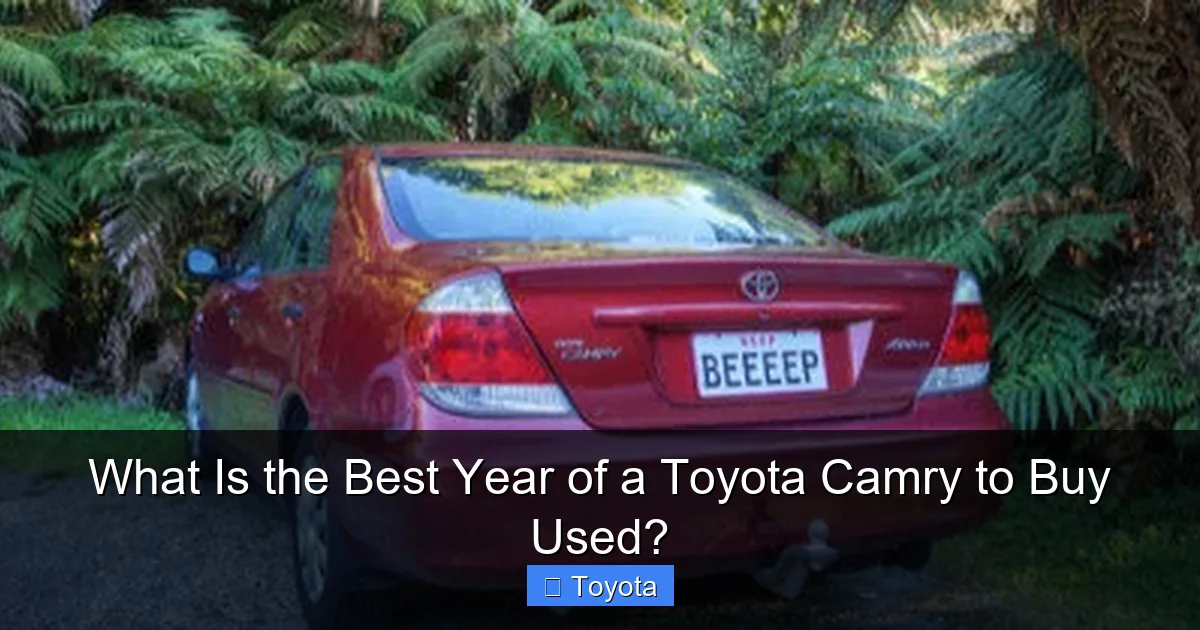
Visual guide about What Is the Best Year of a Toyota Camry to Buy Used?
Image source: assets-global.website-files.com
- XV40 Generation (2007-2011): A massive redesign that became an instant classic. Introduced the modern 2.5L 4-cylinder and 6-speed automatic. Dated by today’s standards but incredibly robust.
- XV50 Generation (2012-2017): A significant refresh inside and out. Improved ride, quieter cabin, and much better interior materials. This is the generation that truly elevated the Camry from “appliance” to “premium mainstream.”
- XV70 Generation (2018-Present): The ground-up redesign that shocked everyone with its aggressive styling. Standard Toyota Safety Sense (TSS), Apple CarPlay/Android Auto (finally!), and more powerful, efficient engines. The tech leap is huge.
For used buyers, the XV50 (2012-2017) often represents the best balance of modern comforts and legendary reliability without the premium price of the newest models. But the older XV40 (2007-2011) is a phenomenal value for those who prioritize absolute mechanical simplicity.
The Best Years: Our Top Picks by Generation
Now, let’s get specific. Within each generation, some model years stand out due to factory updates, recall clearances, or simply waiting for initial bugs to be found and fixed.

Visual guide about What Is the Best Year of a Toyota Camry to Buy Used?
Image source: di-sitebuilder-assets.dealerinspire.com
The Sweet Spot: 2012-2017 Camry (XV50)
This is our top recommendation for most used buyers. The 2012 model was the first of this generation, and while its core powertrain was solid, it had a few minor early issues. The 2013-2017 models are the prime picks here.
- Why 2013+ is better: Toyota addressed a few minor software gremlins in the 6-speed automatic and infotainment system. Interior quality saw subtle improvements year-over-year.
- The 2016-2017 Refresh: These received a mid-cycle refresh with a slightly revised front end, an updated (and finally responsive) touchscreen, and the inclusion of Toyota’s Safety Sense suite (Pre-Collision System, Lane Departure Alert, Automatic High Beams) on most trims. This is a huge value-add for safety-conscious buyers.
- Hybrid Note: The Camry Hybrid from this period (2012-2017) is also exceptional. The battery technology is proven, and these models deliver fantastic real-world fuel economy (40+ MPG) with no compromise in performance. A 2015-2017 Hybrid is arguably one of the best used car values on the market.
Practical Example: A well-cared-for 2015 Camry SE with 80,000 miles, a clean CARFAX, and Toyota Safety Sense will likely cost less than a base-model 2019 but offer nearly identical mechanical reliability and a much better infotainment experience than a 2012.
The Budget King: 2007-2011 Camry (XV40)
If your budget is tight and you just need a car that will run forever, look here. These are the last of the truly simple, rugged Camrys.
- Why they’re great: The 2.5L 4-cylinder and 3.5L V6 are among the most bulletproof engines Toyota ever built. The 6-speed automatic is tough. You can find these with 150,000+ miles that feel like new if serviced.
- What you give up: Soft-touch plastics are minimal. The infotainment system is ancient by today’s standards (no touchscreen, basic Bluetooth). Safety tech is limited to basic airbags and stability control. Noise insulation is noticeably worse than later models.
- Best Year to Target: The 2010-2011 models are the final years of this generation. They often have more updated software and were built with slight manufacturing refinements. A 2011 model is less likely to have the rare early engine oil consumption issues some 2007-2008 models had.
Tip: If you buy one of these, budget $500-$800 for a full tune-up, new spark plugs, and a transmission fluid change if records are missing. It’s cheap insurance that will make the car run like new.
The Tech Leap: 2018-2021 Camry (XV70)
This is for the buyer who wants modern safety tech, Apple CarPlay, and a more stylish ride, but still wants Toyota reliability. These are newer, so they cost more, but they offer the most features.
- Why they’re compelling: Standard Toyota Safety Sense 2.0 on all trims is a massive advantage. The infotainment system is vastly improved. The cabin is quieter and feels more substantial. Styling is subjective but undeniably more modern.
- Caveats: They are more expensive used. The new 8-speed automatic in V6 models is generally excellent but has had a few isolated reports of shuddering at low speeds (often fixed with a software update). The base 4-cylinder is adequate but not powerful.
- Best Value: A 2019-2020 model. You avoid the very first model year (2018) of a ground-up redesign, which can have minor bugs, but still get the full suite of modern features at a discount over a 2021+ model. A Certified Pre-Owned (CPO) 2019 from a Toyota dealer can be an outstanding deal with a factory-backed warranty.
For a deep dive into Camry-specific features like the Hold button on a Toyota Camry or how to change the time on a Toyota Camry, we have dedicated guides to help you master your specific model.
What to Look For: Inspection Tips for Used Camrys
Knowing the best years is useless if you buy a neglected car. Your pre-purchase checklist is more important than the model year on the title.
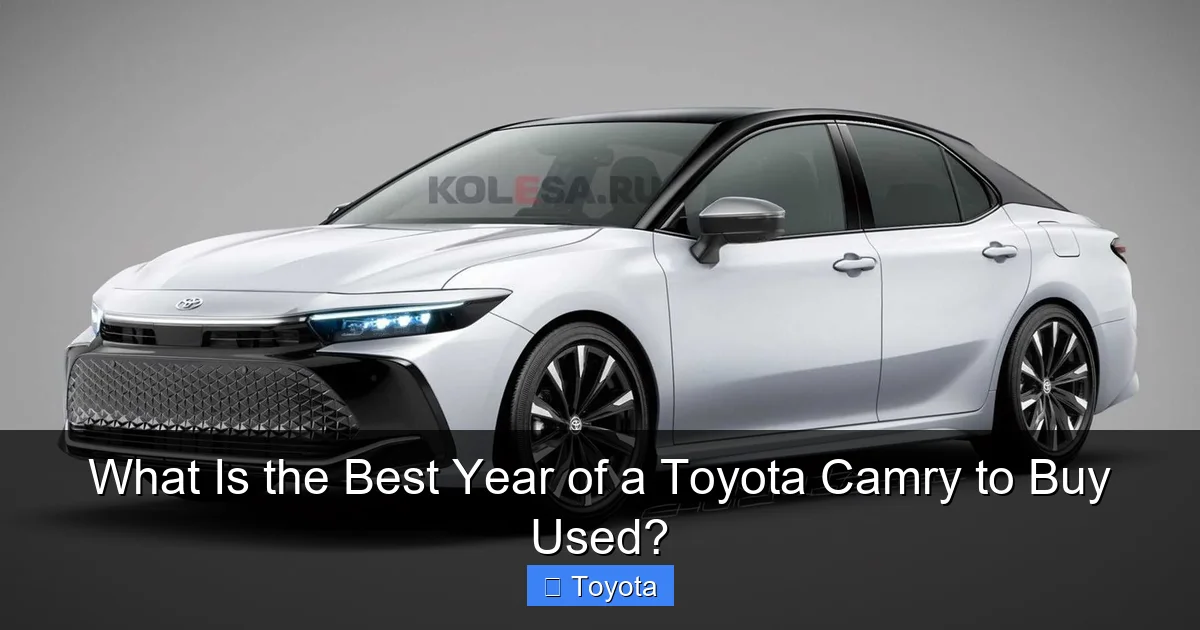
Visual guide about What Is the Best Year of a Toyota Camry to Buy Used?
Image source: cdn.motor1.com
The Non-Negotiable: Pre-Purchase Inspection (PPI)
Never, ever buy a used Camry (or any used car) without a PPI by an independent mechanic. Spend $150-$200. It will tell you if the car has hidden accidents, transmission wear, engine issues, or rust. This inspection is your crystal ball. A seller who refuses a PPI is selling you a problem.
Critical Areas to Check
- Transmission: For the 6-speed automatic (2007-2017), feel for smooth, hesitation-free shifts, especially from 1st to 2nd gear when cold. Any slipping, harsh clunks, or delayed engagement is a major red flag. For the 8-speed (2018+), test for smoothness at low speeds.
- Engine: Check for excessive oil consumption (look for low oil on dipstick). Listen for smooth operation. The 2.5L 4-cylinder should be quiet and vibration-free. A slight oil leak from the valve cover gasket is common and cheap to fix; a major rear main seal leak is not.
- Rust: Check the rocker panels behind the front wheels, the rear wheel arches, and the undercarriage. Southern and Western states cars will be pristine. A car from the “Salt Belt” (Northeast, Midwest) can be a rust bucket.
- Interior & Electronics: Test every button, window, lock, and the infotainment system. Ensure the air conditioning blows cold. Blown speakers or a dead touchscreen are annoying but fixable; a failed climate control module is expensive.
Common Issues and Recalls by Model Year
Even the best cars have known weak spots. Being aware of them helps you ask the right questions and verify repairs.
XV40 (2007-2011) Quirks
- Oil Consumption: Some 2007-2008 2.5L engines were known to burn oil. Toyota extended the warranty for this. Ensure any related repairs were done under the extended warranty program.
- Power Steering: Early models (2007-2008) had an electric power steering system that could fail. Most were replaced under recall or warranty by 2009, but verify the repair history.
- Windshield Wiper Motors: These can fail, requiring a costly replacement. Ask if it’s been done.
XV50 (2012-2017) Quirks
- Infotainment Glitches: Early touchscreen systems (2012-2014) could be slow and buggy. A software update often helps. The 2015+ systems are better.
- Sunroof Rattle: Some models have a sunroof that can rattle due to a misaligned glass panel. It’s usually a simple adjustment.
- AC Odor: A musty smell from the vents is common and is typically caused by a clogged cabin air filter or mold in the evaporator case. Replacing the filter and cleaning the case solves it.
XV70 (2018+) Quirks
- Transmission Shudder (V6/8-speed): A small number of 2018-2019 V6 models experienced a vibration/shudder at low speeds. This was often addressed with a Transmission Control Module (TCM) software update.
- Audio System Glitches: Early versions of the new infotainment system had occasional crashes or Bluetooth connectivity issues, often fixed with updates.
Action Step: Go to the NHTSA.gov website and enter any VIN you’re seriously considering. You can see all open and completed recalls for that specific vehicle and verify if they’ve been addressed. This is a free and powerful tool.
Making Your Final Decision: Budget, Mileage, and Features
With all this info, how do you choose? It comes down to a simple framework.
Step 1: Set Your Absolute Budget
This includes not just the purchase price, but sales tax, registration, and a $500-$1,000 immediate maintenance fund for things like tires, brakes, or fluids. If your total budget is $15,000, your car price should be around $13,000.
Step 2: Prioritize Your “Must-Haves”
Is it:
- Ultra-low cost of ownership? Target a 2009-2011 4-cylinder Camry.
- Modern safety and tech? Target a 2018+ model with Toyota Safety Sense.
- Best fuel economy? Target a 2012-2017 Hybrid.
- Best ride and interior? Target a 2016-2017 SE or XLE trim.
Step 3: Search by Condition, Not Just Year
This is the most important step. A 2012 with one owner, full service records from a dealership, and 60,000 miles is a far better buy than a 2016 with two owners, no records, and 120,000 miles. Use filters on Autotrader or Cars.com for “1-Owner” and “Carfax Available.” Be prepared to wait for the right car to come along.
Once you find a contender, verify its history. A low credit score can affect your financing options, so it’s wise to check your own credit and get pre-approved before shopping. This gives you negotiating power and clarity on your true budget.
Strong Conclusion
So, what is the best year of a Toyota Camry to buy used? For the vast majority of buyers seeking the perfect blend of modern comfort, proven reliability, and value, the answer lies within the 2013-2017 model years (XV50 generation). They are the most refined of the bulletproof era. For the ultra-budget-conscious, the 2010-2011 (XV40) models are unbeatable mechanical workhorses. For tech-focused buyers, the 2019-2020 (XV70) models offer a significant leap forward.
Ultimately, the specific car’s history and condition will always outweigh its model year badge. A well-maintained, non-accident Camry from any generation from 2007 onward will likely serve you faithfully for years. Arm yourself with knowledge, get a professional inspection, and you’ll find a Camry that isn’t just a good used car buy, but a great one. It’s the sensible choice that makes every other argument about “driving excitement” fade into irrelevance when you’re saving thousands on repairs and enjoying a stress-free commute.
Frequently Asked Questions
Is a high-mileage Toyota Camry a good buy?
Yes, if it has a complete service history. The Camry’s 2.5L engine and 6-speed automatic are known to last 300,000+ miles. A 2012 Camry with 200,000 miles and documented oil changes is often a better buy than a 2016 with 120,000 miles and no history. Always get a mechanic’s inspection to verify the powertrain’s health.
Should I buy a Camry Hybrid or the gas model?
For most used buyers, the gas 4-cylinder is the simplest and cheapest to maintain. The Hybrid is an excellent choice if you drive mostly city/highway and want significantly better fuel economy (40+ MPG vs. 30 MPG). Hybrid battery replacements are rare (often over 200,000 miles) and the system is very reliable. If your commute matches the hybrid’s strength, it’s a fantastic buy.
What are the worst Camry years to avoid?
Avoid the very first model year of any new generation if possible (2007, 2012, 2018). These can have minor, unresolved issues. Specifically, be cautious with 2007-2008 models regarding oil consumption and power steering; verify these were addressed. Also, be wary of any Camry with a salvage title or incomplete service records, regardless of year.
Does the Camry hold its value well?
Extremely well. It consistently ranks at the top of its class for resale value. This means you lose less money off the lot and will recoup a higher percentage of your purchase price when you sell. This strong residual value is a key reason it’s such a smart used car purchase.
What is the average price for a good used Camry?
Prices vary wildly by generation, mileage, and region. As of late 2023, you can expect to pay: $8,000-$12,000 for a clean 2009-2011 model, $12,000-$18,000 for a 2013-2017 model, and $20,000-$28,000 for a 2018-2021 model. Always compare prices on local listings and adjust for your specific market.
Are there any common problems I should budget for?
Yes. For 2007-2011 models, budget for a potential water pump or thermostat (common at 100k+ miles). For 2012-2017 models, plan for a set of brakes and tires if they haven’t been replaced. For all models, the timing belt/water pump service is critical on the 3.5L V6 (typically due around 90k-120k miles) and can cost $800-$1,200. Factor this into your purchase decision if it’s due soon.