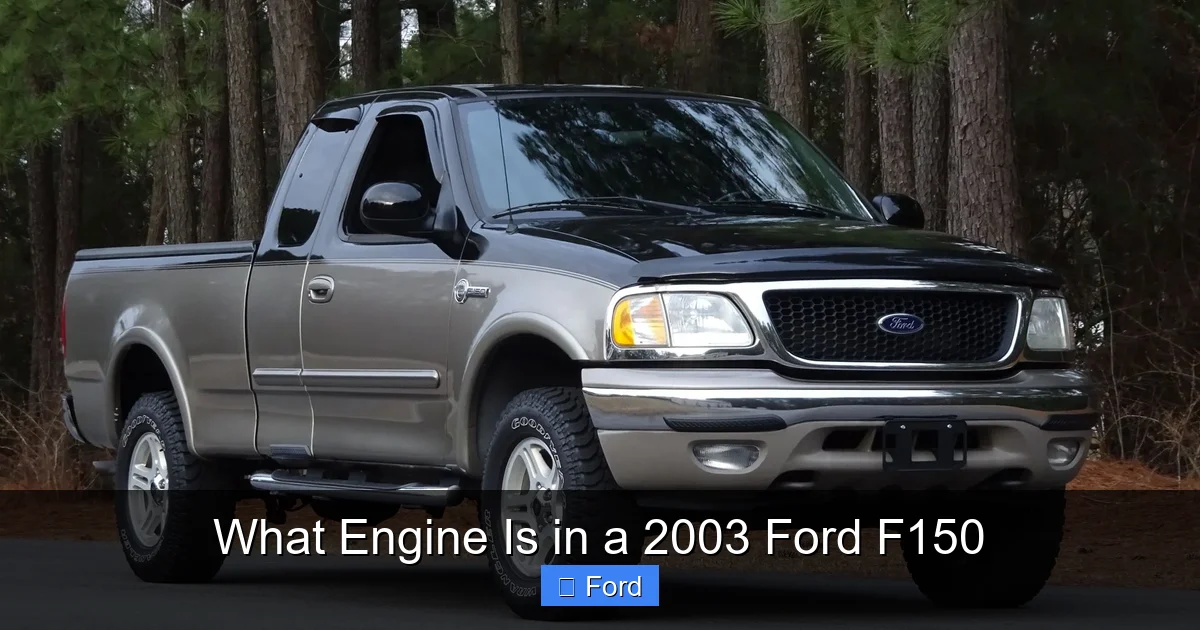
What Engine Is in a 2003 Ford F150

Contents
- 1 Key Takeaways
- 2 📑 Table of Contents
- 3 Unpacking the Legend: Your Guide to the 2003 Ford F150 Engine
- 4 The 2003 F150 Engine Lineup: A Tale of Three (Mostly) V8s
- 5 The Heart of the Beast: Ford’s Modular Engine Family
- 6 Deep Dive: The 4.6L Triton V8 – The Reliable Workhorse
- 7 Deep Dive: The 5.4L Triton V8 – The Tow-Monster with a Edge
- 8 Marriage of Power: The 2003 F150 Transmission
- 9 Buying a Used 2003 Ford F150: The Engine Checklist
- 10 The Final Word: Why the 2003 F150 Engine Still Matters
- 11 Frequently Asked Questions

Car Wax Polish

Car Hydraulic Jack
Fuel Injector Cleaner

Dashboard Polish
The 2003 Ford F150 came with two primary engine options: the 4.6L Triton V8 and the more powerful 5.4L Triton V8, both part of Ford’s Modular engine family. A standard 4.2L V6 was also available on select base models. The 5.4L, especially the 3-valve version, was the top choice for towing and hauling, while the 4.6L offered a reliable balance of power and efficiency. Understanding these 2003 Ford F150 engine options is key to buying a used truck that fits your needs.
Key Takeaways
- Two Main V8s: The 2003 F150 primarily used the 4.6L (220-234 hp) and 5.4L (300-330 hp) Triton V8s from Ford’s Modular engine family.
- The Modular Family: These engines share design architecture with Ford’s DOHC 4.6L in the Mustang Cobra, but the truck versions used SOHC heads for reliability and low-end torque.
- 4.6L Triton: A reliable, proven workhorse. The 2-valve version (220 hp) was common, while the rare 3-valve (234 hp) offered slightly more power. Known for spark plug issues in early models.
- 5.4L Triton: The powerhouse. The 2-valve (300 hp) and especially the 3-valve (330 hp) provided significant towing capacity. The 3-valve had some cam phaser and timing chain concerns.
- The Forgotten V6: A 4.2L V6 (204 hp) was available on the XL and STX regular cab models but is extremely rare today and less desirable for heavy-duty tasks.
- Transmission Match: Both V8s were paired with the robust 4R70W (4-speed) or the newer 4R75W automatic. The 5.4L 3-valve required the stronger 4R75W.
- Reliability is Key: Both engines can last 200k+ miles with proper maintenance, especially regular oil changes using the correct oil. Neglecting engine oil is a primary cause of failure.
📑 Table of Contents
- Unpacking the Legend: Your Guide to the 2003 Ford F150 Engine
- The 2003 F150 Engine Lineup: A Tale of Three (Mostly) V8s
- The Heart of the Beast: Ford’s Modular Engine Family
- Deep Dive: The 4.6L Triton V8 – The Reliable Workhorse
- Deep Dive: The 5.4L Triton V8 – The Tow-Monster with a Edge
- Marriage of Power: The 2003 F150 Transmission
- Buying a Used 2003 Ford F150: The Engine Checklist
- The Final Word: Why the 2003 F150 Engine Still Matters
Unpacking the Legend: Your Guide to the 2003 Ford F150 Engine
So, you’re looking at a 2003 Ford F150. Maybe it’s that trusty work truck you’ve seen around, or a clean used model that caught your eye. You know it’s a solid truck, but the big question looms: what engine is under the hood? The answer isn’t just a number and a letter; it’s a story about Ford’s engineering philosophy at the turn of the millennium. The 2003 Ford F150 engine choices defined this generation’s character—a blend of proven durability and emerging performance technology. Let’s pop the hood and see what made these trucks tick.
For 2003, Ford was in the middle of its 10th-generation F150 run (1997-2004). This was the era of the “Tough Truck” campaign, and the engines reflected that. They weren’t the high-revving, fuel-injected monsters of today, but rather stout, pushrod V8s built for one thing: moving weight. Whether you’re buying one to haul a trailer, plow snow, or just need a reliable daily driver, knowing the difference between a 4.6 and a 5.4 is the first step to making a smart purchase. We’ll break down each option, their quirks, and what they mean for you as an owner or buyer.
The 2003 F150 Engine Lineup: A Tale of Three (Mostly) V8s
Step back for a second. In the early 2000s, the American truck market was a V8 kingdom. While competitors offered straight-sixes and early V6s, Ford bet big on its Modular V8 architecture. For the 2003 model year, the F150’s brochure listed three engines, but two dominated the roads. The standard engine for most trims was the 4.6L Triton V8. Step up to the Lariat, King Ranch, or any regular cab with the towing package, and you likely got the 5.4L Triton V8. The third option, a 4.2L V6, was a footnote—available only on base XL and STX regular cab models with the 6.5-foot bed. It was a decent engine from the Ranger, but in a full-size truck, it was outmatched. You’ll rarely, if ever, find one for sale today.
Why So Few Choices? The Philosophy of Simplicity
Ford’s strategy was brilliantly simple. They took two existing V8s, refined them for truck duty, and used them across nearly every configuration. This meant parts commonality, simpler assembly, and lower costs. For you, the used buyer, this is a huge win. Mechanics know these engines inside and out. Parts are abundant and relatively inexpensive. There’s no exotic technology to fail unexpectedly. This is old-school, proven hardware. But “proven” doesn’t mean perfect. Each engine has its own personality, strengths, and well-documented weaknesses.
The Heart of the Beast: Ford’s Modular Engine Family
To understand the 2003 F150 engine, you need to understand its family tree: the Ford Modular engine platform. Launched in the early 1990s, the Modular engine was Ford’s first foray into overhead-cam V8s (and later V6s). The name “Modular” referred to its shared design components—like a common 90-degree block, bore spacing, and cylinder head design—that could be scaled from 4.6L to 5.4L and beyond.
Here’s the crucial distinction: while the Mustang SVT Cobra’s 4.6L was a dual-overhead-cam (DOHC) high-revving beast, the truck 4.6L and 5.4L used a single-overhead-cam (SOHC) design. Why? Low-end torque. Trucks need grunt off the line, not horsepower at 6,000 RPM. The SOHC setup, with its two valves per cylinder (in the 2-valve versions), was simpler, more robust, and perfectly tuned for the truck’s power band. This is why these engines feel so torquey and durable in an F150, but would feel sluggish in a sports car.
Key Modular Family Traits for Truck Owners
- Aluminum Heads: Both the 4.6L and 5.4L used aluminum cylinder heads. This saved weight but means you must be vigilant about coolant leaks. A leaking head gasket or cracked head can introduce coolant into the oil, causing catastrophic failure. Always check for a milky sludge under the oil cap.
- Timing Chains: No timing belts! These engines use a timing chain system that should last the life of the engine under normal conditions. However, on high-mileage 5.4Ls, especially the 3-valve, the tensioners and guides can wear, leading to chain noise and potential failure.
- Plastic Intake Manifold: A notorious weak point. The 2003 5.4L 3-valve used a composite plastic intake manifold with coolant crossover passages. These can crack, leaking coolant internally or externally. The 4.6L and 5.4L 2-valve used a more reliable all-metal intake.
Deep Dive: The 4.6L Triton V8 – The Reliable Workhorse
This is the engine you’ll find in the vast majority of 2003 F150s. It displaced 281 cubic inches (4.6 liters) and was offered in two flavors for 2003: the standard 2-valve and a higher-output 3-valve version. The 2-valve was the default for XL, XLT, and most FX4 models, making 220 horsepower and 305 lb-ft of torque. The 3-valve, available on Lariat and some specialty models, bumped output to 234 horsepower and the same 305 lb-ft. The difference came from Ford’s 3-valve cylinder head technology—three valves per cylinder (two intake, one exhaust) for better breathing.
Why the 4.6L 2-Valve is So Common and Beloved
Simplicity. That’s the 4.6L 2-valve’s middle name. With its cast-iron block, aluminum heads, and SOHC valvetrain, it’s an engineer’s dream of durability. It revs smoothly, delivers power right where you need it for merging and light hauling, and doesn’t ask for much beyond regular oil changes. Many of these engines have crossed 300,000 miles with basic maintenance. The power rating might seem low today, but in a 2003 F150, it was adequate for most tasks. It’s the definition of a “no-surprise” engine.
The Spark Plug Issue: A Famous (and Fixable) Flaw
Here’s the big caveat: early 4.6L engines (1997-2002) had a design flaw where the spark plugs could blow out of the cylinder head. Ford changed the design for 2003, using a slightly different threaded insert, which largely solved the problem. However, it’s still a critical check when buying any used 4.6L. Look for records of the repair. If the plugs haven’t been changed recently, a professional mechanic should inspect them. Replacing them requires a special tool to avoid damaging the threads. It’s a known issue, but one that, if addressed, doesn’t spell doom for the engine.
Maintenance Tips for Long Life
Treat this engine right, and it will treat you right. Stick to a strict oil change interval—every 5,000 miles is a safe bet with conventional oil, or 7,500+ with full synthetic. Watch for any coolant loss; a slow leak into the oil will destroy bearings. The plastic valve covers can become brittle and leak oil; replacing them is a cheap fix. Overall, the 4.6L is the low-stress, high-reliability choice for someone who wants a truck to start every morning without drama.
Deep Dive: The 5.4L Triton V8 – The Tow-Monster with a Edge
Step into the 5.4L Triton, and you’ve entered a different league. Displacing 330 cubic inches (5.4 liters), this engine meant business. In 2003, it came in two versions: the 2-valve (300 hp, 365 lb-ft) and the 3-valve (330 hp, 365 lb-ft). The torque figure is what matters here—that massive 365 lb-ft is available low in the RPM range, making this truck a trailer-pulling, hill-climbing beast. If you regularly tow over 5,000 lbs or need maximum payload, the 5.4L is the engine you want.
The 3-Valve Revolution and Its Complications
The 2003 5.4L 3-valve was a significant update. It featured Ford’s first use of variable camshaft timing (VCT) on a truck engine and the aforementioned plastic intake manifold. The power jump from 300 to 330 hp was noticeable. However, this new technology brought new potential problems. The cam phasers, which adjust cam timing, can wear out on high-mileage engines, causing a rattling noise on cold start (the “death rattle”). While not an immediate death sentence, it’s an expensive repair (often $2,000+). The plastic intake manifold is also a failure point; cracks can cause coolant leaks, overheating, and hydrolock.
The 2-Valve: Simpler, Still Powerful
The 5.4L 2-valve is a torque monster with fewer electronic complexities. It uses a traditional metal intake and no VCT. It makes the same 300 hp and 365 lb-ft as the earlier 1999-2002 models. It’s slightly less refined than the 3-valve and has a different, deeper exhaust note. For many buyers, the 2-valve is the sweet spot: you get the massive towing capacity of the 5.4L without the worry of cam phaser failure. It’s a tank of an engine.
Which 5.4L Should You Seek?
If you’re buying a 2003 F150 with a 5.4L, your first job is to identify which version it is. Look under the hood. The 3-valve has “3V” or “DOHC” cast into the valve covers. The 2-valve covers are simpler. For a used truck, a well-maintained 2-valve is often the more prudent choice due to lower repair risk. A 3-valve with documented cam phaser and intake manifold repairs can be a fantastic, powerful engine. Always get a pre-purchase inspection from a Ford specialist who can check for these specific issues.
Marriage of Power: The 2003 F150 Transmission
An engine is only as good as the transmission sending its power to the wheels. In 2003, Ford paired its V8s with two versions of the legendary 4-speed automatic: the 4R70W and the updated 4R75W. The difference is in the internal components and torque capacity. The 4R75W, introduced mid-generation, had revised valve body solenoids and a slightly stronger case. It was the mandatory partner for the 5.4L 3-valve engine and was also common on the 5.4L 2-valve. The 4.6L typically got the 4R70W.
Both transmissions are robust, but age and neglect are their enemies. The most common issue is a failure of the “E” or “D” clutch pack, causing harsh 1-2 or 2-3 shifts, slips, or a complete lack of a gear. A thorough transmission scan for solenoid and pressure codes is a must on any high-mileage F150. Many transmissions were rebuilt with upgraded parts and can last another 150,000 miles. When evaluating a truck, a smooth, firm shift pattern is a great sign. If you’re comparing to other trucks, you might wonder what transmission is in a 1996 Dodge Ram 1500—it’s a different story entirely, often with its own set of concerns.
Buying a Used 2003 Ford F150: The Engine Checklist
Armed with engine knowledge, here’s your practical buying guide. Don’t just fall in love with a truck’s color or wheels. Its heart—the engine and transmission—dictates its future.
Your Pre-Purchase Inspection (PPI) Must-Haves
- Verify the Engine: Confirm via the VIN (8th character) and visual inspection (valve covers, intake) whether it’s a 4.6L 2-valve, 4.6L 3-valve, 5.4L 2-valve, or 5.4L 3-valve. This is non-negotiable.
- Cold Start Listen: Start the truck cold from sitting overnight. Listen for any ticking, rattling, or knocking. A 5.4L 3-valve with bad cam phasers will have a distinct rattle for 1-3 seconds on cold start that goes away as oil pressure builds.
- Check for Coolant in Oil: Pull the dipstick and oil filler cap. Look for a creamy, milkshake-like substance on the dipstick or under the cap. This is a sign of a failed head gasket, cracked head, or intake leak—a major red flag.
- Inspect for Leaks: Look around the engine for oil, coolant, or power steering fluid leaks. Pay special attention to the rear of the engine (rear main seal), valve covers, and the plastic intake manifold for coolant stains.
- Transmission Test: During the test drive, feel for any slipping, harsh engagements, or delayed shifts between 1-2 and 2-3. Drive it on a hill and feel for shuddering.
- Service History: A full history is gold. Look for records of timing chain services (if recommended at high miles), spark plug changes (on 4.6Ls), and transmission fluid/filter changes. Regular oil changes are the single best indicator of care.
Matching Engine to Your Needs
Be honest with yourself. A 2003 F150 with the 4.6L is perfect for: daily driving, light towing (boats, small utility trailers), and general hauling. It’s the most economical to buy, insure, and maintain. The 5.4L (any version) is for the serious user: frequent towing of large boats, campers, or work trailers, hauling heavy loads in the bed, or plowing snow. The power difference is significant. If you don’t need that extra grunt, the 4.6L will serve you faithfully with slightly better fuel economy.
The Final Word: Why the 2003 F150 Engine Still Matters
The 2003 Ford F150 represents a peak of simple, reliable truck engineering. Its engines are not the most powerful by today’s standards, but they are famously durable. The 4.6L Triton is arguably one of the most reliable mass-produced V8s ever made. The 5.4L Triton, with its higher output and known quirks, offers more capability but requires a more discerning eye during purchase. Both are fixable, both are understandable, and both have a massive aftermarket support network. When you find a well-maintained example with a clean history, you’re not just buying a truck—you’re buying a piece of dependable machinery that, with basic care like maintaining proper oil pressure and fluid levels, can faithfully serve for another decade. The 2003 Ford F150 engine choice is the first and most important decision in your used truck journey. Choose wisely, inspect thoroughly, and you’ll have a workhorse that truly earns its keep.
Frequently Asked Questions
What is the difference between the 4.6L and 5.4L engine in a 2003 Ford F150?
The main difference is displacement and power. The 5.4L is larger, making 300-330 hp and 365 lb-ft of torque compared to the 4.6L’s 220-234 hp and 305 lb-ft. This gives the 5.4L significantly more towing and hauling capacity. The 5.4L 3-valve also has more advanced features like variable cam timing.
Which 2003 F150 engine is the most reliable?
The 4.6L 2-valve Triton is widely considered the most reliable due to its simpler design, lack of known major design flaws (after the 2003 spark plug change), and proven longevity. The 5.4L 2-valve is also very reliable. The 5.4L 3-valve is powerful but has potential issues with cam phasers and the plastic intake manifold that require careful inspection.
What are the common problems with the 2003 Ford F150 5.4L engine?
The most common issues are specific to the 5.4L 3-valve version. These include cam phaser wear (causing a cold-start rattle), failure of the plastic intake manifold (leading to coolant leaks), and potential timing chain guide wear. The 5.4L 2-valve is much less prone to these problems.
What transmission came with the 2003 Ford F150?
All 2003 F150s with the 4.6L or 5.4L engines came with a 4-speed automatic transmission. The standard was the 4R70W. The heavier-duty 5.4L engines, especially the 5.4L 3-valve, were paired with the upgraded 4R75W transmission, which had internal improvements for better durability and shift quality.
How can I tell if my 2003 F150 has a 2-valve or 3-valve engine?
Look at the valve covers. The 2-valve engines have a simple, flat valve cover with “Ford” and “Triton” lettering. The 3-valve engines have a taller, more complex valve cover with large “3V” or “DOHC” logos cast into them. You can also check the VIN; the 8th character will indicate the engine type, which can be decoded online.
Should I buy a 2003 F150 with the 4.2L V6 engine?
Only if you have very light-duty needs and find an exceptionally clean, low-mileage example at a very low price. The 4.2L V6 was rare in the F150 and was not designed for the truck’s full capabilities. It will struggle with heavy loads, has less refinement, and parts support is more limited compared to the V8s. For most buyers, a V8 is the better long-term choice.