
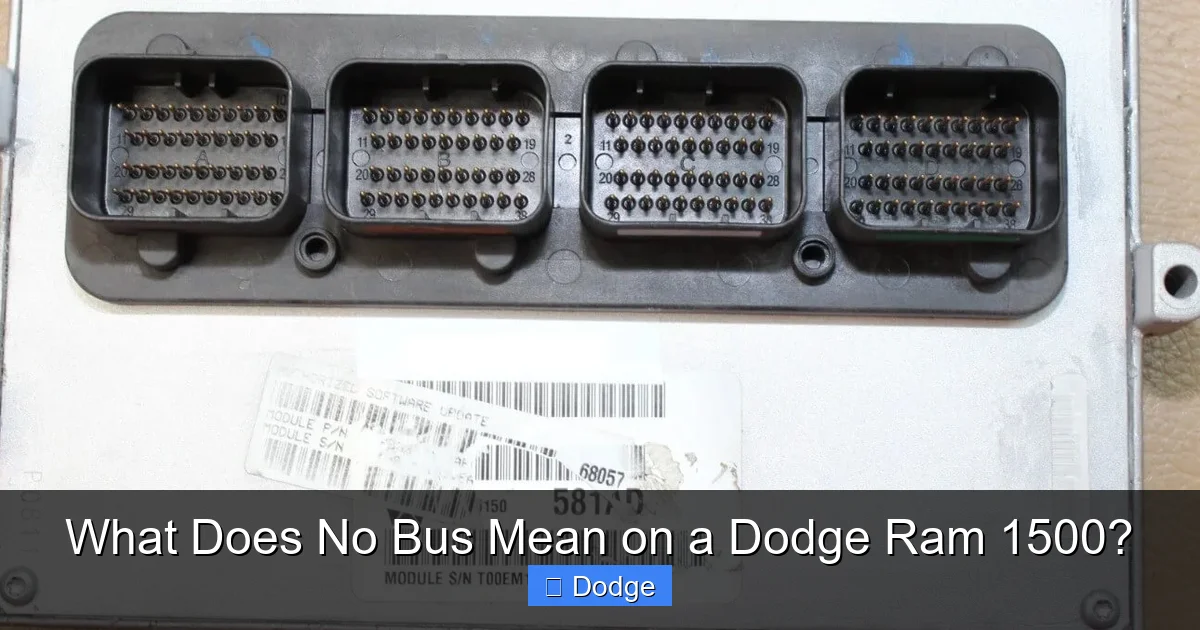
What Does No Bus Mean on a Dodge Ram 1500?

Contents
- 1 Key Takeaways
- 2 📑 Table of Contents
- 3 Understanding the “No Bus” Message on Your Dodge Ram 1500
- 4 What Is the CAN Bus and Why Does It Matter?
- 5 Common Causes of “No Bus” in Dodge Ram 1500
- 6 How to Diagnose a “No Bus” Error Step by Step
- 7 DIY Fixes and Preventative Maintenance Tips
- 8 When to Call a Professional
- 9 Conclusion
- 10 Frequently Asked Questions

Car Vacuum Cleaner (Portable)

Car Roof Rack Cross Bars

Waterless Car Wash Spray

Power Steering Fluid
If your Dodge Ram 1500 displays a “No Bus” message, it means the vehicle’s onboard computer can’t communicate with one or more electronic control modules. This issue often stems from wiring problems, blown fuses, or faulty sensors—but it’s usually fixable with basic diagnostics.
Key Takeaways
- “No Bus” indicates a communication failure between the Powertrain Control Module (PCM) and other vehicle systems via the CAN bus network.
- Common causes include damaged wiring, corroded connectors, or blown fuses—especially in older Ram 1500 models exposed to moisture or road salt.
- A dead or weak battery can trigger “No Bus”, as low voltage disrupts module communication even if the engine starts.
- Faulty PCMs or aftermarket accessories (like alarms or remote starters) may interfere with the data bus and cause the error.
- Diagnosing requires an OBD2 scanner that supports live data and module communication checks—not just basic code readers.
- Simple fixes like reseating connectors or replacing a fuse often resolve the issue without costly repairs.
- Ignoring “No Bus” can lead to drivability problems, warning lights, or even prevent the truck from starting.
📑 Table of Contents
Understanding the “No Bus” Message on Your Dodge Ram 1500
You’re cruising down the highway in your trusty Dodge Ram 1500 when suddenly, the dashboard lights up like a Christmas tree. The check engine light flashes, the radio cuts out, and a cryptic message appears: “No Bus.” Your first thought might be, “What in the world does that even mean?” Don’t panic—you’re not alone. Thousands of Ram owners have faced this same confusing alert, and while it sounds alarming, it’s often less serious than it appears.
At its core, “No Bus” is a communication error. Modern vehicles like the Dodge Ram 1500 rely on a complex network of computers called Electronic Control Modules (ECMs) or Control Units. These modules—responsible for everything from engine management to airbags—talk to each other over a digital highway known as the Controller Area Network (CAN) bus. When one or more of these modules can’t “hear” the others, the system throws a “No Bus” error. Think of it like a group chat where everyone suddenly goes silent—the main computer (usually the PCM, or Powertrain Control Module) doesn’t know what’s going on.
This issue isn’t unique to Dodge Rams, but it’s particularly common in 2009–2018 models due to their extensive use of CAN bus architecture and susceptibility to environmental wear. Whether you’re driving a lifted Ram through muddy trails or commuting daily in snowy climates, moisture, vibration, and aging wiring can all contribute to this frustrating message. The good news? In most cases, “No Bus” is a symptom—not a death sentence for your truck.
What Is the CAN Bus and Why Does It Matter?
Visual guide about What Does No Bus Mean on a Dodge Ram 1500?
Image source: psychoautos.com
To truly understand “No Bus,” you need to grasp what the CAN bus actually does. Imagine your Ram 1500 as a high-tech orchestra. Each instrument—the engine, transmission, ABS system, airbags, infotainment—plays its part, but they all need a conductor to stay in sync. That conductor is the CAN bus.
The Controller Area Network (CAN) is a robust vehicle communication standard developed in the 1980s and widely adopted by automakers in the 2000s. Instead of running separate wires from every sensor to the main computer (which would turn your truck into a spaghetti junction of cables), the CAN bus allows multiple modules to share a single pair of wires—called CAN High and CAN Low—to exchange data. This reduces weight, simplifies wiring, and enables advanced features like adaptive cruise control, blind-spot monitoring, and real-time diagnostics.
In your Dodge Ram 1500, the PCM acts as the central hub. It sends and receives signals from modules like the Transmission Control Module (TCM), Body Control Module (BCM), and Anti-lock Braking System (ABS). If any part of this network fails—whether due to a broken wire, corroded connector, or power issue—the PCM loses contact with one or more modules. When that happens, it can’t confirm the status of critical systems, so it displays “No Bus” as a safety precaution.
Why does this matter? Because without proper communication, your truck’s computer can’t make informed decisions. It might disable certain functions, trigger warning lights, or even prevent the engine from starting. For example, if the PCM can’t talk to the TCM, it may refuse to shift gears properly—or at all. That’s why addressing a “No Bus” error promptly isn’t just about clearing a message; it’s about restoring your vehicle’s intelligence and safety.
Common Causes of “No Bus” in Dodge Ram 1500
Visual guide about What Does No Bus Mean on a Dodge Ram 1500?
Image source: psychoautos.com
Now that you know what “No Bus” means, let’s dive into why it happens. While the error always points to a communication breakdown, the root cause can vary widely. Here are the most frequent culprits reported by Ram 1500 owners and mechanics alike.
1. Damaged or Corroded Wiring Harnesses
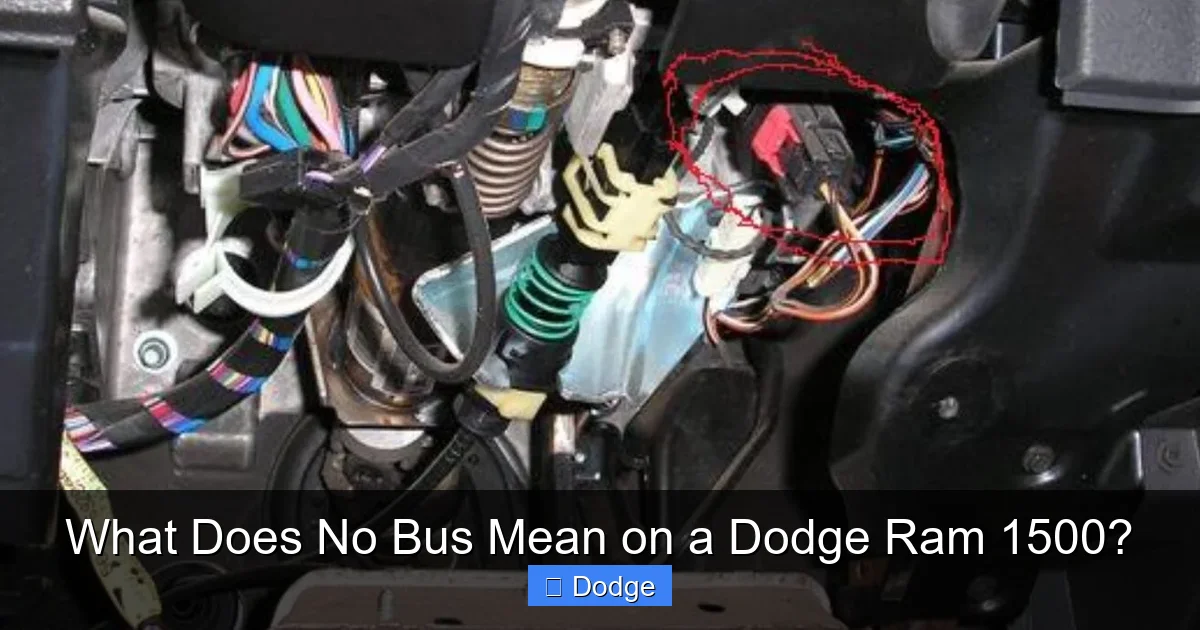
One of the top reasons for “No Bus” errors is physical damage to the wiring that carries CAN bus signals. In Dodge Rams—especially those built between 2009 and 2015—the main harness runs near the firewall, under the dash, and along the frame rails. Over time, exposure to road salt, moisture, and heat can degrade insulation, leading to frayed wires or short circuits.
A classic example: a Ram owner in Minnesota noticed “No Bus” appearing after heavy snowfall. Upon inspection, he found that salt corrosion had eaten through the CAN High wire near the driver’s side wheel well. The fix? Replacing a 12-inch section of harness and sealing it with dielectric grease. Simple, but easy to miss if you’re not looking.
2. Blown Fuses or Poor Ground Connections
Your Ram’s electronics run on a delicate balance of power and grounding. If a fuse blows—particularly one that powers the PCM, BCM, or instrument cluster—it can sever communication across the entire network. The most commonly affected fuses are in the Power Distribution Center (PDC) under the hood or the Interior Fuse Box behind the glove compartment.
Similarly, a bad ground connection can cause erratic behavior. Ground points on Dodge Rams are often located near the battery, under the dashboard, or on the engine block. Rust, loose bolts, or paint buildup can interrupt the return path for electrical current, leading to voltage drops that confuse the modules.
Pro tip: Always check fuse #11 (10A) in the interior fuse box and fuse #30 (20A) in the PDC—these are frequently linked to “No Bus” issues in Ram 1500s.
3. Weak or Dying Battery
It might sound unrelated, but a weak battery is a sneaky cause of “No Bus.” Modern vehicles require stable voltage (typically 12.6V or higher) for modules to communicate properly. If your battery is old, sulfated, or has a bad cell, voltage can dip below 11V—especially when accessories like headlights or the AC are running. This drop disrupts the CAN bus, causing modules to “drop off” the network.
We’ve seen cases where a Ram started fine but threw “No Bus” within minutes of driving. A load test revealed the battery couldn’t hold charge under demand. Replacing it solved the problem instantly.
4. Faulty PCM or Other Control Modules
While less common, a failing Powertrain Control Module can itself cause “No Bus” by refusing to transmit or receive signals. Symptoms include intermittent stalling, no-start conditions, or multiple warning lights. However, before blaming the PCM, rule out wiring and power issues first—replacing a PCM is expensive ($800–$1,500+), and often unnecessary.
Other modules, like the Body Control Module (BCM) or Instrument Cluster, can also fail and disrupt communication. For instance, a water-damaged BCM in a flood-prone area might short out and take the entire network down.
5. Aftermarket Electronics Interference
Adding accessories like remote starters, alarms, or performance tuners can backfire if installed incorrectly. These devices often tap into the CAN bus or power lines, introducing noise or drawing excessive current. A poorly wired remote start, for example, might create a voltage spike that resets modules or damages communication lines.
If your “No Bus” issue started after installing new gear, disconnect the accessory and see if the problem disappears. Many Ram owners have traced their woes to cheap Chinese-made alarms spliced into the OBD2 port.
How to Diagnose a “No Bus” Error Step by Step
Visual guide about What Does No Bus Mean on a Dodge Ram 1500?
Image source: psychoautos.com
Diagnosing “No Bus” isn’t as simple as pulling a trouble code—because often, there isn’t one. Instead, you need a methodical approach to isolate the fault. Here’s a practical guide any Ram owner can follow.
Step 1: Check the Battery and Charging System
Start with the basics. Use a multimeter to test battery voltage with the engine off (should be 12.4–12.7V) and with the engine running (13.7–14.7V). If voltage is low, charge the battery and retest. Also, inspect terminals for corrosion and ensure they’re tight.
If the battery checks out, move to the alternator. A failing alternator can cause voltage fluctuations that mimic “No Bus” symptoms.
Step 2: Scan for Communication Errors
Not all OBD2 scanners are created equal. Basic code readers can’t detect network issues—you need one that supports live data and module communication tests (like the BlueDriver, Autel MaxiCOM, or Snap-on scanners).
Plug in your scanner and look for:
– “No Communication” with specific modules (e.g., TCM, BCM)
– U-codes (U0xxx), which indicate network problems
– Missing modules in the vehicle configuration
If the scanner can’t communicate with any modules, the issue is likely power, ground, or a broken CAN wire.
Step 3: Inspect Fuses and Grounds
Locate your fuse boxes and check the following:
– Interior fuse box: Fuse #11 (10A, instrument cluster)
– PDC under hood: Fuse #30 (20A, PCM), Fuse #32 (10A, CAN bus)
Use a test light or multimeter to confirm power on both sides of each fuse. Replace any blown fuses—but if they blow again immediately, you have a short circuit.
Next, inspect ground points. Clean and tighten the main battery ground, engine ground strap, and chassis grounds under the dash. Apply dielectric grease to prevent future corrosion.
Step 4: Examine Wiring Harnesses
Focus on areas prone to damage:
– Near the firewall (where harnesses pass through)
– Along the frame rails (exposed to road debris)
– Under the driver’s side dash (subject to foot traffic and moisture)
Look for:
– Cracked or melted insulation
– Pinch points (e.g., where harnesses rub against metal)
– Corroded connectors (green or white powder)
Use a multimeter to test continuity between CAN High (typically orange/white wire) and CAN Low (orange/black wire). There should be no direct short (0 ohms) and resistance should be around 60 ohms when measured across the two wires with the ignition off.
Step 5: Test Individual Modules (If Needed)
If all else fails, you may need to isolate modules. Disconnect one module at a time (starting with non-critical ones like the radio or climate control) and see if communication returns. This helps identify a faulty module causing a network crash.
Warning: Only do this if you’re comfortable with electronics. Disconnecting the wrong module can trigger additional errors.
DIY Fixes and Preventative Maintenance Tips
The best part about “No Bus” issues? Many are fixable at home with basic tools. Here’s how to tackle common problems and keep your Ram running smoothly.
Reseat and Clean Connectors
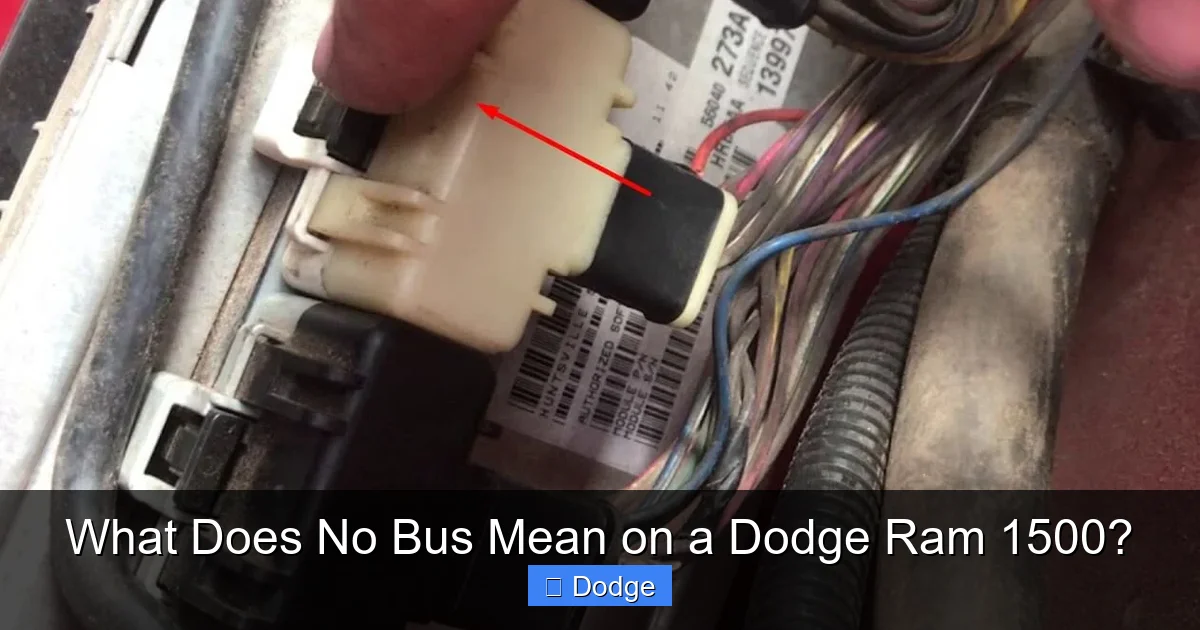
Over time, connectors can loosen or accumulate dirt. Simply unplugging and reseating the PCM, BCM, and instrument cluster connectors can restore contact. Before reinserting, spray them with electrical contact cleaner and apply a dab of dielectric grease to prevent moisture ingress.
Repair Damaged Wiring
If you find a broken wire, don’t just wrap it in tape. Use solder and heat shrink tubing for a permanent fix. For harnesses near the firewall, consider adding loom wrap or conduit for extra protection.
Upgrade to a Quality Battery
Invest in a high-quality AGM (Absorbent Glass Mat) battery, especially if you live in extreme climates. AGM batteries handle vibration better and maintain stable voltage—key for CAN bus reliability.
Avoid Cheap Aftermarket Parts
Stick to reputable brands for accessories. If you must install a remote start or alarm, have it done by a professional who understands CAN bus integration.
Regular Inspection Routine
Add a quick electrical check to your maintenance schedule:
– Every 6 months: Inspect battery terminals and main grounds
– Annually: Check fuse integrity and scan for pending codes
– After off-roading or deep water crossings: Examine harnesses for damage
When to Call a Professional
While many “No Bus” issues are DIY-friendly, some require expert help. Seek a qualified mechanic or dealership if:
– The problem persists after checking fuses, battery, and wiring
– You suspect PCM failure (requires advanced diagnostics)
– Multiple modules are unresponsive
– You’re uncomfortable working with high-voltage systems
Modern diagnostics often require factory-level scan tools and software updates—something most home garages don’t have.
Conclusion
Seeing “No Bus” on your Dodge Ram 1500 can be unsettling, but it’s rarely a sign of catastrophic failure. More often than not, it’s a communication hiccup caused by something simple—a loose connector, a blown fuse, or a weak battery. By understanding how the CAN bus works and following a systematic diagnostic approach, you can often resolve the issue yourself and save hundreds in repair bills.
Remember: “No Bus” is your truck’s way of saying, “I can’t talk to my team.” Once you restore that connection—whether by cleaning a ground, replacing a wire, or swapping a battery—your Ram will be back to its reliable, powerful self. Stay proactive with maintenance, avoid sketchy aftermarket mods, and don’t ignore early warning signs. Your Ram deserves to run smart, not silent.
Frequently Asked Questions
What does “No Bus” mean on a Dodge Ram 1500?
“No Bus” indicates that the vehicle’s main computer (PCM) cannot communicate with one or more electronic control modules over the CAN bus network. This communication failure triggers warning lights and may affect drivability.
Can a bad battery cause “No Bus” on a Ram 1500?
Yes. A weak or dying battery can cause voltage drops that disrupt module communication, leading to a “No Bus” error—even if the truck starts normally.
Is “No Bus” the same as a check engine light?
No. While both indicate problems, “No Bus” specifically refers to a network communication failure, whereas the check engine light usually points to engine or emissions issues.
Can I drive my Ram 1500 with a “No Bus” message?
It’s not recommended. Driving with “No Bus” can lead to unpredictable behavior, loss of critical functions, or a no-start condition. Address the issue promptly.
How much does it cost to fix a “No Bus” error?
Costs vary widely. Simple fixes like replacing a fuse or cleaning connectors cost under $20. Complex issues like PCM replacement can exceed $1,000.
Will disconnecting the battery reset “No Bus”?
Sometimes—but only temporarily. A battery reset may clear the error if it was caused by a glitch, but it won’t fix underlying wiring, fuse, or module problems.


