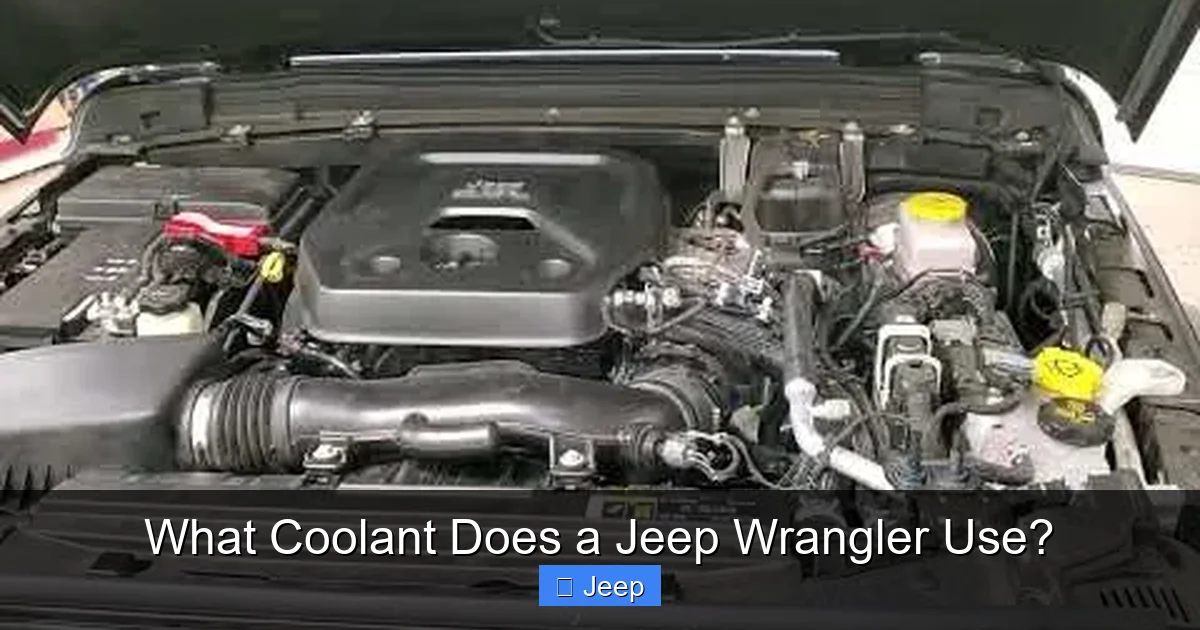
What Coolant Does a Jeep Wrangler Use?

Contents
- 1 Key Takeaways
- 2 📑 Table of Contents
- 3 Why Your Jeep Wrangler’s Coolant Isn’t Something to Guess At
- 4 Coolant 101: More Than Just “Antifreeze”
- 5 The Specific Answer: What Coolant Does YOUR Jeep Wrangler Use?
- 6 How to Identify, Check, and Top Up Your Coolant
- 7 The Critical Don’ts: Mistakes That Cost Thousands
- 8 Off-Road and Extreme Duty Considerations
- 9 Conclusion: Your Simple, Bulletproof Checklist
- 10 Frequently Asked Questions

Car Floor Mats (Universal)

LED Emergency Road Flares

Rear View Camera

Phone Mount for Bike
Using the correct coolant in your Jeep Wrangler is non-negotiable for engine health. Most modern Wranglers (JL/JT and later JK) require a specific OAT (Organic Acid Technology) coolant, typically orange or pink. Older models (TJ) and some diesel engines may use different specifications. Never guess based on color alone—always consult your owner’s manual for the exact specification (like Mopar® OAT Coolant) to prevent corrosion, overheating, and catastrophic engine failure.
Key Takeaways
- Modern Wranglers (JL/JT, late JK) primarily use OAT coolant: Look for the specification “Mopar® OAT Coolant” or a meeting the Chrysler MS-90032 standard, typically orange or pink.
- Older Wranglers (TJ, early JK) often used HOAT coolant: These were typically green or yellow and met the Chrysler MS-7177 standard. Knowing your model year is critical.
- The diesel engine (EcoDiesel) has its own requirement: It uses a specific G12++ or G13 equivalent coolant, often purple, and is not interchangeable with gasoline engine coolant.
- Color is an unreliable indicator: Coolant color is a dye added by manufacturers and can vary. A “green” coolant from one brand may be chemically different from another. Always use the specification, not the color.
- Mixing coolants is a recipe for disaster: Combining OAT and HOAT, or using a universal coolant, can create a gel-like substance that clogs coolant passages, leading to overheating and engine damage.
- Your owner’s manual is the ultimate authority: It lists the exact coolant type, capacity, and service interval for your specific Wrangler’s VIN, model year, and engine.
- Check and top up with distilled water only: If you must add a small amount in an emergency, use distilled water, not tap water, to prevent mineral deposits. Plan a proper flush with the correct coolant ASAP.
📑 Table of Contents
- Why Your Jeep Wrangler’s Coolant Isn’t Something to Guess At
- Coolant 101: More Than Just “Antifreeze”
- The Specific Answer: What Coolant Does YOUR Jeep Wrangler Use?
- How to Identify, Check, and Top Up Your Coolant
- The Critical Don’ts: Mistakes That Cost Thousands
- Off-Road and Extreme Duty Considerations
- Conclusion: Your Simple, Bulletproof Checklist
Why Your Jeep Wrangler’s Coolant Isn’t Something to Guess At
Imagine your Jeep Wrangler’s engine as a high-performance athlete. It generates an incredible amount of heat just doing its job—pushing that iconic boxy shape down the highway or conquering a rocky trail. Left unchecked, that heat would quickly turn metal into a molten, seized mess. This is where coolant, also called antifreeze, becomes your engine’s lifeline. It’s not just a liquid that stops freezing; it’s a complex chemical cocktail that fights corrosion, lubricates seals, and transfers heat with precision.
For a Wrangler owner, this is doubly important. The very nature of Wrangler ownership—off-roading, towing, idling on trails—puts extra thermal stress on the powerplant. Using the wrong coolant is like feeding your athlete a diet of junk food. It might work for a while, but eventually, systems break down. The consequences range from a pesky coolant leak to a complete engine meltdown, a repair that can easily exceed the value of the vehicle. Getting this right is one of the simplest, most cost-effective forms of preventive maintenance you can perform. This guide will cut through the confusion of colors and brands, giving you the definitive answer for your specific Jeep Wrangler.
Coolant 101: More Than Just “Antifreeze”
What Coolant Actually Does
Let’s break down the three core jobs of coolant. First, and most obviously, it lowers the freezing point and raises the boiling point of the water in your cooling system. This prevents the liquid from turning to ice in a frigid winter night or from violently boiling over during a desert summer crawl. Second, and critically, it contains corrosion inhibitors. These are special additives that form a protective chemical film on the delicate metal surfaces inside your engine—the aluminum cylinder heads, the iron block, the steel water pump, and the copper or brass in the heater core. Without these inhibitors, electrolysis and rust would eat through these components from the inside out. Third, modern coolants have additives that prevent cavitation (tiny vapor bubbles that can erode metal) and provide mild lubrication for water pump seals.
Visual guide about What Coolant Does a Jeep Wrangler Use?
Image source: jeepmodified.com
The Chemistry Breakdown: IAT, OAT, and HOAT
All coolants are a mix of water and a base chemical, usually ethylene glycol or, less commonly, propylene glycol (the “safer” but less efficient version). The magic, and the confusion, lies in the “technology” of the corrosion inhibitors. Think of them as different brands of protective wax for your car, each formulated for specific metal types and service intervals.
- IAT (Inorganic Acid Technology): The classic “green” coolant. It uses silicates and phosphates as inhibitors. It’s cheap and effective but needs to be changed frequently, typically every 2 years or 30,000 miles, as the inhibitors deplete quickly. It’s largely obsolete for modern vehicles.
- OAT (Organic Acid Technology): The modern standard for most cars since the late 1990s. It uses organic acids (like sebacate and benzoate) and typically contains no silicates or phosphates. It’s often orange, red, pink, or turquoise. The big advantage is longevity—service intervals are often 5 years or 150,000 miles. It’s excellent for aluminum components.
- HOAT (Hybrid Organic Acid Technology): As the name implies, it’s a hybrid. It combines the organic acids of OAT with a small amount of silicates (from IAT) for extra aluminum protection. It’s often yellow, gold, or turquoise. Service life is similar to OAT. Many European and some American manufacturers, including Chrysler for a period, used HOAT.
You might also see PHT (Phosphate Hybrid Technology), which is essentially HOAT with a specific phosphate blend, common in some Asian vehicles. Then there are the extended-life, “G12” series coolants (G12, G12+, G12++, G13) from the Volkswagen Group, which are specific OAT variants. The key takeaway: the chemical technology matters infinitely more than the color.
The Specific Answer: What Coolant Does YOUR Jeep Wrangler Use?
Here is the crucial part. Jeep Wrangler coolant specifications have changed over the years and differ by engine. The golden rule is to check your owner’s manual or the label on your coolant reservoir. However, we can break it down by major generation and engine type. Chrysler (Stellantis) has used two primary coolant specifications across the Wrangler line: the older MS-7177 (HOAT) and the current MS-90032 (OAT).

Visual guide about What Coolant Does a Jeep Wrangler Use?
Image source: adventurejeep.com
TJ and Early JK Generations (1997-2018)
The beloved TJ Wrangler (1997-2006) and the early JK Wranglers (2007-2012, and some up to 2018) predominantly used a HOAT coolant meeting the Chrysler MS-7177 specification. This coolant was typically yellow or gold in color when new. It was often sold under the Mopar® brand as “Antifreeze/Coolant, 5 Year/100,000 Mile Formula.” If you have a TJ or an early JK with the 3.6L Pentastar V6 (introduced in 2012) or the older 4.0L inline-six, there is a very high probability it uses this MS-7177 HOAT coolant. However, the switch to the newer OAT standard began during the JK run.
Late JK, JL, and JT Generations (2013-Present)
Starting around the 2013-2014 model year for the JK and continuing with the current JL (2018+) and JT Gladiator (2020+), Chrysler transitioned to a long-life OAT coolant meeting the MS-90032 specification. This is the coolant you’ll most commonly find in a modern Wrangler. It is typically orange or pink (Mopar® calls it “Orange Antifreeze/Coolant”). This is the coolant used in the standard 3.6L Pentastar V6 and the 2.0L turbocharged 4xe hybrid engine. The service interval for this OAT coolant is typically 10 years or 150,000 miles, whichever comes first. This is the most common answer for a 2015+ Wrangler.
The Diesel Exception: The EcoDiesel (2014-2018 JK, 2020+ JT)
The 3.0L EcoDiesel V6 engine found in some JK Wranglers and the new JT Gladiator has its own, unique coolant requirement. It requires a G12++ or G13 equivalent coolant, which is a very specific, extended-life OAT formulation often colored purple or violet. This specification (often referenced as Pentosin® G12++ or equivalent) is critical. Using the standard OAT (MS-90032) or HOAT (MS-7177) coolant in the EcoDiesel can lead to severe water pump failure and other issues. The owner’s manual for a diesel Wrangler will explicitly state this requirement. This is a perfect example of why you cannot rely on color or assume all Wranglers use the same fluid.
How to Identify, Check, and Top Up Your Coolant
Step 1: Find Your Specification
The absolute best method is to open your owner’s manual. Look in the “Fluids and Lubricants” or “Capacities and Specifications” section. It will list “Engine Coolant” with a part number or specification (e.g., “Mopar® Antifreeze/Coolant, MS-90032” or “G12++”). If you don’t have the manual, check the coolant reservoir cap. It often has the specification printed on it. You can also look at a service sticker under the hood from a previous dealer service. When in doubt, take a photo of your current coolant (in the reservoir) and the cap to a trusted Jeep dealer or parts store for identification.

Visual guide about What Coolant Does a Jeep Wrangler Use?
Image source: towingcap.com
Step 2: Visual Check of Level and Condition
Your Wrangler has a translucent coolant recovery tank (usually on the driver’s side near the radiator). It has “FULL” and “LOW” marks. Only check the level when the engine is completely cold. Never open a hot cooling system; the pressurized boiling liquid can cause severe burns. The coolant should be a vibrant, clear color (orange, pink, yellow, or purple, depending on spec). If it looks rusty, brown, muddy, or has debris floating in it, it’s time for a flush. If the level is consistently low, you have a leak that needs diagnosing—do not just keep topping it up.
Step 3: Topping Up Correctly
If you need to add a small amount, you have two safe options, in order of preference:
- The Perfect Mix: Use the exact pre-mixed coolant that matches your specification (e.g., “Mopar® Orange 50/50 Pre-Mix”). This is 50% coolant and 50% distilled water, ready to pour.
- The DIY Mix: If you have concentrated coolant, mix it 50/50 with distilled water only. Never use tap water; its minerals cause scale and deposits. Use a clean container and measure carefully.
Slowly pour the mix into the reservoir until it reaches the “FULL” (cold) line. Replace the cap securely. If you find yourself adding coolant regularly (more than a quart every few months), a pressure test for leaks is necessary. For context on other fluids, understanding what type of gas does a Toyota Corolla use is just as specific for that vehicle.
The Critical Don’ts: Mistakes That Cost Thousands
DON’T: Mix Coolants or Rely on “Universal” Coolant
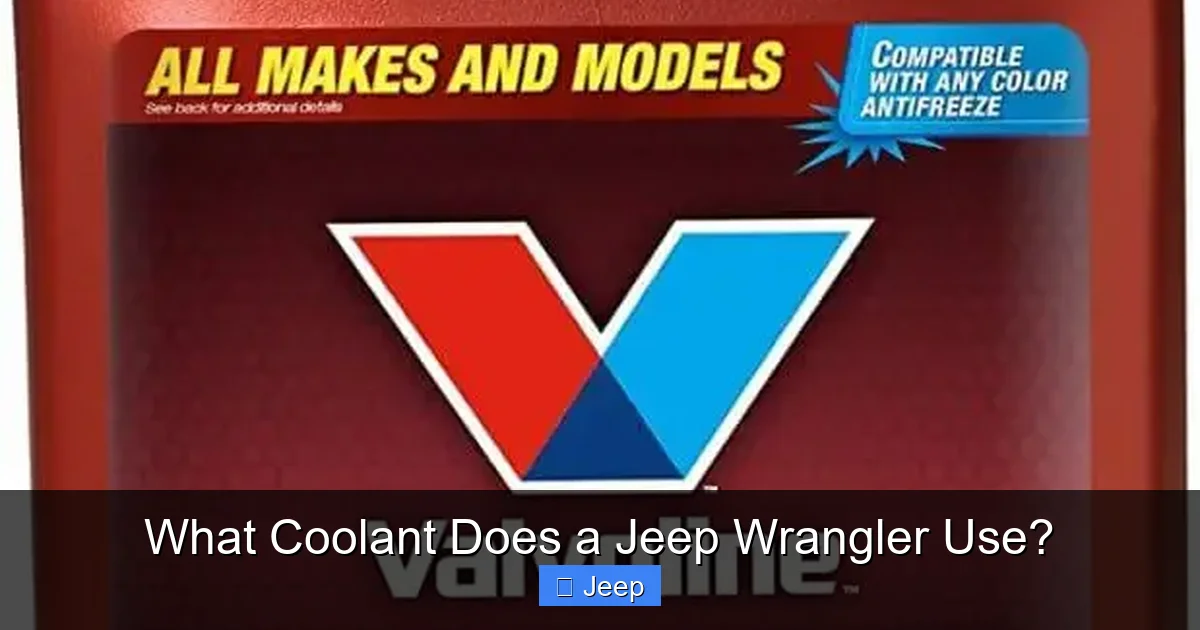
This is the most common and dangerous error. Mixing an OAT (orange) with a HOAT (yellow) or an IAT (green) can cause the additives to react and form a gel or precipitate. This gel can clog the tiny passages in the radiator, heater core, and even inside the engine block, creating a catastrophic blockage. “Universal” or “All Makes” coolants are a gamble. They are usually a very basic IAT formulation and are not designed for the long service intervals or specific metal alloys (like the aluminum in your Pentastar engine) of modern Jeeps. They will deplete quickly and offer poor protection. Always use the exact specification.
DON’T: Use Straight Water (Except in Extreme Emergency)
In a pinch, if you are overheating and have no coolant, adding water can get you to a safe location. But it is a temporary measure only. Water has no corrosion inhibitors, no lubricants for the water pump, and will freeze in cold weather, expanding and cracking the engine block or radiator. It also promotes rust and mineral buildup. If you add water, you must completely flush the system and refill with the correct 50/50 mix as soon as possible.
DON’T: Skip the Flush When Due
Coolant doesn’t just get dirty; its chemical inhibitors are consumed over time. A “coolant flush” isn’t just about draining old fluid; it’s about completely removing all the depleted, acidic, and particulate-laden old coolant from the system, including the engine block and heater core. Running expired coolant leaves your engine’s metal surfaces unprotected and vulnerable to corrosion and cavitation. Follow the interval in your manual—for MS-90032 OAT, it’s often 10 years/150k miles, but for the older MS-7177 HOAT, it was 5 years/100k miles. Never exceed the interval.
Off-Road and Extreme Duty Considerations
As a Wrangler owner, you might push your vehicle harder than the average commuter. Towing a trailer up a long grade in summer, crawling through sand dunes all day, or running a heavy aftermarket bumper and winch increases engine load and heat. In these scenarios, the quality of your coolant becomes even more vital.
While you must always stick to the correct chemical specification, consider using a high-quality, name-brand coolant (like Mopar® or a reputable equivalent like Zerex G05 for HOAT or Zerex G12++ for diesels). These brands have rigorous quality control. Some enthusiasts also use coolant additives that claim to enhance heat transfer or provide extra protection, but these should only be used after thorough research and never as a substitute for the correct, full-strength coolant. Your cooling system’s capacity is fixed; diluting it with an additive reduces the concentration of the vital corrosion inhibitors. For true extreme duty, some modify their cooling systems with larger radiators or auxiliary fans, but the coolant itself remains the same specified fluid.
Conclusion: Your Simple, Bulletproof Checklist
So, what coolant does a Jeep Wrangler use? The answer is: It depends entirely on your model year and engine. For the vast majority of gasoline-powered Wranglers from 2013 onward, it’s a 50/50 pre-mix of OAT coolant meeting Chrysler MS-90032 (orange/pink). For older TJ and early JK models (pre-2013), it’s likely HOAT coolant meeting MS-7177 (yellow/gold). For any Wrangler with the 3.0L EcoDiesel engine, it’s the specific G12++ equivalent (purple). Your single source of truth is the owner’s manual. Never, ever guess based on color. The cost of a few gallons of the correct coolant is insignificant compared to the thousands a cooling system failure will cost. Check your level twice a year, flush the system on schedule, and your Wrangler’s engine will keep its cool, on the road and off it, for years to come.
Frequently Asked Questions
Can I use a universal coolant in my Jeep Wrangler?
No. Universal coolants are typically a basic IAT formulation that does not meet the extended-life OAT or HOAT specifications required by your Wrangler. Using one will lead to premature corrosion and potential damage. Always use the exact specification (MS-90032, MS-7177, or G12++) listed in your owner’s manual.
My coolant is green/yellow/orange—does that tell me what it is?
Color is not a reliable indicator. While Chrysler’s OAT is often orange and HOAT yellow, other brands use these colors for different formulations. A green coolant could be an old IAT or a different manufacturer’s HOAT. The only way to know for sure is to check your owner’s manual for the specification (MS number) or the part number on your original coolant bottle/cap.
What happens if I accidentally mix two different coolants?
Mixing incompatible coolants (like OAT and HOAT) can cause a chemical reaction that creates a gel or sludge. This can quickly clog the narrow passages in your radiator, heater core, and engine, causing overheating and severe damage. If a significant mix occurs, the system should be completely flushed immediately.
Can I add straight water to my Wrangler’s coolant in an emergency?
Only as a temporary measure to get to a safe location for a proper repair. Straight water offers zero corrosion protection, will freeze in cold weather (cracking components), and contains minerals that cause deposits. After using water, the entire cooling system must be flushed and refilled with the correct 50/50 coolant mix as soon as possible.
How often should I change the coolant in my Jeep Wrangler?
The interval depends on the coolant type. For the current MS-90032 OAT coolant, it’s typically every 10 years or 150,000 miles. For the older MS-7177 HOAT coolant, it was every 5 years or 100,000 miles. For the EcoDiesel’s G12++ coolant, follow the manual, usually 5 years/100k miles. Never exceed these intervals, as the corrosion inhibitors deplete over time.
My coolant level is low but I don’t see a leak—what’s wrong?
A slow, invisible leak is the most likely cause. Common spots include the water pump seal (which may drip from a weep hole behind the pulley), the thermostat housing gasket, or a tiny crack in the plastic radiator tank. A pressure test by a mechanic is needed to find the leak. A less common but serious possibility is a blown head gasket, where combustion pressure forces coolant into the cylinders or oil system, often accompanied by white exhaust smoke or milky oil.