
Truck Cover Problems: Common Causes, Fixes, and Prevention

Quick Answer
Most truck cover problems come from worn weather seals, loose clamps, incorrect rail alignment, poor fabric tension, dirty tracks, damaged latches, or a cover that does not match the truck bed correctly. Before replacing the entire cover, inspect its mounting points, seals, hinges, drains, and alignment. If you’re still choosing a cover, understanding the differences between pickup truck tonneau cover styles can also help you avoid recurring fitment problems.
Common truck cover problems
- Water leaks: Check compressed seals, front bulkhead gaps, tailgate gaps, rail alignment, and drain tubes.
- Cover rattling: Look for loose clamps, latches, rails, hinges, or unsecured folded panels.
- Soft cover sagging: Inspect tension adjusters, support bows, fabric condition, and mounting position.
- Latch problems: Clean the mechanism and check whether the rails or cover have shifted out of alignment.
- Sticking operation: Clean retractable tracks and inspect folding hinges, rollers, and moving hardware.
- Poor fit: Confirm the exact truck year, model, bed length, rail system, liner, and cover application.
Before driving
- Never drive with a tonneau cover, panel, latch, or cargo that cannot be securely fastened.
Truck cover problems can turn a useful pickup accessory into a daily frustration. I’ve seen seemingly serious leaks and rattles come down to something as small as one shifted clamp or a flattened piece of weather seal.
This guide covers the problems I’d check first on soft, folding, hard, and retractable tonneau covers. It also explains when a repair makes sense and when replacement is the smarter choice.
In This Guide
- What Causes Most Truck Cover Problems?
- Why Is My Truck Cover Leaking?
- Why Is My Truck Cover Rattling, Flapping, or Sagging?
- Why Won’t My Truck Cover Close, Latch, or Open?
- Which Problems Affect Different Truck Cover Types?
- Should You Repair or Replace a Problem Truck Cover?
- How Can You Prevent Truck Cover Problems?
- Truck Cover Problems FAQ
What Causes Most Truck Cover Problems?
Most truck cover problems are caused by installation, alignment, wear, contamination, or incorrect fitment. The cover itself may still be usable even when it leaks, rattles, or refuses to latch.
A tonneau cover is a flexible or rigid cover mounted across a pickup truck’s cargo bed. Depending on its design, it may roll, fold, retract, lift, or remain as a single hinged panel.
Loose mounting hardware
Clamps and rail hardware can move as the truck experiences vibration, temperature changes, rough roads, and repeated opening and closing. Even small movement can affect how the cover seals.
Check the mounting hardware before adjusting anything else.
- Inspect every clamp: Make sure none have shifted along the bed rail.
- Check rail position: Both rails should remain straight and parallel.
- Look for uneven gaps: One raised corner often points to mounting movement.
- Follow manufacturer torque instructions: More tightening is not always better.
Incorrect installation or alignment
A cover can look properly installed while still sitting slightly crooked. That small error can create trouble at the tailgate, side seals, or latch points.
This is especially common after removing and reinstalling a tonneau cover.
If you’re working with an existing rail system, review how tonneau covers work with truck bed rails before changing brackets or mounting points.
Weather-seal deterioration
Foam and rubber seals flatten as they age. Heat, sunlight, dirt, repeated compression, and cold weather can also make some materials less flexible.
Look for these warning signs:
- cracked rubber
- flattened foam
- sections pulling away from the cover
- missing corner seals
- visible daylight around a closed cover
Wrong cover fitment
A truck cover needs to match more than the manufacturer’s badge on the tailgate. Bed length, model year, factory rails, liners, toolboxes, and other accessories can change fitment.
For example, two versions of the same pickup may use different bed dimensions or mounting arrangements.
Section Takeaway: Most truck cover failures should be diagnosed from the mounting system outward. Check fitment, clamps, rail alignment, seals, and moving hardware before assuming the complete cover has failed.
Why Is My Truck Cover Leaking?
A leaking truck cover usually has a seal, alignment, drainage, or bed-gap problem. Most tonneau covers should be treated as weather-resistant rather than completely watertight.
The location of the water often gives you the best clue.
| Where You Find Water | Likely Cause | What to Check First |
|---|---|---|
| Front of bed | Bulkhead gap or front seal | Front weather strip and corner gaps |
| One side | Misaligned rail or damaged side seal | Rail height and clamp position |
| Tailgate area | Tailgate gap or rear seal | Rear corners and seal compression |
| Under retractable canister | Blocked or disconnected drain | Drain tubes and outlets |
| Between folding panels | Hinge or panel seal wear | Hinge seals and panel alignment |
How to find a tonneau cover leak
Don’t replace every seal at once. Locate the actual water path first.
- Dry the truck bed. Remove existing water so new leaks are easy to identify.
- Close and latch the cover. Set it exactly as you would before driving.
- Use a gentle hose flow. Start low and work across one section at a time.
- Watch from inside or underneath. A helper makes the process easier.
- Mark the first entry point. Water can travel along rails before dripping elsewhere.
Check the front bulkhead
The front wall of the truck bed can sit at a different height from the side rails. That creates a potential opening beneath the cover’s front edge.
A missing or compressed bulkhead seal can let rain enter near the cab.
Inspect drainage systems
Retractable covers and some rail-based systems intentionally channel water toward drains. A blocked drain can make that water overflow into the bed.
- Remove leaves and dirt from drain channels.
- Check drain tubes for kinks.
- Confirm tubes remain attached.
- Make sure the outlet is not blocked.
Don’t chase absolute waterproofing
A pickup bed has seams, stake pockets, tailgate gaps, and other openings beyond the tonneau cover. A few drops during severe weather don’t automatically mean the cover has failed.
Persistent streams or soaking cargo deserve attention.
Section Takeaway: Find exactly where water enters before adding weather stripping. Randomly stacking extra seals can make the cover sit too high and create new leaks.
Why Is My Truck Cover Rattling, Flapping, or Sagging?
Rattling usually points to movement between parts, while flapping or sagging is more common with soft covers that have lost proper tension. Neither problem should be ignored if the cover cannot stay securely fastened.
Truck cover rattles while driving
Start with the mounting points rather than the cover surface. A slightly loose rail or clamp can become surprisingly noisy at road speed.
- Clamps: Check for movement against the bed rails.
- Latches: Confirm they fully engage without excessive play.
- Folding panels: Make sure open panels are properly strapped down.
- Hinges: Look for wear or loose fasteners.
- Accessories: Check rails, racks, toolboxes, and cargo nearby.
If you use a folding design, this guide to truck folding tonneau covers explains how their panels and mounting systems differ from roll-up covers.
Soft tonneau cover flaps
A properly installed soft cover should remain reasonably taut. Severe flapping can mean the tension is too loose or the side fastening system is not holding correctly.
Inspect the adjustment mechanism before pulling harder on the material.
- Check the front mounting position.
- Inspect tension adjusters.
- Verify side hook-and-loop strips engage fully.
- Check snaps, if equipped.
- Inspect support bows.
- Look for stretched or damaged fabric.
Owners considering this style can compare the normal construction and maintenance needs of soft tonneau covers for pickup trucks.
Why does a soft truck cover sag?
Some movement is normal on flexible material. A deep pocket that collects rainwater is different.
Sagging can develop when:
- support bows are missing or damaged
- fabric tension is too loose
- the frame has shifted
- vinyl or fabric has stretched with age
- water or snow has overloaded the surface
Don’t place heavy cargo on a soft tonneau unless its manufacturer specifically rates the cover for that load.
Section Takeaway: Noise and sagging are often adjustment problems, but a cover that cannot remain securely attached is a safety issue. Secure it correctly before returning to normal driving.
Why Won’t My Truck Cover Close, Latch, or Open?
A tonneau cover that will not latch usually has alignment, tension, dirt, hardware, or fitment problems. Forcing the latch can damage the mechanism and hide the real cause.
Cover won’t latch at the tailgate
Check whether the cover reaches the latch evenly on both sides. Uneven engagement suggests the cover or rail system has shifted.
- Open the cover and inspect both side rails.
- Check whether rail spacing remains even.
- Inspect latch hooks and brackets.
- Remove dirt from the mechanism.
- Check soft-cover tension.
- Close the cover without forcing it.
If one latch reaches while the other misses, don’t immediately adjust only that latch. Verify that the entire cover remains square on the bed.
Cover suddenly becomes hard to close
Temperature can change flexible-cover tension. Vinyl can feel considerably tighter in cold weather than it does on a warm afternoon.
Dirt, ice, swollen seals, or a shifted rail can also increase closing effort.
Retractable tonneau cover gets stuck
Retractable systems depend on clean, parallel tracks. Dirt or small debris can create resistance and make the cover feel jammed.
- Inspect both tracks.
- Remove loose debris carefully.
- Check the cover for sideways movement.
- Inspect rollers or guides where accessible.
- Check the canister area.
- Use only manufacturer-approved lubrication.
Don’t flood an unknown track mechanism with grease. Some lubricants attract dirt and can make the problem worse.
Broken release cable or latch
A broken latch assembly usually needs replacement rather than improvised repair. The release system is responsible for keeping the cover secured.
Mechanic Alert: If a broken mounting bracket, damaged truck bed rail, drilled attachment, or structural part needs repair, have a qualified technician or accessory installer inspect it instead of improvising a roadside fix.
Which Problems Affect Different Truck Cover Types?
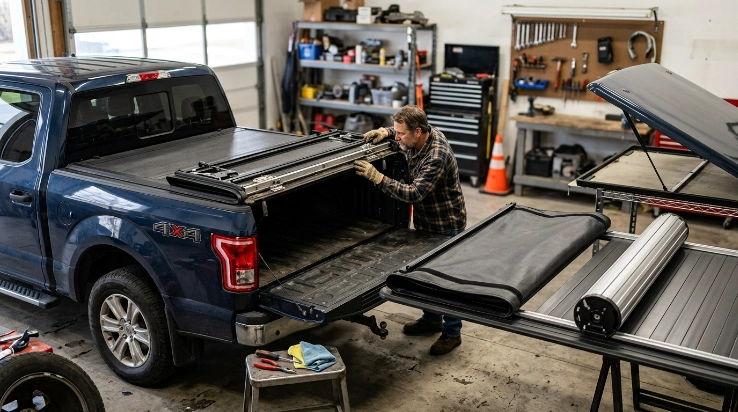
Different tonneau designs fail in different ways. Knowing the cover type helps you inspect the right parts first.
| Cover Type | Common Problems | First Inspection |
|---|---|---|
| Soft roll-up | Flapping, sagging, edge leaks | Tension, side fasteners, seals |
| Soft folding | Corner leaks, clamp movement, frame shift | Clamps and frame alignment |
| Hard folding | Hinge leaks, rattles, latch alignment | Hinges, rails, latches |
| Retractable | Sticking, drainage problems, track binding | Tracks, drains, canister |
| One-piece hinged | Latch, hinge, strut, perimeter-seal problems | Mounting alignment and hardware |
Soft covers
Soft designs rely more heavily on fabric tension. They can be convenient and lightweight, but loose tension becomes obvious quickly.
Vinyl condition also matters. Cracking, shrinking, torn edges, or failing side fasteners can eventually justify replacing the cover material.
Hard folding covers
Hard folding covers depend on multiple panels staying aligned. Their hinge areas, seals, rail systems, and latches deserve extra attention.
A panel that suddenly sits higher than the others may indicate a shifted rail or damaged hinge rather than a bad seal.
Retractable covers
Retractable covers have more moving components than simple roll-up designs. Tracks, guides, canisters, locks, and drains can all need maintenance.
Bed space also matters because the canister usually occupies some room near the cab.
Fitment matters on every design
I’ve found fitment checks especially useful when a cover has never worked correctly since installation. A problem present from day one deserves a different diagnosis than one that appears after several years.
Confirm the truck’s exact bed configuration before modifying hardware.
Section Takeaway: Match the diagnosis to the cover design. A sagging soft cover and a binding retractable cover may look equally frustrating, but their likely causes are completely different.
Should You Repair or Replace a Problem Truck Cover?
Repair the cover when the problem involves adjustment, replaceable seals, ordinary hardware, drains, or serviceable latches. Consider replacement when major structural components or the cover material have deteriorated beyond reliable repair.
Problems usually worth repairing
- loose mounting clamps
- minor rail misalignment
- worn weather stripping
- blocked drains
- replaceable latch components
- incorrect soft-cover tension
- minor hardware corrosion
Problems that may justify replacement
- Major vinyl deterioration: Multiple cracks or large tears can make patching temporary.
- Warped structural panels: A hard panel that no longer sits correctly may never seal properly.
- Damaged frame: Bent structural pieces can affect both operation and attachment.
- Repeated latch failure: Worn mounting points can prevent reliable engagement.
- Wrong application: A cover made for another bed configuration is rarely worth modifying.
- Unavailable parts: An older discontinued design may be impractical to maintain.
Don’t use appearance alone to decide
A faded cover can still function well. Meanwhile, a clean-looking cover with damaged attachment hardware may be unsafe to use.
Function comes first.
Pay special attention to anything responsible for keeping the cover attached during driving. The National Highway Traffic Safety Administration’s cargo guidance stresses that loads must be secured so objects cannot separate from the vehicle.
Section Takeaway: Cosmetic wear doesn’t automatically require replacement. Structural damage, unreliable attachment, severe material failure, or incorrect fitment matter much more.
How Can You Prevent Truck Cover Problems?
Regular inspection prevents many truck cover problems from becoming expensive failures. You don’t need specialized equipment for the basic checks.
Clean the rails and seals
Dirt can keep seals from compressing evenly. Grit trapped under mounting points can also contribute to scratches.
Use mild cleaning products compatible with your cover’s material.
Inspect clamps periodically
Check mounting hardware after installation and periodically afterward. A rough trip or repeated removal can change alignment.
Follow the manufacturer’s instructions rather than tightening every fastener as hard as possible.
Keep moving parts clean
Folding hinges, retractable tracks, and latch mechanisms work better when dirt hasn’t accumulated around them.
Only apply lubricants recommended for the specific system.
Watch the weather seals
Replace damaged weather stripping before large gaps develop. Correct seal positioning is usually more effective than piling new material over an existing problem.
Secure the cover before every trip
This matters most after hauling oversized cargo. Drivers sometimes fold or roll a cover out of the way and forget to secure the stored section.
- Latch closed covers completely.
- Use retaining straps on folded sections when supplied.
- Secure rolled covers with their designated straps.
- Don’t drive with a loose panel.
- Check cargo independently of the tonneau cover.
NHTSA advises drivers to tie cargo down, double-check the load, and consider how it would behave during sudden braking or a bump. A tonneau cover should never replace proper cargo restraint.
Inspect after removing and reinstalling the cover
Don’t assume the old mounting marks automatically guarantee correct alignment. Position the cover carefully and test every function again.
Open it, close it, latch it, check its clearances, and perform a water test when needed.
Section Takeaway: Clean components, correct alignment, healthy seals, secure hardware, and routine inspections prevent most recurring tonneau cover problems.
Truck Cover Problems FAQ
Why does my tonneau cover leak when it rains?
Common causes include compressed weather seals, front bulkhead gaps, tailgate gaps, misaligned rails, damaged hinge seals, or blocked drainage tubes. Locate the exact entry point with a controlled hose test before replacing seals or adjusting the cover.
Is a truck bed cover supposed to be completely waterproof?
Most tonneau covers are better described as water-resistant rather than completely waterproof. Pickup beds have tailgate gaps, seams, corners, and other openings that can allow some moisture inside during heavy rain or pressure washing.
Why does my tonneau cover flap on the highway?
A soft tonneau can flap when fabric tension is too loose, side fasteners aren’t fully engaged, support bows are damaged, or the mounting system has shifted. Stop and inspect the attachment system if the cover looks capable of coming loose.
Why won’t my tonneau cover latch?
Check the rail alignment, latch position, cover tension, mounting clamps, and dirt around the latch. If only one side engages, verify that the entire cover remains square before adjusting the individual latch.
Can I replace only the tonneau cover seals?
Often, yes. Many weather strips and seals can be replaced separately when the cover itself remains structurally sound. Use material compatible with the cover and avoid adding excessive seal thickness that prevents the cover from sitting correctly.
Why is my retractable tonneau cover hard to open?
Dirt in the tracks, poor rail alignment, damaged guides, canister problems, or incorrect lubrication can create resistance. Clean and inspect the system first, then follow the manufacturer’s maintenance instructions rather than forcing the cover.
Is it safe to drive with a broken truck cover latch?
Do not drive normally with a cover that cannot be securely fastened. A loose cover or panel may move at speed and create a hazard. Secure or remove it according to the manufacturer’s instructions and repair the failed attachment before regular use.
Final Takeaway
Truck cover problems usually have a logical cause. Start with the simple things: fitment, mounting clamps, rail alignment, seals, latches, tension, tracks, and drainage.
Don’t immediately replace a tonneau cover because it develops one leak or rattle. Many problems can be corrected once you’ve identified the actual failure point.
At the same time, don’t improvise around broken attachment hardware. A truck cover must remain reliably secured whenever the vehicle is moving.
Give your cover a quick inspection today. Catching one flattened seal, loose clamp, or dirty track now can prevent a much more frustrating problem later.
