
SUV Cover Fit Problems: Causes, Fixes, and Sizing Guide

Quick Answer
Most SUV cover fit problems come from choosing the wrong length, width, height, or body style. Roof rails, spoilers, mirror pockets, antennas, spare tires, and loose universal sizing can also change the fit. A properly fitted cover should follow your SUV’s shape without stretching tightly or leaving large areas of loose fabric. Car and Driver’s car-cover testing also stresses the importance of correct sizing and secure fit.
Common SUV Cover Fit Problems
- Too loose: Excess fabric can balloon, flap, shift, or expose parts of the SUV in wind.
- Too tight: The cover may strain seams or pull against mirrors, spoilers, and other exterior parts.
- Wrong height: A cover made for a lower crossover may not reach the lower body of a taller SUV.
- Accessory interference: Roof racks, bull bars, rear-mounted spare tires, and spoilers can change the required dimensions.
- Poor mirror alignment: Incorrectly positioned mirror pockets can pull the entire cover out of shape.
- Wrong body category: Compact, midsize, and full-size SUVs often need different cover proportions even when two vehicles have similar lengths.
Best First Check
- Measure the SUV itself and compare those measurements with the cover maker’s sizing chart instead of relying only on labels such as “SUV large.”
An SUV cover can look simple until you try to stretch one over a tall roof, large mirrors, roof rails, and a rear spoiler. I’ve found that most frustrating fit problems become easier to diagnose once you stop looking only at the cover’s advertised vehicle category.
The actual dimensions and shape matter more. This guide explains how I would diagnose an SUV car cover that’s too loose, too tight, too short, or awkward around accessories.
In This Guide
- What Should a Properly Fitted SUV Cover Look Like?
- Why Doesn’t My SUV Cover Fit Properly?
- How Can You Tell if an SUV Cover Is Too Big or Too Small?
- How Do You Measure an SUV for a Car Cover?
- How Do Roof Racks, Spoilers, and Spare Tires Affect Fit?
- How Do You Fix Common SUV Cover Fit Problems?
- Frequently Asked Questions
What Should a Properly Fitted SUV Cover Look Like?
A correctly fitted SUV cover should follow the vehicle’s general body shape while leaving enough room for installation and removal. It shouldn’t need aggressive stretching, and large sections shouldn’t hang loose enough to flap freely.
An SUV cover is a removable protective fabric shell sized to fit over the vehicle’s body and exterior features. Its job is to create a barrier without creating unnecessary movement or pressure against the vehicle.
Signs of a good SUV cover fit
- Roof: The fabric follows the roof without a large sagging pocket.
- Mirrors: Mirror pockets align naturally when the cover includes them.
- Bumpers: The front and rear hems reach their intended positions without heavy stretching.
- Sides: The cover reaches far enough down to protect the doors and lower body.
- Elastic: The hem grips the vehicle rather than hanging several inches away.
- Straps: Fastening points line up without pulling the whole cover sideways.
A little looseness is normal, especially with a universal cover. The problem starts when excess material can repeatedly slide or snap against the vehicle.
I use one simple test after installation. I walk around the SUV and check whether one corner can be shifted several inches without the rest of the cover moving with it.
Large independent folds usually tell me the sizing is too generous. A cover stretched like a fitted bedsheet raises the opposite concern.
Secure does not mean extremely tight
A cover shouldn’t be pulled tightly over sharp corners, mirrors, antennas, roof accessories, or spoilers. Excess tension can stress the fabric and seams.
Correct fit falls between those extremes. You want controlled fabric with enough room to accommodate the vehicle’s shape.
Current car-cover testing from Car and Driver likewise recommends measuring the vehicle carefully and notes that model-specific covers generally provide a more precise fit than broad universal sizing. :contentReference[oaicite:0]{index=0}
Why Doesn’t My SUV Cover Fit Properly?
Your cover may not fit because the advertised size doesn’t match your SUV’s real dimensions or body shape. Exterior accessories and incorrectly positioned features can make the mismatch worse.
Here are the problems I would investigate first.
The cover uses broad universal sizing
Universal covers often group many vehicles into categories such as small SUV, midsize SUV, and large SUV. Two vehicles inside one category can still have different rooflines and proportions.
One may be tall and boxy. Another may be long, low, and heavily tapered at the rear.
- Overall length may be similar while roof height differs.
- Rear hatch shapes can require different amounts of fabric.
- Mirror locations may not match.
- Front and rear overhangs can vary.
- Roof-mounted equipment changes the effective height.
That explains why a cover can technically fall inside the listed length range yet still fit badly.
You chose a cover using only the SUV model name
Vehicle generations change. A newer version of an SUV may be longer, wider, or shaped differently from an earlier version with the same model name.
Trim and accessory packages can also matter. Don’t assume one size automatically fits every model year or configuration.
Vehicle research services such as Edmunds can help you confirm which generation and configuration you own before comparing dimensions with a cover chart.
The front and rear are reversed
This sounds obvious, but universal covers can look surprisingly similar at both ends. Installing one backwards can make mirror pockets miss their positions and prevent the elastic from settling correctly.
Check for a front label before deciding the cover is defective.
The cover has shrunk or changed shape
An older cover can become harder to fit if its fabric, elastic, or seams deteriorate. A previously acceptable cover may gradually feel tighter or sit differently.
- Inspect stretched seams.
- Look for shortened or distorted elastic sections.
- Check damaged mirror pockets.
- Compare both sides for uneven tension.
- Look for material that has become stiff or brittle.
Don’t force deteriorated fabric over the SUV. That can turn a sizing problem into a torn cover.
Section Takeaway: SUV cover fit problems aren’t determined by length alone. Body shape, model generation, orientation, accessories, and cover condition can all change how the cover sits.
How Can You Tell if an SUV Cover Is Too Big or Too Small?
A cover that’s too large usually leaves deep folds and excessive movement. A cover that’s too small pulls hard against corners and may fail to reach the bumpers or lower body.
This comparison makes the difference easier to diagnose.
| What You Notice | Likely Fit Problem | Best Next Check |
|---|---|---|
| Large folds along doors | Cover may be too wide | Compare SUV width with sizing chart |
| Fabric balloons over roof | Excess material or weak fastening | Check height, straps, and overall size |
| Rear bumper remains exposed | Cover may be too short | Measure overall vehicle length |
| Mirror pockets pull forward or rearward | Wrong model shape or orientation | Check front label and fitment listing |
| Seams stretch around roof rails | Height allowance may be insufficient | Measure with accessories installed |
| Elastic will not reach both bumpers comfortably | Cover may be too short or incorrectly installed | Verify orientation and length |
| Cover easily shifts sideways | Cover may be too wide or poorly secured | Check width and fastening system |
Problems caused by an oversized SUV cover
Too much fabric gives moving air more material to catch. Outdoors, those loose areas may lift or move across the body.
- Roof sections may balloon.
- Fabric may bunch around doors.
- Elastic hems may hang below the bumpers.
- Straps may carry more load in wind.
- Leaves and debris may enter through loose edges.
Loose fabric becomes more concerning when grit is present between the cover and paint. Movement plus contamination can increase the chance of visible marks.
Problems caused by an undersized SUV cover
A small cover often reveals itself immediately. You may need excessive force just to reach the front or rear bumper.
- Seams become visibly stretched.
- Mirrors pull against fabric.
- Lower doors remain exposed.
- Elastic rolls upward instead of gripping beneath the body.
- Roof rails or spoilers create hard pressure points.
Don’t treat difficult installation as proof that you need to “break in” the cover. Recheck its specified dimensions first.
Section Takeaway: Loose folds, ballooning, and uncontrolled movement point toward oversizing. Exposed panels, stretched seams, and excessive tension point toward undersizing.
How Do You Measure an SUV for a Car Cover?
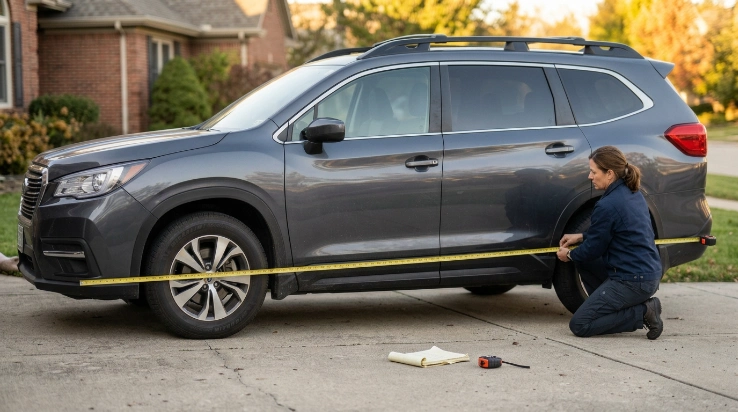
Measure your SUV’s length, width, and height before comparing it with a universal cover chart. Measure the vehicle in the configuration that will actually be covered.
A tape measure is normally all you need.
1. Measure overall length
Measure from the farthest point at the front to the farthest point at the rear. Include permanently installed parts that the cover must pass over.
Don’t automatically use a body-panel-to-body-panel measurement if a rear accessory extends beyond the vehicle.
2. Measure the widest area
Check the cover maker’s instructions before including mirrors. Some sizing systems use body width, while others account for mirrors through the cover design.
Follow the manufacturer’s definition instead of mixing measurement methods.
3. Measure overall height
Measure from the ground or specified reference point to the highest part the cover must clear. Roof rails and cargo hardware can matter here.
A tall SUV can have substantially different cover needs from a lower crossover even when their lengths appear similar.
4. Identify unusual exterior equipment
- Factory or aftermarket roof rails
- Roof baskets
- Crossbars
- Rear-mounted spare tires
- Front bull bars
- Running boards
- Large rear spoilers
- Fixed antennas
- Aftermarket body accessories
Now compare all relevant measurements with the manufacturer’s chart. Avoid choosing by vehicle category alone when dimensional information is available.
If you’re unsure about the exact vehicle configuration, Kelley Blue Book provides broad vehicle research tools that can help identify model, year, and trim information.
I also avoid choosing the absolute limit of a size range when bulky accessories are present. A theoretical match on paper doesn’t guarantee the fabric will sit correctly around every protrusion.
Section Takeaway: Measure the actual SUV you intend to cover. Length, width, height, and installed accessories provide a much better sizing picture than a generic “large SUV” label.
How Do Roof Racks, Spoilers, and Spare Tires Affect Fit?
Exterior accessories change the space a cover needs to occupy. They can also concentrate tension in areas where a standard cover wasn’t designed to stretch.
This is especially important on SUVs because roof and rear-body accessories are common.
Roof rails and crossbars
Low factory roof rails may fit beneath some standard covers without trouble. Tall crossbars, baskets, and cargo systems are more complicated.
- They increase effective vehicle height.
- They create additional corners beneath the fabric.
- They can prevent the sides from reaching low enough.
- They can create concentrated pressure on seams.
If an accessory is removable and the cover maker advises removing it, that can give the cover a more predictable surface.
Rear spoilers
A spoiler can make an otherwise correct-length cover feel too short. The fabric must travel over the added height before reaching the rear bumper.
Don’t force a tight cover downward by pulling on the rear elastic. Check whether the cover specifically accommodates your body style.
Rear-mounted spare tires
A spare tire mounted outside the rear hatch changes both length and rear profile. Covers intended for SUVs without an external spare may fit poorly.
Look for fitment information that explicitly addresses this configuration.
Mirrors and mirror pockets
Mirror pockets are useful only when they align correctly. A pocket several inches away from the mirror can pull the entire side panel out of position.
Don’t force the mirror into an incorrectly positioned pocket. Confirm the vehicle generation and cover orientation first.
Antennas
Fixed antennas require special attention because a tightly stretched cover can place concentrated force on them. Never push hard against an antenna just to make the material reach.
Follow the cover and vehicle manufacturer’s instructions when an antenna opening or other accommodation is required.
Mechanic Alert: If an accessory, mirror, antenna, or exterior component becomes loose while installing a cover, stop. Have a qualified technician inspect the component rather than forcing the cover around it.
Section Takeaway: An accessory can turn a correct basic measurement into a poor real-world fit. Size the cover for the SUV as it is equipped, not merely for the stock body dimensions.
How Do You Fix Common SUV Cover Fit Problems?
Start by identifying whether the problem comes from installation, fastening, accessories, deterioration, or incorrect sizing. Don’t immediately buy another cover until you know why the current one fits badly.
I use the following order because it rules out the easy mistakes first.
- Verify the orientation. Find the front label and make sure the cover isn’t reversed.
- Check mirror placement. Confirm the pockets line up naturally without stretching.
- Reinstall carefully. Center the roof section before fitting the front and rear hems.
- Inspect accessories. Look for rails, racks, spoilers, or spare tires altering the shape.
- Measure the SUV. Record length, width, and height using the cover manufacturer’s method.
- Compare the sizing chart. Confirm your measurements sit inside the correct range.
- Inspect the cover. Look for failed elastic, torn seams, distortion, or material deterioration.
- Check fastening. Use supplied straps and buckles according to the maker’s instructions.
What if the cover is slightly loose?
First make sure the looseness isn’t simply caused by incorrect centering. A cover positioned several inches too far forward can leave excess fabric elsewhere.
Use only the fastening system designed for that cover. Don’t improvise with hard hooks, abrasive ropes, or attachments that can contact the body.
What if the cover is much too loose?
Large folds across the roof and doors usually indicate a sizing problem that straps alone won’t solve. Tightening one area may simply move the excess fabric somewhere else.
Replacing it with a more appropriate size or model-specific design is usually the cleaner solution.
What if the cover is slightly tight?
Check orientation, mirror pockets, and accessory interference first. A correctly sized cover can appear too small when one part isn’t seated properly.
If installation still requires significant force, stop stretching it.
What if the cover keeps blowing off?
Wind problems usually involve loose sizing, inadequate fastening, or air getting beneath open edges. Inspect the entire installation rather than adding random tie-downs.
- Check the front and rear elastic.
- Inspect every buckle and strap.
- Look for oversized side panels.
- Check whether wind can enter beneath a loose bumper area.
- Inspect ripped strap attachment points.
Outdoor covers are commonly designed with stronger weather protection and fastening than indoor covers. Car and Driver’s 2026 testing similarly notes secure straps as an important feature for outdoor use. :contentReference[oaicite:1]{index=1}
Mechanic Alert: Never crawl beneath an SUV supported only by a jack to route or retrieve a car-cover strap. Use a safe alternative or get qualified assistance.
When should you replace the cover?
Fit adjustments won’t repair a cover whose basic structure has failed. Replacement makes sense when damaged material prevents a stable, predictable fit.
- Elastic no longer grips the vehicle.
- Multiple seams are separating.
- Fabric has permanently stretched or distorted.
- Mirror pockets are torn.
- Straps continually pull out of their attachment points.
- The cover remains dangerously tight despite correct installation.
- Oversizing creates constant uncontrolled movement.
For broader information about vehicle and equipment safety concerns, the National Highway Traffic Safety Administration maintains vehicle-safety resources for consumers.
Section Takeaway: Installation errors are worth correcting, but straps can’t turn the wrong-size cover into the right one. Re-measure when fit problems remain after proper installation.
Frequently Asked Questions
Should an SUV cover be tight or loose?
An SUV cover should be secure rather than extremely tight. It should follow the vehicle’s shape without large loose folds, yet it should not require heavy stretching over mirrors, roof rails, bumpers, spoilers, or other exterior features.
Why doesn’t my large SUV cover fit my SUV?
“Large SUV” is a broad sizing label, not a universal body specification. Your SUV may be taller, wider, or shaped differently from the vehicles the cover was designed around. Compare actual length, width, height, accessories, and model-specific fitment information.
Can a car cover be too big for an SUV?
Yes. An oversized cover can leave excess material around the roof, doors, and bumpers. Outdoors, that material may move considerably in wind, place extra stress on fasteners, and allow debris to enter through loose edges.
Can a tight SUV cover damage mirrors or trim?
An excessively tight cover can place unwanted pressure on mirrors, spoilers, antennas, roof accessories, seams, and trim. Don’t force a clearly undersized cover into place. Recheck measurements and the manufacturer’s fitment instructions instead.
Do roof rails change car-cover size?
They can. Low factory rails may already be accommodated by a cover, while tall crossbars or roof baskets can increase effective height and change how far the cover reaches down the sides. Always measure the SUV in its normal covered configuration.
Why are the mirror pockets on my SUV cover in the wrong place?
First confirm that the cover isn’t installed backwards. If orientation is correct, the cover may be intended for another SUV generation, body shape, or universal size. Don’t stretch the fabric aggressively just to force the mirrors into the pockets.
Is a custom-fit SUV cover better than a universal cover?
A model-specific cover generally has a better chance of matching the vehicle’s roofline, mirrors, and body proportions. Universal covers can still work, but their broader sizing may create more excess material on some SUVs. Car and Driver also recommends model-specific sizing when precise fit is the priority. :contentReference[oaicite:2]{index=2}
Bottom line: SUV cover fit problems are usually solved by checking dimensions, orientation, accessories, and fastening instead of simply pulling harder on the fabric.
Measure your SUV before replacing the cover, and pay attention to how it behaves after installation. A simple cover that stays secure and follows the vehicle properly is more useful than a feature-heavy cover with the wrong proportions.
