Possible Condition with the Engine Control System on Hyundai

Contents
- 1 Key Takeaways
- 2 📑 Table of Contents
- 3 Introduction: Your Hyundai’s Silent Guardian
- 4 Understanding the Hyundai Engine Control System
- 5 Warning Signs Your Engine Control System is Struggling
- 6 Decoding the Mystery: Diagnostic Trouble Codes (DTCs)
- 7 Top Culprits Behind the Conditions
- 8 DIY Checks vs. Professional Diagnosis: Where Do You Draw the Line?
- 9 Preventative Maintenance for a Healthy Engine Control System
- 10 Conclusion: Knowledge is Power (and Savings)
- 11 Frequently Asked Questions



The engine control system (ECU) is your Hyundai’s brain, managing everything from fuel injection to emissions. When it fails, you might see a check engine light, rough running, or poor fuel economy. While some issues are simple sensor faults, others require a professional’s diagnostic tools. Understanding the warning signs and common culprits can save you time and money.
Key Takeaways
- The ECU is the central computer: It constantly monitors sensors and adjusts engine parameters for performance, efficiency, and emissions.
- A lit Check Engine Light is the primary warning: It indicates the ECU has detected a problem it cannot correct automatically.
- Common symptoms include rough idle, stalling, and poor fuel economy: These often point to faulty sensors like the MAF, O2, or throttle position sensor.
- Diagnostic Trouble Codes (DTCs) are clues, not diagnoses: A code like P0300 (Random/Multiple Cylinder Misfire) tells you *what* is happening, not *why*.
- Simple fixes can range from tightening a gas cap to cleaning sensors: Always check the simplest possibilities first before assuming major component failure.
- Complex issues like internal ECM failure or severe wiring harness damage require a professional: They have advanced scanners and reprogramming capabilities.
- Preventative maintenance is key: Keeping sensors, connections, and the air intake system clean helps prevent many ECU-related problems.
📑 Table of Contents
- Introduction: Your Hyundai’s Silent Guardian
- Understanding the Hyundai Engine Control System
- Warning Signs Your Engine Control System is Struggling
- Decoding the Mystery: Diagnostic Trouble Codes (DTCs)
- Top Culprits Behind the Conditions
- DIY Checks vs. Professional Diagnosis: Where Do You Draw the Line?
- Preventative Maintenance for a Healthy Engine Control System
- Conclusion: Knowledge is Power (and Savings)
Introduction: Your Hyundai’s Silent Guardian
Your Hyundai’s engine control system, often called the ECU (Engine Control Unit) or ECM (Engine Control Module), is the vehicle’s central nervous system. This sophisticated computer processes data from dozens of sensors every second, making micro-adjustments to fuel injection, ignition timing, and airflow. Its goal is to keep your engine running powerfully, cleanly, and efficiently. When this system encounters a problem it can’t solve, it alerts you—often with the infamous check engine light. But what exactly can go wrong with this critical system? Understanding the possible conditions helps you respond correctly, avoid costly mistakes, and keep your Hyundai reliable.
This guide will walk you through the most common issues that can plague a Hyundai’s engine control system. We’ll break down the warning signs, explain what those cryptic diagnostic codes mean, explore typical causes, and help you decide between a DIY fix and a trip to the mechanic. Think of this as your roadmap to navigating one of the most complex systems in your car.
Understanding the Hyundai Engine Control System
Before diving into problems, it helps to know what you’re dealing with. The engine control system isn’t just one box; it’s a network of hardware and software working in concert.
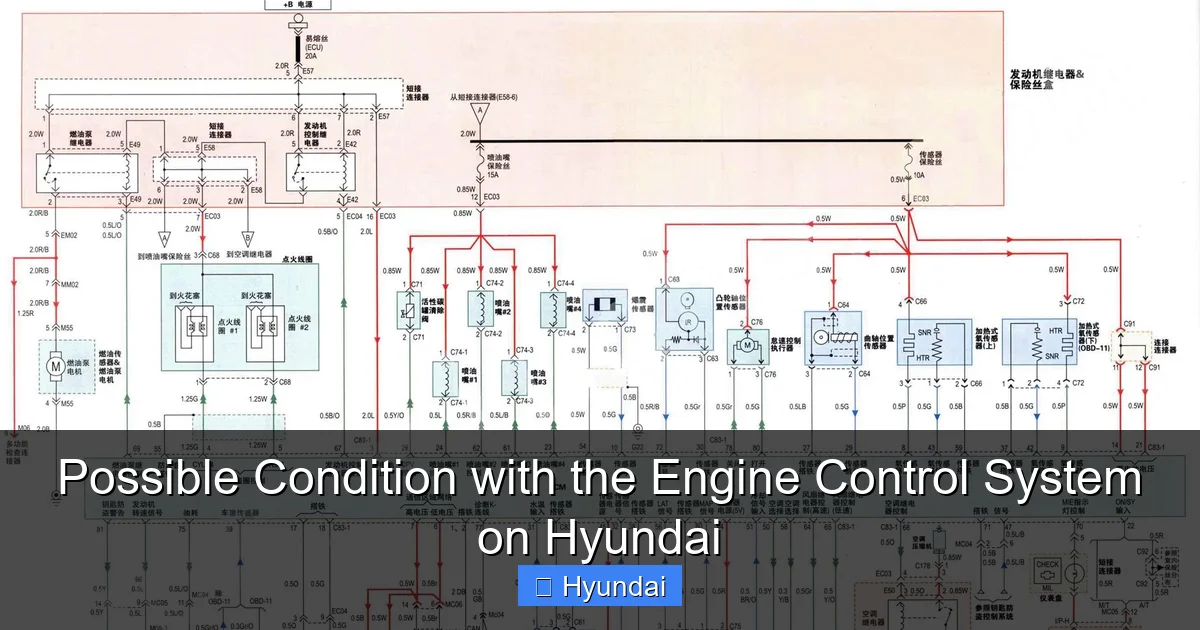
Visual guide about Possible Condition with the Engine Control System on Hyundai
Image source: seekic.com
The Brain: The ECU/ECM
The heart of the system is the ECU itself—a hardened computer located typically under the hood, often near the firewall. It runs proprietary software (firmware) programmed with maps for fuel delivery, spark advance, and idle speed based on engine RPM, load, temperature, and altitude. When you turn the key, it runs a self-diagnostic check (the “bulb check” on your dash) and begins listening to its sensor阵列.
The Senses: Key Sensors
The ECU relies on accurate input. Critical sensors include:
- Mass Air Flow (MAF) Sensor: Measures the volume and density of air entering the engine.
- Oxygen (O2) Sensors: Monitor oxygen levels in the exhaust to fine-tune the air-fuel mixture.
- Throttle Position Sensor (TPS): Tells the ECU how far the accelerator pedal is pressed.
- Manifold Absolute Pressure (MAP) Sensor: Measures engine load.
- Coolant Temperature Sensor: Informs the ECU if the engine is cold or at operating temperature.
- Crankshaft/Camshaft Position Sensors: Tell the ECU the exact position of the rotating assembly for precise fuel injection and spark timing.
The Actuators: The ECU’s Hands
Based on sensor data, the ECU commands various actuators:
- Fuel Injectors: Pulse to deliver the precise amount of fuel.
- Ignition Coils/Spark Plugs: Fire at the exact right moment.
- Idle Air Control Valve (IACV) or Electronic Throttle Body: Regulates air bypass for idle speed.
- EGR Valve: Recirculates exhaust gases to reduce emissions.
- Variable Valve Timing (VVT) Solenoids: Adjust camshaft timing for performance and efficiency.
When any part of this communication loop fails—sensor, wiring, or actuator—the engine control system can’t do its job properly, leading to the conditions we’ll discuss next.
Warning Signs Your Engine Control System is Struggling
Your Hyundai will give you clues. Pay attention to these common symptoms that point directly to the engine control system or its components.
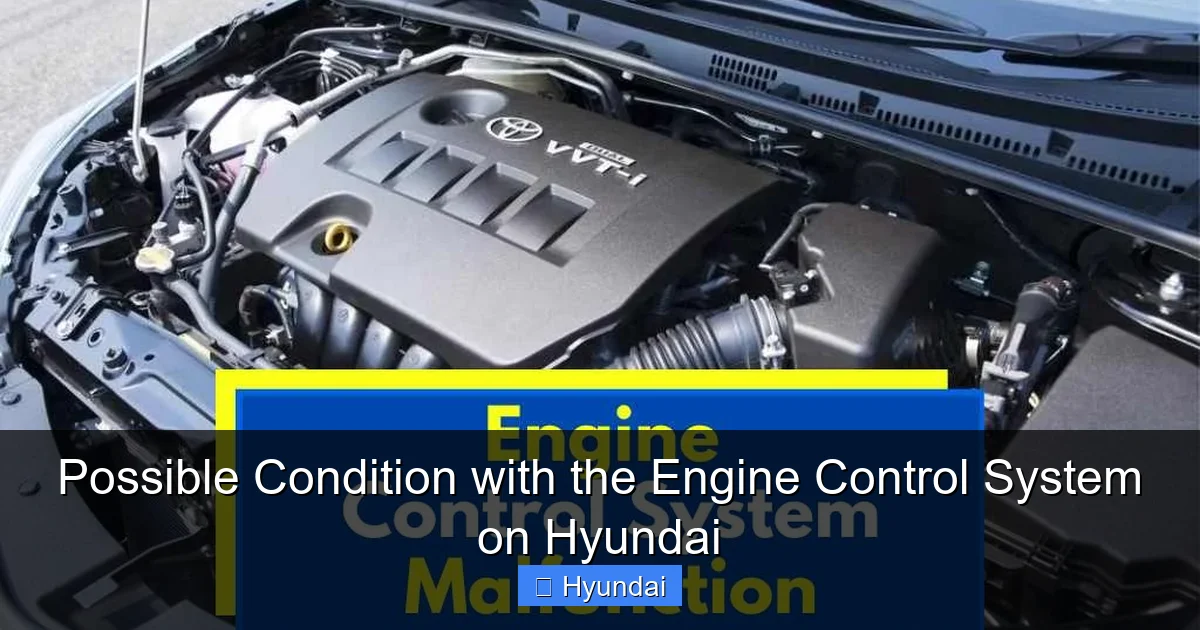
Visual guide about Possible Condition with the Engine Control System on Hyundai
Image source: onestopwheel.com
The Check Engine Light (MIL)
This is the most obvious sign. The Malfunction Indicator Lamp (MIL) illuminates when the ECU stores a Diagnostic Trouble Code (DTC). It could be a loose gas cap or a failed catalytic converter. Never ignore it. Even if the car seems to drive fine, you could be causing catalytic converter damage or increasing emissions. A simple OBD-II scanner read (often free at auto parts stores) will reveal the code(s) and is the first critical step.
Performance Problems: Hesitation, Stalling, and Rough Idle
If your Hyundai feels hesitant when you press the accelerator, stalls at stoplights, or has a shaky, uneven idle, the ECU is likely getting bad data or can’t control the actuators properly. A faulty MAF sensor sending incorrect airflow data or a bad throttle position sensor giving wrong pedal position readings are classic causes. These issues disrupt the precise air-fuel mixture the ECU tries to maintain.
Poor Fuel Economy
Are you filling up more often? A malfunctioning O2 sensor is a prime suspect. If an O2 sensor reports a “lean” condition (too much air), the ECU will dump extra fuel to compensate, wasting gasoline. Similarly, a stuck-open EGR valve or a clogged air filter can cause the ECU to miscalculate the ideal mixture, leading to inefficient combustion.
Failed Emissions Test
In regions requiring emissions testing, a failing system will almost certainly cause a failure. The ECU’s primary job includes managing emissions control systems (O2 sensors, catalytic converter, EGR). If any of these components or their monitoring circuits are faulty, the test will detect excessive hydrocarbons (HC), carbon monoxide (CO), or nitrogen oxides (NOx).
Hard Starting or No-Start Conditions
In severe cases, the ECU might go into a “limp mode” or fail entirely. If your Hyundai cranks but won’t start, or starts then immediately dies, the ECU may not be sending signals to the fuel injectors or ignition coils. This could be due to a complete loss of power to the ECU, a failed crankshaft position sensor (which tells the ECU when to fire), or internal ECU failure.
Unusual Engine Sounds
While not always directly ECU-related, pinging (pre-ignition) or backfiring can indicate the ECU is advancing ignition timing too much based on incorrect sensor data (e.g., a faulty knock sensor).
Decoding the Mystery: Diagnostic Trouble Codes (DTCs)
When the check engine light comes on, the ECU stores one or more DTCs. These alphanumeric codes are standardized (OBD-II) but have manufacturer-specific nuances. Think of them as symptoms, not final diagnoses.
Visual guide about Possible Condition with the Engine Control System on Hyundai
Image source: bryansgarage.com
How to Read Codes
You need an OBD-II scanner. Basic code readers are inexpensive and available at any auto parts store. For more detailed data and manufacturer-specific codes, a professional-grade scan tool is better. Plug the scanner into the port under your dashboard (usually near the steering column), turn the ignition on, and follow the device prompts to read “stored” or “pending” codes.
Common Hyundai Engine Control DTCs
While codes vary by model year and engine type (Theta, Gamma, Kappa, etc.), here are frequent offenders:
- P0011, P0016: Camshaft Position “A” – Timing Over-Advanced or Bank 1. Often points to a faulty VVT solenoid, low oil pressure (VVT needs oil), or a stretched timing chain/belt on interference engines.
- P0300-P0304: Random/Multiple Cylinder Misfire or Misfire on Cylinder 1-4. Causes range from spark plugs and ignition coils to fuel injectors, compression issues, or vacuum leaks.
- P0171, P0174: System Too Lean (Bank 1 or 2). Indicates too much air or not enough fuel. Check for vacuum leaks, dirty/failed MAF sensor, or weak fuel pump.
- P0420: Catalyst System Efficiency Below Threshold. Usually means the catalytic converter is failing, but can also be caused by a faulty O2 sensor (especially the downstream one) or an exhaust leak before the front O2 sensor.
- P0121, P0122, P0123: Throttle Position Sensor (TPS) Circuit Range/Performance or Low/High Input. The ECU isn’t getting a consistent signal from the throttle pedal or electronic throttle body.
- P0135, P0155: O2 Sensor Heater Circuit (Bank 1/2 Sensor 1). The heater that brings the O2 sensor to operating temperature quickly has failed, causing increased emissions until the sensor warms up.
Critical: A code tells you which *system* is out of spec. For example, a P0300 code means a misfire is detected, but you must perform diagnostics to find if it’s a bad spark plug, coil, injector, or something else. Never just replace parts based on a code.
Top Culprits Behind the Conditions
Now let’s get into the mechanical and electrical failures that trigger those codes and symptoms.
Faulty Oxygen (O2) Sensors
O2 sensors degrade over time (typically 100,000+ miles). A failing sensor sends incorrect voltage signals, causing the ECU to miscalculate the fuel mixture. This leads to poor fuel economy, a rotten egg smell (sulfur), and eventually a P0420 or P013X code. Replacing an O2 sensor is a common and often straightforward fix.
Dirty or Failed MAF Sensor
The MAF sensor’s delicate wire or film can get coated with dirt, oil, or debris from a dirty air filter. This causes it to under-report airflow, leading to a lean condition (P0171) and poor performance. Sometimes, cleaning it with a dedicated MAF cleaner can restore function. If cleaning doesn’t work, replacement is needed.
Throttle Body and Electronic Throttle Control (ETC) Issues
In modern Hyundais with drive-by-wire systems, the electronic throttle body (ETB) is crucial. Carbon buildup can cause it to stick or not close properly, leading to high idle, stalling, or a P0121 code. In some cases, the throttle body motor itself fails, requiring replacement. After replacement or cleaning, a throttle body adaptation procedure (often done with a scan tool) is necessary. For specific procedures on other models, you might consult resources like how to reset the electronic throttle control system on a Dodge Charger, which illustrates the general principle of recalibration after throttle body work.
Wiring Harness and Connector Problems
This is a huge category. Over time, wiring can become brittle, connectors can corrode or develop micro-cracks, and sensors can be jarred loose. A bad ground or an intermittent short can cause signals to drop in and out, creating phantom codes and erratic behavior. Always inspect connectors and wires for damage, corrosion, or looseness when diagnosing sensor-related codes.
ECM/ECU Software Glitches or Failure
Less common but possible. Sometimes, the ECU’s software can develop bugs, especially after a battery disconnect or voltage spike. A dealer can often perform a software update (reflash) to fix driveability issues. Complete ECU failure is rare but can happen due to water damage, internal short, or severe voltage issues. This requires replacement and often professional programming to match your vehicle’s VIN and specifications.
DIY Checks vs. Professional Diagnosis: Where Do You Draw the Line?
Your approach depends on your skill, tools, and the symptoms.
Simple Checks You Can Do Yourself
- Check the gas cap: A loose or damaged gas cap is the #1 cause of a P0455 (EVAP System Leak) code. Tighten it until it clicks or replace it if the seal is cracked.
- Inspect for obvious issues: Look for disconnected, broken, or corroded sensor connectors and vacuum hoses under the hood.
- Read and clear codes: Use an OBD-II scanner to see what codes are stored. Clear them after repairs to see if they return.
- Visual sensor inspection: Look at the MAF sensor (between air filter and throttle body) and O2 sensors (on the exhaust) for obvious damage or contamination.
- Check fuses: The ECU and its sensors have dedicated fuses. A blown fuse can disable a system. Consult your owner’s manual for fuse locations.
When to Call a Professional
- Multiple, complex, or manufacturer-specific codes: Interacting systems require advanced knowledge.
- No-start conditions with no obvious cause: Crankshaft/camshaft sensor issues or ECU power/ground problems need circuit testing.
- Internal engine issues suspected: Codes for low compression or timing issues (P0011/P0016) may indicate serious mechanical work.
- Need for ECU reprogramming: After replacing certain components (like a throttle body), adaptation is required. Dealerships or specialty shops have the software.
- Lack of tools or confidence: Diagnosing an intermittent wiring problem or a failing sensor that needs live data stream analysis is best left to experts.
Remember, a professional diagnosis fee is often cheaper than replacing the wrong part. If you’re ever in doubt, seek a reputable mechanic, especially one familiar with Hyundai’s common issues.
Preventative Maintenance for a Healthy Engine Control System
An ounce of prevention is worth a pound of cure. Here’s how to keep your Hyundai’s ECU and its sensors happy.
Replace the Engine Air Filter Regularly
A clogged air filter restricts airflow, making the MAF sensor work harder and potentially allowing unfiltered dust to coat the sensor itself. Follow your owner’s manual schedule (often every 15,000-30,000 miles). A clean air filter protects the MAF and ensures accurate airflow measurement.
Use Quality Fuel and Keep the Fuel System Clean
Poor-quality fuel can lead to carbon buildup on intake valves and the throttle body, affecting airflow and sensor readings. Using top-tier gasoline and occasionally adding a fuel system cleaner can help. For severe carbon buildup on direct-injection engines, a professional walnut blasting service may be needed.
Inspect and Clean Sensors Periodically
During routine service, ask your mechanic to visually inspect the MAF sensor and throttle body for dirt. MAF sensors can often be carefully cleaned with a dedicated spray (never touch the sensing element). Throttle bodies can be cleaned with throttle body cleaner and a soft brush.
Address Warning Lights Immediately
Don’t let a check engine light simmer. A small problem (like a failing O2 sensor) can, over time, damage the catalytic converter—a much more expensive repair. Early intervention is always cheaper.
Maintain Healthy Electrical Systems
A weak or failing alternator can cause voltage spikes that damage sensitive electronics like the ECU. Ensure your battery is healthy and terminals are clean. A stable voltage supply is critical for all engine control components.
Conclusion: Knowledge is Power (and Savings)
Your Hyundai’s engine control system is a marvel of engineering, but it’s not infallible. The conditions it can develop range from simple, inexpensive fixes like a loose gas cap or dirty sensor to complex, costly repairs like a failed catalytic converter or internal ECU issue. The key is to recognize the warning signs—the check engine light, performance changes, and poor fuel economy—and respond with a methodical approach: read the codes, research the common causes for your specific Hyundai model and engine, and start with the simplest, most likely fixes.
While many sensor replacements and cleaning tasks are within the reach of a competent DIYer, never hesitate to consult a professional for complex diagnostics or when internal engine or ECU problems are suspected. Investing in a proper diagnosis upfront will almost always save you money in the long run by preventing misdiagnosis and unnecessary part replacements. By understanding how your Hyundai’s brain works and what can confuse it, you become a smarter owner, better equipped to maintain your vehicle’s reliability and performance for years to come.
Frequently Asked Questions
Can I keep driving my Hyundai with the check engine light on?
It depends on the symptom. If the car is running smoothly with no performance issues, a short drive to get it diagnosed is usually okay. However, if you notice severe misfiring, stalling, overheating, or strange noises, stop driving immediately and have it towed. Continuing to drive with a serious fault can cause catastrophic engine or catalytic converter damage.
How much does it typically cost to fix an engine control system problem on a Hyundai?
Costs vary wildly. Replacing a faulty gas cap ($15) or cleaning a MAF sensor ($30 for cleaner) is cheap. A new oxygen sensor can range from $150-$400+ including labor. A throttle body replacement might be $400-$800. Major issues like a failed catalytic converter or ECU replacement can exceed $1,500. Always get a specific diagnosis for an accurate quote.
Will disconnecting the battery reset the engine control system and turn off the check engine light?
Disconnecting the battery will clear stored codes and turn off the light temporarily, but it does not fix the underlying problem. The light will return as soon as the ECU redetects the fault (often within a few drive cycles). It also resets other systems like the radio and clock, and on some models, it may affect steering angle sensor calibration. The proper procedure is to fix the problem, then clear the codes with a scanner.
What’s the difference between a check engine light and a service engine soon light?
There is no functional difference. Both are Malfunction Indicator Lamps (MIL). “Check Engine” is the more common term in the U.S., while “Service Engine Soon” is also used, especially on some GM and older vehicles. They both indicate the ECU has stored a diagnostic trouble code that needs attention.
Can a bad or dead battery cause engine control system problems?
Yes. A severely discharged or failing battery can cause low voltage conditions that confuse the ECU and other modules, potentially setting multiple erratic codes. A battery with a bad cell can also cause voltage spikes when the alternator tries to charge it, which can damage sensitive electronics like the ECU. Always test the battery and charging system if you experience electrical gremlins.
My Hyundai’s check engine light is flashing. What does that mean?
A flashing check engine light is a severe warning. It indicates a misfire is occurring that is severe enough to potentially overheat and damage the catalytic converter. You should stop driving as soon as it is safe and have the vehicle towed to a repair shop. Common causes include a failed ignition coil, bad spark plug, or a major fuel injector problem.