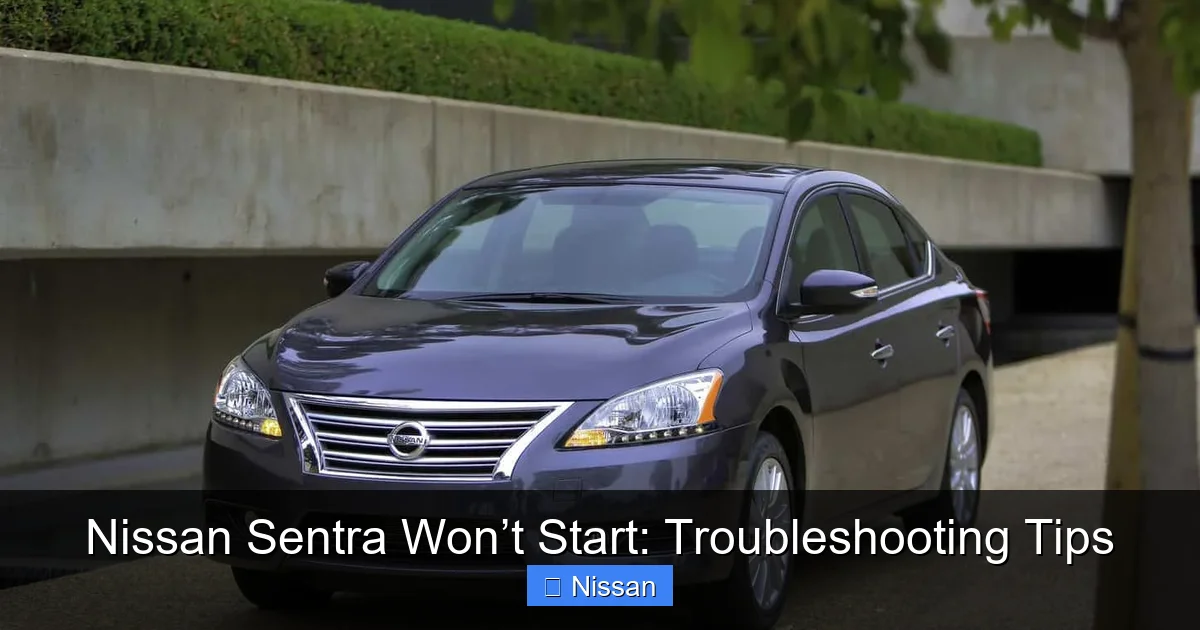
Nissan Sentra Won’t Start: Troubleshooting Tips

Contents
- 1 Key Takeaways
- 2 📑 Table of Contents
- 3 Why Won’t My Nissan Sentra Start? A Friendly Guide to Getting Back on the Road
- 4 1. Start with the Battery: The Most Common Culprit
- 5 2. Listen Closely: What the Sounds Tell You
- 6 3. The Starter Motor: Is It Spinning Its Wheels?
- 7 4. Ignition Switch and Key Issues
- 8 5. Fuel and Spark: The Engine Cranks but Won’t Fire
- 9 6. When to Call a Mechanic: Knowing Your Limits
- 10 Final Thoughts: Stay Calm and Troubleshoot Smart
- 11 Frequently Asked Questions



If your Nissan Sentra won’t start, don’t panic—most issues are fixable with basic troubleshooting. From dead batteries to faulty starters, this guide walks you through the most common causes and practical solutions to get your car back on the road fast.
Key Takeaways
- Check the battery first: A dead or weak battery is the #1 reason a Nissan Sentra won’t start—test voltage and clean terminals.
- Listen for clicking sounds: Rapid clicking often means a bad battery or poor connection; slow cranking may point to a failing starter.
- Inspect the starter motor: If the engine doesn’t crank at all, the starter could be faulty or have electrical issues.
- Test the ignition switch: A worn ignition switch can prevent power from reaching the starter, even with a good battery.
- Look at fuel and spark systems: No start with cranking? Check fuel pump, fuel filter, spark plugs, and ignition coils.
- Don’t ignore the immobilizer: A flashing security light may mean the key isn’t recognized—try a spare key or reprogram.
- When to call a pro: If basic checks don’t help, a mechanic with diagnostic tools can pinpoint complex electrical or engine issues.
📑 Table of Contents
- Why Won’t My Nissan Sentra Start? A Friendly Guide to Getting Back on the Road
- 1. Start with the Battery: The Most Common Culprit
- 2. Listen Closely: What the Sounds Tell You
- 3. The Starter Motor: Is It Spinning Its Wheels?
- 4. Ignition Switch and Key Issues
- 5. Fuel and Spark: The Engine Cranks but Won’t Fire
- 6. When to Call a Mechanic: Knowing Your Limits
- Final Thoughts: Stay Calm and Troubleshoot Smart
Why Won’t My Nissan Sentra Start? A Friendly Guide to Getting Back on the Road
You’re running late for work, you hop into your Nissan Sentra, turn the key—and nothing happens. Or maybe it cranks slowly, sputters, and dies. Frustrating, right? Don’t worry. You’re not alone. Thousands of Sentra owners face this issue every year, and in most cases, the fix is simpler than you think.
The good news? Most “Nissan Sentra won’t start” problems are caused by a handful of common culprits. Whether it’s a dead battery, a faulty starter, or an electrical glitch, understanding what to look for can save you time, stress, and money. This guide will walk you through step-by-step troubleshooting tips—no mechanic degree required. We’ll keep it simple, practical, and jargon-free, so you can diagnose and often fix the issue yourself.
Before we dive in, remember: safety first. Always park on a flat surface, engage the parking brake, and disconnect the battery if you’re doing hands-on work. And if you’re ever unsure, don’t hesitate to call a professional. But for now, let’s figure out why your Sentra is giving you the silent treatment.
1. Start with the Battery: The Most Common Culprit

Visual guide about Nissan Sentra Won’t Start: Troubleshooting Tips
Image source: autoily.com
Let’s be honest—when a car won’t start, the battery is usually the first suspect. And for good reason. In the Nissan Sentra, a weak or dead battery is responsible for more no-start issues than any other single factor. Why? Because the battery powers everything: the starter, the ignition system, the fuel pump, and even the dashboard lights.
So how do you know if it’s the battery? Start by turning the key to the “ON” position (but don’t crank the engine). Do the dashboard lights come on? Are they dim or flickering? If they’re weak or barely visible, your battery might be low. Try turning on the headlights. If they’re dim or don’t turn on at all, that’s another red flag.
How to Test Your Battery
The best way to check your battery is with a multimeter. Set it to DC voltage (usually marked as “V” with a straight line). Touch the red probe to the positive terminal (+) and the black probe to the negative terminal (–). A healthy battery should read between 12.4 and 12.7 volts when the car is off. If it’s below 12.2 volts, it’s likely too weak to start the engine.
No multimeter? No problem. Many auto parts stores (like AutoZone or O’Reilly) offer free battery testing. Just drive over and ask—they’ll hook it up to their tester in minutes.
Jump-Starting Your Sentra
If your battery is dead, jump-starting might get you going. Here’s how:
1. Park a working car close to your Sentra (but not touching).
2. Connect the red jumper cable to the positive terminal of the dead battery.
3. Connect the other red clip to the positive terminal of the good battery.
4. Connect the black clip to the negative terminal of the good battery.
5. Attach the final black clip to an unpainted metal surface on your Sentra (like a bolt on the engine block)—this grounds the circuit and reduces spark risk.
6. Start the working car and let it run for a few minutes.
7. Try starting your Sentra. If it starts, let it run for at least 15–20 minutes to recharge the battery.
8. Disconnect the cables in reverse order.
⚠️ Important: Never let the jumper cables touch each other while connected to a live battery. And avoid jump-starting if the battery is swollen, leaking, or smells like rotten eggs—this could indicate a dangerous internal failure.
When to Replace the Battery
Car batteries typically last 3–5 years. If your Sentra’s battery is older than that—or if it’s been jump-started multiple times—it might be time for a replacement. Look for signs like slow cranking, frequent jumps, or a battery warning light on the dashboard.
When replacing, make sure to get a battery with the correct group size and cold cranking amps (CCA) for your Sentra model. Most Sentras use a Group 35 battery with around 600–700 CCA. Check your owner’s manual or the label on the old battery to be sure.
2. Listen Closely: What the Sounds Tell You

Visual guide about Nissan Sentra Won’t Start: Troubleshooting Tips
Image source: wonder007.com.tw
Your car talks to you—if you know how to listen. The sounds it makes (or doesn’t make) when you try to start it can give you major clues about what’s wrong. Let’s break down the most common noises and what they mean.
Rapid Clicking Noise
You turn the key, and all you hear is a rapid “click-click-click-click” sound. No engine cranking. This is classic battery trouble. The clicking comes from the starter solenoid trying to engage, but there’s not enough power to turn the motor.
This usually means:
– The battery is dead or very weak.
– The battery terminals are corroded or loose.
– The ground connection is poor.
Try cleaning the battery terminals with a wire brush and baking soda solution. Tighten the connections. If that doesn’t help, test the battery voltage. If it’s low, charge or replace it.
Slow or Labored Cranking
The engine turns over, but it’s slow, sluggish, or sounds like it’s struggling. This could still be a battery issue—especially in cold weather—but it might also point to:
– A failing starter motor.
– A bad alternator (not charging the battery while driving).
– Corroded or damaged cables.
If the cranking gets slower over time, or if it only happens when the engine is hot, the starter might be overheating or wearing out.
No Sound at All
You turn the key—and silence. No clicking, no cranking, nothing. This is more serious. Possible causes:
– A completely dead battery.
– A faulty ignition switch.
– A blown main fuse or fusible link.
– A bad starter relay.
Check the battery first. If it’s good, inspect the fuses under the hood and inside the cabin. Look for the main engine fuse (often 80A or 100A) and the starter relay. If they’re intact, the ignition switch or starter circuit might be the issue.
Engine Cranks but Won’t Start
This is different. The engine turns over normally, but it doesn’t fire up. This means the starter is working, but something else is preventing combustion. We’ll cover this in more detail later, but common causes include:
– No fuel (empty tank, bad fuel pump, clogged filter).
– No spark (bad spark plugs, ignition coils, or crankshaft sensor).
– Immobilizer system blocking startup.
3. The Starter Motor: Is It Spinning Its Wheels?

Visual guide about Nissan Sentra Won’t Start: Troubleshooting Tips
Image source: carglassadvisor.com
If your battery is good but the engine won’t crank, the starter motor might be the problem. The starter is a small electric motor that turns the engine over when you turn the key. If it fails, your Sentra won’t start—no matter how good the battery is.
How the Starter Works
When you turn the key to “START,” electricity flows from the battery to the starter solenoid. The solenoid pushes a gear (the pinion) into the engine’s flywheel and powers the motor. The motor spins the engine until it starts.
If the starter is bad, you might hear:
– A single loud click (solenoid engaging, but motor not spinning).
– A grinding noise (gear not meshing properly).
– No sound at all (no power reaching the starter).
Testing the Starter
Testing a starter isn’t always easy without tools, but here are a few DIY checks:
1. **Tap Test**: With the key off, gently tap the side of the starter motor with a hammer or wrench. Then try starting the car. If it starts, the starter brushes or armature might be worn—time for a replacement.
2. **Voltage Test**: Use a multimeter to check for 12 volts at the starter’s main power wire when the key is turned to “START.” If there’s power but the starter doesn’t turn, it’s likely faulty.
3. **Relay Swap**: Many Sentras use a starter relay in the fuse box. Try swapping it with a similar relay (like the horn relay) to see if that fixes the issue.
⚠️ Warning: The starter is located under the engine and can be tricky to access. If you’re not comfortable working under the car, leave this to a mechanic.
Starter Replacement Tips
If you confirm the starter is bad, replacement is usually straightforward—but labor-intensive. You’ll need to:
– Disconnect the battery.
– Remove air intake components (if in the way).
– Unbolt the starter (usually 2–3 bolts).
– Disconnect electrical connections.
– Install the new starter and reassemble.
Most starters cost $100–$300, and labor can add $100–$200 if done by a shop. But if you’re handy, you can save money by doing it yourself.
4. Ignition Switch and Key Issues
Sometimes, the problem isn’t the battery or starter—it’s the ignition switch. This small component sends power to the starter when you turn the key. If it’s worn or damaged, your Sentra won’t start, even with a full battery.
Symptoms of a Bad Ignition Switch
– The car won’t start, but the dashboard lights come on.
– Intermittent starting—works sometimes, doesn’t others.
– Accessories (radio, lights) work, but the engine won’t crank.
– The key feels loose or wobbly in the ignition.
In older Sentras (2000s models), the ignition switch can wear out from repeated use. The internal contacts degrade, breaking the circuit to the starter.
Testing the Ignition Switch
This requires a multimeter and some electrical knowledge. You’ll need to:
1. Remove the steering column covers.
2. Locate the ignition switch (usually near the key cylinder).
3. Test for continuity or voltage when the key is turned.
If you’re not comfortable with this, a mechanic can test it quickly with a scan tool.
The Immobilizer System: Is Your Key Recognized?
Modern Sentras (2007 and newer) have an immobilizer system. It uses a chip in the key to communicate with the car’s computer. If the system doesn’t recognize the key, it won’t allow the engine to start—even if you turn the key.
Signs of an immobilizer issue:
– The security light on the dashboard flashes or stays on.
– The car cranks but won’t start.
– You’re using a non-chip key or a damaged key.
Try these fixes:
– Use a spare key with a working chip.
– Clean the key’s chip with a soft cloth.
– Reprogram the key (some auto parts stores can do this).
– Check for a faulty immobilizer antenna (around the ignition cylinder).
If the immobilizer is the issue, you may need a locksmith or dealership to reprogram the key or replace the antenna.
5. Fuel and Spark: The Engine Cranks but Won’t Fire
So your Sentra cranks normally—but it won’t start. This means the starter and battery are fine, but the engine isn’t getting fuel, spark, or both. Let’s look at the most common causes.
Fuel System Problems
If the engine isn’t getting fuel, it won’t start. Common fuel issues include:
– **Empty gas tank**: Sounds silly, but it happens. Check the fuel gauge.
– **Bad fuel pump**: The pump sends fuel from the tank to the engine. If it fails, no fuel reaches the injectors. Listen for a humming sound from the rear of the car when you turn the key to “ON.” No sound? The pump might be dead.
– **Clogged fuel filter**: Over time, debris builds up in the filter, restricting fuel flow. Replace every 30,000–60,000 miles.
– **Faulty fuel injectors**: If injectors are clogged or stuck closed, fuel won’t spray into the cylinders.
Ignition System Problems
No spark = no combustion. Check these components:
– **Spark plugs**: Worn or fouled plugs won’t ignite the fuel. Remove one and check for cracks, carbon buildup, or gaps. Replace if needed.
– **Ignition coils**: These send high voltage to the spark plugs. A bad coil can cause misfires or no start. Use an OBD2 scanner to check for coil-related trouble codes.
– **Crankshaft position sensor**: This tells the computer when to fire the spark plugs. If it fails, the engine won’t start. Common on 2007–2012 Sentras.
Using an OBD2 Scanner
An OBD2 scanner is a small tool that plugs into your car’s diagnostic port (usually under the dashboard). It reads trouble codes that can point to specific issues.
For example:
– Code P0335 = Crankshaft position sensor problem.
– Code P0230 = Fuel pump circuit issue.
– Code P0300 = Random misfire (could be spark or fuel related).
Many auto parts stores lend scanners for free. Just plug it in, read the codes, and bring them in for help.
6. When to Call a Mechanic: Knowing Your Limits
Let’s be real—not every problem can be fixed in the driveway. Some issues require specialized tools, knowledge, or safety precautions. Here’s when it’s time to call a pro.
Complex Electrical Issues
If you’ve checked the battery, starter, and fuses—and still no start—the problem might be in the wiring, ECU (engine computer), or a hidden short circuit. These require diagnostic tools and experience to trace.
Timing Belt Failure
In some Sentra models (especially 2000–2006), a broken timing belt can prevent the engine from starting—or worse, cause internal damage. If the engine turns over but sounds “off” or makes a clunking noise, stop immediately. A broken timing belt can destroy the engine.
Internal Engine Problems
Low compression, seized pistons, or damaged valves can prevent starting. These are serious mechanical issues that need a full engine inspection.
Safety First
Never work on a running engine. Don’t bypass safety systems. And if you smell fuel, see smoke, or hear unusual noises, stop and call for help.
A good mechanic can run a full diagnostic, test sensors, and pinpoint the exact cause. While it costs money, it can save you from bigger repairs down the road.
Final Thoughts: Stay Calm and Troubleshoot Smart
When your Nissan Sentra won’t start, it’s easy to panic. But most of the time, the fix is within reach. Start with the basics: check the battery, listen for sounds, and inspect the starter. Then move on to fuel, spark, and electrical systems.
Keep a basic toolkit in your car: jumper cables, a multimeter, and a spare fuse kit. And don’t forget your owner’s manual—it has valuable info on fuse locations, battery specs, and troubleshooting steps.
Remember, you don’t have to be a mechanic to solve many no-start issues. With patience and the right approach, you can often get your Sentra running again—without a costly tow or repair bill.
And if all else fails? That’s what professionals are for. There’s no shame in calling for help. The goal is to get you back on the road safely and reliably.
Frequently Asked Questions
Why won’t my Nissan Sentra start even with a new battery?
Even with a new battery, your Sentra might not start due to a faulty starter, bad ignition switch, or immobilizer issue. Check for power at the starter and listen for unusual sounds. A diagnostic scan can help identify hidden electrical problems.
Can a bad alternator prevent my Sentra from starting?
Yes. If the alternator isn’t charging the battery while driving, the battery can drain over time. This leads to a no-start condition. Test the alternator output with a multimeter—it should read 13.5–14.5 volts with the engine running.
How do I know if my starter is bad?
Signs include no cranking, a single loud click, or grinding noises. Try the tap test: gently hit the starter with a tool while someone turns the key. If it starts, the starter is likely failing and needs replacement.
What does it mean if my Sentra cranks but won’t start?
This usually points to fuel or ignition problems. Check the fuel pump (listen for a hum), spark plugs, and ignition coils. Use an OBD2 scanner to check for trouble codes related to fuel delivery or engine sensors.
Can a dirty fuel filter cause a no-start?
Yes, especially if it’s severely clogged. A dirty filter restricts fuel flow, preventing the engine from getting enough fuel to start. Replace the fuel filter every 30,000–60,000 miles as part of regular maintenance.
Why does my Sentra only start when I jump it?
This suggests a weak battery or a failing alternator. The battery can’t hold a charge, so it needs external power to start. Test both the battery and alternator—replace the battery if old, or fix the alternator if it’s not charging properly.