
New Jersey Window Tint Law

New Jersey enforces some of the strictest window tint laws in the U.S., with a 70% VLT limit for front side windows and a complete ban on front windshield tint. For BMW owners, this means factory-tinted rear windows are often legal, but aftermarket front tint is not. Violations can lead to fines, failed inspections, and fix-it tickets. Always verify your tint percentage with a professional before hitting the road.
So, you just picked up your dream BMW—maybe a sleek 3 Series or a powerful X5—and you’re thinking about adding some aftermarket window tint. It looks great, keeps the cabin cooler, and adds a touch of privacy. But before you book that tint shop appointment, you need to become an expert on one thing: the New Jersey window tint law. New Jersey isn’t just strict; it’s famously, rigidly specific. What’s legal for your friend’s car in Pennsylvania or New York could get you a ticket and a failed inspection in the Garden State. Let’s break down everything a BMW owner needs to know, from VLT percentages to how this law impacts your annual inspection.
Key Takeaways
- Front Windshield & Front Side Windows Are Highly Restricted: New Jersey law prohibits any aftermarket tinting on the front windshield (except a 6-inch visor strip) and mandates a minimum of 70% Visible Light Transmission (VLT) for front side windows. This means they must be very light.
- Rear Windows Have More Flexibility: The rear side windows and rear windshield can be tinted to any darkness, including limousine tint (5% VLT), as long as the vehicle has side mirrors on both sides.
- BMW Factory Tint Is Typically Legal: Many new BMW models come with a factory-installed rear window tint (usually around 15-20% VLT). This is generally legal in NJ, but you must verify the exact percentage, as some sport packages may have darker rear tints.
- Reflectivity and Color Are Also Regulated: Tint cannot be more than 20% reflective. Red, amber, and yellow tints are explicitly prohibited on any window.
- Enforcement is Active and Penalties Apply: Police can stop you for tint violations. You’ll receive a fix-it ticket requiring tint removal or replacement, plus a fine. Your vehicle will also fail the mandatory annual inspection if illegal tint is detected.
- Medical Exemptions Exist but Are Rare: A dermatologist or physician can provide an exemption for darker front side tint for specific medical conditions (like lupus or xeroderma pigmentosum), but the process is stringent and the exemption must be carried in the vehicle.
- Used Car Sales Require Disclosure: If you sell a BMW in New Jersey with aftermarket tint, you must disclose it. The buyer can request removal or a price adjustment, and illegal tint can complicate the sale.
📑 Table of Contents
- Understanding the Core of NJ Tint Law: VLT Explained
- The Front Windshield and Front Side Window Rules: The Most Critical Section
- Rear Windows: More Freedom, But Not Without Rules
- Enforcement, Penalties, and the Inspection Station Connection
- BMW-Specific Considerations and Factory Tint
- Medical Exemptions: A Possible Loophole, But a Narrow One
- Practical Steps for a BMW Owner in New Jersey
Understanding the Core of NJ Tint Law: VLT Explained
At the heart of the New Jersey window tint law is VLT, or Visible Light Transmission. Think of VLT as a percentage of sunlight that can pass through your window. A 70% VLT window lets 70% of light in and is very lightly tinted. A 5% VLT “limo tint” only lets 5% of light in and is extremely dark. New Jersey sets different VLT limits for different windows on your vehicle. The rules are clear, but the consequences for ignoring them are real.
What Does 70% VLT Actually Look Like?
Many drivers, especially those coming from states with darker tint allowances, are shocked by what 70% VLT means. It’s barely a tint at all—more like a factory UV blocker. On a BMW with a dark interior, the difference from an untinted window is subtle. You’ll get some UV protection and a tiny bit of heat rejection, but not the dramatic, dark appearance or significant cooling effect of a 30% or 20% tint. If you’re used to darker tints, 70% will feel like you have no tint at all. It’s crucial to see a sample before committing, as expectations vs. reality can lead to disappointment.
The law is not a suggestion; it’s a hard standard measured with a calibrated photometer by police and inspection stations. Tint shops in New Jersey are well-aware of these limits and will typically only offer legal options. However, some out-of-state shops or less-scrupulous installers might still apply darker film. Never assume a shop knows NJ law—always ask to see their legal VLT chart for New Jersey before they start work on your BMW.
The Front Windshield and Front Side Window Rules: The Most Critical Section
This is where most BMW owners run into trouble. New Jersey’s rules for the front driver and passenger windows and the windshield are exceptionally stringent.
Visual guide about New Jersey Window Tint Law
Image source: windowtintlaws.us
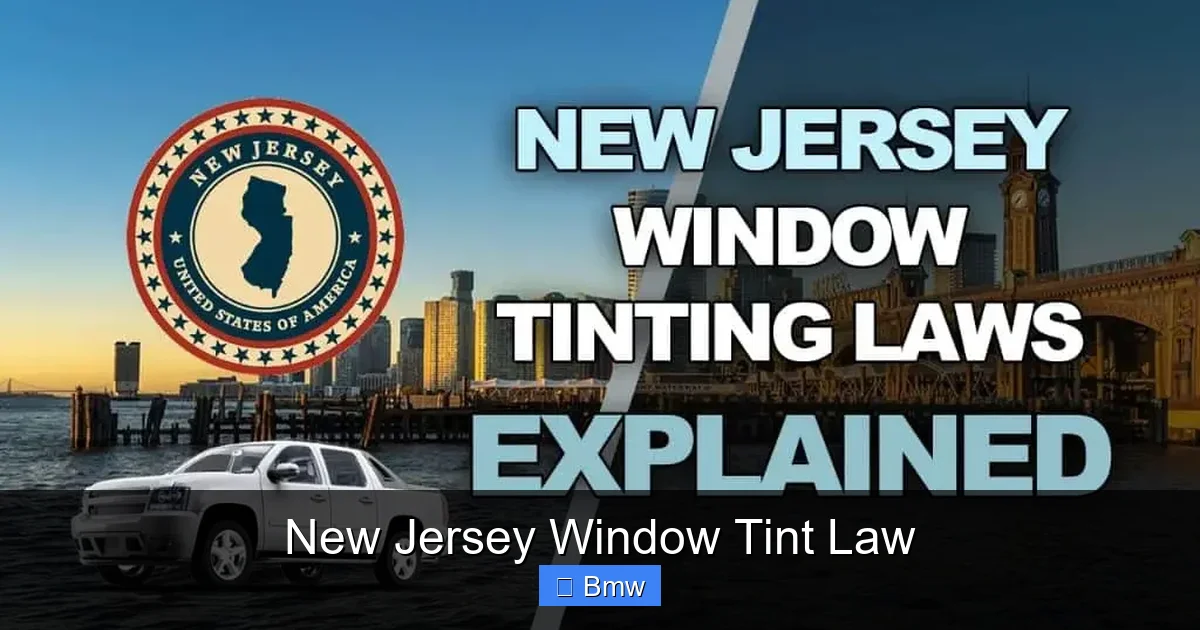
Front Windshield: Almost No Tint Allowed
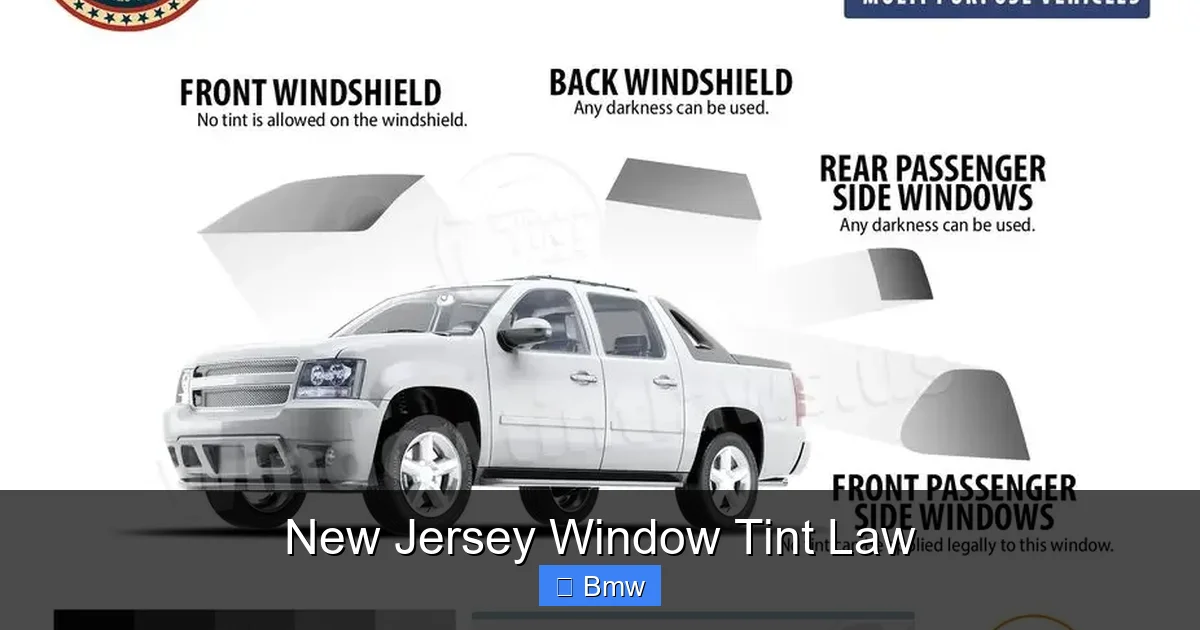
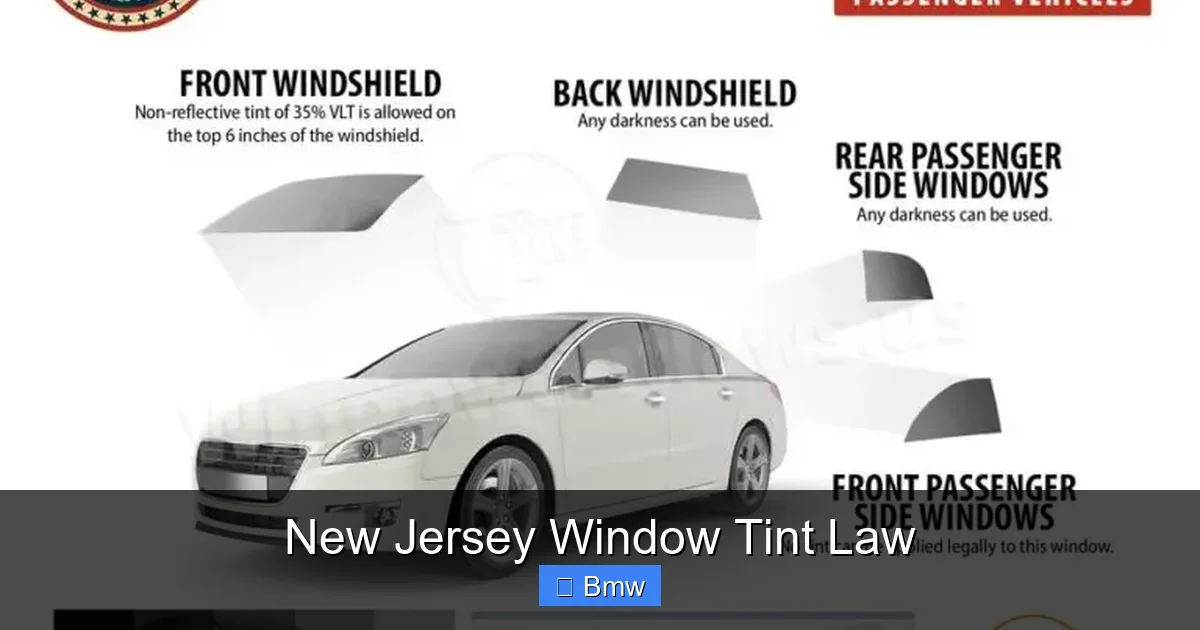
NJ law 39:3-74 explicitly states that no material or device may be applied to the front windshield that reduces the light transmitted through it. The only exception is a non-reflective, manufacturer-installed or dealer-installed visor strip across the top of the windshield. This strip must be no more than 6 inches in height and cannot extend below the AS-1 line (the line etched into the windshield by the manufacturer). Aftermarket “sun strips” or full windshield tint are illegal. This rule applies to all vehicles, including BMWs with advanced camera and sensor systems behind the mirror. Tinting the windshield can interfere with these systems, which is another major reason for the ban.
Front Side Windows: Minimum 70% VLT
The front driver and passenger side windows must allow at least 70% of light to pass through. This is a “factory plus” standard, meaning many factory-tinted front windows on newer BMWs (like some M models with optional packages) might already be at or near this limit. However, most standard BMWs come with clear glass front windows. Applying any aftermarket film that brings the VLT below 70% is a direct violation. For a BMW owner, this means the classic “two-tone” look—darker rear, lighter front—is legally mandated. You cannot have a uniform dark tint all around.
There is no medical exemption for the front windshield. Medical exemptions, where granted, only apply to the front side windows. We’ll cover exemptions in a later section. For now, assume your BMW’s front two windows must remain essentially clear.
Rear Windows: More Freedom, But Not Without Rules
The good news for BMW owners who love a dark, sleek look is that the rules for the rear are much more lenient. The rear side windows (behind the driver and front passenger) and the rear windshield can be tinted to any darkness you desire, from a subtle 50% to a deep 5% limousine tint. This allows for that popular “factory tint” look or even darker custom installations.
However, there is one crucial catch: if you tint the rear windshield, you must have two outside rearview mirrors on your vehicle—one on each side. This is standard on all modern BMWs, so this requirement is almost always met. The law is designed to ensure the driver has adequate rear vision without relying solely on a rear window that might be completely opaque. For BMWs with integrated mirror caps or camera-based systems, this isn’t an issue.
Many new BMWs, especially from the last decade, come from the factory with a rear window tint. This is almost always in the 15-20% VLT range and is perfectly legal. When in doubt, check your BMW’s window sticker (the Monroney label) under “Window Sticker” or “Exterior” for a “Solar Attenuating Glass” or “Privacy Glass” designation. The exact VLT isn’t always listed, but you can often find it in the owner’s manual or by contacting BMW customer service with your VIN.
Enforcement, Penalties, and the Inspection Station Connection
Understanding the law is one thing; understanding the real-world consequences is another. In New Jersey, tint violations are enforced actively by police and are automatically flagged during your mandatory annual vehicle inspection.
Visual guide about New Jersey Window Tint Law
Image source: windowtintlaws.us
The “Fix-It” Ticket and Fines
If an officer believes your BMW’s tint is too dark, they will typically issue a “fix-it” ticket (also called a “correctable violation”). This means you must get the illegal tint removed or replaced with legal tint and then provide proof (usually a receipt from a tint shop or a signed waiver) to the court or municipal office. There is also a fine associated with the ticket, which varies by municipality but often ranges from $50 to $150. Ignoring the ticket leads to increased penalties and possible suspension of your registration. The officer may also use a photometer on the spot to measure VLT, and their reading is generally accepted as evidence.
For BMW owners, this is a major hassle. Removing aftermarket tint is not trivial; it often requires a professional to avoid damaging the defroster lines or the glass itself. You’ll pay for removal and possibly re-tinting with a legal film. It’s an expensive lesson in pre-purchase research.
Annual Inspection Failure
New Jersey requires an annual safety and emissions inspection for all vehicles. The inspection station will check your window tint as part of the safety inspection. If they measure the front side windows below 70% VLT, they will fail your inspection immediately. You will receive a “reject” sticker and must correct the tint within a specified period (usually 7 days) and return for a re-inspection, often for a fee. Your registration cannot be renewed without a passed inspection. This creates a direct, unavoidable link between illegal tint and your ability to legally drive your BMW in NJ.
Some BMW owners mistakenly believe that because their car is a “luxury” or “performance” vehicle, they might get a pass. This is not true. The law applies equally to a Toyota Camry and a BMW M5. The inspection station’s photometer does not care about your badge.
BMW-Specific Considerations and Factory Tint
As a BMW owner, you have some unique factors to consider when navigating the New Jersey window tint law.
Visual guide about New Jersey Window Tint Law
Image source: windowtintlaws.us
Decoding Factory Tint vs. Aftermarket Tint
BMW offers “Privacy Glass” or “Solar Attenuating Glass” as a factory option on many models. This is applied at the factory during glass manufacturing, not as a film. It is permanent and integrated. Factory tint on the rear windows of a BMW is almost always legal in NJ. However, the front windows are almost always clear glass from the factory, with very rare exceptions on specific high-security packages. If your BMW has a darker-than-clear front window from the factory, it is almost certainly an aftermarket modification done by a previous owner.
How can you tell? Factory tint is usually uniform and has no bubbles, peeling edges, or scratches. It’s part of the glass itself. Aftermarket film will often have a slight sheen, may have minor imperfections, and you might feel a very slight edge where the film ends if it wasn’t done perfectly. The easiest test is to look at the rear window defroster lines. On factory tint, the lines are clearly visible and etched into the glass. On aftermarket film, the lines are often covered by the film and may appear fainter or not at all. If in doubt, a professional tint shop or glass shop can tell you instantly.
Sensors, Cameras, and Advanced Driver Assistance Systems (ADAS)
Modern BMWs are loaded with cameras and sensors behind the windshield: lane departure warnings, adaptive cruise control, automatic emergency braking, and rain-sensing wipers all rely on a clear, unobstructed view. Applying aftermarket tint to the front windshield is illegal, but even a very light film on the front side windows can sometimes interfere with side mirror camera systems (like the Around View Monitor) or blind-spot detection sensors located in the rear bumper that “see” through the rear side glass. While a 70% VLT film is legal, it’s wise to choose a high-quality, non-metallic film from a reputable brand to minimize any potential signal interference. Always ask your tint installer about ADAS compatibility.
The Used Car Purchase Trap
Buying a used BMW in New Jersey with dark tint? Proceed with extreme caution. The seller may not be aware it’s illegal, or they may be deliberately hiding it. Before you buy, do this: during your daytime test drive, look at the front side windows. If they appear significantly darker than the windshield or the rear windows, it’s likely illegal. Your next step is to take the car to a professional tint shop or an inspection station before finalizing the sale and ask them to measure the VLT. This $20-$50 check could save you hundreds in removal costs and a failed inspection later. If the tint is illegal, use it as a negotiating point to either have the seller remove it or lower the price to cover your removal costs.
Medical Exemptions: A Possible Loophole, But a Narrow One
New Jersey law does provide for a medical exemption from the front side window VLT requirements. This is not a casual “I like it dark” exemption. It is reserved for individuals with specific, documented medical conditions that are exacerbated by sunlight exposure.
Who Qualifies for a Medical Exemption?
The law lists conditions such as:
- Lupus erythematosus
- Xeroderma pigmentosum
- Porphyria
- Severe photosensitivity due to medication
- Other serious skin conditions as determined by a physician
The condition must be certified by a licensed physician (MD or DO) or dermatologist. The physician must state that the condition requires the patient to be shielded from ultraviolet and/or bright sunlight, and that the use of a motor vehicle with darker side window tint is medically necessary.
The Application Process
The exemption is not automatic. The driver must apply to the New Jersey Motor Vehicle Commission (MVC) with:
- A completed Application for Vehicle Window Tint Medical Exemption (Form MV-8).
- The original, signed certification from the physician.
- The required fee.
If approved, the MVC issues a special certificate and a decal that must be displayed on the lower left corner of the rear window. This decal is valid for as long as the physician’s certification is valid (up to 4 years). You must carry the MVC certificate in the vehicle at all times. Police will still be able to stop you, but you can show them the exemption documentation. The process is deliberate and paperwork-heavy, designed to prevent abuse. For a BMW owner without a qualifying condition, this path is not an option.
Practical Steps for a BMW Owner in New Jersey
So, what do you do if you want tint on your BMW and want to stay 100% legal in New Jersey?
Step 1: Know Your Factory Setup
Check your BMW’s window sticker or owner’s manual. Identify if you have factory privacy glass on the rear. If you do, you already have a legal, high-quality tint. Enjoy it. Do not add aftermarket film over factory tint, as it can cause bubbling and damage.
Step 2: If You Need Aftermarket Tint, Choose a Legal Package
For the rear windows, you have free rein. For the front side windows, you must select a film with a VLT of 70% or higher. Reputable NJ tint shops will only offer legal options. Ask them to show you the VLT chart. A quality shop will also use a meter to verify the film’s VLT before installation. For the front windshield, do not tint it. The 6-inch visor strip is legal, but it’s purely cosmetic and offers minimal benefit.
Step 3: Choose the Right Film Type
For a BMW, you want a film that won’t interfere with your electronics. Opt for a non-metallic, ceramic, or hybrid film. These are radio-frequency (RF) friendly and won’t disrupt keyless entry, GPS, or ADAS signals. Metallic films (dyed or metallized) can cause static and sensor problems. Ceramic films offer the best heat rejection without metallic content, but they are more expensive. Given the cost of a BMW, investing in a high-quality ceramic film for the rear is a wise choice for performance and longevity.
Step 4: Get It Done Professionally
Do not attempt a DIY tint kit on your BMW. The windows on a 5 Series or X5 are complex curves. A poor installation will bubble, peel, and look terrible. It will also likely fail inspection if the film is uneven or has defects. Pay for professional installation. A good shop will also provide a warranty on both the film and the labor. They will also give you a certificate of compliance stating the VLT percentage of the installed film, which you should keep with your vehicle documents.
Step 5: Keep Documentation
Keep your tint shop receipt and any certificate of compliance. If you are ever pulled over or go for inspection, having proof that you had legal film installed by a professional can be helpful, though the inspector’s meter reading is the final word.
By following these steps, you can enjoy the benefits of window tint on your BMW in New Jersey without the stress of tickets, failed inspections, or costly removals. Remember, when it comes to the New Jersey window tint law, the front windows are off-limits for darkness, the rear is your playground, and the windshield is a no-tint zone. Play by these rules, and you and your BMW will be good to go.
Frequently Asked Questions
Can I tint the front side windows of my BMW darker than 70% in New Jersey?
No. New Jersey law is absolute: the front driver and passenger side windows must allow at least 70% of light to pass through (70% VLT). Any film that makes them darker is illegal, regardless of your vehicle make or model. This includes any aftermarket film, even if it’s a high-end ceramic product.
My BMW came with dark tint on the rear windows from the factory. Is that legal?
Yes, in almost all cases. Factory-installed privacy glass on the rear windows and rear windshield is legal in New Jersey, regardless of its darkness. The law only restricts aftermarket tint on the front windows and windshield. You should verify your specific model’s factory tint percentage, but it is designed to comply with NJ law.
What are the penalties for having illegal tint on my BMW in NJ?
You will likely receive a “fix-it” ticket requiring you to remove or replace the illegal tint. You must show proof of correction to the court. There is also a monetary fine (typically $50-$150). Additionally, your vehicle will fail its annual state inspection, preventing you from renewing your registration until the tint is made legal.
Can I get a medical exemption for front window tint on my BMW in New Jersey?
Yes, but only for specific, severe photosensitive medical conditions like lupus or xeroderma pigmentosum. You must obtain a certification from a licensed physician and apply for an official exemption decal from the NJ MVC. The process is strict and not granted for general preferences like wanting a darker look or more privacy.
Will window tint interfere with my BMW’s sensors and cameras?
It can, especially metallic films. Many BMWs have cameras behind the windshield and sensors that rely on clear glass. While a legal 70% VLT non-metallic or ceramic film on the front sides is generally safe, any film on the front windshield is illegal and will certainly interfere with camera-based systems. For the rear, high-quality ceramic films are RF-friendly and safe for keyless entry and rear sensors.
I’m buying a used BMW in NJ with dark tint. How can I tell if it’s legal?
The easiest way is to have a professional tint shop or an official inspection station measure the VLT with a photometer before you buy. Visually, if the front side windows appear significantly darker than the windshield, they are likely illegal. You can also check for signs of aftermarket film (bubbles, edges, covering defroster lines) versus factory glass (defroster lines are clearly etched into the glass).