Michigan Window Tint Law

Contents
- 1 Key Takeaways
- 2 📑 Table of Contents
- 3 Decoding VLT: What That Percentage Really Means
- 4 The Specific Michigan Window Tint Law Breakdown
- 5 Exceptions, Exemptions, and Special Cases
- 6 Penalties, Enforcement, and What Happens If You’re Caught
- 7 Installation Requirements and Your Responsibilities
- 8 Practical Tips for the Michigan BMW Owner
- 9 Conclusion: Stay Cool, Stay Legal
- 10 Frequently Asked Questions

Carburetor Cleaner

Liquid Car Polish

Car MP3 Player

Radiator Coolant
Michigan window tint law allows non-reflective tint on the front windshield and front side windows, but with strict Visible Light Transmission (VLT) limits. The rear windows can be darker. Violations can lead to fines and fix-it tickets. This guide breaks down the exact percentages, medical exemptions, and enforcement rules specific to Michigan, ensuring your BMW or any vehicle remains compliant and road-legal.
So, you’re thinking about tinting the windows on your BMW. Maybe it’s to cut down the Michigan sun glare during those long summer drives around the Great Lakes, to add a sleek, custom look, or to increase privacy. Whatever your reason, before you head to the nearest tint shop, you absolutely need to understand the Michigan window tint law. It’s not a suggestion; it’s a legal requirement with specific rules that, if broken, can lead to tickets, fines, and a mandatory removal of your new tint. This guide will walk you through everything you need to know, from the exact legal percentages for your 3 Series or X5 to the subtle details that often trip people up.
Michigan’s laws are a bit of a mixed bag compared to some other states. They are relatively permissive for rear windows but quite strict for the front. This “dual” system means you have to pay close attention to which window you’re tinting. For a BMW owner, this is especially important because many modern BMWs come with factory-tinted glass from the manufacturer, usually around 20-30% VLT on the rear. You must know the difference between factory tint and aftermarket film and how the law treats them. We’ll clear all that up. Let’s dive in.
Key Takeaways
- VLT is Key: Michigan law measures tint darkness by Visible Light Transmission (VLT) percentage. Lower numbers mean darker tint.
- Front Window Rules: Front side windows must allow more than 70% of light in (VLT > 70%). The windshield can have non-reflective tint on the top 4 inches.
- Rear Window Freedom: The rear side windows and back windshield have no darkness limit for most vehicles, allowing very dark tint.
- Medical Exemptions: A signed affidavit from a physician can exempt you from the front-side window VLT rule for specific medical conditions.
- No Reflective/Mirrored Tint: Michigan prohibits any metallic or mirrored tint that creates a reflective appearance on any window.
- Penalties Apply: First offenses are typically “fix-it” tickets requiring correction, but repeated violations can lead to higher fines.
- Installers Must Certify: Tint installers in Michigan are required to provide a compliance certificate for every vehicle they tint.
📑 Table of Contents
- Decoding VLT: What That Percentage Really Means
- The Specific Michigan Window Tint Law Breakdown
- Exceptions, Exemptions, and Special Cases
- Penalties, Enforcement, and What Happens If You’re Caught
- Installation Requirements and Your Responsibilities
- Practical Tips for the Michigan BMW Owner
- Conclusion: Stay Cool, Stay Legal
Decoding VLT: What That Percentage Really Means
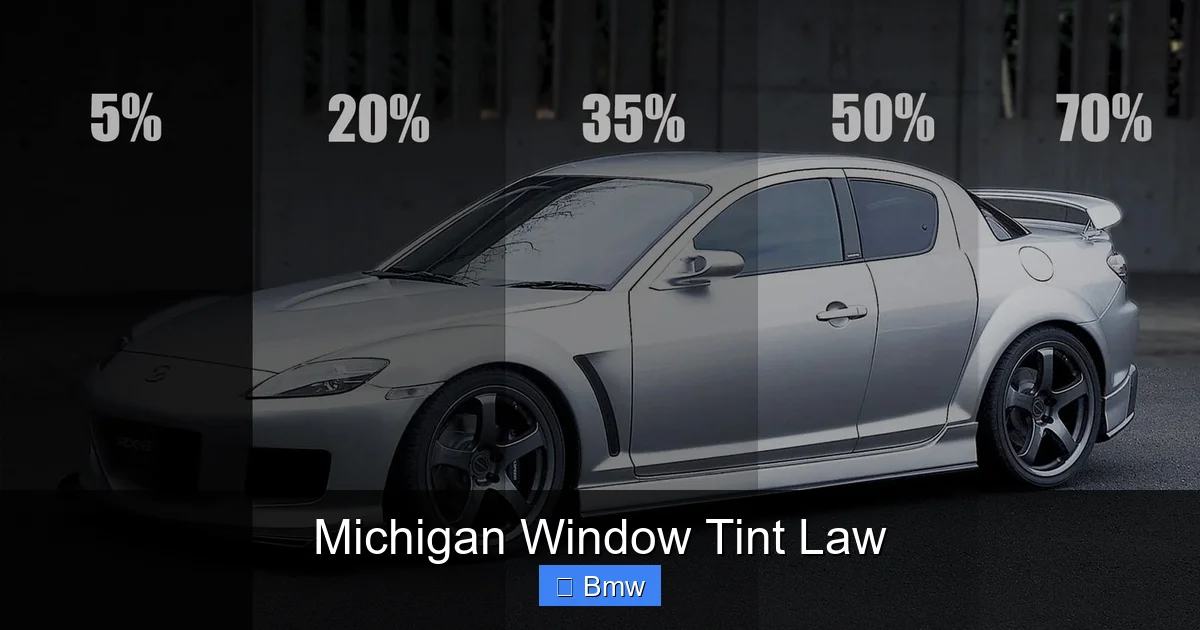
Before we talk Michigan rules, we need to speak the language. The entire law revolves around VLT, or Visible Light Transmission. This is the percentage of visible light that passes through your window glass and film combination. A VLT of 70% means 70% of outside light gets in, making the window quite clear. A VLT of 20% means only 20% of light enters, resulting in a very dark, private window.
How VLT is Measured and Tested
Law enforcement and certified inspectors use a device called a photometer or tint meter. This handheld tool is placed on the inside of the window and measures the amount of light that passes through. It’s a scientific measurement, not an opinion. The meter gives a direct VLT reading. This is why claiming “it looks legal” won’t save you; the objective number is what matters. For BMWs with complex curved glass, getting an accurate reading can sometimes be tricky, but the law applies uniformly.
Factory Tint vs. Aftermarket Tint: A Critical Difference
This is a huge point of confusion. Your new BMW likely has “factory tint” on the rear windows. This is actually dyed glass, not a film applied on top. The law in Michigan (and most states) treats this differently. The factory-installed tint is considered part of the original glass and is grandfathered in, regardless of its darkness. You can legally have a BMW with factory 20% rear glass because it was installed by the manufacturer. However, if you take that same car and apply a 20% aftermarket film over the already dark factory glass, you are now creating a combined VLT that is likely far darker than 20%, and you are violating the law because you are adding an aftermarket film. You must always calculate the combined VLT of glass + film. A reputable installer will know this and test your existing glass before recommending a film percentage. If you’re looking at how much it costs to tint a BMW 3 Series, part of that quote should include a VLT assessment of your current windows.
The Specific Michigan Window Tint Law Breakdown
Now for the nuts and bolts. Michigan Compiled Law 257.813 lays out the rules. Here is what they mean for your vehicle, broken down by window location.
Visual guide about Michigan Window Tint Law
Image source: low-offset.com
Front Windshield
This is simple. Michigan allows a non-reflective tint strip on the top of the windshield. The key word is “non-reflective.” You cannot have a mirrored or metallic film here. The tint strip must not extend more than 4 inches downward from the top of the windshield. This is primarily to block sun glare for the driver. For a BMW with a large, panoramic windshield, this 4-inch strip is often barely noticeable but provides some benefit. Anything beyond that is illegal.
Front Side Windows (Driver & Passenger)
Here is the big one. Michigan law is very clear: the front side windows must have a VLT of more than 70%. In plain English, this means you can only use a very light tint. Most standard “factory” glass is around 70-75% VLT. Applying any aftermarket film, even a clear UV-blocking film, will typically push you below 70% and make you non-compliant. This rule exists so law enforcement can clearly see inside the vehicle for safety purposes. For a BMW owner, this means your front doors should remain virtually clear. Many people mistakenly think they can put a 50% film on the fronts because it’s “legal” in other states, but in Michigan, that’s a guaranteed ticket.
Rear Side Windows and Rear Windshield
Michigan is much more lenient here. For passenger vehicles (sedans, coupes, wagons like a BMW 3 or 5 Series), there is no darkness limit specified for the rear side windows or the rear windshield. You can go as dark as you want, commonly 5% (limo tint) or anything in between. This is great for privacy and keeping your trunk area cool. However, for SUVs, vans, and trucks (like an BMW X3 or X5), the rule is slightly different. The rear side windows and rear windshield must allow more than 20% of light in (VLT > 20%). So an SUV can have dark tint, but not completely blacked-out rear windows. Always check your specific BMW model’s classification.
Exceptions, Exemptions, and Special Cases
The law isn’t just a blanket rule. There are specific situations where different standards apply.

Visual guide about Michigan Window Tint Law
Image source: tintinghub.com
Medical Exemptions
Michigan recognizes that certain medical conditions require protection from sunlight. Conditions like lupus, xeroderma pigmentosum, porphyria, or severe photosensitivity may qualify. To get an exemption for your front side windows (allowing darker than 70% VLT), you must:
- Obtain a signed affidavit from a licensed physician (MD or DO) stating your diagnosis and the need for window tint.
- Carry this signed affidavit in your vehicle at all times.
- The affidavit must be renewed as specified by the physician, typically annually.
- The tint must still be non-reflective. The medical exemption only changes the VLT requirement for the front sides.
This is not a “get out of jail free” card for any reason. The condition must be legitimate and documented. If pulled over, you must be able to present the notarized or signed affidavit to an officer.
Commercial Vehicles and Limousines
Vehicles used for hire (taxis, limousines) and certain commercial vehicles may have different standards, often allowing darker rear tint for passenger privacy. If your BMW is used as a registered livery vehicle, different rules may apply. For standard personal use, these commercial exemptions do not apply.
The “Factory Tint” Gray Area
As mentioned, factory-tinted glass is legal. The problem arises when people add film over it. If your BMW has 25% factory glass in the rear and you add a 20% film, the combined VLT is not 20%—it’s much darker (around 5-10%). You are now violating the law if your vehicle type requires a minimum VLT (like an SUV’s 20% rear rule). Always get a professional measurement before adding film over factory tint. You can learn more about what different percentages look like in real life to avoid mistakes.
Penalties, Enforcement, and What Happens If You’re Caught
Getting caught with illegal tint isn’t the end of the world, but it is a hassle with financial consequences.

Visual guide about Michigan Window Tint Law
Image source: windowtintinginlv.com
Type of Ticket: The “Fix-It” Ticket
In Michigan, a first-time window tint violation is typically issued as a “correctable” or “fix-it” ticket. This means you are not immediately fined a large sum. Instead, you are given a period (usually 30 days) to:
- Remove the illegal tint, OR
- Replace it with compliant tint, OR
- Obtain a valid medical exemption.
You must then get the vehicle inspected by a law enforcement officer or a designated official (often at a police station or Michigan Secretary of State office) who will sign off that the violation is corrected. Once signed, you mail the ticket portion back to the court, and the matter is closed with no fine.
Fines for Subsequent Offenses
If you are caught again within a certain period (often 1-2 years), the court may impose an actual fine. The amount varies by county and municipality but can range from $100 to $200 or more. The second offense will also likely not be a fix-it ticket. It’s simply not worth the risk or the time to keep going back to court. The cost of a window tint ticket can easily exceed the cost of having the tint professionally removed and replaced with legal film.
How and When You’ll Be Stopped
Police use tint meters during routine traffic stops. If your windows look excessively dark, especially the front sides, they will test them. You can also be stopped at official inspection stations or during a vehicle safety inspection. A tint violation is a primary offense in Michigan, meaning an officer can pull you over solely for that reason. It’s a common stop, especially in summer.
Installation Requirements and Your Responsibilities
The responsibility for compliance falls on the vehicle owner, but installers play a key role in Michigan.
Installer Certification
Michigan law requires that any person or business installing aftermarket window tint must provide the vehicle owner with a written statement (a “compliance certificate”) that includes:
- The installer’s name and address.
- The make, model, and year of the vehicle.
- The VLT percentage of the film installed on each window.
- A statement that the installation complies with Michigan law.
This certificate is your proof. Keep it in your glove compartment. If you are pulled over and claim your tint is legal, the officer may ask for this certificate. A professional installer will always provide this. If they don’t, that’s a major red flag.
Your Due Diligence
Before you tint, you must:
- Know Your Car’s Classification: Is your BMW a passenger car or an SUV? This changes the rear window rules.
- Test Your Factory Glass: Have a professional measure the existing VLT of your factory glass, especially on the rear.
- Choose the Right Film: Based on the test, select a film percentage that will result in a *combined* VLT that is legal. For front sides, you likely need a 70%+ (very light) film, if any at all.
- Get the Certificate: Ensure you receive the mandatory compliance certificate after installation.
Skipping these steps is how people end up with illegal tint. The most common car window tinting mistakes often involve not accounting for factory glass or misunderstanding state-specific VLT limits.
Practical Tips for the Michigan BMW Owner
Let’s bring it all together with actionable advice for you.
For a New BMW Purchase (With Factory Tint)
If your BMW already has dark rear glass from the factory, your main decision is about the front sides. Since the front must be >70% VLT, you have two practical choices: leave them completely stock (factory glass is usually compliant), or install a very high-quality clear ceramic film. This clear film blocks UV rays (protecting your interior from cracking and fading) and can provide a tiny bit of heat rejection without significantly darkening the window. It’s a great upgrade that stays legal. Avoid any film with a visible tint on the front doors.
For an Older BMW Without Factory Tint
If your car has clear glass all around, you have more options. You can legally tint the rear sides and back window as dark as you like (for sedans) or down to 20% (for SUVs). For the front sides, you must stick to a film that results in >70% VLT. This is often a “clear” or “70%” film. Remember, the goal for the front is UV protection and minimal heat rejection, not privacy. You can also consider just a clear UV film for all windows for maximum protection without changing appearance.
Choosing a Reputable Installer in Michigan
Don’t just pick the cheapest shop on Google. Call and ask: “Do you provide the state-mandated compliance certificate?” “Do you test the existing glass VLT before recommending a film?” “Can you guarantee the final VLT on the front windows will be above 70%?” A shop that knows Michigan law and is prepared to answer these questions is your best bet. They want a legal, lasting installation just as much as you do. You might also want to check out tools for perfect tinting if considering a DIY approach, but for legal certainty, professional installation is strongly recommended.
Conclusion: Stay Cool, Stay Legal
Navigating the Michigan window tint law doesn’t have to be complicated. The core principle is simple: very light or clear on the front two doors (VLT > 70%), and you have freedom on the rear (with the 20% minimum for SUVs). Always account for your factory glass, get a compliance certificate, and if you have a legitimate medical need, secure that paperwork. For your BMW, this means prioritizing UV protection and heat rejection on the front with a compliant film, and enjoying the privacy and style of darker rear tint where allowed. By following these guidelines, you can enhance your driving experience, protect your car’s interior, and avoid the headache of a fix-it ticket. When in doubt, consult with a certified Michigan tint installer who can give you specific advice for your exact BMW model and year. A little research upfront saves a lot of trouble down the road.
Frequently Asked Questions
Can I have 20% tint on my front windows in Michigan?
No. Michigan law requires front side windows to have a VLT of more than 70%. A 20% tint is far too dark and illegal. Only the rear windows can be tinted to 20% or darker depending on your vehicle type.
Does the Michigan window tint law apply to the front windshield?
Yes, but it’s less restrictive. You can have a non-reflective tint strip at the top of the windshield, but it cannot extend more than 4 inches downward. The rest of the windshield must remain clear.
What is the penalty for a first-time window tint violation in Michigan?
It is typically a “fix-it” or correctable ticket. You are given a short period (like 30 days) to remove or correct the illegal tint and then get the vehicle inspected for compliance. You usually avoid a monetary fine if you correct it promptly.
How do police test window tint darkness?
They use a handheld device called a tint meter or photometer. It is placed on the inside of the window and gives an objective, scientific reading of the VLT percentage. It is not based on visual guesswork.
My BMW has factory-tinted rear windows. Can I add a darker film over them?
You must be extremely careful. Adding film over factory tint creates a combined VLT that is darker than either layer alone. You must have the combined VLT measured to ensure it stays within the legal limit for your vehicle type (e.g., >20% for an SUV rear). It’s easy to accidentally go too dark.
Are there any colors of tint that are illegal in Michigan?
Yes. Michigan specifically prohibits any window tint that is “reflective” or “mirrored” in appearance, regardless of its darkness. This includes many metallic and chrome films. The tint must be a standard non-reflective dyed or ceramic film.