
Humid Climate Car Cover Issues: Causes, Risks, and How to Prevent Moisture Damage

Quick Answer
Humid climate car cover issues usually come from condensation, trapped moisture, slow drying, poor airflow, and a cover that stays damp against the vehicle. Humid air can reach its dew point against cooler body panels, causing water to form even when rain never penetrates the cover; the National Weather Service explanation of dew point helps explain why.
Problems to watch for
- Condensation: Humid air can leave water droplets beneath the cover after temperatures change.
- Slow evaporation: Dampness lasts longer when airflow around the vehicle is limited.
- Mildew and odors: Repeated damp storage can create musty conditions on the cover or nearby surfaces.
- Corrosion risk: Persistent moisture becomes more concerning around chips, exposed metal, fasteners, and existing corrosion.
- Paint rubbing: Moisture mixed with dust or grit can make a poorly fitted, moving cover more troublesome.
- Wet cover storage: Folding a damp cover can trap moisture inside the fabric and seams.
Best first move
- Remove the cover, dry both the vehicle and cover completely, then correct the airflow, fit, drainage, or cover-type problem before reinstalling it.
If you live somewhere muggy, rainy, coastal, or tropical, covering a car takes more thought than simply buying the most waterproof fabric. I pay almost as much attention to what happens under the cover as what lands on top of it.
This guide explains why humidity causes trouble, how to separate condensation from an actual leak, and how I would protect an everyday vehicle through long stretches of humid weather.
In This Guide
- Why Does Humidity Cause Problems Under a Car Cover?
- Is the Water Under Your Car Cover Condensation or a Leak?
- What Damage Can a Car Cover Cause in a Humid Climate?
- What Type of Car Cover Works Best in Humid Weather?
- How Do You Prevent Moisture Under a Car Cover?
- Frequently Asked Questions
- Final Takeaway
Why Does Humidity Cause Problems Under a Car Cover?
Humidity becomes a car-cover problem when moisture-laden air enters the space around the vehicle and cannot dry quickly. A cover can block rain while still allowing condensation to develop underneath.
Humidity describes water vapor in the surrounding air. The more useful concept for understanding condensation is often the dew point, which is the temperature at which water vapor begins condensing into liquid water.
Why condensation can appear beneath a dry cover
Imagine parking a warm vehicle during a humid evening. The body panels, glass, wheels, ground, and surrounding air do not all cool at exactly the same rate.
If a surface cools to the dew point, moisture can condense on it. That can happen without a hole in the cover and without rain reaching the paint.
I see this as the biggest misunderstanding around humid-weather cover use. Owners sometimes assume every wet patch proves the cover leaked.
- Warm, humid air: The air contains plenty of water vapor.
- Cooling vehicle surfaces: Metal and glass can change temperature as evening conditions change.
- Restricted drying: The cover can reduce air movement immediately around the body.
- Wet ground: Damp pavement, grass, or soil can keep the immediate parking area moist.
- Repeated weather cycles: Daytime heat followed by cooler nights can create recurring condensation conditions.
Breathable does not mean moisture-proof
A breathable cover is designed to allow some vapor movement through its material. It does not create a dry bubble around the car.
Likewise, a water-resistant or waterproof outer surface cannot stop moisture already present beneath the cover. The parking environment still matters.
Current Car and Driver car-cover testing evaluates factors such as weather protection, fit, material quality, and moisture resistance rather than treating every cover as a simple tarp.
The practical lesson is simple. In humid climates, water management needs both exterior protection and a realistic path for drying.
Section Takeaway: Humidity can create water beneath a car cover without rain leaking through it. Temperature changes, dew point, airflow, and the surrounding parking surface all influence how long that moisture remains.
Is the Water Under Your Car Cover Condensation or a Leak?
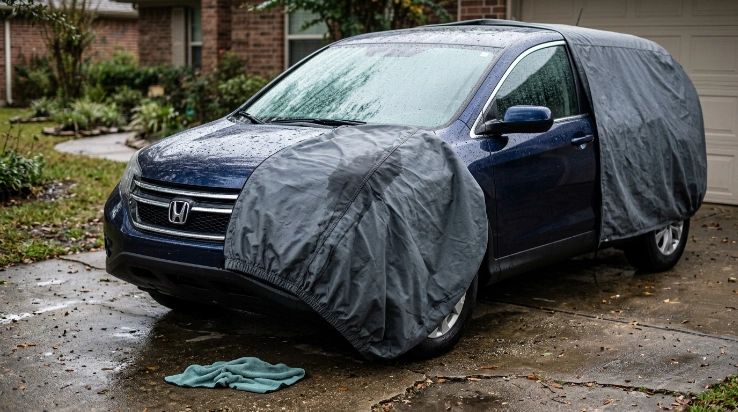
Check the moisture pattern before blaming the cover material. Condensation usually appears differently from rain entering through one damaged seam or worn area.
I start by removing the cover after the weather clears and inspecting both sides. Look at the roof, windshield, hood, trunk, mirrors, lower panels, seams, and elastic hems.
| What You Find | Likely Explanation | What to Check Next |
|---|---|---|
| Fine droplets spread across several panels | Condensation is likely | Humidity, dew point, airflow, wet ground |
| One wet stripe directly below a seam | Possible seam leakage | Seam damage, stitching, coating wear |
| Moisture after covering a recently washed car | Water was likely trapped during installation | Drying time before covering |
| Wet lower areas after heavy rain | Splash, runoff, wicking, or wet-ground exposure | Parking surface, hem position, drainage |
| Repeated wetness in exactly one location | Localized cover or vehicle issue | Tear, seam, trim opening, seal, drainage path |
Check the inside of the cover
The inner surface often gives you another clue. A concentrated damp area can point toward a particular seam, fold, or worn section.
Uniform light dampness is more consistent with humid-air condensation. That becomes especially plausible after a warm day followed by a cooler night.
Do not reinstall it immediately
If the car is wet underneath, remove the cover and let both surfaces dry. Putting the same damp cover straight back on only resets the moisture problem.
- Remove the cover without dragging it across dirty paint.
- Inspect the vehicle for droplets, staining, or persistent wet areas.
- Check both sides of the cover.
- Spread or hang the cover so air reaches damp fabric.
- Let the vehicle dry completely.
- Correct obvious leaks, drainage problems, or poor fit before covering again.
For general ownership checks beyond the cover itself, the Kelley Blue Book maintenance center provides broader vehicle-care guidance for everyday owners.
Section Takeaway: A wet car does not automatically mean a leaking cover. The distribution of the water, recent weather, vehicle temperature, seams, and parking surface usually reveal more.
What Damage Can a Car Cover Cause in a Humid Climate?
A properly used cover does not automatically damage a vehicle in humid weather. Trouble develops when moisture, contamination, poor fit, and long exposure overlap.
The risk is higher when the owner rarely removes the cover to inspect what is happening underneath.
Persistent moisture around exposed metal
Modern automotive paint and clear coat provide strong barriers when intact. Chips, scratches, damaged seams, fasteners, and existing corrosion deserve more attention.
If water stays around exposed metal repeatedly, I would correct that condition rather than trusting the cover to solve it.
Mechanic Alert: If you find spreading corrosion, bubbling paint, damaged body seams, or structural rust, have a qualified repair or body professional inspect the area.
Mildew and musty odors
A damp cover left wet for extended periods can smell musty. Moisture combined with dirt and poor airflow also creates an unpleasant storage environment.
This problem often begins after someone removes a rain-soaked cover, folds it tightly, and places it in the trunk. The cover never gets a proper drying cycle.
- Dry before folding: Check seams and thick hems because they can remain damp after the main fabric feels dry.
- Keep it clean: Organic debris and grime make damp storage worse.
- Use airflow: Spread the fabric rather than leaving it balled up.
- Check storage bags: Do not seal a damp cover inside a closed container.
Paint rubbing and contamination
Humidity itself does not sand your clear coat. Dirt trapped between a moving cover and the paint is the bigger concern.
A loose cover can shift in wind, especially around corners, mirrors, roof edges, and bumpers. Add grit, and repeated movement becomes something I try hard to avoid.
I always prefer putting a cover on a reasonably clean vehicle. I also keep the inside of the cover away from dirty pavement during removal.
Water spots and residue
Water that repeatedly dries on paint or glass can leave mineral residue depending on the water source. This is one reason I do not leave a visibly wet vehicle covered for days.
If you are assessing the wider condition of an older or stored car, Consumer Reports’ car maintenance and repair resources provide useful background on keeping a vehicle in good condition.
Section Takeaway: The most concerning humid-climate combination is moisture plus time plus contamination. A clean, dry vehicle and regularly inspected cover reduce those variables substantially.
What Type of Car Cover Works Best in Humid Weather?
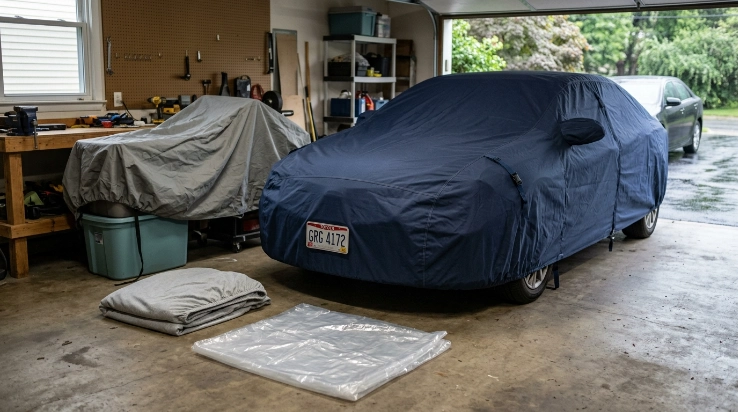
For a humid climate, I look for balanced moisture management rather than the most aggressive waterproof claim on the package. Fit, breathability, weather resistance, inner-surface quality, and secure fastening all matter.
The right choice also depends on whether the vehicle lives in a garage, under a carport, or fully outdoors.
| Cover Type | Best Use | Humid-Climate Concern |
|---|---|---|
| Breathable indoor cover | Enclosed garage | Does not protect adequately from outdoor rain |
| Fitted outdoor weather-resistant cover | Driveway or exposed parking | Still needs drying and periodic inspection |
| Loose universal cover | Occasional protection when sized correctly | Excess material can move in wind |
| Non-breathable plastic sheet | Limited temporary applications | Poor moisture management for routine vehicle storage |
Prioritize a secure fit
I want enough shape that the cover follows the car without large loose panels. It should not require excessive stretching around mirrors, spoilers, antennas, or trim.
Secure straps or other manufacturer-designed fastening points can help control movement outdoors. Never improvise attachments that could strike or scratch the body.
Look beyond the word “waterproof”
Rain protection matters outdoors, especially during long wet seasons. However, water from the sky is only one source of moisture.
A humid parking area can still place moisture beneath a waterproof outer layer. That is why drying speed and vapor movement matter too.
Match the inner surface to your paint
The material touching the vehicle should be clean and suitable for painted surfaces. Dirt embedded in the liner changes the equation.
I would also replace a cover once its lining becomes rough, contaminated, deteriorated, or difficult to clean. Old fabric does not become safer merely because it still keeps some rain away.
Section Takeaway: In humid weather, the best car cover is not simply the one that blocks the most water. Choose a secure, paint-friendly cover that suits the parking environment and can dry properly between wet cycles.
How Do You Prevent Moisture Under a Car Cover?
You cannot remove humidity from outdoor air, but you can reduce how long water stays trapped around the vehicle. My routine focuses on starting dry, maintaining airflow, controlling contamination, and checking the car after wet weather.
1. Never cover a dripping-wet vehicle for long storage
Give a washed or rain-soaked car time to dry before covering it for an extended period. Pay attention to mirrors, trim gaps, door handles, spoilers, and other places where water hides.
A few remaining droplets are different from deliberately trapping a soaked car. The goal is to avoid starting a storage period with excess water already present.
2. Keep the cover itself dry
A damp liner transfers moisture directly into the space you are trying to protect. Check both surfaces before installation.
If the cover was recently removed during rain, spread it open. Let seams, straps, elastic sections, and thick fabric dry fully.
3. Avoid wet or poorly drained parking areas
A puddled driveway or constantly damp patch of ground can keep the area beneath the car humid. Improve drainage or move the vehicle when practical.
Grass and soil also stay damp longer than many paved surfaces after rain. The immediate microclimate around the vehicle matters.
4. Inspect after major rain or sharp temperature changes
I would not leave an outdoor-covered vehicle untouched for weeks during a humid rainy season. Periodic checks catch condensation, leaks, loose straps, contamination, and pooling early.
- Lift the cover and inspect the roof and glass.
- Check the hood, trunk, and lower body panels.
- Feel the inner cover surface for dampness.
- Look for water pooling in sagging fabric.
- Check straps and hems for movement.
- Dry everything before reinstalling if moisture is present.
5. Keep the car and inner liner clean
Dust becomes more concerning when the cover moves against the vehicle. Sand and road grit are especially worth removing first.
I avoid dragging the inside surface across pavement during installation. When folding the cover, I also try to keep its paint-contacting side away from the dirty outer surface.
6. Watch the forecast’s dew point, not just rain
A clear forecast does not guarantee a dry vehicle. Condensation can form during humid overnight cooling even when no precipitation falls.
The National Weather Service explains that dew point represents the temperature at which condensation occurs. When air temperature approaches dew point, conditions are favorable for moisture to appear on cooler surfaces.
7. Let a stored vehicle breathe periodically
For long-term storage, occasional inspection is more useful than assuming the cover can be ignored indefinitely. Remove it during suitable dry conditions and check the vehicle.
For broader scheduled-maintenance planning during storage, Edmunds’ car maintenance resources can help you keep the rest of the vehicle from being overlooked while you focus on exterior protection.
Section Takeaway: Prevention comes down to drying, cleanliness, drainage, correct fit, and inspection. A car cover works best as part of a storage routine, not as a substitute for one.
Frequently Asked Questions
Should I use a car cover in a humid climate?
Yes, you can use a car cover in a humid climate when the cover suits the storage environment and you manage moisture properly. Start with a clean, dry car, use an appropriate fitted cover, and inspect underneath it after wet or muggy weather.
Can a breathable car cover still get condensation underneath?
Yes. Breathable material can help vapor escape, but it cannot prevent every condensation event. If a vehicle surface cools to the surrounding air’s dew point, water can form beneath the cover even when the fabric itself is working as designed.
Is a waterproof car cover bad in humid weather?
Not automatically. Outdoor cars often need strong rain protection, but waterproofing does not eliminate humidity beneath the cover. Look at the complete design, including breathability, fit, drying characteristics, seams, inner material, and fastening system.
Why is my car wet under the cover when it did not rain?
Condensation is a likely explanation. Humid air can cool against the vehicle until it reaches its dew point, causing liquid water to form on the body or glass even during rain-free weather.
How often should I remove a car cover in humid weather?
There is no universal interval for every climate and cover. I would inspect more frequently during prolonged rain, high humidity, major temperature swings, or long outdoor storage, especially if you have found condensation underneath before.
Can moisture under a car cover cause rust?
Persistent moisture can contribute to corrosion concerns, especially where metal is already exposed by chips, scratches, damaged coatings, or existing rust. If you repeatedly find wet areas, correct the moisture source rather than continuing to cover the vehicle unchanged.
Should I cover my car immediately after washing it?
I would let the vehicle dry first, especially before long-term storage. Water can remain around mirrors, trim, handles, panel gaps, and other hidden areas after the main painted surfaces look dry.
Final Takeaway
Humid climate car cover issues usually come down to moisture management. The biggest mistake is assuming that a waterproof cover automatically creates a dry environment underneath.
Start with a clean, dry vehicle and a clean, dry cover. Choose a fitted design appropriate for your parking conditions, then inspect it during extended periods of wet or humid weather.
If you discover condensation, remove the cover and let everything dry completely. Repeated dampness is a signal to investigate airflow, drainage, fit, cover condition, or the parking environment rather than simply covering the car again.
That small amount of attention can make a car cover much more useful. In humid climates, the goal is not only to keep rain off the car but also to give unwanted moisture a way out.
