
How to Tighten a Car Cover: Step-by-Step Guide

Quick Answer
To tighten a car cover, first center it over the vehicle and pull the elastic hems securely below the front and rear bumpers. Then tighten the cover’s built-in straps, buckles, or drawcords until the fabric is snug without stretching the seams; proper sizing and fastening are also important factors highlighted in current car-cover testing from Car and Driver.
Quick tightening steps
- Center the cover: Align the front, rear, mirrors, and seams before applying tension.
- Seat both hems: Pull the elastic edges below the front and rear bumpers.
- Remove loose folds: Smooth large pockets of fabric without stretching the material.
- Tighten the straps: Secure only the straps, buckles, or cords designed for your cover.
- Check for movement: The cover should stay close to the body instead of ballooning or flapping.
- Do not overtighten: Excess tension can strain seams, elastic, grommets, and mirror pockets.
Before you walk away
- Confirm that no strap, buckle, hook, or cable is rubbing directly against painted bodywork.
A loose car cover can turn a simple protection job into a frustrating one. Wind catches the extra material, the cover shifts, and fabric may keep moving across the paint.
I use a simple approach: fix the fit first, then tighten the retention system. This guide explains how to tighten a car cover safely, whether yours uses elastic hems, belly straps, buckles, drawcords, or locking grommets.
In This Guide
- How Tight Should a Car Cover Be?
- How Do You Tighten a Car Cover Step by Step?
- How Do You Tighten Different Types of Car Covers?
- How Do You Stop a Car Cover From Flapping in the Wind?
- Why Is My Car Cover Still Loose After Tightening?
- What Should You Avoid When Tightening a Car Cover?
- Frequently Asked Questions
How Tight Should a Car Cover Be?
A car cover should be snug enough to limit flapping but loose enough to avoid stretching its fabric, seams, elastic, and attachment points. Tightening harder cannot compensate for a badly sized cover.
Definition: A properly tightened car cover follows the basic shape of the vehicle while its intended retention system prevents large sections from lifting, sagging, or ballooning.
What does a properly tightened cover look like?
Start by looking at the front and rear. Both lower hems should sit where the manufacturer intended instead of riding high on the bumpers.
- Front-to-rear alignment: The cover is centered instead of pulling toward one end.
- Mirror alignment: Mirror pockets, when provided, sit naturally over the mirrors.
- Controlled side panels: Large sections do not hang several inches away from the body.
- Secure lower edge: Wind cannot easily get beneath an exposed corner.
- Relaxed seams: Stitching and panel seams do not look stretched or distorted.
Snug does not mean stretched
Owners sometimes pull every strap as hard as possible because tighter feels safer. That can shift the load from the cover’s fit to relatively small buckles, seams, grommets, or elastic sections.
A better test is movement. Give the cover a gentle tug at several areas and check whether it returns to position without sliding across the vehicle.
As of 2026, car covers range from simple universal shells to model-specific covers with multiple underbody straps. The correct tension therefore depends on the fastening system supplied with your cover.
Section Takeaway: A secure cover follows the vehicle without looking stretched. If tightening creates distorted seams or strained attachment points, back off the tension.
How Do You Tighten a Car Cover Step by Step?
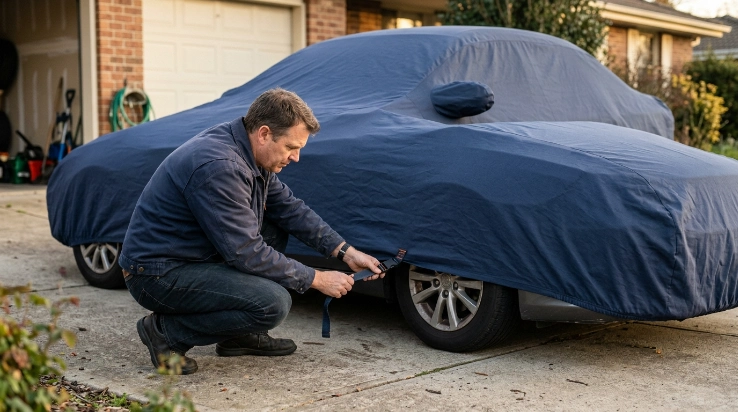
The safest way to tighten a car cover is to position it correctly before touching the straps. Trying to pull an off-center cover tight usually creates tension in the wrong places.
- Start with a clean, dry vehicle. Remove noticeable dirt, grit, leaves, or moisture before installation.
- Identify the front and rear. Look for labels, mirror pockets, antenna openings, or the manufacturer’s orientation markings.
- Center the cover. Spread it evenly over the roof, hood, trunk, and sides.
- Seat the elastic hems. Pull the front hem below the front bumper and the rear hem below the rear bumper.
- Smooth large loose areas. Move excess fabric toward its natural position instead of stretching one section.
- Fasten the retention system. Connect the supplied belly straps, buckles, drawcords, or wheel-area straps.
- Tighten gradually. Alternate between attachment points instead of fully tightening one strap first.
- Perform a final movement check. Look for corners or broad panels that still lift easily.
Why tighten each strap gradually?
Gradual adjustment helps keep the cover centered. Pulling one belly strap fully tight can drag the entire cover sideways before the opposite areas are secured.
I prefer making a light first pass around the vehicle. I then return to each fastening point and remove only the remaining slack.
- Check the front hem.
- Check the rear hem.
- Inspect both sides.
- Confirm mirror-pocket alignment.
- Check every buckle or strap.
Do a final paint-contact check
Make sure plastic buckles, hooks, cable locks, and loose strap ends cannot repeatedly hit the body. Soft fabric does little good if hard hardware is tapping against the paint.
Keeping both surfaces reasonably clean also matters because movement over trapped grit can increase the chance of visible marks. General exterior-care guidance is available through Consumer Reports’ automotive resources.
Section Takeaway: Position first and tighten second. A centered cover usually needs less tension than one that was pulled tight while misaligned.
How Do You Tighten Different Types of Car Covers?
Different retention systems solve the same basic problem in different ways. Use the components designed into your cover rather than improvising aggressive attachment methods.
| Cover Type | Best Tightening Method | What to Avoid |
|---|---|---|
| Elastic-hem cover | Seat front and rear hems fully below the bumpers | Stretching the fabric to compensate for weak elastic |
| Buckle-strap cover | Connect each supplied strap and remove slack gradually | Cranking one strap tight while others remain loose |
| Drawcord cover | Pull the cord until the lower opening sits securely | Pulling until the hem puckers or seams distort |
| Grommet-and-cable cover | Use the cable mainly for retention or security | Using the grommets to tension the entire cover |
| Custom-fit cover | Seat fitted panels correctly, then secure supplied straps | Forcing incorrectly aligned mirror or spoiler pockets |
What about universal-fit covers?
Universal covers usually leave more unused material because one pattern must accommodate many vehicles. Correct vehicle measurements therefore become especially important.
Car and Driver’s 2026 cover testing also emphasizes proper sizing and fit across different cover designs. A cover that is fundamentally oversized may remain loose even after every supplied strap is secured.
- Too much length: Excess material gathers around one or both bumpers.
- Too much width: Large side panels hang away from the doors.
- Too much height: Fabric forms loose pockets around the roofline.
- Wrong body shape: A nominally correct size still fails to follow your vehicle’s contours.
Section Takeaway: Tightening methods vary, but correct sizing comes first. Retention hardware should stabilize the cover rather than reshape an oversized one.
How Do You Stop a Car Cover From Flapping in the Wind?
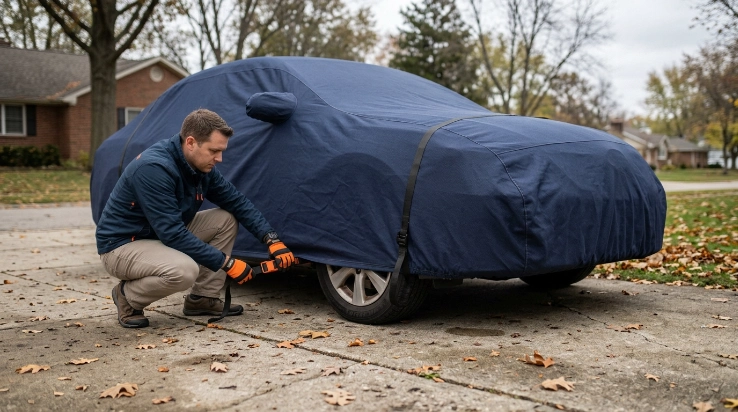
To stop a car cover from flapping, reduce the amount of fabric that wind can lift and make sure every intended fastening point is engaged. Start with the hems before adding tension elsewhere.
Check the wind-entry points first
Wind often gets underneath through a loose corner or side panel. Once air enters, the cover can inflate like a shallow balloon.
- Seat both bumper hems completely.
- Connect every supplied underbody strap.
- Close adjustable buckles.
- Secure manufacturer-provided wheel-area straps.
- Recheck loose corners after the main straps are tightened.
If the cover still develops large pockets of air, inspect its size and shape. More strap tension may not solve the actual problem.
Use wind straps only as intended
Some outdoor covers include straps that pass beneath the vehicle and connect at opposite sides. These can control the broad center sections that elastic hems alone may not hold.
Keep straps away from hot exhaust components, sharp edges, moving parts, and areas where hardware could contact the paint. Follow the cover manufacturer’s routing instructions whenever they are available.
A locked car cover also should not be treated as a complete vehicle anti-theft system. For vehicle-security practices, see the NHTSA vehicle theft prevention guidance.
Section Takeaway: Wind control comes from closing entry points and controlling loose fabric. Extra tension cannot reliably fix an oversized or poorly shaped cover.
Why Is My Car Cover Still Loose After Tightening?
A cover that remains loose after correct installation usually has a sizing, elastic, strap, or shape problem. Identify which one applies before adding another fastening device.
| What You See | Likely Cause | What to Do |
|---|---|---|
| Large folds everywhere | Cover may be oversized | Recheck the manufacturer’s sizing chart |
| One end stays loose | Cover may be off-center | Remove tension, recenter, and reinstall |
| Hem slips off repeatedly | Elastic may be stretched or damaged | Inspect the hem and consider replacement |
| Center balloons in wind | Underbody retention may be loose | Check the intended belly straps or buckles |
| Mirror pockets pull sideways | Alignment or shape may be wrong | Recenter before tightening again |
Check worn elastic and straps
Retention components age along with the rest of the cover. Elastic can lose tension, buckles can crack, stitching can loosen, and straps can stretch or fray.
Inspect those parts while the cover is off the vehicle. Replacement is often safer than repeatedly tightening damaged hardware.
Know when the size is the real problem
If correctly positioned fabric still forms broad hanging panels, stop tightening. Compare the vehicle’s dimensions and body style against the cover manufacturer’s fit chart.
When shopping for a replacement, broader vehicle buying and ownership information is also available through Kelley Blue Book.
Section Takeaway: Persistent looseness is usually a fit or wear problem, not a lack-of-force problem. Diagnose the cause instead of tightening harder.
What Should You Avoid When Tightening a Car Cover?
Avoid anything that puts concentrated force on the cover or creates hard contact against the vehicle. Car-cover retention works best when tension is spread across the components designed to carry it.
- Do not overtighten straps: Stop if seams, grommets, or panels begin to distort.
- Do not rely on locking grommets alone: They may secure a cable without controlling the entire cover.
- Do not attach hooks to random vehicle parts: Sharp or moving components can damage straps or the vehicle.
- Do not trap loose hardware against paint: Buckles and hooks should not repeatedly strike body panels.
- Do not cover heavy dirt: Grit beneath a moving cover can work against the finish.
- Do not cover a wet vehicle unnecessarily: Moisture needs an opportunity to escape.
- Do not use tightening as a sizing fix: Excess fabric will remain excess fabric.
Should you use bungee cords?
I would not make generic bungee cords my first choice when the manufacturer already provides a retention system. Their hooks and concentrated tension may create contact points the cover was never designed to handle.
If your cover needs extra wind retention, look for compatible accessories from its manufacturer. That keeps the attachment method closer to the original design.
Inspect the cover after bad weather
Wind can change strap tension and expose weaknesses that were not obvious during installation. Check the cover after unusually windy weather instead of assuming yesterday’s adjustment is still correct.
- Look for pulled stitching.
- Inspect elastic hems.
- Check grommets for distortion.
- Confirm buckles still lock securely.
- Look for frayed or twisted straps.
- Make sure the cover remains centered.
Section Takeaway: Use the cover’s intended retention system and distribute tension evenly. More force is not automatically more protection.
Frequently Asked Questions
How tight should I pull my car cover straps?
Pull the straps until obvious slack is removed and the cover stays close to the vehicle. Stop before seams, grommets, buckles, or fabric begin stretching noticeably. The goal is controlled movement, not maximum tension.
Why does my car cover keep blowing off?
A cover can blow loose because it is oversized, installed off-center, missing its underbody straps, or held by worn elastic. Start by centering both hems correctly, then secure every manufacturer-provided fastening point before considering extra accessories.
Can I tighten an oversized car cover?
You can reduce some looseness with the supplied straps, but tightening cannot completely correct an oversized cover. If large folds remain after proper installation, compare the cover dimensions with your vehicle and consider a better-fitting size.
Can a car cover be too tight?
Yes. A cover is too tight when fitting it requires excessive stretching or when seams, mirror pockets, hems, or attachment points remain under obvious tension. An undersized cover may also keep slipping from one end as you pull the opposite end into place.
How do I secure a car cover without straps?
First make sure its elastic front and rear hems sit completely below the bumpers. If the cover was designed without additional straps, consult its manufacturer’s recommended wind-retention accessories instead of attaching improvised hooks directly to the vehicle.
Should a car cover move in the wind?
A small amount of fabric movement can occur outdoors, but large-scale flapping, ballooning, or repeated sliding signals a problem. Check the size, positioning, elastic, and retention system before simply increasing tension.
Should I tighten my car cover every time I use it?
Check its fit each time you install it, especially outdoors. Straps can be adjusted during installation, while elastic hems and buckles should be inspected periodically for wear. After strong winds, check the cover again for shifting or damage.
Final Takeaway: The best way to tighten a car cover is simple: center it, seat the hems, remove loose folds, and gradually secure the manufacturer’s straps or cords. If the cover still flaps after that, investigate sizing or worn retention parts instead of pulling harder.
A well-fitted cover should protect your daily driver without becoming another maintenance problem. Get the fit right first, and the tightening process becomes much easier.