
How to Stop Car Cover Scratching Paint: A Practical 2026 Guide

Quick Answer
To stop a car cover scratching paint, put it only on clean, dry paint and keep the inside of the cover clean. Use a properly fitted cover that cannot flap heavily in wind, and lift the fabric during installation instead of dragging it across body panels. The same contamination-control principle appears in Consumer Reports’ car-washing guidance, which recommends removing loose dirt before rubbing the finish.
5 Steps That Reduce Car Cover Scratches
- Clean the paint: Remove dust, sand, pollen, and road grime before installing the cover.
- Clean the lining: Never put a gritty or ground-contaminated cover back onto the vehicle.
- Check the fit: Excess fabric should not flap repeatedly across mirrors, fenders, or roof edges.
- Lift, don’t drag: Install and remove the cover by lifting and folding sections instead of pulling them sideways.
- Keep both dry: Let the vehicle and cover dry before putting them together.
Fast Diagnostic Tip
- If scratches concentrate around mirrors, roof edges, spoilers, or fenders, inspect cover movement and fit first.
If you’re trying to figure out how to stop car cover scratching paint, the cover material is only part of the story. Dirt, movement, fit, and the way you handle the cover usually matter just as much.
I treat a car cover much like a giant detailing towel. Once the paint-side surface becomes contaminated with grit, I don’t want it sliding across a daily driver’s clear coat.
In This Guide
- Why Does a Car Cover Scratch Paint?
- How Do You Stop a Car Cover From Scratching Paint?
- What Type of Car Cover Is Safest for Paint?
- How Should You Put On and Remove a Car Cover?
- What Should You Do If the Cover Already Scratched the Paint?
- When Should You Skip Using a Car Cover?
- Frequently Asked Questions
Why Does a Car Cover Scratch Paint?
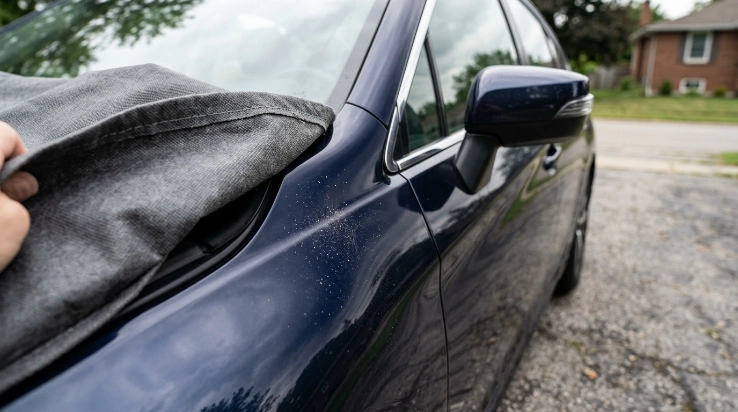
A car cover can contribute to scratches when abrasive contamination becomes trapped between the fabric and the paint. Movement then drags those particles across the clear coat.
Paint marring means light surface defects such as fine scratches, haze, or swirl-like marks in the vehicle’s clear coat. The clear coat is the transparent protective paint layer above the colored base coat on most modern vehicles.
Is the car cover fabric itself causing the scratches?
Sometimes, but not always. A clean, paint-safe fabric touching clean paint is a different situation from the same fabric pressing against sand or road dust.
The combination I watch is simple: contamination + pressure + movement. Remove any one of those factors and you reduce the risk.
| What You Notice | Likely Cause | What to Do |
|---|---|---|
| Fine random marks | Dust or grit under the cover | Wash the vehicle and clean the cover |
| Marks around mirrors or fender peaks | Repeated fabric movement | Improve fit and secure the cover |
| Long straight scratches | Cover dragged during removal | Lift and fold instead of pulling |
| Hazy repeated contact areas | Dirty lining or loose fit | Inspect lining, sizing, and tie-downs |
Why does wind make the problem worse?
Wind can repeatedly move loose fabric across the same contact points. Mirrors, spoilers, roof edges, fenders, and bumper corners often receive more rubbing than flat central panels.
- Loose side panels: Wind can push them inward and pull them away repeatedly.
- Oversized covers: Extra fabric gives wind more material to move.
- Worn elastic: Old hems may no longer hold the cover tightly around the vehicle.
- Unused straps: A cover designed for tie-downs may move excessively if they aren’t secured.
That is why a soft lining alone doesn’t guarantee scratch-free use. A soft surface contaminated with abrasive particles can still mark paint.
How Do You Stop a Car Cover From Scratching Paint?
The best prevention routine is to control what touches the paint before the cover goes on. Start with a clean vehicle, a clean cover, and as little unnecessary fabric movement as possible.
1. Never cover obviously dirty paint
If the vehicle has visible sand, dusty road film, dried mud, or gritty pollen, clean it first. Putting a cover over that contamination traps abrasive material exactly where you don’t want it.
Kelley Blue Book also recommends regular cleaning with appropriate products and soft materials as part of long-term exterior car care.
2. Inspect the inside of the cover
Run a clean hand over the lining before installation. Look for grit, leaves, dried dirt, hardened stains, or small debris caught in seams.
- Don’t place the paint-side lining on pavement.
- Don’t drag the cover across a garage floor.
- Don’t fold a dirty exterior surface into the clean lining carelessly.
- Follow the cover maker’s cleaning instructions.
- Let the cover dry fully before storage.
3. Check how tightly the cover fits
A car cover should fit securely without excessive loose fabric. It also shouldn’t require force to stretch over mirrors, spoilers, antennas, or other body features.
I pay special attention to the cover after it is fully installed. Large suspended folds or panels that can balloon easily are warning signs outdoors.
4. Keep the vehicle dry before covering it
Don’t install the cover immediately after washing while water remains around trim, mirrors, panel seams, or badges. Dry the vehicle and check the cover too.
Moisture doesn’t create scratches by itself, but wet contamination can stay trapped against the finish. A damp cover can also become harder to handle cleanly.
5. Don’t depend on wax or ceramic coating to stop abrasion
Wax, sealants, and ceramic coatings can help protect a vehicle’s finish in different ways. None should be treated as permission to rub grit across the surface.
As of 2026, my rule remains simple: protect the protective layer too. Keep the contact surfaces clean even when the vehicle has paint protection.
Section Takeaway: Preventing car cover scratches comes down to cleanliness, fit, dryness, and controlled movement. A premium cover cannot compensate for dirt trapped between the fabric and paint.
What Type of Car Cover Is Safest for Paint?
The safest car cover is one designed for your storage environment that fits correctly and has a paint-friendly inner surface. Material matters, but correct use matters more.
Custom fit vs. universal fit: which is better?
A properly designed custom-fit cover usually has less unnecessary material around the body. Less loose fabric can mean less movement in windy conditions.
A universal cover can still work if its dimensions and shape suit the vehicle. Problems start when large sections hang loose or the cover cannot stay centered.
| Cover Feature | Why It Matters |
|---|---|
| Secure fit | Reduces uncontrolled movement across paint |
| Clean, soft inner surface | Reduces direct abrasion when kept contamination-free |
| Proper outdoor retention | Helps prevent lifting and flapping |
| Appropriate breathability | Allows trapped moisture vapor more opportunity to escape |
| Correct vehicle shape | Avoids excessive pressure around mirrors, spoilers, and trim |
Don’t assume more layers automatically mean safer paint contact. I would rather use a clean, well-fitted cover than a thick cover that constantly moves across a dusty vehicle.
How Should You Put On and Remove a Car Cover?
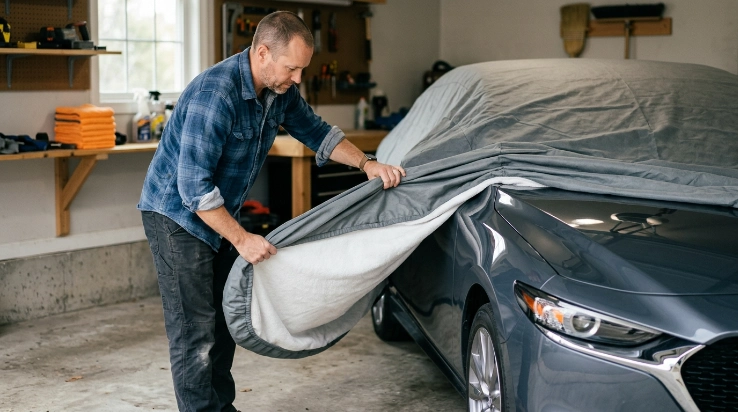
Install and remove the cover with controlled lifting movements. Avoid pulling a large section sideways across the hood, roof, or trunk.
How to install a car cover without dragging it
- Confirm the car is clean: Check the hood, roof, trunk, and lower panels for grit.
- Identify front and rear: Orient the cover before it touches the vehicle.
- Position the center: Place the folded cover along the vehicle’s upper centerline when the design allows it.
- Unfold carefully: Lower sections toward each side instead of pulling them across the paint.
- Seat the hems: Fit the front and rear sections around the bumpers.
- Fit special areas: Position mirror pockets and other shaped sections without forcing them.
- Secure retention: Use the cover’s intended straps or fastening system according to its instructions.
If your vehicle needs washing first, Edmunds recommends an initial rinse to remove loose debris and a clean wash mitt with proper automotive soap in its car-washing guide.
How to remove the cover without scratching paint
I reverse the process and keep the lining away from the floor. The goal is to minimize sideways sliding while keeping the clean side clean.
- Release straps and retention points.
- Lift the lower sides upward rather than dragging them.
- Fold each side toward the roof or vehicle centerline.
- Work from the ends toward the middle.
- Lift the final folded section completely off the vehicle.
- Store it somewhere clean and dry.
Never toss a clean cover onto a dusty driveway while you move the car. One careless placement can transfer grit onto the surface that later touches the paint.
Section Takeaway: Treat installation and removal like detailing work. Lift, fold, and control the fabric instead of sliding large contaminated sections across painted panels.
What Should You Do If the Cover Already Scratched the Paint?
First, stop using the cover until you know what caused the marks. Cleaning or polishing the paint without fixing the underlying cover problem can let the damage return.
Are the marks actually scratches?
Wash and dry the affected panel carefully, then inspect it under good lighting. Dirt transfer, residue, water spotting, and light paint marring can look similar from a distance.
- Random fine marks: Check for contamination inside the cover.
- Marks in repeated contact zones: Check fit and wind movement.
- Straight lines: Review how the cover is installed and removed.
- Deep scratches: Consider professional paint assessment.
Can light car-cover scratches be polished out?
Some light clear-coat defects may improve with proper paint correction. Deep scratches that penetrate farther into the finish need different treatment.
Don’t immediately attack the panel with aggressive compounds. If bonded surface contamination is present, proper decontamination may need to come before polishing.
Car and Driver’s guide to proper automotive clay-bar use explains how bonded contaminants can be removed as part of paint preparation.
If you cannot judge the scratch depth or you’re uncomfortable polishing automotive paint, a reputable professional detailer is the safer option. Removing too much clear coat creates a larger problem than a few light swirl marks.
When Should You Skip Using a Car Cover?
Sometimes leaving the cover off temporarily is safer than installing it under poor conditions. A cover is a protection tool, not something that must be used every time the vehicle is parked.
I would delay installation in these situations:
- The vehicle is gritty: Wash it before trapping abrasive dirt beneath fabric.
- The cover is dirty: Clean the lining before it touches paint again.
- Either surface is wet: Let both dry completely first.
- The cover is flapping badly: Fix the sizing or retention problem.
- The lining touched dirty ground: Inspect and clean it before reinstalling.
- The cover is damaged: Torn seams, hardened material, or failed elastic can affect fit and contact.
A clean garage can also change the equation. If the car is already protected from weather, a clean indoor dust cover may make more sense than a heavy outdoor-style cover.
Frequently Asked Questions
Can a soft car cover still scratch paint?
Yes. A soft car cover can contribute to scratches when sand, dust, road grit, or other contamination becomes trapped underneath it. Cleanliness and movement matter alongside material softness.
Will a car cover scratch black paint?
Any paint color can develop fine marks, but light marring is often easier to notice on dark glossy finishes. Keeping the vehicle and cover clean is more important than relying on paint color to hide damage.
Should I wash my car every time before putting the cover on?
You don’t necessarily need a full wash after every short period of clean storage. However, don’t cover the vehicle when the surface has visible or gritty contamination that could move against the paint.
Can I put a car cover on a dusty car?
It’s better not to. Dust can contain harder particles that become abrasive when fabric moves over them, especially during installation, removal, or windy outdoor conditions.
Does ceramic coating prevent car cover scratches?
Ceramic coating can add useful surface protection, but it doesn’t make the finish scratch-proof. You should still use a clean cover, clean paint, careful handling, and a secure fit.
Should a car cover be tight or loose?
It should fit securely without large areas of uncontrolled loose fabric, but it shouldn’t be stretched so tightly that seams or shaped areas put excessive pressure on trim and body features.
How do I keep the inside of my car cover clean?
Keep the lining off the ground, fold the cover carefully, store it dry, and clean it according to the manufacturer’s instructions. Inspect the paint-side surface before every installation.
The bottom line: If you want to stop a car cover scratching paint, focus on what sits between the cover and the clear coat. Clean paint, a contamination-free lining, proper fit, dry surfaces, and careful installation do most of the work.
Before covering your car again, spend a few minutes checking the paint, lining, fit, and high-contact areas. That small routine can prevent you from chasing the same swirl marks later.