How to Put the Soft Top Down on a 2-door Jeep Wrangler

Contents
- 1 Key Takeaways
- 2 📑 Table of Contents
- 3 Introduction: Embracing the Open Air in Your Jeep Wrangler
- 4 Understanding Your 2-Door Jeep Wrangler Soft Top System
- 5 Pre-Drop Checklist: The Essential First Steps
- 6 Step-by-Step: How to Put the Soft Top Down
- 7 Common Challenges and How to Troubleshoot Them
- 8 Maintaining Your Soft Top for Longevity and Performance
- 9 Putting It All Together: Practice and Patience
- 10 Frequently Asked Questions

Emergency First Aid Kit

Car Wireless Charger Mount

Tire Pressure Monitoring System (TPMS)

Car Battery Charger
Putting the soft top down on your 2-door Jeep Wrangler is a straightforward process you can master with a little practice. It involves releasing the header latches, folding the rear window, and carefully folding the top sections into the designated storage boot. Always ensure your Jeep is parked on a level surface and the top is dry to prevent mildew and stretching. Following the correct sequence is key to preventing damage to the fabric, zippers, and frame.
Key Takeaways
- Preparation is Crucial: Always park on a level surface, clean the top, and ensure it’s completely dry before folding to prevent mildew and material damage.
- Sequence Matters: Follow the exact order: release header, lower rear window, then fold the top sections in a specific pattern to avoid jamming.
- Mind the Zippers and Windows: The rear window zipper is a common point of failure; unzip it fully and carefully to prevent tears.
- Secure the Boot: The storage boot must be properly latched and sealed to secure the folded top and protect it from elements while driving.
- Regular Maintenance: Clean and condition your soft top regularly, just as you would check your tire pressure on any vehicle for optimal performance.
- Don’t Force It: If you encounter resistance, stop and reassess. Forcing components can lead to expensive repairs to the frame or fabric.
- Practice Makes Perfect: The first few times may be slow. Perform the operation in a controlled environment like your driveway to build confidence.
📑 Table of Contents
- Introduction: Embracing the Open Air in Your Jeep Wrangler
- Understanding Your 2-Door Jeep Wrangler Soft Top System
- Pre-Drop Checklist: The Essential First Steps
- Step-by-Step: How to Put the Soft Top Down
- Common Challenges and How to Troubleshoot Them
- Maintaining Your Soft Top for Longevity and Performance
- Putting It All Together: Practice and Patience
Introduction: Embracing the Open Air in Your Jeep Wrangler
There’s nothing quite like the feeling of the wind in your hair and the sun on your face in a Jeep Wrangler. The iconic removable top is a huge part of the Wrangler’s charm, offering unparalleled flexibility. For many new owners, the act of putting the soft top down can seem daunting. It’s a ballet of latches, zippers, and fabric folding that feels foreign at first. But I’m here to tell you it’s a skill anyone can learn. Think of it not as a complex mechanical procedure, but as a simple, repeatable ritual that unlocks your Jeep’s full potential. This guide will walk you through every single step, from pre-flight checks to the final latch, ensuring you do it correctly and confidently every single time.
We’ll focus specifically on the classic 2-door Jeep Wrangler models (TJ, JK, JL, and JT) with the factory-style soft top. While the exact hardware may vary slightly by year, the fundamental principles remain identical. We’ll cover the common pitfalls, like that tricky rear window zipper, and how to avoid them. By the end, you’ll be able to drop the top in under two minutes, ready for whatever adventure lies ahead. Remember, taking care of your Jeep’s soft top is as important as understanding basic maintenance like how to change an air filter on any daily driver—it’s about preserving your investment for the long haul.
Understanding Your 2-Door Jeep Wrangler Soft Top System
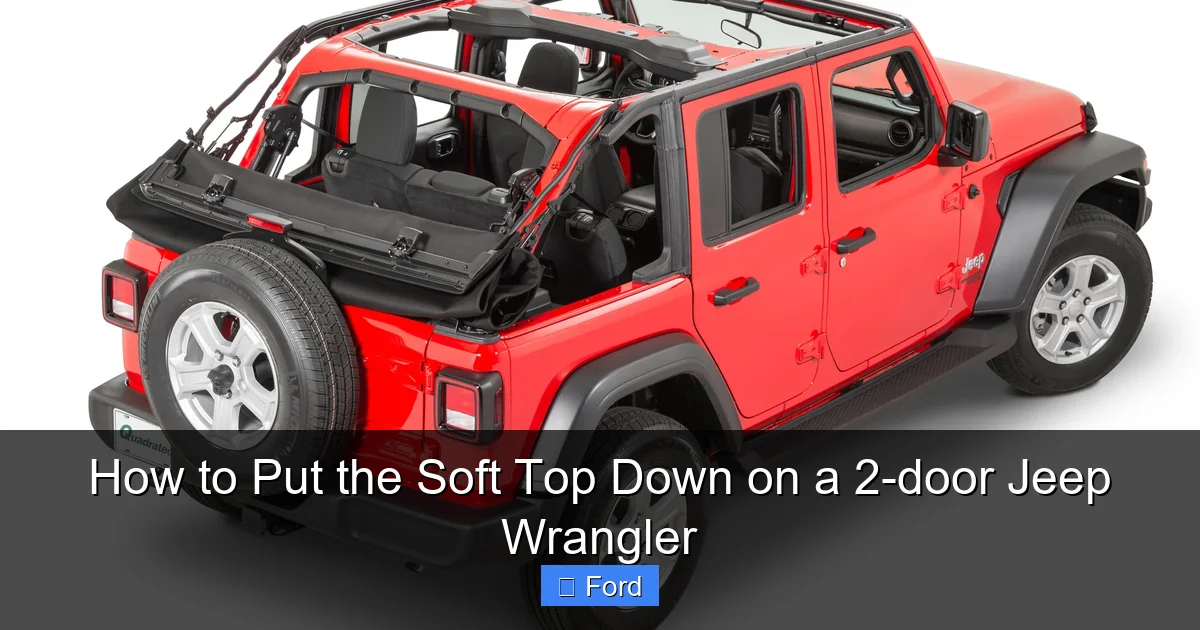
Before you touch a single latch, it helps to understand what you’re working with. The 2-door Wrangler soft top is a multi-piece system designed for easy removal. It typically consists of the front header (the part behind the seats), the main sail panels (the large side sections), and the rear window section, often with a zip-out rear window. The entire assembly is secured to the Jeep’s roll cage and door frames via a series of hook-and-loop fasteners (Velcro), snap buttons, and, most importantly, metal latches. The folded top is stored in a boot that attaches to the rear of the passenger compartment.

Visual guide about How to Put the Soft Top Down on a 2-door Jeep Wrangler
Image source: quadratec.com
The Key Components You Need to Know
- Header Latches: These are the primary release points, usually located at the top of the windshield frame on each side. They have a red pull tab for easy identification.
- Door Header Seals: The long rubber or fabric seals that run along the top of the door frames. The top’s header bar tucks under these.
- Rear Window Zipper: This is the most delicate part. It connects the rear window to the main top fabric and must be fully unzipped before folding.
- Rear Corner Latches: Small latches at the very rear corners of the top that secure it to the body.
- Boot: The fabric cover that goes over the folded top. It has a prominent zipper and usually a Velcro strip that attaches to the rear of the roll bar.
Familiarizing yourself with these parts will make the instructions that follow much clearer. It’s like learning the basic controls of your vehicle before you hit the road.
Pre-Drop Checklist: The Essential First Steps
Skipping preparation is the number one cause of top damage. Rushing into the folding process with a dirty, wet, or cold top is a recipe for stretched fabric, broken zippers, and mildew. Set aside two minutes for this checklist.

Visual guide about How to Put the Soft Top Down on a 2-door Jeep Wrangler
Image source: file.kelleybluebookimages.com
1. Park Smart and Level
Your Jeep must be on a perfectly flat surface. An incline can cause the folded top to shift or not fit properly into the boot, putting stress on the seams and latches. Engage the parking brake. If you’re on a slight slope, turn the wheels toward the curb for extra security.
2. Clean and Dry is Non-Negotiable
Never fold a soft top that is wet from rain or washing. Water trapped in the folds will cause the fabric to stretch and create perfect conditions for mold and mildew to grow within days. If your top is damp, let it air dry completely with the windows up. Similarly, brush off any loose dirt, sand, or debris from the top and the rear deck area. Grit acts like sandpaper inside the folded layers.
3. Check the Temperature
Soft vinyl or fabric tops are less flexible when cold. If it’s below 50°F (10°C), the material can be stiff and more prone to cracking. If possible, perform the operation in a garage or on a warmer day. If you must do it in the cold, handle the material gently and avoid sharp bends.
4. Unlock Your Doors and Roll Down Windows
This is a critical safety and practicality step. The door header seals need to clear the top as you lower it. Roll down both driver and passenger windows at least halfway. Also, ensure your doors are unlocked. On some models, the door locks can interfere with the top’s path if engaged.
Step-by-Step: How to Put the Soft Top Down
Now, let’s get into the meat of the process. We’ll break it down into three clear phases: Release, Fold, and Secure. Go slowly at first.

Visual guide about How to Put the Soft Top Down on a 2-door Jeep Wrangler
Image source: mcgrathautoblog.com
Phase 1: Release the Top from the Jeep
Step 1: Release the Header Latches. Locate the two red tabs on the header bar (the bar that runs across the top of the windshield). Pull each tab firmly outward and upward. You should hear a distinct “clunk” as the latch disengages from its catch on the windshield frame. Do this for both sides.
Step 2: Unfasten the Door Header Seals. The header bar is held down by long Velcro strips that attach to the door frames. Starting at one end, peel back the Velcro. You may need to use both hands—one to hold the header up slightly and the other to pull the Velcro free. Work your way along both sides until the header is completely loose.
Step 3: Unzip and Lower the Rear Window. This is the step that trips people up. Locate the long zipper at the rear of the top, where the rear window meets the main sail panel. Fully unzip it from one side to the other. Once unzipped, gently push the rear window inward and downward. It will fold and rest against the main top fabric. On some models, there are small plastic clips or retainers for the window; unhook these if present.
Step 4: Unsnap the Rear Corners. At the very back of the top, you’ll find two small snap buttons, one on each side. Press the center of each snap to release it from its socket. This frees the rear corners of the top.
Step 5: Lift the Header Bar. With the rear window down and corners unsnapped, you can now lift the entire front header assembly up and forward. It will pivot on the rear corners. Lift it high enough to clear the windshield frame completely and lay it back over the rear of the top. Don’t force it; it should move smoothly now that it’s released.
Phase 2: Folding the Top into the Boot
Step 6: Fold the Sail Panels (The “Accordion” Fold). This is the core folding technique. Starting from one side, take the large sail panel (the side section) and fold it inward toward the center of the Jeep. The goal is to get it to lie flat against the rear window and the other sail panel. You’ll typically make two or three “Z” or accordion-style folds. Work from the back forward, smoothing the fabric as you go. The exact fold lines are often pre-creased from factory use. Repeat for the other side sail panel, folding it over the first one. You should now have a relatively flat, rectangular bundle of fabric centered over the rear seat area.
Step 7: Fold the Header Bar. The header bar you lifted in Step 5 now needs to be folded down onto the bundle. It will naturally want to fold in the middle. Bring the two ends of the header bar down and tuck them over the top of your fabric bundle. It should fit neatly within the perimeter of the sail panels.
Step 8: Position the Boot. Unzip the storage boot completely. The boot is a large, often square or rectangular, fabric cover. Slip it over the entire folded top bundle from the front. The boot’s front edge should align with the front edge of your folded top (which is now at the rear seat back). The boot’s rear zipper should be at the very back, near the tailgate.
Phase 3: Securing the Boot
Step 9: Zip the Boot Closed. Starting at one side, zip the boot closed along its rear edge. The zipper can be stiff; use steady pressure. Ensure the fabric is lying smooth inside the boot as you zip to avoid wrinkles or bunching.
Step 10: Attach the Boot to the Roll Bar. At the top rear of the boot, there is a long Velcro strip. This must attach to the corresponding Velcro strip on the rear roll bar (the bar behind the rear seat). Reach behind the folded top and press the boot’s Velcro firmly onto the roll bar’s Velcro. This is what holds everything in place while driving.
Step 11: Final Security Check. Give the entire boot a firm tug backward. It should not move. Ensure the zipper is fully closed and the Velcro is fully engaged. Your soft top is now safely down and stored. You’re ready to hit the road with the wind in your hair!
Common Challenges and How to Troubleshoot Them
Even with the best instructions, you might hit a snag. Here’s how to handle the most frequent issues.
The Rear Window Zipper is Stuck or Won’t Unzip Fully
This is the #1 problem. The zipper can jam if the fabric is misaligned or if dirt/debris is in the teeth.
- Solution: First, ensure the rear window is fully unzipped from both ends. Sometimes it binds in the middle. Gently wiggle the zipper pull back and forth while applying steady pressure. Never pull hard at an angle. If it’s truly stuck, carefully unzip it a few inches from the other end to relieve tension. Lubricate the zipper teeth with a small amount of zipper lubricant or even a bit of soap if you’re in a pinch. Always clean the zipper after use.
The Top Won’t Fold Flat / Seems Too Bulky
This usually means the folding sequence is off, or the rear window wasn’t properly stowed inside the folds.
- Solution: Unfold everything and start over. First, confirm the rear window is folded inward and lying flat against the main top fabric. When folding the sail panels, make crisp, sharp folds along the pre-creased lines. The goal is to eliminate air pockets and bulk. Sometimes the header bar gets tucked in incorrectly; ensure it’s lying flat on top of the sail panels before covering with the boot.
The Boot Won’t Zip or Attach Properly
The boot zipper can be tight, or the Velcro may not align.
- Solution: Ensure the folded top bundle is centered and not pushed too far forward or back. The boot is designed for a specific size. If the zipper is extremely tight, you likely have too much fabric inside or it’s misaligned. Unzip, adjust the fold, and try again. For the Velcro, make sure both strips are clean of dirt and lint. Press from the center outward to ensure full contact.
The Top is Tight or Hard to Move (Cold Weather)
As mentioned, vinyl stiffens in the cold.
- Solution: Patience. Gently warm the material with your hands. Do not use a hair dryer or heat gun, as concentrated heat can damage the vinyl. Work slowly, section by section. It will become more pliable as you handle it.
Maintaining Your Soft Top for Longevity and Performance
Getting the top down is only half the battle. Keeping it in great shape ensures it goes up and down smoothly for years. This is a long-term investment in your Jeep’s value and your driving enjoyment.
Regular Cleaning is Non-Negotiable
Dirt and pollutants are abrasive. Clean your top at least twice a year, or more often if you drive in dusty or coastal areas. Use a dedicated soft top cleaner (like those from Bestop or Raggtop) and a soft brush. Never use household cleaners, bleach, or solvents. Rinse thoroughly with a low-pressure hose. Always clean the top in the shade, on a cool surface.
Conditioning Prevents Cracks and Fading
After cleaning and while the top is still damp, apply a vinyl or fabric conditioner. This replenishes plasticizers in the vinyl, keeping it supple and resistant to cracking. For fabric tops (like Sailcloth), use a specific fabric guard that repels water and stains. This step is as vital as resetting your tire pressure light after a rotation—it’s preventative care.
Inspect and Lubricate Zippers
Inspect all zippers, especially the rear window, for wear, missing teeth, or debris. Clean them with a toothbrush. Apply a silicone-based zipper lubricant annually. This prevents corrosion and ensures smooth operation.
Storage Considerations
If you plan to store the top down for an extended period (weeks), consider a soft top boot cover for extra UV and weather protection. If storing the top itself (if you have a hard top), keep it in a cool, dry place, loosely folded, not under heavy items that could cause creases.
Putting It All Together: Practice and Patience
Your first few attempts might take ten minutes. That’s okay! The muscle memory will develop quickly. Find a quiet weekend morning, follow this guide step-by-step, and don’t rush. The process is designed to be logical and safe. Once you’ve done it successfully three times, it will become second nature. You’ll find yourself dropping the top on a whim because the sun is out, not because you have to plan for a 20-minute chore. That’s the freedom the Wrangler promises. Remember, a well-maintained soft top is a joy to use. Treat it with respect, and it will provide years of open-air thrills. Just like knowing how to open your gas tank is a simple but essential skill for any driver, mastering your Jeep’s top is a fundamental rite of passage.
Frequently Asked Questions
Can I put the soft top down in the rain?
No, you should never put a soft top down when it’s wet. Folding wet fabric traps moisture, leading to severe mildew, stretching, and permanent water spots. Always ensure the top is completely dry.
My rear window zipper is stuck. What should I do?
First, ensure it’s fully unzipped from both ends. Gently wiggle the pull tab while applying steady pressure. If it’s jammed by dirt, carefully clean the teeth with a soft brush. A tiny amount of silicone-based zipper lube can help. Never force it violently.
How long should it take to put the top down?
With practice, an experienced owner can do it in 60-90 seconds. For a beginner, allow 5-10 minutes to go slowly and avoid mistakes. Rushing is the main cause of damage.
Is it okay to drive with the soft top down on the highway?
Yes, the Wrangler is designed for this. However, secure all loose items inside the cabin. Expect significant wind noise and buffeting. The boot must be securely latched. High speeds can cause the boot to vibrate; ensure it’s firmly attached.
Can I leave the soft top down overnight or in the snow?
It’s not recommended. While the boot provides some protection, prolonged exposure to heavy rain, snow, or UV rays will degrade the fabric and the boot itself. For long-term storage, it’s best to have a hard top or a dedicated garage cover.
What’s the difference between putting down a 2-door and a 4-door Wrangler top?
3>The process is 95% identical. The main difference is the size and weight of the rear section on a 4-door, which is longer and can be more cumbersome to fold. The latch and zipper locations are the same. The principles of the accordion fold remain unchanged.