
How Much Can a Ford F-150 2.7 Ecoboost Tow?

The Ford F-150 with the 2.7L EcoBoost engine is a towing workhorse. Depending on the model year and configuration, its maximum conventional towing capacity ranges from 7,000 to 10,000 pounds. This powerful, turbocharged V6 provides excellent torque for hauling boats, campers, and trailers, making it a top choice for those who need serious capability without the fuel economy penalty of a larger V8.
So, you’re eyeing a Ford F-150 with the 2.7-liter EcoBoost engine. Smart move. It’s one of the most popular engine choices for a reason: it blends impressive power with fantastic fuel efficiency. But if you’re reading this, you’re probably thinking about more than just commuting. You want to know: how much can this truck actually pull? How much can a Ford F-150 2.7 EcoBoost tow? It’s the million-dollar question for anyone looking to haul a boat to the lake, a camper to the mountains, or a utility trailer for work. The answer, like most things in the truck world, is: it depends. But we’re going to break down every single variable so you know exactly what your specific truck can do. Forget vague answers; we’re getting precise.
First, let’s set the stage. The 2.7L EcoBoost is not the same engine as the larger 3.5L twin-turbo V6. It’s a more compact, efficient turbocharged V6 that Ford designed specifically for the F-150. It produces a robust 325 horsepower and, more importantly, 400 pound-feet of torque. That torque number is your best friend when towing. It’s what gives you the grunt to get a heavy trailer rolling from a stop and the power to maintain speed uphill. But that torque has to be managed by the truck’s transmission, drivetrain, and frame. That’s where the official ratings come from. Ford tests every configuration to determine its safe maximum towing capacity, and we’re about to unpack those numbers.
Key Takeaways
- Capacity Varies: The 2.7L EcoBoost’s max tow rating isn’t one number. It ranges from 7,000 to 10,000 lbs based on cab/bed size, axle ratio, and optional towing packages.
- Torque is Key: This engine’s strength is its low-end torque (400 lb-ft), which is crucial for getting a heavy trailer moving smoothly and maintaining speed on grades.
- Configuration Matters: A Regular Cab with 8′ bed and 3.31 or 3.55 axle ratio typically offers the highest ratings. Adding a 4×4 system or larger cab reduces capacity slightly.
- Payload is Different: Never confuse towing capacity (what you pull) with payload (what you carry in the bed/cab). The 2.7L’s payload is typically lower than the 3.5L EcoBoost or 5.0L V8.
- Proper Setup is Essential: You must use the correct hitch (usually a Class IV), a weight-distributing hitch for heavier loads, and a proper brake controller to tow at the truck’s maximum rated capacity safely.
📑 Table of Contents
- Understanding the 2.7L EcoBoost Engine’s Role in Towing
- Official Towing Capacity Figures: The Numbers Game
- Factors That Influence Your Actual Towing Capacity
- Real-World Towing Scenarios: What Can You Actually Pull?
- Comparing the 2.7L EcoBoost to Other F-150 Engines
- Essential Towing Tips for Your 2.7L EcoBoost F-150
- Conclusion: A Capable and Efficient Towing Partner
Understanding the 2.7L EcoBoost Engine’s Role in Towing
Before we dive into the raw numbers, it helps to understand what makes this engine tick for towing. The 2.7L EcoBoost uses two small turbochargers to force more air into the engine, allowing it to burn more fuel and produce more power than a naturally aspirated engine of the same size. The beauty of a twin-turbo setup is that it provides a broad, flat torque curve. You get strong pulling power from low RPMs all the way through the powerband. This means less gear hunting and a more relaxed towing experience.
Power and Torque Breakdown
The 2.7L EcoBoost in the F-150 has been refined over the years. For the 2021-2023 models, the output is 325 hp at 5,500 rpm and 400 lb-ft of torque from 1,750 rpm to 4,000 rpm. That peak torque starting at just 1,750 rpm is critical. It means as soon as you touch the throttle, you have maximum pulling force available. This is especially helpful when starting on a hill or merging onto a highway with a heavy load. The engine is paired with a 10-speed automatic transmission, which is a marvel of modern engineering. It has incredibly short, precise shifts and a wide range of gear ratios. This transmission is programmed to hold gears when towing, keeping the engine in its optimal power band. It also features a dedicated “Tow/Haul” mode that changes shift points and enables the transmission’s integrated exhaust brake (on models so equipped) to help slow the truck and trailer on downgrades, reducing brake wear.
Official Towing Capacity Figures: The Numbers Game
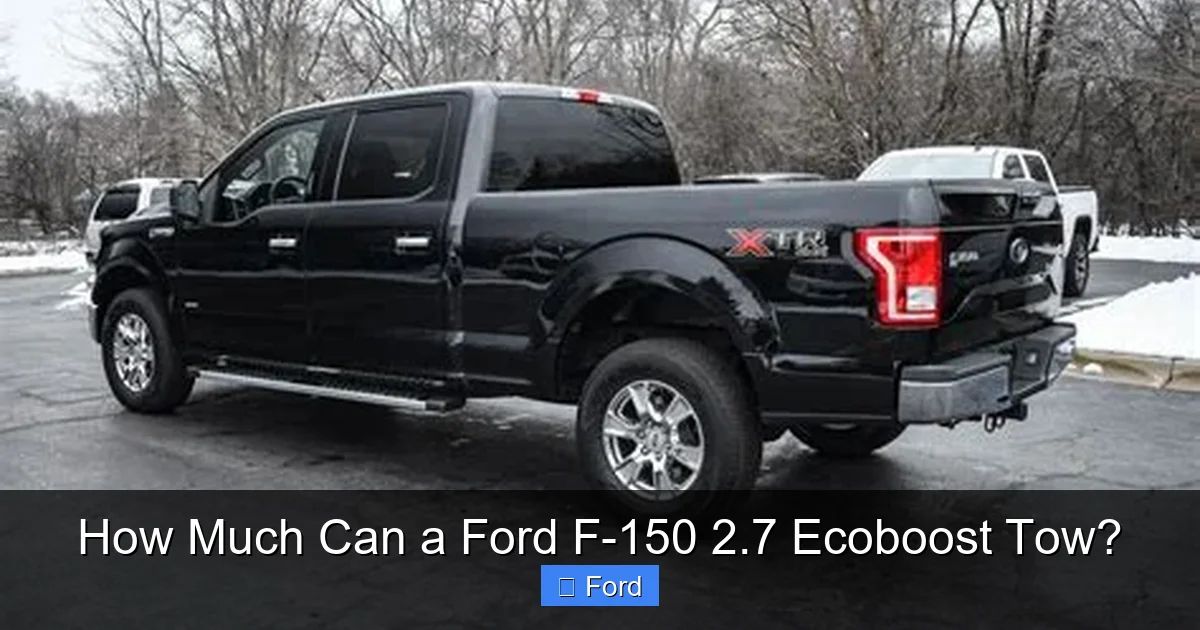
Alright, the moment you’ve been waiting for. What are the actual numbers? Ford publishes maximum conventional towing capacities for each F-150 configuration. “Conventional” towing means the trailer weight is carried on a hitch attached to the truck’s frame. It does not include gooseneck or fifth-wheel ratings for this engine (those are reserved for the heavier-duty Super Duty trucks). For the 2.7L EcoBoost, the official maximum ratings have evolved slightly over recent model years. Here is a general breakdown for current (2021-2023) and recent (2018-2020) models.
Visual guide about How Much Can a Ford F-150 2.7 Ecoboost Tow?
Image source: autozonic.com
Maximum Capacities by Configuration (Recent Models)
For the 2021-2023 F-150 with the 2.7L EcoBoost, the highest rating is 10,000 pounds. You achieve this with the following combination:
- Cab & Bed: Regular Cab, 8-foot bed.
- Drivetrain: 2WD or 4WD.
- Axle Ratio: 3.55 electronic locking rear axle (or 3.73 in some packages).
- Package: Max Trailer Tow Package (which includes the integrated trailer brake controller, tow hitch, and upgraded cooling systems).
Now, what happens if you change those variables? A very common and popular configuration is the SuperCrew (4-door) with a 5.5-foot bed. In that setup, the maximum towing capacity with the 2.7L EcoBoost and the Max Trailer Tow Package drops to 9,000 pounds. The shorter bed and heavier cab structure reduce the capacity slightly. If you go to a SuperCab (2+2 doors) with a 6.5-foot bed, the max is typically 9,500 pounds. Adding 4×4 generally reduces the capacity by 500-1,000 pounds compared to the 2WD version of the same configuration due to the added weight of the transfer case and front axle.
What About Older Models (2018-2020)?
For the 2018-2020 F-150 with the second-generation 2.7L EcoBoost, the maximum rating was 9,000 pounds for the Regular Cab 8-foot bed with the proper package. The 2021 redesign and transmission upgrade allowed Ford to increase the max rating to 10,000 lbs for the optimal configuration. So, a 2019 F-150 2.7L can still tow an immense amount, but the absolute ceiling is a bit lower than the newest models. Always check your specific truck’s door jamb sticker for its exact, certified ratings. Those are the numbers that legally apply to your vehicle.
Factors That Influence Your Actual Towing Capacity
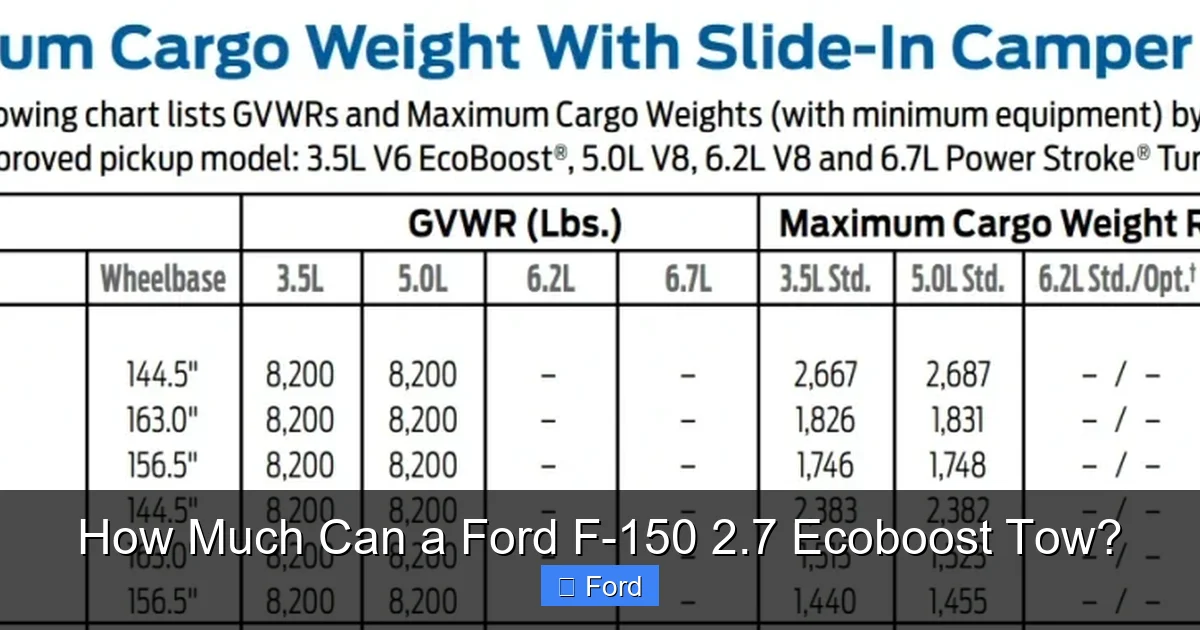
That sticker on your door jamb is the bible. It lists your truck’s specific GVWR (Gross Vehicle Weight Rating), GAWR (Gross Axle Weight Ratings), and the all-important “Maximum Trailer Weight” for your exact configuration. But what goes into determining that number? Understanding these factors helps you shop smarter and tow safer.
Visual guide about How Much Can a Ford F-150 2.7 Ecoboost Tow?
Image source: towengine.com
The Critical Role of Axle Ratio and Packages
Your axle ratio—like 3.31, 3.55, or 3.73—is a gear reduction in the rear differential. A higher number (3.73) means the engine turns more times for each wheel revolution. This gives you more mechanical advantage, better acceleration, and more towing power, but it reduces fuel economy at cruising speeds. A lower number (3.31) is better for highway fuel economy but has less “grunt” for heavy towing. For max tow, you want the numerically higher ratio. This is why the Max Trailer Tow Package, which often includes the 3.55 or 3.73 axle, is so important. It also typically adds:
- An upgraded rear axle with a higher weight capacity.
- A heavy-duty radiator and sometimes an auxiliary transmission cooler.
- An integrated trailer brake controller.
- A tow hitch mounted directly to the frame.
- Pro Trailer Backup Assist™.
Skipping this package on a 2.7L EcoBoost F-150 can drastically reduce its rated towing capacity, sometimes to as low as 5,000 lbs for certain configurations, because the standard cooling system and drivetrain components aren’t sized for sustained heavy loads.
The Impact of Cab Style, Bed Length, and 4×4
Every pound counts. A Regular Cab is hundreds of pounds lighter than a SuperCrew. A short bed is lighter than a long bed. That saved weight can be allocated to the tongue weight of the trailer. This is why the Regular Cab 8-foot bed consistently has the highest tow rating. Similarly, a 2WD model is lighter than a 4×4. The 4×4 system adds significant weight (transfer case, front axle, driveshafts), which eats into the truck’s payload and towing capacity. It’s a trade-off for off-road and severe weather capability. When comparing trucks, a 4×4 with the same engine and cab will almost always have a lower max tow rating than its 2WD sibling.
Real-World Towing Scenarios: What Can You Actually Pull?
Numbers on a spec sheet are one thing. Seeing what those numbers mean in the real world is another. Let’s translate 7,000-10,000 pounds into actual trailers and gear you might encounter. Remember, your trailer’s *loaded* weight is what matters, not its empty weight.
Visual guide about How Much Can a Ford F-150 2.7 Ecoboost Tow?
Image source: storage.googleapis.com
Common Trailer Types and Their Weights
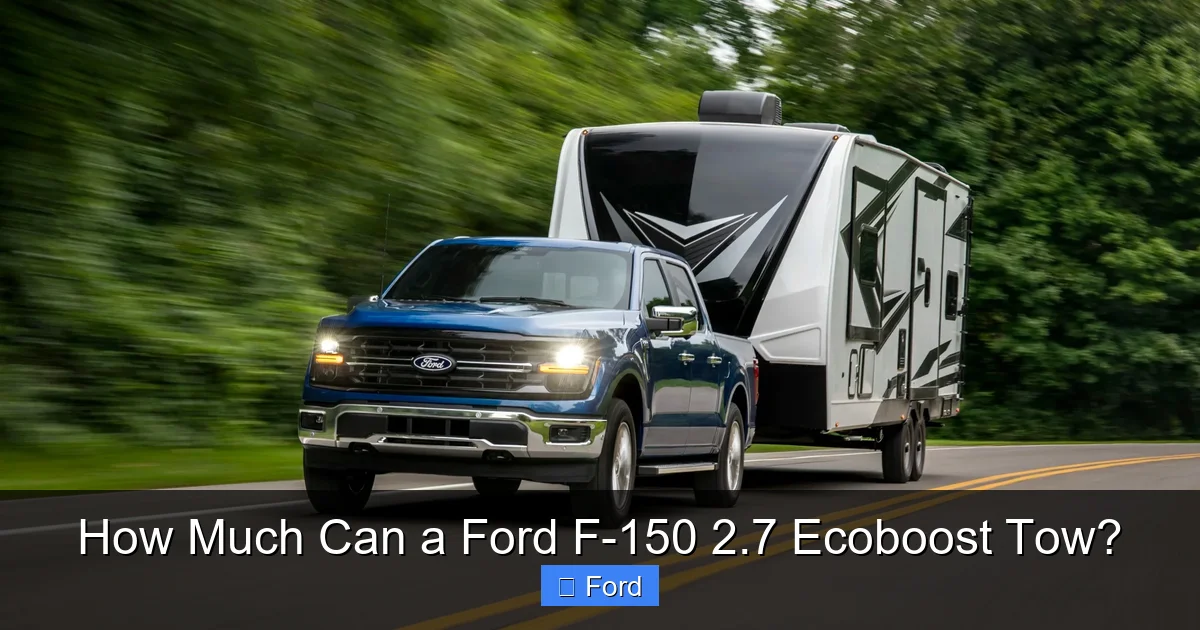
Large Travel Trailer (30-35 ft): A well-equipped, full-size travel trailer with amenities, propane, water, and gear can easily weigh 8,000 to 10,000 pounds. A 2.7L EcoBoost F-150 in its highest-rated configuration (10,000 lb capacity) can handle this, but you’ll be right at the limit. You must meticulously manage your cargo weight inside the trailer and ensure the F-150’s payload (what you carry in the truck) isn’t exceeded by the trailer’s tongue weight (typically 10-15% of trailer weight). For a 9,000 lb trailer, that’s 900-1,350 lbs on the hitch. That eats into your truck’s payload fast.
Mid-Size Travel Trailer (25-28 ft): These are very popular and typically weigh between 5,500 and 7,500 pounds loaded. This is the sweet spot for the 2.7L EcoBoost. You’ll have comfortable margin, easier acceleration, and less strain on the transmission. You can still enjoy a nice camper with kitchen, bathroom, and sleeping space.
Boat and Jet Ski Trailers: A large bass boat or a dual-PWC jet ski trailer with a heavy-duty truck on it can hit 6,000-8,000 pounds. A center console boat on a tandem axle trailer can also be in this range. The 2.7L EcoBoost is excellent for this, as boats are usually aerodynamically cleaner than large square-fronted campers, reducing wind resistance.
Utility/Car Hauler Trailers: An enclosed car trailer with a vehicle on it is a classic heavy load. A small car (like a Honda Civic) on an enclosed trailer might be 4,500-5,500 lbs. A larger SUV or truck on an open car hauler can push 7,000-9,000 lbs. Again, within the F-150’s range, but payload management is key.
Horse Trailer: A two-horse bumper pull trailer with tack and gear can weigh 5,000-6,500 lbs. A larger slant-load trailer will be heavier. The 2.7L EcoBoost is up to the task for most typical horse towing scenarios.
Payload: The Silent Capacity Limiter
Here is the single most important piece of real-world advice: you will likely run out of payload before you run out of towing capacity. Towing capacity and payload are separate ratings. Your truck’s payload is what it can carry in the cab and bed combined (passengers, cargo, the trailer’s tongue weight). A typical F-150 2.7L EcoBoost SuperCrew might have a payload rating around 1,500-1,800 lbs. Five people and their gear can easily be 600-800 lbs. Add a toolbox, maybe some camping gear, and a trailer tongue weight of 1,000 lbs from a 8,000 lb trailer, and you’re at or over your payload limit. This is dangerous and illegal. You must weigh your fully loaded truck and trailer at a public scale to know your actual weights and ensure you are within both the GVWR and GAWR limits on your door jamb sticker. For those needing maximum payload for heavy tongue weights, the 3.5L EcoBoost or 5.0L V8 models often offer 500-1,000 lbs more payload capacity.
Comparing the 2.7L EcoBoost to Other F-150 Engines
Is the 2.7L the right EcoBoost for your towing needs? Let’s see how it stacks up against its siblings in the F-150 lineup. This helps you decide if you should look for a different engine or if the 2.7L is sufficient.
2.7L vs. 3.5L EcoBoost Twin-Turbo V6
The 3.5L EcoBoost is the F-150’s max-tow king. It produces 400 hp and 500 lb-ft of torque. Its maximum conventional towing capacity is a massive 14,000 pounds (in the Regular Cab 8-foot bed with the High-Output package). It also has significantly higher payload capacity. The 3.5L is the choice for serious, frequent towing of the largest trailers. The 2.7L, with its 10,000 lb max, is for the vast majority of truck owners who tow large but not extreme trailers. The 2.7L will feel more responsive at low speeds due to its smaller size and lighter weight, but the 3.5L has more reserve power for steep mountain passes with a maxed-out trailer.
2.7L vs. 5.0L V8
The legendary 5.0L V8 (“Coyote”) offers 400 hp and 410 lb-ft of torque. Its maximum towing capacity is very close to the 2.7L EcoBoost, typically around 9,000-10,000 lbs in similar configurations. The choice here is about character and efficiency. The V8 offers a classic, smooth power delivery and sound. The 2.7L EcoBoost will almost always get better fuel economy, especially under light load, and has more low-end torque feel. For pure, unadulterated towing, the V8’s power delivery can be more predictable, but the EcoBoost’s torque advantage is noticeable.
When comparing across brands, the 2.7L EcoBoost F-150 holds its own very well. Competitors like the GMC Sierra 1500 with the 2.7L turbo I4 or 5.3L V8 have similar ratings. For those considering a midsize truck, the capabilities are much lower. A Toyota Tacoma or GMC Canyon with their most powerful engines max out in the 6,500-7,000 lb range. The full-size F-150, even with the “smaller” 2.7L, offers a substantial leap in towing capability over these midsize models.
Essential Towing Tips for Your 2.7L EcoBoost F-150
You’ve got the truck with the right numbers on the sticker. Now, how do you put it all into practice safely and effectively? Towing is a skill, and having the right equipment is only half the battle.
The Non-Negotiable Equipment Checklist
First, your hitch. For towing at the upper limits of the F-150’s capacity, you need a Class IV receiver hitch. This is a 2-inch receiver, and it’s what comes with the Max Trailer Tow Package. Never use a bumper-pull hitch; you must use a frame-mounted hitch. For trailers over 5,000 lbs, a weight-distributing hitch is highly recommended and often required by law. This uses spring bars to distribute the trailer’s tongue weight across both the truck’s front and rear axles, preventing the rear from sagging and improving steering and braking. You also absolutely need a trailer brake controller wired into your truck. The F-150’s integrated controller is excellent. Without it, you are relying solely on your truck’s brakes to stop thousands of pounds, which is dangerous and will severely wear them out.
Pre-Trip and Driving Practices
Before every trip, do a walk-around. Check trailer tire pressure (inflate to the max on the sidewall when cold), lug nuts, safety chains, and lights. Ensure the weight is balanced. The tongue weight should be 10-15% of the total trailer weight. Use the Tow/Haul mode on your transmission selector. This holds gears longer, uses the exhaust brake (if equipped), and provides more responsive shifts. When driving, anticipate everything. Your stopping distance will increase dramatically. Allow more room to merge and change lanes. On long downgrades, use your transmission and exhaust brake to control speed, saving your wheel brakes from overheating. Remember, you are driving a much longer, wider vehicle. Take corners wider to avoid clipping curbs with the trailer tires. Finally, if you’re new to towing, practice in a large, empty parking lot. Learn how your trailer reacts to steering inputs and practice backing up. The Pro Trailer Backup Assist system can be a huge help here.
Conclusion: A Capable and Efficient Towing Partner
So, how much can a Ford F-150 2.7 EcoBoost tow? The clear answer is: up to 10,000 pounds in its optimal configuration, and typically between 7,000 and 9,500 pounds for the more common SuperCrew and SuperCab setups. That is a tremendous amount of towing capacity, enough for most large boats, full-size travel trailers, and heavy-duty utility trailers. The engine’s strong, low-end torque and the sophisticated 10-speed transmission make it feel confident and composed while pulling heavy loads, all while returning much better fuel economy than a larger V8.
The key to unlocking this capability safely lies in three things: knowing your truck’s specific ratings from the door jamb sticker, properly equipping it with the right hitch and brake controller, and respecting the payload limits. Always remember that the trailer’s loaded weight and tongue weight are the numbers that matter. If you stay within all of Ford’s engineered limits, your 2.7L EcoBoost F-150 will be a reliable, powerful, and efficient towing machine for years to come. It’s a testament to modern engineering that such a relatively small, turbocharged engine can handle jobs that once required a massive V8. Do your homework, set up your truck correctly, and enjoy the tow.
Frequently Asked Questions
Can I tow a 10,000 lb trailer with my F-150 2.7L EcoBoost?
Only if your specific truck has the maximum rated capacity of 10,000 lbs. This requires a Regular Cab 8-foot bed, the Max Trailer Tow Package (including the 3.55 or 3.73 axle), and often 2WD. Most common SuperCrew configurations are rated for 9,000 lbs. Always check your door jamb sticker for your exact “Maximum Trailer Weight.”
What’s the difference between towing capacity and payload?
Towing capacity is the maximum weight your truck can pull behind it. Payload is the maximum weight you can carry *inside* the truck—passengers, cargo, and the trailer’s tongue weight. You must stay within both limits. A heavy trailer’s tongue weight can quickly exceed your payload rating even if the trailer is under the tow rating.
Do I need a weight-distributing hitch for the F-150 2.7L?
For trailers over 5,000 lbs, a weight-distributing hitch is strongly recommended and often legally required. It helps level the truck, improves steering and braking, and keeps weight off the rear axle, which is crucial for safety and to stay within your truck’s Gross Axle Weight Rating (GAWR).
How does the 2.7L EcoBoost compare to the 3.5L for towing?
The 3.5L EcoBoost has a much higher maximum towing capacity (up to 14,000 lbs) and significantly more payload. The 2.7L maxes out at 10,000 lbs. For most large but not extreme trailers, the 2.7L is perfectly capable and more fuel-efficient. Choose the 3.5L if you regularly tow the largest fifth-wheels or gooseneck trailers.
What package do I need to get the maximum tow rating?
You need the Max Trailer Tow Package. This is not optional if you want the full rated capacity. It includes the heavy-duty radiator, integrated trailer brake controller, tow hitch, upgraded rear axle (usually 3.55 or 3.73 ratio), and trailer sway control. Without it, your truck’s towing capacity is drastically reduced.
Is the 2.7L EcoBoost reliable for high-mileage towing?
Yes, when properly maintained. The 2.7L EcoBoost has proven to be a very durable engine. For high-mileage or frequent heavy towing, diligent maintenance is key: use high-quality synthetic oil, change the transmission fluid more frequently than the factory interval (especially if towing often), and keep the cooling system in perfect condition. The engine is designed for this work.
