How to Open the Hood of a Jeep Patriot

Contents
- 1 Key Takeaways
- 2 📑 Table of Contents
- 3 Your Friendly Guide to Popping the Hood on a Jeep Patriot
- 4 The Standard Two-Step Process: Inside Then Outside
- 5 Understanding Your Hood’s Anatomy: Prop Rod and Latches
- 6 Troubleshooting: When the Hood Won’t Budge
- 7 A Note on Model Year Differences and Similarities
- 8 Final Safety Checks and Best Practices
- 9 Frequently Asked Questions

Magnetic Car Phone Mount

Car LED Headlight Bulb
Interior Cleaner Spray

Dash Cam
Opening the hood of your Jeep Patriot is a simple two-step process, but knowing the exact location of the release mechanisms is key. First, you’ll pull the interior hood release latch located under the dashboard on the driver’s side. Then, you must reach outside the vehicle to manually disengage a secondary safety catch under the front edge of the hood. This guide covers every detail, from standard operation to troubleshooting stuck hoods in cold weather or with a dead battery, ensuring you can access your engine bay confidently for any maintenance task.
Key Takeaways
- The process is a two-step system: An interior cable release disengages the primary latch, followed by a manual secondary catch release from outside the vehicle.
- The interior release is always under the dashboard: For all Jeep Patriot model years, look for a hood symbol on a lever or handle in the lower left corner of the driver’s footwell.
- You must find the secondary catch: After the interior release, feel for a small metal lever or tab under the front center of the hood, near the grille, and push or slide it to fully open.
- Always use the prop rod correctly: Your Patriot uses a metal prop rod, not hydraulic arms. Insert it securely into the designated hole on the hood’s underside to hold it open safely.
- Common issues include rust and cold weather: A stuck secondary catch is often due to corrosion or ice. Gentle tapping, lubricant, or carefully warming the area can resolve it.
- Safety is paramount: Ensure the hood is fully propped and stable before working. Never work under an unsupported hood.
- If the cable breaks, access is from below: A broken interior release cable requires reaching the primary latch from underneath the vehicle, a more complex procedure.
📑 Table of Contents
Your Friendly Guide to Popping the Hood on a Jeep Patriot
So, you need to check your oil, top up the windshield washer fluid, or maybe take a peek at the engine bay. The first step? Getting that hood open. For a Jeep Patriot, it’s a straightforward process once you know where to look. Unlike some cars with a single button or a purely exterior handle, your Patriot uses a reliable, two-step mechanical system. This design is great for safety—it prevents the hood from flying open accidentally while you’re driving—but it does mean you have to use both hands in two different places. Don’t worry, it’s easy! This guide will walk you through every single detail, from the standard procedure to what to do when things don’t go smoothly. Think of me as your friend in the driveway, talking you through it.
We’ll start with the normal, everyday method. Then, we’ll dive deep into the mechanics of how it all works, show you exactly where to find each part (with clear descriptions), and tackle the “what ifs.” What if it’s freezing cold and the hood is iced shut? What if the interior lever feels loose or does nothing? What if you’ve just bought a used Patriot and the previous owner didn’t leave you a prop rod? We’ve got answers. By the end, you’ll be a hood-opening expert for your Jeep Patriot, ready to handle basic maintenance or just satisfy your curiosity about what’s under there.
The Standard Two-Step Process: Inside Then Outside
Opening the hood of your Jeep Patriot is a consistent process across all model years (2007-2017). It never changes. It’s a dance of two moves: first inside the car, then outside at the front. Let’s break it down.

Visual guide about How to Open the Hood of a Jeep Patriot
Image source: smartvehiclecare.com
Step 1: The Interior Hood Release Lever
Sit down in the driver’s seat. Look to your lower left, at the area where your left foot rests. You’re not looking at the floor mat, but at the actual plastic panel of the dashboard and footwell. You’re searching for a small, usually black or gray, lever or handle. It will have a symbol on it—a picture of a hood with an arrow pointing up. This is your primary release.
To operate it, you simply pull on this lever firmly towards you. You should feel and hear a distinct clunk or thunk sound from the front of the vehicle. That’s the sound of the main latch under the hood disengaging. The hood itself might pop up slightly on its springs, maybe a half-inch to an inch. That’s normal and a good sign! The primary latch is now free. If you pull the lever and hear nothing, or feel no resistance, the cable might be broken or disconnected. We’ll cover that later.
Pro Tip: If you’re having trouble spotting it, turn on the dome light in your car. The lever is almost always in the same spot, but dirt or debris in the footwell can hide it. Sweep your hand around the base of the A-pillar (the post beside your windshield) and down the firewall (the wall between the engine and cabin).
Step 2: The Secondary Safety Catch
Now, get out of the car and walk to the front. Stand facing the grille and the raised hood. You need to slide your hand under the front edge of the hood. Feel along the metal, right in the center, about 6-12 inches back from the very front lip. You’re looking for a small, flat, metal lever or tab, usually about the size of your thumb. This is the secondary catch. Its job is to hold the hood down securely even if the primary latch accidentally opens.
With your fingers, you need to push this tab to the left (driver’s side) or sometimes slide it sideways. The exact direction can vary slightly by year, but it’s almost always a lateral motion. You’ll feel some spring tension. Push firmly, and you should hear another clunk as the secondary catch releases. Now, you can lift the hood fully. Use your other hand to support the front edge as you lift, as the hood is heavy.
Visual Landmark: On many Patriots, there’s a small rubber stopper or a dimple in the metal paint right where the secondary catch is located. If you see that, you’re in the right zone.
Understanding Your Hood’s Anatomy: Prop Rod and Latches
To truly master this, it helps to understand the parts involved. Your Jeep Patriot hood does not use hydraulic gas struts like many modern cars. Instead, it uses a simple, robust, and fail-safe system: a metal prop rod.

Visual guide about How to Open the Hood of a Jeep Patriot
Image source: jeepautocare.com
The All-Important Prop Rod
Once the hood is fully open, you’ll see a long, thin, silver metal rod hinged at one end to the front of the engine bay (on the radiator support). The other end is a curved hook. On the underside of the hood, you’ll find a small, round, black plastic or metal socket. Your job is to take the hooked end of the prop rod and snap it firmly into this socket. This holds the heavy hood up at a safe working angle, usually about 45-60 degrees.
Critical Safety Rule: NEVER work under the hood if the prop rod is not securely engaged. The hood could fall suddenly, causing severe injury or damage. Also, never use a wooden stick, a hammer handle, or any makeshift prop. The official prop rod is engineered to hold the weight safely. If your Patriot is missing its prop rod, you must source a replacement from a Jeep dealer, a parts store, or an online retailer before doing any work. Driving without a properly secured hood is extremely dangerous.
The Dual-Latch System Explained
The two-step system is a safety feature mandated by law. The interior lever controls the primary latch via a steel cable that runs through the firewall. When you pull the lever, it pulls this cable, which rotates a lever on the primary latch mechanism mounted on the radiator support. This releases the main keeper.
The secondary catch is a completely separate, manual mechanism. It’s a spring-loaded pawl that physically blocks the hood from rising until you disengage it. This ensures that even on a bumpy road, if the primary latch were to fail, the secondary catch would keep the hood latched. It’s old-school, but incredibly reliable. This is why you always have to perform that second, manual step. If your car had only the interior release, the hood could pop open at high speed—a terrifying and dangerous situation.
Troubleshooting: When the Hood Won’t Budge
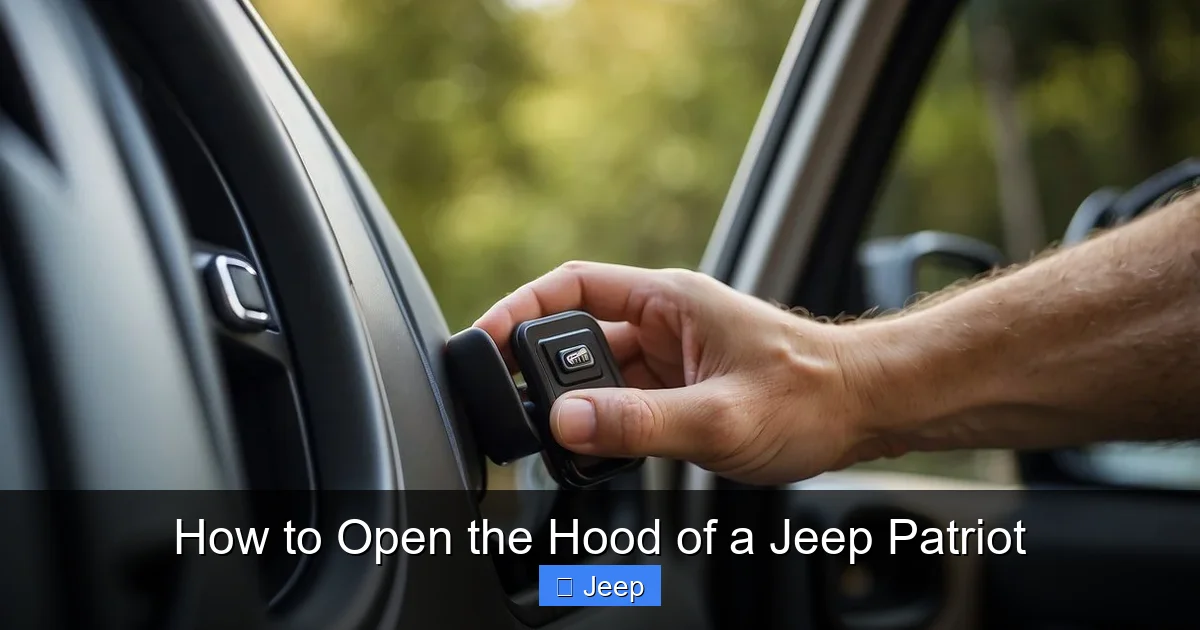
So you pulled the lever, but the hood didn’t move an inch. Or maybe it moved a bit but won’t lift fully because the secondary catch is stuck. Don’t force it! Forcing a stuck hood can bend metal, break cables, or cause the whole assembly to fail. Let’s diagnose the common problems.
Visual guide about How to Open the Hood of a Jeep Patriot
Image source: koala.sh
The Usual Suspect: A Stuck Secondary Catch
This is by far the most common issue, especially in older Patriots or those in regions with harsh winters. The secondary catch mechanism, being exposed to the elements at the very front of the engine bay, is prone to rust, dirt, and ice buildup.
For Rust/Debris: Spray a penetrating lubricant like WD-40 directly into the secondary catch mechanism (you may need to get a good look with a flashlight). Work the lever back and forth manually with your hand if you can reach it. Gently tap the metal around the catch with a plastic or rubber mallet to help break it free. Never use a metal hammer directly on the hood or latch.
For Ice: If it’s freezing, the hood or the catch itself may be iced to the radiator support. Do not yank. Carefully pour lukewarm (not hot!) water over the seam where the hood meets the grille/frame. Alternatively, use a hair dryer on a warm setting to melt the ice around the latch area. Once the ice melts, try the two-step process again.
The Interior Lever Does Nothing (Loose or Broken Cable)
If you pull the interior lever and it feels completely loose, with no resistance, or if it pulls out an excessive amount of slack, the cable is likely broken or detached at one end.
This is a more involved fix. You have two options, both requiring access from under the vehicle. With the Patriot safely lifted on jack stands (or at a professional shop), you can locate the primary latch assembly on the radiator support. You may be able to manually manipulate the lever on the latch with a long screwdriver or pliers to release it, just as the cable would. This gets the hood open for the short term so you can, for example, jump-start the car or check the oil. However, the broken cable will need to be replaced to restore normal interior operation. This is not a job for a beginner, as it often involves removing parts to access the cable ends.
Related Tip: If your battery is completely dead, the interior release will still work because it’s a mechanical cable, not an electric solenoid. However, if you’re dealing with a dead battery scenario in a different vehicle that uses an electric release, the process is different. Your Patriot’s mechanical system is actually an advantage here.
The Hood Pops But Won’t Lift (Secondary Catch Still Engaged)
Sometimes, the primary latch releases (you hear the thunk), but the hood only raises a quarter-inch and stops. This means the secondary catch is still engaged. You need to reach under that slightly raised edge and find the secondary catch tab. It might be harder to locate because the gap is small. Use a flashlight and feel carefully. Push it firmly sideways. If it’s corroded, you may need to apply lubricant and wait a few minutes, then try again with more force.
A Note on Model Year Differences and Similarities
From the first 2007 model to the last 2017, the Jeep Patriot’s hood release mechanism remained virtually identical. You will not find an exterior hood handle or a push-button release under the grille. The system is consistently the interior lever + exterior secondary catch. This is great news for owners—what you learn for your 2012 model works perfectly for a 2009 or a 2016.
This simple, mechanical system is a hallmark of many Jeep, Dodge, and Chrysler vehicles from that era. It’s also found in many other brands’ base models. For instance, the process for a Toyota RAV4 or a Subaru Forester follows the exact same two-step logic, though the precise location and shape of the levers may differ slightly. The core principle—interior release disengages main latch, then you manually disengage a secondary catch—is universal for these types of systems.
Final Safety Checks and Best Practices
You’ve got the hood open. Great! Before you slide under there for any reason, complete these final checks.
- Secure the Prop Rod: Double-check that the prop rod is snapped firmly into its socket on the hood. Give it a little tug. It should not come loose.
- Check for Wind: If it’s a windy day, the large surface area of the open hood can catch wind like a sail. The prop rod is designed for this, but extreme gusts can be problematic. If a strong wind comes up, consider closing the hood and securing it again later.
- Mind the Sharp Edges: The hood underside, radiator support, and engine components can have sharp metal edges. Wear gloves if you’ll be reaching in deeply.
- Never Prop with a Tool: As mentioned, never substitute the prop rod. If you lose it, close the hood immediately and order a replacement.
- Close Properly: When finished, lower the hood slowly until it is about a foot from closed, then let it drop from that height to allow the primary latch to engage fully. You should hear a solid, definitive clunk. Then, press down firmly on the front center of the hood to ensure both latches are fully seated. Never slam it.
Frequently Asked Questions
My Jeep Patriot’s hood is frozen shut. What’s the safest way to open it?
Do not try to force it. Instead, carefully pour lukewarm water over the seam where the hood meets the grille and radiator support to melt the ice. You can also use a hair dryer on a warm setting. Once the ice melts, try the normal two-step process. Avoid using hot water, as the sudden temperature change could crack the plastic grille or windshield.
Can I open the hood with one hand?
Technically, yes, but it’s not recommended. You must pull the interior release with one hand, then walk to the front and use your other hand to release the secondary catch and support the hood’s weight. Trying to do both with one hand is awkward, risks dropping the hood release lever, and makes it hard to support the heavy hood as it lifts, which can cause it to slam down or damage the hinges.
Is it safe to work under the hood if I only have the prop rod from my old Jeep Cherokee?
Only if the prop rod is identical in length and has the correct hook design to fit securely into the socket on your Patriot’s hood. Using an incorrect or shorter rod means the hood is not properly supported and can fall. Always use the correct, specified prop rod for your specific vehicle model and year.
When should I call a professional instead of trying to fix a stuck hood?
If you’ve tried lubricating and gently freeing the secondary catch with no success, or if you suspect the interior release cable is broken (it feels loose or has excessive play), it’s time to call a mechanic. Forcing a broken cable or a severely corroded latch can cause more expensive damage. A professional can safely access the latch from underneath or replace the cable correctly.
Do all Jeep Patriots from 2007 to 2017 use the exact same hood release system?
Yes, they do. There were no significant changes to the manual, two-step hood release mechanism throughout the entire production run. The location of the interior lever and the design of the secondary catch are consistent. This makes repair parts and procedures the same across all model years.
What do I do if the hood will open but won’t stay up on the prop rod?
First, ensure the prop rod is fully inserted into the socket on the hood’s underside. The socket can sometimes become misaligned or damaged. If the rod won’t stay in, the socket may be cracked or worn out. Do not use the vehicle. The hood must be supported. You will likely need to replace the prop rod socket, which is part of the hood’s underside panel, or the entire prop rod assembly if the hook is worn.