How to Open a Bmw Boot from the Inside

Contents
- 1 Key Takeaways
- 2 📑 Table of Contents
- 3 Why Knowing Your BMW’s Interior Boot Release is Non-Negotiable
- 4 Understanding the Two Core Systems: Mechanical vs. Electronic
- 5 Model-by-Model Breakdown: Where to Find the Release
- 6 The Universal Last Resort: Folding the Rear Seats
- 7 Troubleshooting: What to Do When the Release Fails
- 8 Safety and Preventative Practices
- 9 Conclusion: Empowerment Through Understanding
- 10 Frequently Asked Questions



Opening your BMW’s boot from the inside is a crucial skill for safety, convenience, and emergencies. The method varies significantly by model year and generation, from a simple manual pull handle in older cars to hidden electronic releases in modern ones. Always locate and test your specific vehicle’s interior trunk release before you need it in a hurry.
Key Takeaways
- Location is model-dependent: The interior boot release changes by BMW generation (E90, F30, G20, etc.). Know your specific model’s year and platform.
- Two primary types exist: Manual mechanical releases (a cable or lever) and electronic releases (a button or touch-sensitive area).
- Safety first: The primary purpose is emergency egress. Never use excessive force if the mechanism is stuck; troubleshoot instead.
- Check for child locks: Some models have a separate child safety lock on the trunk lid that disables the interior handle.
- Folding rear seats is often key: In many BMWs, the main way to access the trunk from the cabin is by folding the rear seats forward, which may require a separate release.
- Dead battery complications: A completely dead 12V battery can disable electronic releases; manual methods become critical.
- Consult your manual: Your owner’s manual is the definitive guide for your vehicle’s specific procedure and diagrams.
📑 Table of Contents
- Why Knowing Your BMW’s Interior Boot Release is Non-Negotiable
- Understanding the Two Core Systems: Mechanical vs. Electronic
- Model-by-Model Breakdown: Where to Find the Release
- The Universal Last Resort: Folding the Rear Seats
- Troubleshooting: What to Do When the Release Fails
- Safety and Preventative Practices
- Conclusion: Empowerment Through Understanding
Why Knowing Your BMW’s Interior Boot Release is Non-Negotiable
Picture this: you’re on a long road trip, the kids are in the back, and you’ve just loaded the trunk with coolers and luggage. You slam the boot shut, jump in the driver’s seat, turn the key (or push the start button), and drive off. An hour later, you realize the trunk latch didn’t fully engage, and it’s now rattling. Or worse, you’re at a crowded event and accidentally lock your keys inside the boot with a precious cargo. Panic sets in. This is the moment where knowing how to open your BMW boot from the inside transforms from a neat trivia fact into an absolutely essential piece of driver knowledge.
For BMW owners, this knowledge is doubly important. The brand’s engineering philosophy prioritizes a clean, uncluttered interior. This means that unlike some American or Japanese cars where a bright red pull-cord hangs from the ceiling, BMW often integrates its trunk release into a trim panel, a floor mat, or makes it accessible only after folding the rear seats. The method is not always intuitive. It’s designed to be sleek, not necessarily obvious in a stressful moment. Mastering this feature is about more than convenience; it’s about maintaining control of your vehicle in unexpected situations, ensuring you can access your cargo or, in a rare but critical emergency, create an exit path from the cabin to the outside world via the trunk.
This guide will deconstruct the mystery. We will journey through BMW’s model generations, from the classic E90 3 Series to the latest G60 5 Series and i-series electric vehicles. We’ll cover manual cables, hidden switches, electronic buttons, and the all-important rear seat fold-down mechanism. By the end, you’ll be able to walk to your parked BMW, sit in the driver’s seat, and confidently reach for the correct release without a second thought.
Understanding the Two Core Systems: Mechanical vs. Electronic
Before we dive into specific models, it’s vital to understand the two fundamental ways BMWs achieve interior trunk access. This foundational knowledge will help you diagnose your own car even if your exact year/model isn’t listed here.

Visual guide about How to Open a Bmw Boot from the Inside
Image source: automotoride.com
The Mechanical Cable System
This is the traditional, fail-safe method. A physical steel cable runs from a lever or handle inside the cabin, through the rear seatback structure, and connects to the trunk latch mechanism. When you pull the handle, it tensions the cable, which directly pivots the latch arm to release the lock. The beauty of this system is its independence from the car’s electrical system. If the battery is dead, the fuse is blown, or the central locking module has failed, a mechanical cable will still work. You’ll typically find this as a black plastic handle or T-bar lever mounted on the rear trunk lid interior, on the lower edge of the rear window, or sometimes on the parcel shelf behind the rear seats. It often has a trunk icon on it. Pulling it releases the primary latch; you then push the trunk lid up from the outside.
The Electronic Button/Switch System
As BMWs became more electronically sophisticated, especially from the F30 3 Series (2012+) onward, mechanical cables were increasingly replaced by electronic solenoids. An interior button or touch-sensitive strip sends a signal to the trunk latch motor to unlock. These are often located in more “premium” spots: on the driver’s door panel, on the center console near the gearshift, on the A-pillar, or as a soft-touch area on the trunk lid’s interior trim. The major drawback? It requires a functioning 12V battery and body electronics module. If the battery is completely flat, these buttons will do nothing. However, many BMWs with electronic releases retain a secondary, hidden mechanical release for exactly this dead-battery scenario. This is usually a small flap or cover you pry open to reveal a traditional cable pull.
Model-by-Model Breakdown: Where to Find the Release
Now, let’s get specific. BMW platforms ( chassis codes like E90, F30, G20) define the design language and component placement. Your interior boot release location is almost entirely dictated by your car’s platform and year.
Visual guide about How to Open a Bmw Boot from the Inside
Image source: i.ytimg.com
E90/E91/E92/E93 (3 Series, 2006-2013) & E60/E61 (5 Series, 2004-2010)
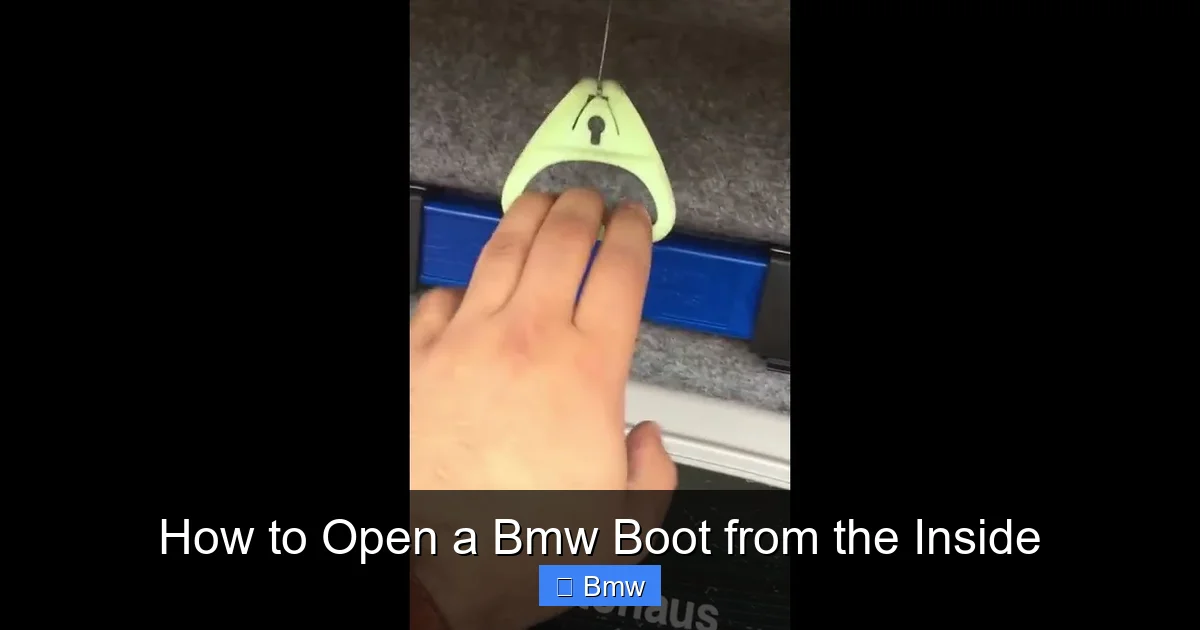
These classic BMWs are the last of the breed where the mechanical cable was king, and its location is fairly consistent. Look for a black plastic handle with a trunk icon mounted on the rear trunk lid itself, on the interior, just below the rear window. It’s usually on the left side (driver’s side in LHD markets). You pull this handle towards you, and it will pop the primary latch. You then go to the rear of the car and lift the trunk lid. There is no separate button on the dash or door for the trunk in these models; this interior handle is the sole method. This is a pure mechanical system. If your E90’s handle is missing or broken, you may need to access the latch via the rear seat cushion removal, which is a more involved process.
F30/F31/F34 (3 Series, 2012-2019) & F10/F11 (5 Series, 2010-2017)
The F-platform introduced a more modern, electronic-centric approach. The primary interior release is an electronic button. For sedans (F30) and wagons (F31), you’ll find it on the driver’s door panel, usually below the window switches or integrated into the door lock/unlock cluster. It has a trunk icon. Pushing it unlocks the trunk solenoid. However, this button will not work with a dead battery.
For these models, BMW provided a hidden mechanical fallback. To access it, you must go to the trunk lid. Look at the inner edge of the trunk lid’s upper trim (the part you see when you open the trunk). You’ll find a small, rectangular, dark-colored plastic flap or cover. Carefully pry this cover off with a plastic trim tool or a flathead screwdriver wrapped in tape. Behind it is a traditional cable pull handle. Pulling this will mechanically release the latch, allowing you to open the trunk. This is your lifesaver if the car battery is dead and the electronic button is inert.
Additionally, in F30/F31 models, the rear seats fold down. The release levers for the seatbacks are on the top edge of the rear seat cushion (in the boot) or on the shoulder of the rear seats (in the cabin). Folding the seats forward provides a large pass-through to the trunk, but this does not open the trunk lid; it just gives cabin access to the cargo area if the trunk lid itself is locked shut.
G20/G21 (3 Series, 2019-Present) & G30/G31 (5 Series, 2017-Present)
BMW’s current generation takes minimalism to the next level. The dedicated trunk button on the driver’s door is often gone. The primary method is now touch-sensitive. Look for a smooth, slightly recessed area on the trunk lid’s inner surface (the part you see when you open the trunk). It’s usually near the center or on the right side. It might have a subtle trunk icon etched into it. A simple touch or press of this area will activate the electronic latch. Like before, this requires battery power.
The hidden mechanical release is still present but can be even more concealed. In many G20/G30 models, you access it by looking at the inner top edge of the trunk lid. There is a small, often black, rubber or plastic plug. Prying this plug out reveals a hole where you can insert your finger and pull a cable loop. This is the manual override. It is absolutely critical to locate this on your specific G20/G30, as the touch pad is useless with a dead battery. Furthermore, the rear seat folding mechanism remains. The release levers are now typically located on the side of the rear seat cushion, visible only when you fold the front part of the cushion up. This is a two-step process: 1) Flip up the rear seat cushion, 2) pull the lever to fold the seatback.
X1, X3, X5, X7 (SAV/SUV Models)
SUVs follow similar logic but with variations. For example, the F97 X1 (2019+) uses a touch-sensitive area on the trunk lid, similar to the G20 3 Series, with a hidden cable release behind a trim plug. The G01 X3 (2018+) is almost identical. Larger SUVs like the G05 X5 and G07 X7 often have the electronic button on the driver’s door or the center console. The manual override is consistently found behind a small access panel on the trunk lid’s inner top rail. The rear seat folding is usually via levers on the top of the seatbacks or on the cargo floor sidewalls. Always remember: SUV = more cargo space, but the same core principles of mechanical vs. electronic apply.
i-Series (i3, i4, iX, i7) and Electric Models
Electric BMWs present a unique scenario. While they have the same trunk release logic, the “dead battery” scenario is more common and more critical. An iX or i4 with a completely depleted high-voltage battery will also have a dead 12V battery, rendering all electronic trunk releases useless. Therefore, locating the hidden mechanical override is 100% mandatory for any electric BMW owner. The location follows the G20/G30 pattern (trim plug on trunk lid top edge), but consult your manual, as the iX’s massive trunk lid may have the access point in a slightly different spot. Some models may also have a dedicated 12V jump-start terminal under the hood to revive the system, but the manual cable is your ultimate backup.
The Universal Last Resort: Folding the Rear Seats
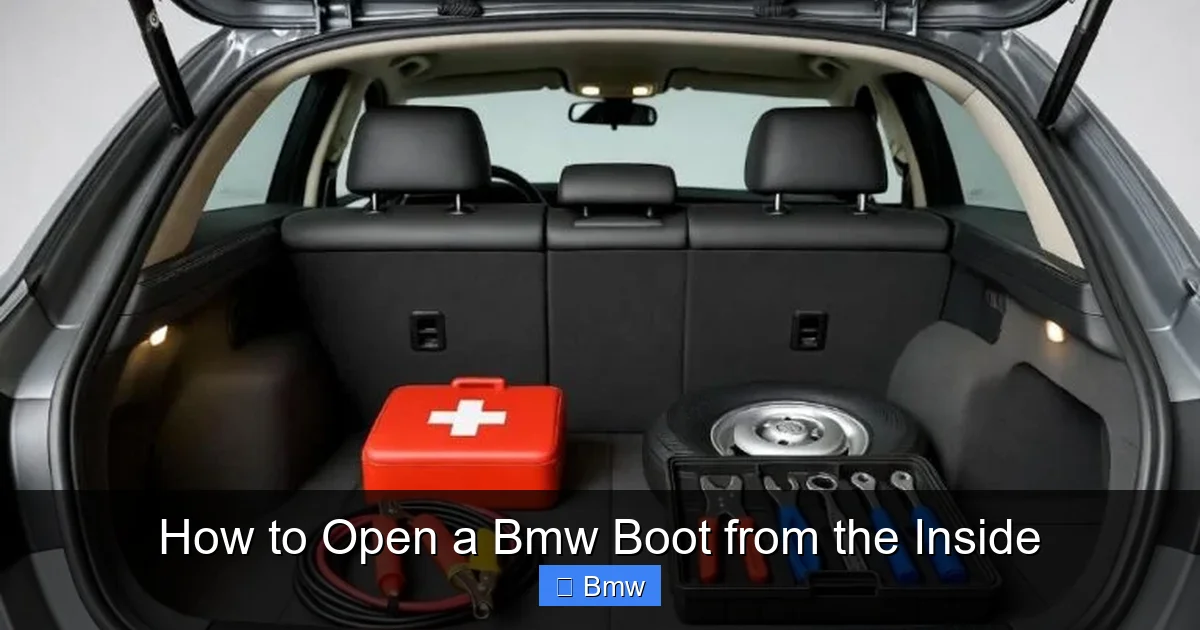
Regardless of your BMW’s specific trunk latch mechanism, there is one nearly universal feature: folding rear seats. This is not technically “opening the boot from the inside,” as the trunk lid remains locked. However, it is the most common way to access the trunk cargo area when you are inside the cabin. This is invaluable if you’ve locked your keys in the trunk or need to retrieve something large without opening the lid.
Visual guide about How to Open a Bmw Boot from the Inside
Image source: aautomotives.com
The process varies. In older models (E90), there are simple levers on the top of the rear seatbacks that you pull to fold them. In F30 models, you often need to first lift the rear seat cushion to expose the lever for the seatback. In current G20 models, you typically press a button on the side of the seat cushion to release it, flip it up, and then pull another lever to fold the backrest. Once the seatbacks are folded forward, you have a vast, unobstructed passage from the rear passenger compartment directly into the trunk well. You can reach in and grab items. This is a critical secondary access method everyone in the household should know. For a detailed guide on this seat-folding process in other vehicles, you can see how it’s done in a Toyota Camry, which illustrates the general principle of interior cargo access that applies across many brands.
Troubleshooting: What to Do When the Release Fails
So you’ve found the correct handle or button, you’ve pulled/pressed it, and… nothing. The trunk remains firmly shut. Don’t panic. Here is your systematic diagnostic checklist.
Step 1: Confirm Power and Fuses
If you’re trying an electronic button and it does nothing, first check if your car’s 12V battery is completely dead. Try unlocking the doors with the key fob. If the fob doesn’t work either, the battery is likely the culprit. Jump-start the car or charge the battery. If the battery is good, locate your owner’s manual and find the fuse box diagram. Identify the fuse for the “Trunk Lid” or “Body Electronics” and check if it’s blown. A simple fuse replacement can solve the problem.
Step 2: Locate and Use the Manual Override
This is your most important skill. For any BMW with an electronic primary release, there is a manual cable override. As described in the model sections, you must find the access panel on the trunk lid’s inner top edge. It’s often a small square or rectangular cover. Pry it off carefully. You will see a cable with a plastic grip or a metal loop. Pull it firmly and steadily. You should hear a distinct “clunk” or “pop” from the latch at the rear of the car. If you feel no resistance or it breaks, the cable itself may be broken or disconnected, requiring professional repair.
Step 3: Check for Child Safety Lock
Some BMW wagons and SUVs have a physical child safety lock on the trunk lid itself. This is a separate key-operated cylinder or a sliding switch on the trunk lid’s edge (outside). If engaged, it mechanically prevents the trunk from being opened from the inside, even if the cable or button is operated. Check your owner’s manual for its location and use the emergency key (the small metal key hidden inside your fob) to disengage it.
Step 4: The “Help from Outside” Method
If you are trapped inside the car (a rare but terrifying scenario) and all interior releases fail, your only option is to get someone’s help from outside. The most reliable method is to have a helper fold the rear seats forward from the trunk side. Once the seatbacks are down, they can reach through the pass-through and manually pull the primary trunk latch release cable from the mechanism side. This requires them to know how the latch works. Alternatively, a locksmith or roadside assistance can use specialized tools to manipulate the latch from the outside through the gap between the trunk lid and body. This is why practicing the seat-fold and knowing the manual override location is so vital for safety.
Safety and Preventative Practices
Knowledge is power, but practice is safety. Here’s how to make this knowledge actionable and prevent lockout situations.
- Locate and Test Immediately: When you first get your BMW (or even a rental), take 5 minutes with the owner’s manual. Find the diagram for the “Trunk Lid” or “Luggage Compartment.” Physically locate the interior release handle/button. Then, with the trunk open, have a friend sit in the driver’s seat and operate it. Watch the trunk latch pop. Do this for both the electronic and manual methods.
- Keep the Emergency Key Accessible: Your BMW key fob has a hidden mechanical key. Know how to extract it. This key is used for the door locks in a dead-fob/fob-battery scenario, and sometimes for a trunk child lock. Keep it on a separate keyring you always carry.
- Never Rely Solely on Electronics: Understand that your car’s fancy touch-sensitive trunk pad is a convenience feature, not a primary safety feature. The manual cable is your true backup. Treat it as such.
- Mind the Load: When packing heavy items, ensure they are secured and not pressing directly against the trunk latch mechanism from the inside. A misaligned latch can prevent the release from working properly.
- Regular Maintenance: During your regular service, ask the technician to inspect the trunk latch and cable for wear, lubrication, and proper operation. A little preventative spray with a dry Teflon lubricant on the latch mechanism (with the trunk open) can keep it operating smoothly for years.
Conclusion: Empowerment Through Understanding
Your BMW is a masterpiece of engineering, but its elegance can sometimes mask simplicity. The ability to open the boot from the inside is not a hidden secret—it’s a designed feature meant to serve you. By taking the time to understand whether your specific model uses a cable, a button, or a touch pad, and by locating that all-important manual override, you convert a potential moment of panic into a routine action. You move from being a passive driver to an empowered owner who understands the machine beneath the leather and aluminum trim. This knowledge connects you to your BMW in a practical, tangible way. So, don’t let it gather dust in the owner’s manual. Find it, test it, and teach it to everyone who drives your car. The next time you need it—whether it’s to grab a forgotten jacket, help a friend with a flat tire, or simply load groceries efficiently—you’ll be ready. You won’t have to search online or call for help. You’ll simply reach, pull, or press, and the boot will open, just as the engineers in Munich intended.
Frequently Asked Questions
What if my BMW’s interior trunk release handle is missing or broken?
If the manual cable handle is physically missing or broken off, you have two options. First, you can often access the cable itself by removing interior trunk trim panels to pull the cable directly. Second, your only other method is to fold the rear seats forward (if possible) and have someone manually operate the latch mechanism from inside the trunk well. A BMW dealer or independent mechanic can also replace the broken handle or cable assembly.
Does folding the rear seats actually open the trunk lid?
No. Folding the rear seats creates a pass-through *into* the trunk cargo area, but it does not disengage the trunk latch itself. The trunk lid remains locked shut. This method is for accessing items inside the trunk when you are already in the cabin, not for opening the lid to load large items from the outside.
My BMW has a touch-sensitive trunk area, but it doesn’t work. What now?
A non-responsive touch pad points to one of three issues: 1) A completely dead 12V battery (most common), 2) A blown fuse for the body electronics/trunk, or 3) A faulty touch pad or latch solenoid. Your immediate solution is to find and use the hidden manual cable release behind the trim plug on the trunk lid’s inner top edge. This will work regardless of battery or fuse status.
Are there any BMW models where you cannot open the trunk from the inside at all?
Virtually all BMW production cars have *some* method of interior trunk access, either via a direct release cable/button or via the rear seat pass-through. However, some very early models (pre-1990s) or specific race-focused variants might lack a dedicated interior release, requiring you to fold seats and reach through. For all modern BMWs sold in the last 25 years, a dedicated interior release mechanism exists.
How do I know if my rear seats can be folded down?
Almost all BMW sedans, wagons, and SUVs since the late 1990s have folding rear seatbacks. Look for a lever, handle, or button on the top edge of the rear seatback, on the side of the rear seat cushion, or on the cargo floor sidewall. In the owner’s manual, search for “Folding Rear Seatback” or “Cargo Area.” If your car has a fixed rear seat (some sports trims or very early models), you will not have this option, making the dedicated trunk release even more critical.
Can I disable the interior trunk release for security?
Generally, no. The interior release is a mandatory safety feature (for emergency egress) and is permanently integrated into the vehicle’s design. Some models have the separate child safety lock on the trunk lid itself, which you can engage with the emergency key to prevent the trunk from being opened from the inside. This is the only “disable” function, and it’s intended for child safety, not anti-theft. The trunk can still always be opened from the outside with the key fob or key.